Unleashing the Power of Web4: An Intelligent and Decentralized Web Ecosystem

Unleashing the Power of Web4: An Intelligent and Decentralized Web Ecosystem

Dirk Kreuter is Europe’s most successful sales trainer. He shares his expert knowledge, which has been proven a thousand times over, in specialist books, online courses and seminars, which has been proven to work. Dirk has invited Anndy Lian to give a keynote speech to his guests on what is Web4 and how a decentralised web can transform the way we operate.


The internet has transformed the way we live, work, and connect with each other. From the early days of the World Wide Web to the rise of social media and e-commerce, the internet has become an integral part of our daily lives. However, it is clear that the current internet infrastructure has its limitations, including issues related to centralization, data privacy, and lack of intelligence. Enter Web4, a new vision for an intelligent and decentralized web that addresses these challenges and unlocks a world of new possibilities.


Understanding Web4:

Web4 represents a paradigm shift in how we envision and interact with the internet. It builds upon the principles of Web3 (decentralization) and integrates advanced technologies such as artificial intelligence (AI), blockchain, and the Internet of Things (IoT) to create a more intelligent and decentralized web ecosystem. Web4 aims to empower individuals, enhance privacy, and foster innovation while leveraging the potential of AI to provide personalized and context-aware experiences.


Key Features of Web4:

Decentralization: Web4 embraces the core tenets of Web3, ensuring that power and control are distributed across a network of interconnected nodes. By moving away from centralized entities and adopting decentralized architectures such as blockchain, Web4 reduces the risk of single points of failure, censorship, and data breaches. This decentralized approach fosters trust, transparency, and resilience in the web infrastructure.

Artificial Intelligence: AI is at the heart of Web4, enabling intelligent automation, data analysis, and decision-making. Through machine learning, natural language processing, and computer vision, Web4 systems can understand and interpret user data, preferences, and behavior. This allows for personalized recommendations, intelligent assistants, and context-aware applications that adapt to individual needs and provide a more intuitive and efficient user experience.

Enhanced Privacy and Security: Web4 prioritizes user privacy and data security. It leverages cryptographic techniques and decentralized identity systems to empower individuals with greater control over their personal information. With Web4, users can choose how their data is shared and accessed, reducing the risks associated with centralized data storage and surveillance. This focus on privacy strengthens user trust and encourages widespread adoption.

Interoperability and Open Standards: Web4 promotes interoperability and open standards, allowing different applications and platforms to seamlessly communicate and share data. By embracing common protocols and APIs, Web4 enables the creation of a vibrant ecosystem where innovative solutions can easily integrate and collaborate. This fosters competition, diversity, and rapid technological advancements, benefitting users and driving innovation forward.

Democratization of Innovation: Web4 empowers individuals and small businesses by reducing barriers to entry and enabling participation in the digital economy. Through decentralized platforms and smart contracts, Web4 enables peer-to-peer transactions, crowdfunding, and new funding models such as initial coin offerings (ICOs) and decentralized finance (DeFi). This democratization of innovation ensures that the benefits of the web are accessible to all, irrespective of geographical location or financial resources.


Potential Applications:

Web4’s intelligent, decentralized nature opens up a wide range of potential applications across various sectors:

Governance and Democracy: Web4 can facilitate transparent and decentralized governance models, enabling citizen participation, voting systems, and smart contracts that automate governance processes. This can lead to more accountable and inclusive decision-making at local, national, and global levels.

Supply Chain and Logistics: Web4 can revolutionize supply chain management by providing real-time tracking, transparency, and traceability. By leveraging blockchain and IoT technologies, Web4 enables secure and efficient supply chain operations, reducing fraud, improving product authenticity, and optimizing logistics processes.

Healthcare and Telemedicine: Web4 can transform healthcare by enabling secure and interoperable health records, personalized medicine, and telemedicine services. AI-powered diagnostics, remote monitoring, and decentralized data sharing can improve patient outcomes, facilitate research, and enhance collaboration among healthcare providers.

Smart Cities and Sustainability: Web4 can contribute to the development of smart cities that optimize resource usage, enhance energy efficiency, and improve urban planning. Through intelligent sensor networks and data analytics, Web4 can enable real-time monitoring, predictive maintenance, and sustainable infrastructure management.


Conclusion:

Web4 represents a bold vision for the future of the internet, one that embraces decentralization, artificial intelligence, and user empowerment. By combining these elements, Web4 has the potential to revolutionize various industries, enhance privacy and security, and democratize access to innovation. However, realizing the full potential of Web4 requires collaboration, standardization, and ethical considerations to ensure that the benefits are accessible to all while safeguarding user rights and societal values. As we embark on this new era of the web, let us envision and build a future that empowers individuals, fosters innovation, and creates a more inclusive and intelligent digital world.


Anndy Lian is an early blockchain adopter and experienced serial entrepreneur who is known for his work in the government sector. He is a best selling book author- “NFT: From Zero to Hero” and “Blockchain Revolution 2030”.

Currently, he is appointed as the Chief Digital Advisor at Mongolia Productivity Organization, championing national digitization. Prior to his current appointments, he was the Chairman of BigONE Exchange, a global top 30 ranked crypto spot exchange and was also the Advisory Board Member for Hyundai DAC, the blockchain arm of South Korea’s largest car manufacturer Hyundai Motor Group. Lian played a pivotal role as the Blockchain Advisor for Asian Productivity Organisation (APO), an intergovernmental organization committed to improving productivity in the Asia-Pacific region.

An avid supporter of incubating start-ups, Anndy has also been a private investor for the past eight years. With a growth investment mindset, Anndy strategically demonstrates this in the companies he chooses to be involved with. He believes that what he is doing through blockchain technology currently will revolutionise and redefine traditional businesses. He also believes that the blockchain industry has to be “redecentralised”.

j j j

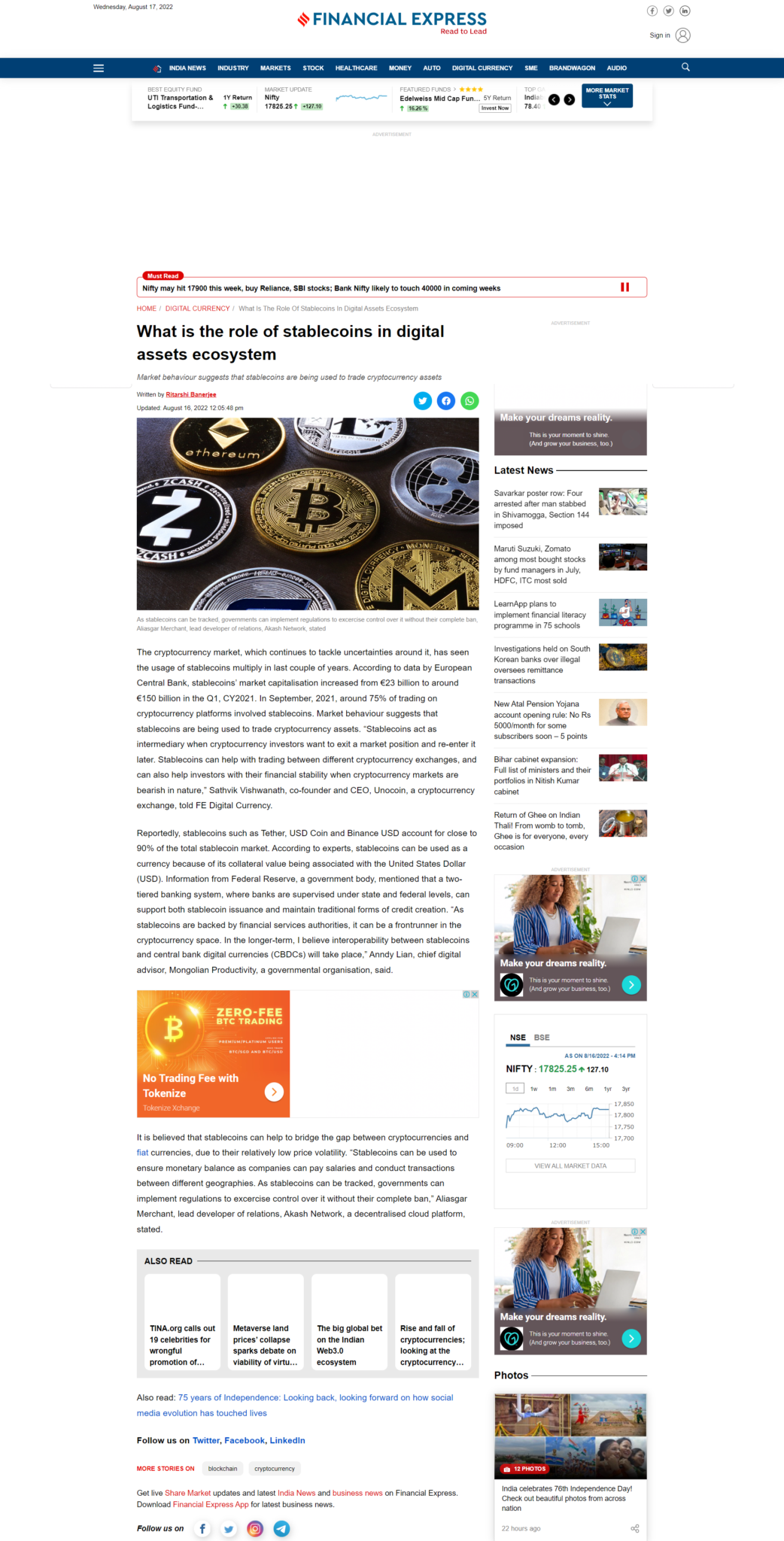
What is the role of stablecoins in digital assets ecosystem

What is the role of stablecoins in digital assets ecosystem

In my view, stablecoins are a form of private money. The concept is not new. As long as the community recognizes this as a form of money, then it is money.

Having said so, it depends on whether you are talking about dollar-collateralized, company-collateralized, cryptocurrency-collateralized, or non-collateralized stablecoins. Each kind of design comes with pros and cons. For the time being those that are properly collateralized and approved by a country’s financial services authority would be in favor and can be the forerunner.

This process is still in the research stage for many countries. Ideally, in the longer term, I would like to see interoperability between various stablecoins and CBDCs. This will then bring out the true meaning of crypto and a new era of financial systems.

– Anndy Lian


What is the role of stablecoins in digital assets ecosystem

The cryptocurrency market, which continues to tackle uncertainties around it, has seen the usage of stablecoins multiply in last couple of years. According to data by European Central Bank, stablecoins’ market capitalisation increased from €23 billion to around €150 billion in the Q1, CY2021. In September, 2021, around 75% of trading on cryptocurrency platforms involved stablecoins. Market behaviour suggests that stablecoins are being used to trade cryptocurrency assets. “Stablecoins act as intermediary when cryptocurrency investors want to exit a market position and re-enter it later. Stablecoins can help with trading between different cryptocurrency exchanges, and can also help investors with their financial stability when cryptocurrency markets are bearish in nature,” Sathvik Vishwanath, co-founder and CEO, Unocoin, a cryptocurrency exchange, told FE Digital Currency.

Reportedly, stablecoins such as Tether, USD Coin and Binance USD account for close to 90% of the total stablecoin market. According to experts, stablecoins can be used as a currency because of its collateral value being associated with the United States Dollar (USD). Information from Federal Reserve, a government body, mentioned that a two-tiered banking system, where banks are supervised under state and federal levels, can support both stablecoin issuance and maintain traditional forms of credit creation. “As stablecoins are backed by financial services authorities, it can be a frontrunner in the cryptocurrency space. In the longer-term, I believe interoperability between stablecoins and central bank digital currencies (CBDCs) will take place,” Anndy Lian, chief digital advisor, Mongolian Productivity, a governmental organisation, said.

It is believed that stablecoins can help to bridge the gap between cryptocurrencies and fiat currencies, due to their relatively low price volatility. “Stablecoins can be used to ensure monetary balance as companies can pay salaries and conduct transactions between different geographies. As stablecoins can be tracked, governments can implement regulations to excercise control over it without their complete ban,” Aliasgar Merchant, lead developer of relations, Akash Network, a decentralised cloud platform, stated.

Anndy Lian is an early blockchain adopter and experienced serial entrepreneur who is known for his work in the government sector. He is a best selling book author- “NFT: From Zero to Hero” and “Blockchain Revolution 2030”.

Currently, he is appointed as the Chief Digital Advisor at Mongolia Productivity Organization, championing national digitization. Prior to his current appointments, he was the Chairman of BigONE Exchange, a global top 30 ranked crypto spot exchange and was also the Advisory Board Member for Hyundai DAC, the blockchain arm of South Korea’s largest car manufacturer Hyundai Motor Group. Lian played a pivotal role as the Blockchain Advisor for Asian Productivity Organisation (APO), an intergovernmental organization committed to improving productivity in the Asia-Pacific region.

An avid supporter of incubating start-ups, Anndy has also been a private investor for the past eight years. With a growth investment mindset, Anndy strategically demonstrates this in the companies he chooses to be involved with. He believes that what he is doing through blockchain technology currently will revolutionise and redefine traditional businesses. He also believes that the blockchain industry has to be “redecentralised”.

j j j

Anndy Lian’s Comments Quoted “DeFI as an open financial ecosystem where you can build various small financial tools and services in a decentralized manner.”- Associated Press

Anndy Lian’s Comments Quoted “DeFI as an open financial ecosystem where you can build various small financial tools and services in a decentralized manner.”- Associated Press

Thanks for taking my comments BitBerry. I got to know about this wallet from UpBit in their early days. Glad to see that they are moving along with the times and working with new partners to expand their business.

Anndy Lian, a DeFI expert and also a Member of Gyeongsangbuk-do Blockchain Special Committee, Government of the Republic of Korea added:

“I am a user of BitBerry and I do see the importance for their wallet to move with the times and embrace DeFI. DeFI as an open financial ecosystem where you can build various small financial tools and services in a decentralized manner. Thanks to their existing framework, BitBerry’s non-custodial nature can let users safely store their own funds without having to rely on third-party institutions to hold their assets. And by partnering with OKEx and listing OKB to their wallet, this has opened up new opportunities for the current users.”


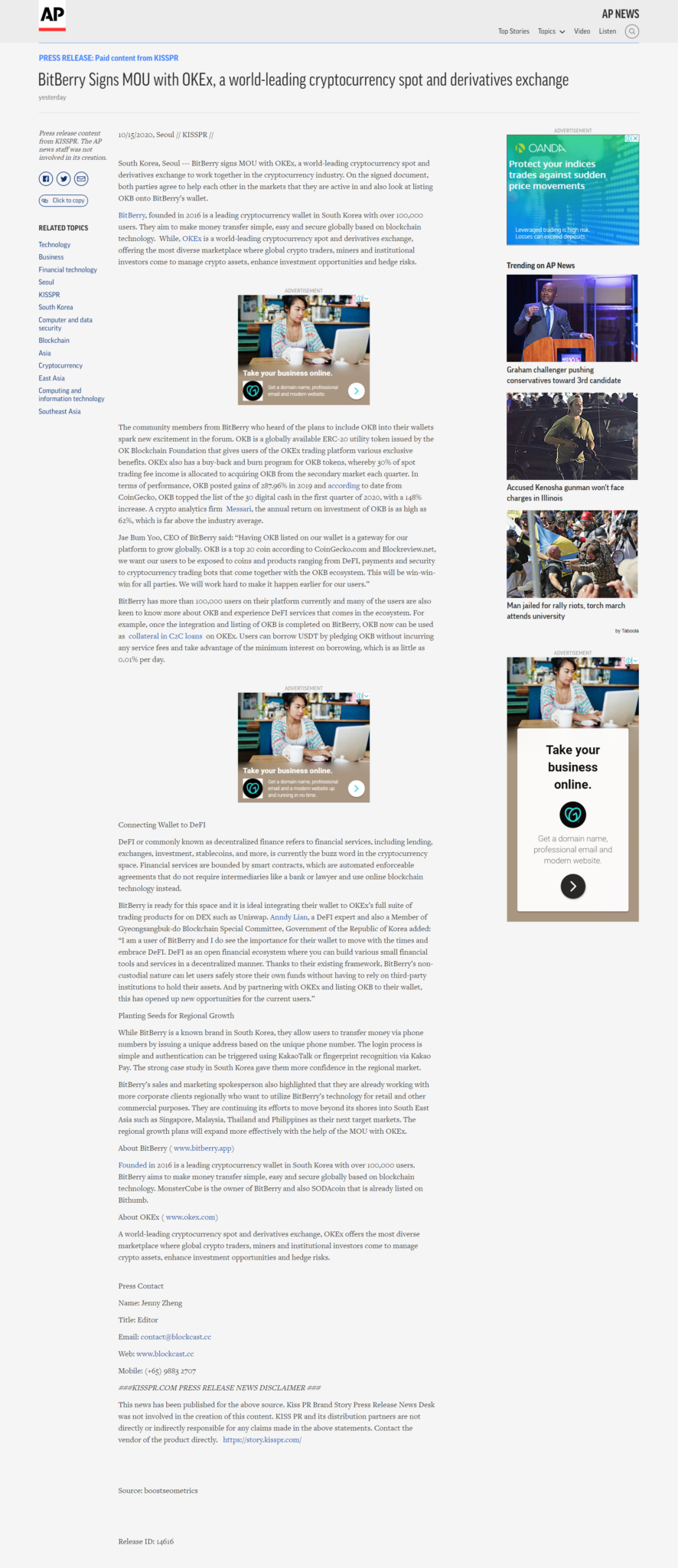
BitBerry Signs MOU with OKEx, a world-leading cryptocurrency spot and derivatives exchange


South Korea, Seoul — BitBerry signs MOU with OKEx, a world-leading cryptocurrency spot and derivatives exchange to work together in the cryptocurrency industry. On the signed document, both parties agree to help each other in the markets that they are active in and also look at listing OKB onto BitBerry’s wallet.

BitBerry, founded in 2016 is a leading cryptocurrency wallet in South Korea with over 100,000 users. They aim to make money transfer simple, easy and secure globally based on blockchain technology.  While, OKEx is a world-leading cryptocurrency spot and derivatives exchange, offering the most diverse marketplace where global crypto traders, miners and institutional investors come to manage crypto assets, enhance investment opportunities and hedge risks.

The community members from BitBerry who heard of the plans to include OKB into their wallets spark new excitement in the forum. OKB is a globally available ERC-20 utility token issued by the OK Blockchain Foundation that gives users of the OKEx trading platform various exclusive benefits. OKEx also has a buy-back and burn program for OKB tokens, whereby 30% of spot trading fee income is allocated to acquiring OKB from the secondary market each quarter. In terms of performance, OKB posted gains of 287.96% in 2019 and according to date from CoinGecko, OKB topped the list of the 30 digital cash in the first quarter of 2020, with a 148% increase. A crypto analytics firm  Messari, the annual return on investment of OKB is as high as 62%, which is far above the industry average.

Jae Bum Yoo, CEO of BitBerry said: “Having OKB listed on our wallet is a gateway for our platform to grow globally. OKB is a top 20 coin according to CoinGecko.com and Blockreview.net, we want our users to be exposed to coins and products ranging from DeFI, payments and security to cryptocurrency trading bots that come together with the OKB ecosystem. This will be win-win-win for all parties. We will work hard to make it happen earlier for our users.”

BitBerry has more than 100,000 users on their platform currently and many of the users are also keen to know more about OKB and experience DeFI services that comes in the ecosystem. For example, once the integration and listing of OKB is completed on BitBerry, OKB now can be used as  collateral in C2C loans  on OKEx. Users can borrow USDT by pledging OKB without incurring any service fees and take advantage of the minimum interest on borrowing, which is as little as 0.01% per day.

Connecting Wallet to DeFI

DeFI or commonly known as decentralized finance refers to financial services, including lending, exchanges, investment, stablecoins, and more, is currently the buzz word in the cryptocurrency space. Financial services are bounded by smart contracts, which are automated enforceable agreements that do not require intermediaries like a bank or lawyer and use online blockchain technology instead.

BitBerry is ready for this space and it is ideal integrating their wallet to OKEx’s full suite of trading products for on DEX such as Uniswap. Anndy Lian, a DeFI expert and also a Member of Gyeongsangbuk-do Blockchain Special Committee, Government of the Republic of Korea added: “I am a user of BitBerry and I do see the importance for their wallet to move with the times and embrace DeFI. DeFI as an open financial ecosystem where you can build various small financial tools and services in a decentralized manner. Thanks to their existing framework, BitBerry’s non-custodial nature can let users safely store their own funds without having to rely on third-party institutions to hold their assets. And by partnering with OKEx and listing OKB to their wallet, this has opened up new opportunities for the current users.”

Planting Seeds for Regional Growth

While BitBerry is a known brand in South Korea, they allow users to transfer money via phone numbers by issuing a unique address based on the unique phone number. The login process is simple and authentication can be triggered using KakaoTalk or fingerprint recognition via Kakao Pay. The strong case study in South Korea gave them more confidence in the regional market.

BitBerry’s sales and marketing spokesperson also highlighted that they are already working with more corporate clients regionally who want to utilize BitBerry’s technology for retail and other commercial purposes. They are continuing its efforts to move beyond its shores into South East Asia such as Singapore, Malaysia, Thailand and Philippines as their next target markets. The regional growth plans will expand more effectively with the help of the MOU with OKEx.


About BitBerry ( www.bitberry.app)

Founded in 2016 is a leading cryptocurrency wallet in South Korea with over 100,000 users. BitBerry aims to make money transfer simple, easy and secure globally based on blockchain technology. MonsterCube is the owner of BitBerry and also SODAcoin that is already listed on Bithumb.


About OKEx ( www.okex.com)

A world-leading cryptocurrency spot and derivatives exchange, OKEx offers the most diverse marketplace where global crypto traders, miners and institutional investors come to manage crypto assets, enhance investment opportunities and hedge risks.


Press Contact

Name: Jenny Zheng

Title: Editor

Email: contact@blockcast.cc

Web: www.blockcast.cc


Source: https://apnews.com/press-release/kisspr/technology-business-financial-technology-seoul-south-korea-61100ffaa3e727fc3827735d699af011

Anndy Lian is an early blockchain adopter and experienced serial entrepreneur who is known for his work in the government sector. He is a best selling book author- “NFT: From Zero to Hero” and “Blockchain Revolution 2030”.

Currently, he is appointed as the Chief Digital Advisor at Mongolia Productivity Organization, championing national digitization. Prior to his current appointments, he was the Chairman of BigONE Exchange, a global top 30 ranked crypto spot exchange and was also the Advisory Board Member for Hyundai DAC, the blockchain arm of South Korea’s largest car manufacturer Hyundai Motor Group. Lian played a pivotal role as the Blockchain Advisor for Asian Productivity Organisation (APO), an intergovernmental organization committed to improving productivity in the Asia-Pacific region.

An avid supporter of incubating start-ups, Anndy has also been a private investor for the past eight years. With a growth investment mindset, Anndy strategically demonstrates this in the companies he chooses to be involved with. He believes that what he is doing through blockchain technology currently will revolutionise and redefine traditional businesses. He also believes that the blockchain industry has to be “redecentralised”.
j j j