
Why Bitcoin ETF Approval is Not Important Any More

Why Bitcoin ETF Approval is Not Important Any More

Bitcoin ETFs, or exchange-traded funds that track the price of Bitcoin, have been a long-awaited and highly anticipated product in the crypto space. For years, investors have hoped that the U.S. Securities and Exchange Commission (SEC) would approve a Bitcoin ETF, as it would provide a convenient and regulated way to gain exposure to the leading cryptocurrency.

However, after several rejections and delays, the SEC has yet to approve a spot Bitcoin ETF, which would hold actual Bitcoin in custody. Instead, the SEC has only approved Bitcoin futures ETFs, which track the price of Bitcoin futures contracts traded on regulated exchanges. These ETFs have their own drawbacks, such as high fees, tracking errors, and rollover risks.

Moreover, the demand for Bitcoin ETFs has been declining, as investors have found other ways to access Bitcoin, such as through crypto exchanges, wallets, apps, and platforms. These alternatives offer more flexibility, security, and control over one’s Bitcoin holdings, as well as lower costs and better performance.

Declining Demand for Bitcoin ETFs

One of the main reasons why the approval of a spot Bitcoin ETF is not important any more is that the demand for Bitcoin ETFs has been declining as investors have found other ways to access Bitcoin.

Based on a report, there were $1.9 billion of inflows from Bitcoin ETF last year. This represents 87% of the total inflows. This is a relatively small amount compared to the total market capitalization of Bitcoin, which was nearly $900 billion as of January 5, 2024, according to statistics from CoinMarketCap.

According to Forbes Advisors, the largest Bitcoin ETF, the ProShares Bitcoin Strategy ETF (BITO), had an AUM of around $904 million, followed by the ProShares Short Bitcoin ETF (BITI), which had an AUM of $69 million and VanEck Bitcoin Strategy ETF (XBTF) with $45 million. The other ETFs had less than $25 million each in AUM.

The low AUM of Bitcoin ETFs indicates that investors are not very interested in these products, as they have other options to access Bitcoin. For example, investors can buy and sell Bitcoin directly on crypto exchanges, such as Coinbase, eToro and Robinhood. These exchanges offer a variety of features, such as low fees, high liquidity, advanced trading tools, and custodial services.

Investors can also store and manage their Bitcoin in crypto wallets, such as Ledger, Trezor, and MetaMask. These wallets allow users to have full control over their private keys, which are the passwords that grant access to their Bitcoin. Users can also send and receive Bitcoin to and from anyone in the world, without intermediaries or restrictions. Investors can also access Bitcoin through crypto apps and platforms, such as Square, PayPal, and Bakkt. These apps and platforms enable users to buy, sell, and spend Bitcoin with ease and convenience, as well as integrate Bitcoin with other financial services, such as payments, lending, and rewards.

These alternatives to Bitcoin ETFs offer more flexibility, security, and control over one’s Bitcoin holdings, as well as lower costs and better performance. For instance, the expense ratio of Bitcoin ETFs ranges from 0.65% to 1.20%, which means that investors have to pay an annual fee of $6.50 to $12 for every $1,000 invested. On the other hand, the fees for buying and selling Bitcoin on crypto exchanges are much lower, typically ranging from 0% to 0.6%, depending on the volume and type of transaction.

Moreover, the performance of Bitcoin ETFs may not match the performance of Bitcoin itself, due to factors such as tracking errors, premiums and discounts, and rollover risks. Tracking errors occur when the price of the ETF deviates from the price of the underlying asset, due to market inefficiencies, liquidity issues, or technical glitches.

Premiums and discounts occur when the market price of the ETF differs from its net asset value (NAV), which is the value of its underlying assets. Rollover risks occur when the ETF has to sell its expiring futures contracts and buy new ones, which may incur losses or gains depending on the price difference.

These factors can result in Bitcoin ETFs underperforming or outperforming Bitcoin, depending on the market conditions. For example, take the reference point from January 1, 2023 to December 19, 2023.

ProShares Bitcoin Strategy ETF (BITO) price on January 1, 2023, was $14.54. On December 19, 2023, the price was $20.87. This represents a return on investment (ROI) of approximately 43.6% for this period. The Bitcoin spot price on January 1, 2023, was $16,540.69. On December 19, 2023, the closing price was $42,270.53. This represents an ROI of approximately 155.2% for this period. This means that BITO underperformed Bitcoin by 111.6%.

Therefore, the demand for Bitcoin ETFs has been declining, as investors have found other ways to access Bitcoin, which offer more flexibility, security, and control over one’s Bitcoin holdings, as well as lower costs and better performance.

Reasons Why the SEC Has Not Approved a Bitcoin ETF

Another reason why the approval of a spot Bitcoin ETF is not important any more is that the SEC has not approved Bitcoin ETF, despite the numerous applications and the growing maturity of the Bitcoin market.

The SEC has been very cautious and conservative in approving Bitcoin ETFs, as it has raised several concerns, such as market manipulation, investor protection, custody, valuation, and liquidity. The SEC has also been very slow and inconsistent in reviewing and deciding on the Bitcoin ETF applications that have been filed over the years.

One of the main concerns that the SEC has expressed is the risk of market manipulation, as Bitcoin is traded on unregulated and fragmented markets, which may be subject to fraud, hacking, or price distortion. The SEC has also questioned the reliability and accuracy of the Bitcoin price indices that are used by the Bitcoin ETFs to track the performance of Bitcoin.

Another concern that has been raised is investor protection, as Bitcoin ETFs may expose investors to high volatility, operational risks, and cybersecurity threats. The SEC has also emphasized the need for adequate disclosure and education for investors, as Bitcoin ETFs may involve complex and unfamiliar concepts and technologies.

A third concern that was cited is custody, as Bitcoin ETFs would have to hold actual Bitcoin in a secure and compliant manner, which may pose technical and legal challenges. The SEC has also stressed the importance of having qualified custodians and auditors for Bitcoin ETFs, as well as contingency plans for potential loss or theft of Bitcoin.

A fourth concern that the SEC has mentioned is the valuation, as Bitcoin ETFs would have to determine the fair value of Bitcoin on a daily basis, which may be difficult due to the lack of standardization and transparency in the Bitcoin market. The SEC has also highlighted the potential for discrepancies and conflicts between the NAV and the market price of Bitcoin ETFs, which may result in premiums or discounts.

A fifth concern that the SEC has pointed out is liquidity, as Bitcoin ETFs would have to meet the liquidity requirements and standards of the SEC, which may be challenging due to the limited availability and trading volume of Bitcoin. The SEC has also warned about the potential for market disruptions and price swings in the Bitcoin market, which may affect the liquidity and stability of Bitcoin ETFs.

These are some of the reasons in my opinion why the SEC has not approved Bitcoin ETF, despite the numerous applications and the growing maturity of the Bitcoin market.

The Delay and its Consequences

The final reason why the approval of a spot Bitcoin ETF is not important any more is that the delay in the SEC’s decision has not made much difference for the Bitcoin market or the adoption of Bitcoin.

Some analysts have speculated that the delay in the SEC’s approval of a spot Bitcoin ETF is due to the change in leadership and priorities of the SEC, as well as the ongoing regulatory and legal developments in the crypto space. For example, the SEC chairman, Gary Gensler, is known for his expertise and interest in cryptocurrencies, but also for his strict and rigorous approach to regulation. The SEC has also been involved in several lawsuits and investigations against crypto companies, such as Ripple and Coinbase.

However, the delay in the SEC’s approval of a spot Bitcoin ETF has not made much difference for the Bitcoin market or the adoption of Bitcoin, as Bitcoin has continued to grow and thrive without the need for a spot Bitcoin ETF. Bitcoin has exhibited a remarkable performance in 2023, reaching new highs and attracting more investors and users. Bitcoin has also gained more recognition and acceptance from governments, central banks, and financial institutions around the world.

Moreover, the delay in the SEC’s approval of a spot Bitcoin ETF has not deterred the innovation and competition in the crypto space, as more fund providers and issuers have launched and applied for different types of Bitcoin ETFs, such as futures ETFs, inverse ETFs, leveraged ETFs, and actively managed ETFs. These ETFs offer various strategies and features to cater to different investor preferences and risk appetites. However, these ETFs also have their own limitations and challenges, as discussed earlier.

Therefore, the delay in the SEC’s approval of a spot Bitcoin ETF has not made much difference for the Bitcoin market or the adoption of Bitcoin, as Bitcoin has continued to grow and thrive without the need for a spot Bitcoin ETF. Of course, I could be wrong too.

Still Important?

In conclusion, the approval of a spot Bitcoin ETF is not important any more, as it would not have a significant impact on the Bitcoin market or the adoption of Bitcoin. The demand for Bitcoin ETFs has been declining, as investors have found other ways to access Bitcoin, which offer more flexibility, security, and control over one’s Bitcoin holdings, as well as lower costs and better performance. Bitcoin is already a highly liquid and legitimate asset, with a global and decentralized network of users, miners, developers, and exchanges.

Bitcoin ETFs may still have some challenges and opportunities in the future, depending on the regulatory and market developments. However, they are not likely to be the catalyst or the driver for the growth and innovation of Bitcoin. Bitcoin ETFs are rather a reflection and a result of the evolution and maturation of Bitcoin, as it becomes more mainstream and accepted by the world.


Source: https://www.blockhead.co/2024/01/09/why-bitcoin-etf-approval-is-not-important-any-more/

Anndy Lian is an early blockchain adopter and experienced serial entrepreneur who is known for his work in the government sector. He is a best selling book author- “NFT: From Zero to Hero” and “Blockchain Revolution 2030”.

Currently, he is appointed as the Chief Digital Advisor at Mongolia Productivity Organization, championing national digitization. Prior to his current appointments, he was the Chairman of BigONE Exchange, a global top 30 ranked crypto spot exchange and was also the Advisory Board Member for Hyundai DAC, the blockchain arm of South Korea’s largest car manufacturer Hyundai Motor Group. Lian played a pivotal role as the Blockchain Advisor for Asian Productivity Organisation (APO), an intergovernmental organization committed to improving productivity in the Asia-Pacific region.

An avid supporter of incubating start-ups, Anndy has also been a private investor for the past eight years. With a growth investment mindset, Anndy strategically demonstrates this in the companies he chooses to be involved with. He believes that what he is doing through blockchain technology currently will revolutionise and redefine traditional businesses. He also believes that the blockchain industry has to be “redecentralised”.

j j j

Short Bitcoin ETF: Is BITI a good hedge against the crypto winter?

Short Bitcoin ETF: Is BITI a good hedge against the crypto winter?

Additional comments:

BITI is designed to give investors a way to profit from declines in the price of Bitcoin. It is the first U.S. fund of its kind. On hearing this before the launch, I know many naysayers were piling into this ETF to short Bitcoin. This also resulted that this vehicle is now the second-largest bitcoin-themed ETF (behind BITO) in the U.S. market with just a few days of trading.

The challenge with a short ETF is timing the market. At this moment of time, I think this ETF started off slower than expected as Bitcoin started climbing back to over $21,000. If they were to be launched in November when Bitcoin hits its all-time high at $69,000, then perhaps you will see more influx of investors jumping in.

Analysts also told me that if investors also bought into BITO and BITI, and if you time right to follow the market’s momentum, you will still be a winner. I agree and disagree with this strategy as timing is the key factor to this.

I have always thought that a spot-based Bitcoin ETF product will be launched first. By seeing another derivatives products launched before the spot-based product, this reinforces my thinking further. I think the regulators are worried about subscriptions of the spot product because they know it will be popular. That is why they approved futures-based ETF, thinking that most risk-conscious investors are unlikely to buy the futures-products. Well, based on the trading figures, I still think the demand is there and it is rising.

Will history repeat itself? Only time will tell.


Short Bitcoin ETF: Is BITI a good hedge against the crypto winter?

ProShares has launched another bitcoin-linked exchange-traded fund (ETF). This new instrument is shorting the coin amid the wider cryptocurrency bear market.

The ETF issuer previously launched a bitcoin futures ETF BITO when the cryptocurrency was enjoying record highs and risk-on sentiment was prevailing.

Both funds trade futures contracts on the Chicago Mercantile Exchange (CME). The difference is only between their short and long positions.

What is a short bitcoin ETF, and what is the long-term sentiment on its performance?

What is ProShares bitcoin ETF?

An exchange-traded fund (ETF) is a basket of securities that tracks an underlying index or instrument, if it’s passive, or it could be actively managed with fund managers picking stocks based on their analysis and financial modelling. ETF prices fluctuate throughout a trading session as they are sold and bought on an exchange.

ETFs typically contain bonds and stocks but more recently have ventured into cryptocurrency territory. Cryptocurrency ETFs were highly anticipated by the community as they aim to boost liquidity and the adoption of digital assets in the world of investing.

In order for an ETF to be established, the company willing to create a fund must file a proposal with the US Securities and Exchange Commission (SEC).

A bitcoin ETF is made up of bitcoin or instruments linked to its price. How does it work?

In theory, bitcoin tokens would have been purchased by the company that owns the fund, securitised and sold or traded on an exchange. But, the SEC is yet to accept such a proposal. The underlying assets in bitcoin ETFs are linked to bitcoin futures contracts traded on the CME.

A futures contract is a standard contract where two parties agree to exchange a specific quantity of assets on a specific day for a certain price. A bitcoin futures contract is an agreement between two sides for the exchange of a contract unit of bitcoin.

Bitcoin short ETF explained

Similarly to BITO, the ProShares Short Bitcoin Strategy ETF, BITI, trades in futures contracts on the CME. The difference is that BITI is a short bitcoin ETF, meaning that it trades short positions. BITI allows investors to profit from the falling price of the cryptocurrency, which could be used as a part of a hedging strategy.

“BITI affords investors who believe that the price of bitcoin will drop with an opportunity to potentially profit or to hedge their cryptocurrency holdings. BITI enables investors to conveniently obtain short exposure to bitcoin through buying an ETF in a traditional brokerage account,”  ProShares CEO Michael L. Sapir said in a statement on 20 June 2022.

The fund tracks the nearest maturing monthly bitcoin futures contract trading on CME and is a rolling index, meaning that the index operates in accordance with a set of predetermined rolling methodology. In BITI’s case, the roll occurs over a five-day period every month, effective prior to the opening of trading and preceding the last trading date of the futures contract.

The last trading date for bitcoin futures contracts is the last Friday of the contract month. The index rolls monthly and distributes the weights 20% each day over a five-day roll period.

BITO has a gross expense ratio of 0.97% and a net expense ratio of 0.95%.

Are you wondering how to buy short bitcoin ETF? As ETFs are bought and sold on an exchange, bitcoin ETFs can be purchased via online brokers and most trading platforms.

For those investors who prefer to put their money in a mutual fund, which trades only once a day,  ProShares’ affiliate mutual fund company launched a Short Bitcoin Strategy ProFund (BITIX), which has the same investment objective as BITI.

“With the additions of BITI and BITIX, ProShares and ProFunds will be the only fund families in the US offering funds that allow investors to express their view on the direction of bitcoin—no matter whether they believe the price will go up or down,” Sapir noted.

Short BTC ETF analysis

It is important to note that investing in a futures-based bitcoin ETF is not a direct investment in the cryptocurrency because the fund tracks CME BTC futures – contracts speculating on the future price of BTC rather than bitcoin itself. Investors should be aware that the price of the ETF could be different to the price of the cryptocurrency itself.

The introduction of the new short bitcoin ETF had “many naysayers were piling into [it] to short bitcoin”, said Anndy Lian, best-selling author of Blockchain Revolution 2030 and chief digital advisor to the Mongolian Productivity Organisation.

What is your sentiment on BTC/USD?

“This also resulted that this vehicle is now the second largest bitcoin themed ETF (behind BITO) in the US market with just a few days of trading.”

According to Lars Seier Christense, chairman of the Concordium Foundation and founder of Saxo Bank, “such reversed price-action investment products are well known in the traditional finance sector, and are typically used for hedging.

“Typically, they cater for investors in markets where shorting is difficult, or where they would not have a relationship with their brokers allowing them to short or where margins of such short positions are very high,” he added.
“I believe such a vehicle could become quite popular for hedging and shorting purposes, being easier to invest in than outright shorts.”

However, Lian also highlighted that the key challenge when trading short ETFs is timing the market. He told Capital.com:

“At this moment in time, I think this ETF started off slower than expected as bitcoin started climbing back to over $21,000. If they were to be launched in November when Bitcoin hit its all-time high at $69,000, then perhaps you will see more influx of investors jumping in [now, as the token has been going down].”

Dan Hoover, Director at Castle Funds,  explained that the futures market in which BITI trades uses CME-listed futures, which close for an hour a day Monday through Thursday, and on Friday until Sunday (Chicago time). BTC can be bought and sold 24/7.

“This delay can create some unexpected price action in the futures as the prices ‘catch up’ to market news in Asia, especially over the US weekend. Additionally, BITI only trades on US trading days, which is even narrower than CME futures trading (9:30AM – 4PM NY time, M-F, observing most major holidays),” Hoover added.

Other competitors are spot or physically-backed bitcoin ETF projects. But, they have been pending SEC approval for a few years now.

“These ETF’s could be used to replicate the BITI strategy much more efficiently, as they avoid the compounding risks of the inverse ETF and the carrying costs of the underlying futures,” Hoover noted.

Short BTC ETF forecast

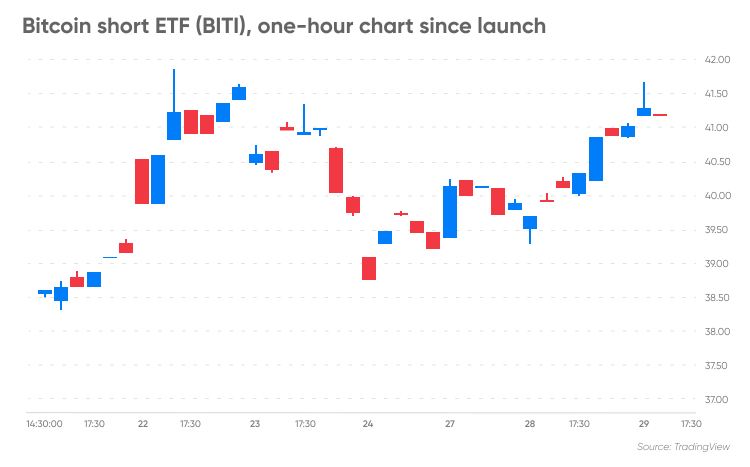
Within a day after its launch, BITI had risen to $41.3 on 22 June, up 3.6% from closing at $39.84 the day before. The fund has pulled back since and is currently (29 June) trading at $39.81.

Source: TradingView

Analysts appear to have mixed feelings on how the short bitcoin ETF will perform, as it was launched at such an uncertain time for cryptocurrencies and BTC.

In a note published on 21 June, Laith Khalaf, head of investment analysis at AJ Bell, noted that “bitcoin isn’t behaving particularly unusually and losses of this magnitude are to be expected, especially after periods of equally extreme price appreciation.”

According to Khalaf, this is not the coin’s worst performance and BTC has suffered worse “crypto winters before and come back to have its day in the sun”.

“The popularity of short BTC ETF’s, such as this latest iteration from ProShares, highlights quite how bearish a run the cryptocurrency market has been on. Short ETFs are suddenly popping up more often, as Bitcoin struggles to find a bid,” Invezz’s data analyst Dan Ashmore told Capital.com.

Long-term, Ashmore is bullish on bitcoin, however, in the short and medium-term, the ETF could perform well as the US Federal Reserve is still struggling to tackle rising inflation and a tight geopolitical situation, according to the analyst.

Saxo Bank’s Christensen agreed with Ashmore, noting that the ETF could be interesting for short-term trading.

“Unless the BTC community is completely wrong about higher levels for BTC longer-term, it would clearly not have a great investment in its own right, but more suited for short-term speculation and hedging of crypto portfolios,” he added.

Note that analysts’ predictions can be wrong. Forecasts shouldn’t be used as substitutes for your own research. Always conduct your own diligence, and remember that your decision to trade or invest should depend on your risk tolerance, expertise in the market, portfolio size and goals.

Keep in mind that past performance doesn’t guarantee future returns. And never invest or trade money you cannot afford to lose.


Original Source: https://capital.com/short-bitcoin-etf-explained


Anndy Lian is an early blockchain adopter and experienced serial entrepreneur who is known for his work in the government sector. He is a best selling book author- “NFT: From Zero to Hero” and “Blockchain Revolution 2030”.

Currently, he is appointed as the Chief Digital Advisor at Mongolia Productivity Organization, championing national digitization. Prior to his current appointments, he was the Chairman of BigONE Exchange, a global top 30 ranked crypto spot exchange and was also the Advisory Board Member for Hyundai DAC, the blockchain arm of South Korea’s largest car manufacturer Hyundai Motor Group. Lian played a pivotal role as the Blockchain Advisor for Asian Productivity Organisation (APO), an intergovernmental organization committed to improving productivity in the Asia-Pacific region.

An avid supporter of incubating start-ups, Anndy has also been a private investor for the past eight years. With a growth investment mindset, Anndy strategically demonstrates this in the companies he chooses to be involved with. He believes that what he is doing through blockchain technology currently will revolutionise and redefine traditional businesses. He also believes that the blockchain industry has to be “redecentralised”.

j j j

Anndy Lian: “Bitcoin ETF could attract more than $400 million in investment accordingly to Bloomberg. This could triple the amount. I am optimistic.”

Anndy Lian: “Bitcoin ETF could attract more than $400 million in investment accordingly to Bloomberg. This could triple the amount. I am optimistic.”

How Did Investors React To bitcoin’s ATH?

Bitcoin’s recent price surge ensured the cryptocurrency reached an all-time high, breaking beyond the $66,000 barrier for the first time, retaining its position as the world’s most valuable cryptocurrency. The market cap of all cryptocurrencies surpassed $2.53 trillion in May this year, reaching an all-time high of $2.64 trillion because of the latest Bitcoin price spike.


Bitcoin’s surge is the number one topic being discussed in our social media and Telegram groups at the moment. Many investors are astonished as to why Bitcoin’s price has risen so dramatically. Let’s look at what this implies for investors as I examine the reasons why the Bitcoin price hit an all-time high this time.

What’s causing Bitcoin’s price to rise?

The launch of the first Bitcoin exchange-traded fund (ProShares Bitcoin Strategy ETF, trading under the ‘BITO’ ticker on Wall Street) on the New York Stock Exchange, is the key driving force behind this Bitcoin price spike. Many crypto sector investors around the world have been advocating the advantages of crypto ETFs for years, most notably Cameron and Tyler Winklevoss, famous for their involvement in Facebook who had their Bitcoin ETF turned down by the Securities and Exchange Commission (SEC) in 2017. The success of this Bitcoin ETF has in turn set a precedent for other cryptocurrency ETFs to pass the audit, and it is also the primary driver for the recent rise in cryptocurrency values. The ProShares ETF witnessed


“one of the biggest first days on record for ETFs, raking in $550 million from crypto-hungry investors. Overall, more than $1.01 billion of shares changed hands,”


according to a report on business news channel CNBC.


Bitcoin Exchange Traded Funds (Bitcoin ETFs) are actually Bitcoin ‘futures’, not direct investments in Bitcoin. Futures are a kind of financial derivatives, which are essentially an agreement to buy and sell assets at a future date, meaning the assets are not owned by the investors. The fund’s main feature is that it allows non-crypto investors to buy Bitcoin without having to register a separate cryptocurrency trading account.


ProShares CEO Michael L. Sapir confirmed:


“BITO will open up exposure to bitcoin to a large segment of investors who have a brokerage account and are comfortable buying stocks and ETFs, but do not desire to go through the hassle and learning curve of establishing another account with a cryptocurrency provider and creating a bitcoin wallet.”


Simply put Bitcoin ETFs are not the same as buying Bitcoin directly.


“The futures-linked fund is subject to rollover risk, meaning that when it periodically closes positions in the futures contracts it holds, it can find itself, as is the case now, repurchasing new batches of future-dated contracts for more money. The situation, known as “contango,” eats into profits,”


confirmed the report in Fortune.


So, if you’re thinking about buying Bitcoin ETFs, make sure you know everything there is to know about futures trading.

What does the Bitcoin price surge mean?

I believe that if you plan to invest in cryptocurrencies for the long term rather than the short term, the latest all-time high of Bitcoin should be treated in the same way as any other volatile asset.


The benefit of buying and holding cryptocurrencies is that you don’t have to feel driven to trade when the price is extremely high or low because you’re working within a longer investing framework. Because of the volatility of cryptocurrencies, the market rises and falls to new highs and lows.


If you’ve done your homework and have a well-defined investment strategy, these price fluctuations shouldn’t affect your long-term position or approach. The best advice is to carefully weigh up the pros and cons of buying Bitcoin for the long term and make sure you have a well-thought-out crypto investment plan at the outset.


To put it another way, some active investors may believe now is a good opportunity to profit, while others believe Bitcoin will continue to grow in value. It was reported recently in Forbes that a panel of 50 bitcoin and cryptocurrency experts has predicted,


“the bitcoin price will continue to climb through 2021, hitting highs of around $80,000, before surging to $250,000 by 2025 and a staggering $5 million per bitcoin by 2030”.


When compared to buying and holding cryptocurrencies, active trading has the advantage of allowing investors to profit from market fluctuations and new all-time highs.


I feel that the launch of the Bitcoin ETF is an important step forward in the mainstream acceptance and usage of cryptocurrencies, which will benefit the whole crypto industry. Indeed, in a recent Motley Fool report, it’s suggested that Ethereum, crypto’s second-biggest player could be an even better bet.


“I think the long-term application building potential of the Ethereum network makes Ether a more attractive option for investors looking to benefit from the evolution of blockchain technologies,”


argued Keith Noonan.


“Ether’s price per token has surged roughly 458% across 2021’s trading. Despite significantly outpacing Bitcoin’s gains across the stretch, I still think Ethereum stands a good chance of outperforming Bitcoin over the long term,”


he added.


The Bitcoin ETF has helped institutional investors gain confidence and may open the door to new retail investors. According to the latest research, more than 50 million people in the US plan to invest in cryptocurrencies next year, and the Bitcoin ETF no doubt will play a crucial role in that adoption process.


The cryptocurrency sector has come a long way since Bitcoin’s launch in 2009, but there is still a long way to go and numerous technical obstacles to overcome before the industry reached mainstream adoption, with the blockchain sector as a whole still missing its “killer app,” and still awaiting its “Netscape moment.”


The crypto community has been waiting for its own version of this moment for years.


“And it may have just arrived with the first U.S. Bitcoin ETF begin trading, with more are on the way, and Bitcoin and Ethereum both hitting all new all-time highs,”


according to Decrypt’s executive editor Jeff John Roberts.


The future regulation of cryptocurrencies in many nations is still an “unknown possibility”. Individual countries are expected to introduce stronger regulatory frameworks and plans relating to the Bitcoin sector soon. As reported in the FT on October 13, the SEC’s indication that it is going to look more closely at how it regulates complex exchange-traded products has implications for future bitcoin ETF rules:


“Last week, SEC Chair Gary Gensler directed staff to study the risks of ETFs employing strategies ‘more complex than typical stocks and bonds’ and draft potential rules to address those concerns,”


the FT confirmed.


“Bitcoin ETF could attract more than $400 million in investment accordingly to Bloomberg. This is just the beginning based on what I see. Give it a few more months, we could see double of what we see right now. Australia’s corporate regulator has given the green light to a range of cryptocurrency-related ETFs, which could see Bitcoin and Ethereum-backed investment funds trading on the ASX in the coming months. This could triple the amount. I am optimistic.”


Anndy Lian, Chairman, BigONE Exchange commented on Twitter.


To conclude, as a result, I advise investors who are taking advantage of the current bull market to be prepared. The Bitcoin market may actually become more volatile because of planned regulatory reforms.


by Jenny Zheng @jennyzhengEarly crypto advocate | Investor | PR Expert | Cofounder of Blockcast.cc


Original Source: https://hackernoon.com/how-did-investors-react-to-bitcoins-ath

Anndy Lian is an early blockchain adopter and experienced serial entrepreneur who is known for his work in the government sector. He is a best selling book author- “NFT: From Zero to Hero” and “Blockchain Revolution 2030”.

Currently, he is appointed as the Chief Digital Advisor at Mongolia Productivity Organization, championing national digitization. Prior to his current appointments, he was the Chairman of BigONE Exchange, a global top 30 ranked crypto spot exchange and was also the Advisory Board Member for Hyundai DAC, the blockchain arm of South Korea’s largest car manufacturer Hyundai Motor Group. Lian played a pivotal role as the Blockchain Advisor for Asian Productivity Organisation (APO), an intergovernmental organization committed to improving productivity in the Asia-Pacific region.

An avid supporter of incubating start-ups, Anndy has also been a private investor for the past eight years. With a growth investment mindset, Anndy strategically demonstrates this in the companies he chooses to be involved with. He believes that what he is doing through blockchain technology currently will revolutionise and redefine traditional businesses. He also believes that the blockchain industry has to be “redecentralised”.

j j j
