Ether soars past US$4,300, gold hits US$3,400: Is a new duty rule about to crash the market?

Ether soars past US$4,300, gold hits US$3,400: Is a new duty rule about to crash the market?

A wave of cautious hope surrounding a potential Russia-Ukraine ceasefire has buoyed global risk sentiment, propelling US stock markets to their strongest weekly performance since June. The S&P 500 climbed 0.8 per cent, the Nasdaq surged one per cent, and the Dow Jones edged up 0.5 per cent, primarily driven by a rally in big technology stocks. This optimism stems from reports of diplomatic engagements, including a confirmed meeting between Presidents Vladimir Putin and Donald Trump, which has sparked speculation about a possible de-escalation in the Russia-Ukraine conflict.

Such a development could alleviate a significant geopolitical overhang, fostering a more favourable environment for risk assets. This positivity is tempered by uncertainties in US monetary policy, trade dynamics, and the evolving role of cryptocurrencies, particularly stablecoins, in reshaping global finance.

The US stock market’s recent gains reflect a broader market narrative of resilience amid geopolitical and economic crosscurrents. The technology sector, a perennial driver of market momentum, has been at the forefront, with companies like Nvidia and AMD playing pivotal roles. Reports indicate that these chipmakers have agreed to remit 15 per cent of their China chip sales revenue to the US government to secure export licenses, a move that underscores the intricate balance between national security and economic interests.

This agreement, while facilitating continued access to the lucrative Chinese market, has sparked debate about its legality under the US Constitution, which prohibits export taxes. Critics argue it could set a precedent for unconventional trade policies, while supporters view it as a pragmatic compromise to maintain technological competitiveness. The deal highlights the strategic importance of semiconductors in global trade, particularly as tensions between the US and China intensify. Despite these complexities, the tech-driven rally in US equities signals investor confidence in the sector’s long-term growth prospects, even as trade uncertainties loom.

In the bond market, US Treasuries experienced a decline last Friday, with yields rising by 3 to 5 basis points across the curve in a subdued trading session. Investors remain focused on the Federal Reserve’s leadership transitions, particularly President Trump’s nomination of Stephen Miran, Chairman of the Council of Economic Advisers, for a Fed governor role. This appointment has fuelled speculation about a potential shift toward a more dovish monetary policy stance, as Miran’s economic philosophy aligns with Trump’s preference for lower interest rates to stimulate growth.

The US Dollar Index, which dipped 0.22 per cent, later recovered some ground following this news, reflecting market sensitivity to Fed leadership changes. The anticipation of upcoming inflation data, with the Consumer Price Index (CPI) report due on Tuesday and the Producer Price Index (PPI) report on Thursday, adds another layer of complexity.

Federal Reserve Chair Jerome Powell’s recent comments at the Federal Open Market Committee meeting, suggesting that a September rate cut is less likely and will hinge on macroeconomic data, have tempered expectations for immediate easing. These reports will be critical in shaping the Fed’s policy trajectory, as persistent inflationary pressures could force a more hawkish stance, impacting both equity and bond markets.

Geopolitical and policy developments have also swayed commodity markets. Gold prices surged to nearly US$3,400 per ounce after a US government agency ruled that gold bars would be subject to duties, triggering volatility in bullion markets. The White House’s promise of a forthcoming clarification has done little to quell uncertainty, as investors grapple with the potential cost implications for gold as a safe-haven asset.

Meanwhile, Brent crude prices remained unchanged after a volatile session, reflecting the market’s indecision amid ceasefire optimism and ongoing geopolitical risks. The stability in oil prices suggests a wait-and-see approach, as traders assess whether reduced tensions in Eastern Europe could ease supply concerns or if other global factors, such as US tariffs, might sustain price pressures.

In Asia, equity indices opened with mixed performance, signalling varied regional responses to global developments. US equity index futures, however, point to a positive opening, suggesting that the momentum from last week’s rally may persist. This divergence underscores the fragmented nature of global risk sentiment, where local economic conditions and policy responses shape market outcomes.

For instance, Hong Kong’s Hang Seng index has benefited from a recovery in Chinese technology stocks, driven by President Xi Jinping’s public engagement with tech leaders, signalling a potential easing of regulatory pressures. This contrasts with mainland China’s more subdued market performance, highlighting the nuanced dynamics within Asian markets.

The cryptocurrency market has emerged as a focal point of investor enthusiasm, propelled by significant policy shifts in the US Bitcoin soared past US$121,000, and Ethereum reached US$4,300, fuelled by President Trump’s executive order exploring the inclusion of cryptocurrencies in 401(k) retirement accounts. This move, which also considers private equity, could unlock substantial demand by opening millions of American retirement portfolios to higher-risk assets.

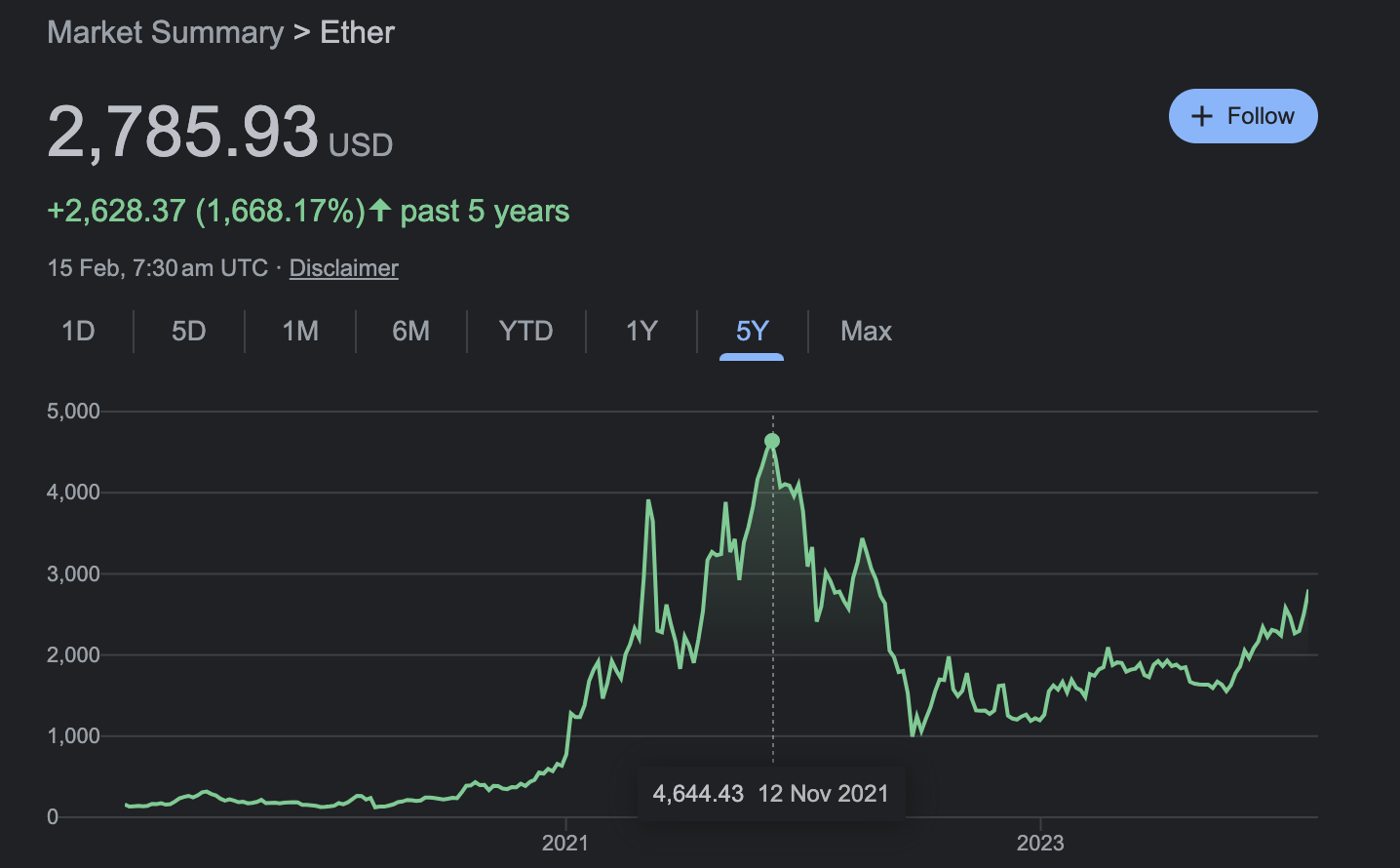
Spot Ethereum exchange-traded funds (ETFs) have outpaced Bitcoin ETFs, attracting US$461 million in inflows over the past week, reflecting robust institutional interest. Ethereum’s price, now 11 per cent below its all-time high of US$4,878, may continue to outperform Bitcoin if these inflows persist. The influence of large corporate treasuries, as noted by industry expert Anndy Lian, underscores their role in driving price action. Lian’s assertion that investors should remain steadfast as long as these treasuries continue buying highlights the market’s reliance on institutional momentum.

Stablecoins, a subset of cryptocurrencies pegged to assets like the US dollar or Bitcoin, are reshaping the competitive landscape between the US and China. In Hong Kong, new legislation aims to position the city as a global hub for stablecoins and Web3 technologies, which leverage blockchain for decentralised internet applications. This strategic pivot seeks to restore Hong Kong’s stature as a financial powerhouse amid intensifying global competition.

In the US, the Trump administration’s embrace of cryptocurrencies, bolstered by campaign support from crypto advocates, signals a proactive approach to integrating digital assets into mainstream finance. The passage of stablecoin regulations in both jurisdictions underscores their potential to revolutionise global finance by offering stable, blockchain-based alternatives to traditional currencies. This rivalry carries risks, as stablecoins could disrupt monetary policy frameworks and challenge the dominance of fiat currencies like the dollar and renminbi.

From a personal perspective, the convergence of these developments paints a picture of a world at a financial crossroads. The optimism surrounding a potential Russia-Ukraine ceasefire offers a glimmer of hope for stabilising global markets, but the path forward remains fraught with uncertainty. The US stock market’s resilience, driven by technology giants, reflects a broader trend of innovation outpacing geopolitical and economic headwinds. The reliance on tech stocks raises concerns about market concentration and vulnerability to sector-specific shocks.

The Federal Reserve’s cautious stance on rate cuts, coupled with upcoming inflation data, suggests that monetary policy will remain a critical determinant of market direction. The cryptocurrency surge, particularly in stablecoins, signals a transformative shift toward decentralised finance, but it also introduces new risks, including regulatory ambiguity and market volatility. The US-China rivalry over stablecoins and Web3 technologies underscores the strategic importance of digital innovation, but it also highlights the potential for economic fragmentation if competitive tensions escalate.

As markets continue to evolve, adaptability and informed decision-making will be paramount in capitalising on emerging opportunities while mitigating inherent uncertainties.


 

Source: https://e27.co/ether-soars-past-us4300-gold-hits-us3400-is-a-new-duty-rule-about-to-crash-the-market-20250811/

Anndy Lian is an early blockchain adopter and experienced serial entrepreneur who is known for his work in the government sector. He is a best selling book author- “NFT: From Zero to Hero” and “Blockchain Revolution 2030”.

Currently, he is appointed as the Chief Digital Advisor at Mongolia Productivity Organization, championing national digitization. Prior to his current appointments, he was the Chairman of BigONE Exchange, a global top 30 ranked crypto spot exchange and was also the Advisory Board Member for Hyundai DAC, the blockchain arm of South Korea’s largest car manufacturer Hyundai Motor Group. Lian played a pivotal role as the Blockchain Advisor for Asian Productivity Organisation (APO), an intergovernmental organization committed to improving productivity in the Asia-Pacific region.

An avid supporter of incubating start-ups, Anndy has also been a private investor for the past eight years. With a growth investment mindset, Anndy strategically demonstrates this in the companies he chooses to be involved with. He believes that what he is doing through blockchain technology currently will revolutionise and redefine traditional businesses. He also believes that the blockchain industry has to be “redecentralised”.

j j j

Ether Rock NFT to Sell For $600K? Bull Market Logic Says Yes

Ether Rock NFT to Sell For $600K? Bull Market Logic Says Yes

With Bitcoin hitting $52K and the entire crypto market riding on an upward trajectory, it’s safe to say we’ve entered a bull market.

Most of the top 10 non-stablecoin cryptocurrencies have enjoyed double-figure percentage returns over the week, signalling unified momentum to buy, buy, buy.

Basking in the glory of this market momentum, investors are finally reaping their rewards after months, if not years of agony.

But just how far is this burst of optimism spreading? After all, the crypto market is notoriously renowned for bogus projects and worthless assets. The infamous Ether Rock NFT collection is a prime example of this.

Rock N Sold

Developed by an anonymous creator in December 2017, Ether Rocks is a CC0 JPEG clipart collection of 100 rocks, which vary in colours but are identical in shape and size.

The project is inspired by Gary Dahl’s 1975 satirical Pet Rock in which people subscribed to the humorous idea of purchasing a rock as a pet. Each rock was packaged in custom cardboard boxes, complete with ventilation holes and straw bedding. Dahl’s absurd concept took the market by storm, selling over 1 million Pet Rocks for $4 each.

Ether Rocks takes a leaf out of Dahl’s bizarre marketing campaign by utilizing the power of community, hype, and satire, whilst offering zero utility to the user.

All 100 Ether Rocks have already been sold but global auction house Sotheby’s is listing one of the NFTs in a sealed-bid auction between 14-21 February 2024.

“By bringing the iconic Pet Rock concept into the digital age through blockchain technology, Ether Rocks invites us to reconsider the boundaries of value, ownership, and cultural significance in the ever-evolving landscape of unconventional trends,” Sotheby’s explains on its auction page.

With an estimate of $500,000 to $700,000, the NFT’s price is mindblowing for non-crypto natives and amazes even the most seasoned crypto enthusiast. Considering each Ether Rock was minted starting at 0.01 ETH, with the last Rock selling at 10 ETH at the time, today’s price of these NFTs is nothing short of astronomical.

Yet, its suggested price range could be regarded as conservative. Earlier this week, Ether Rock #19 was purchased for 279 ETH – worth $739,015 at the time. Its value is now closer to $800,000.

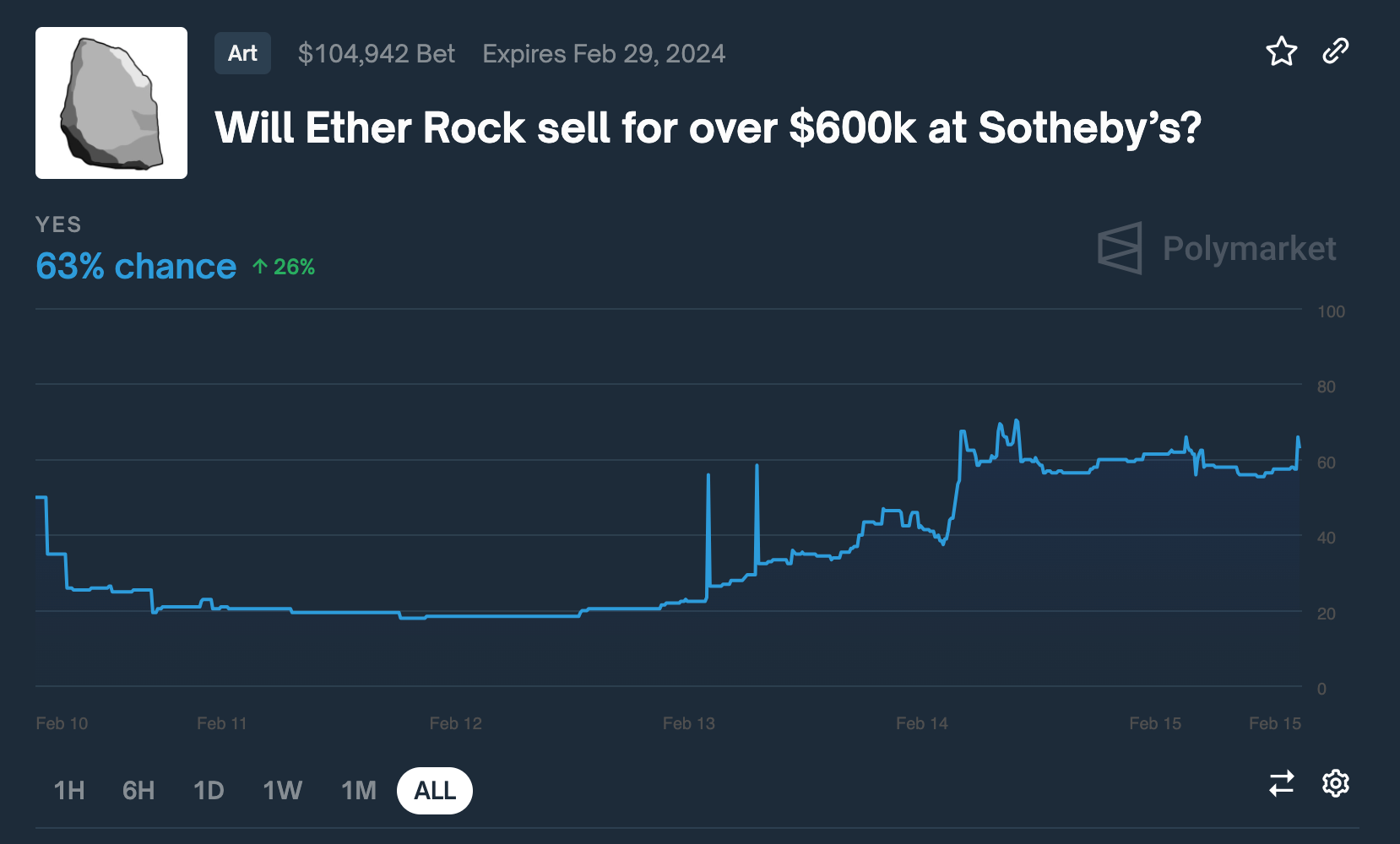
Crypto betting site Polymarket reflects a 63% chance that the Ether Rock will sell for over $600,000 at Sotheby’s auction.

In fact, if the Rock sells for the anticipated target of $600,000, it will only be less than half the price of the collection’s highest sale. In 2021, the most expensive Rock was sold for 420 ETH, costing $1,397,277 at the time.

Rolling Stones, Rolling Markets

The strength of Ether Rocks has largely been on par with the strength of the overall crypto market. When the project hit its all-time high sale in November 2021, the crypto market was in extreme bull mode. Ethereum was above $4K and Bitcoin cleared $60K.

Sotheby’s Ether Rock auction comes at a perfect time as the market is generating momentum in today’s bull cycle.

Whether Ethereum can return to its previous highs is yet to be seen but its strength will certainly be reflected in the price that Ether Rock sells for as investors look for diverse avenues to park their money in.

As Blockhead contributor Anndy Lian explains, “The crypto market is anticipated to be more bullish. This brings the degen narrative back to the scene where this is a way to show their social & cultural capital of the NFTs.”

“Wrapped Ether Rock and BAYC are not just digital assets, but also symbols of status and identity in the NFT community,” Lian added on his blog. “Owning a Wrapped Ether Rock gives the holder a sense of prestige and history, as they own a piece of the early days of NFTs.”


Source: https://www.blockhead.co/2024/02/15/ether-rock-nft-to-sell-for-600k-bull-market-logic-says-yes/

Anndy Lian is an early blockchain adopter and experienced serial entrepreneur who is known for his work in the government sector. He is a best selling book author- “NFT: From Zero to Hero” and “Blockchain Revolution 2030”.

Currently, he is appointed as the Chief Digital Advisor at Mongolia Productivity Organization, championing national digitization. Prior to his current appointments, he was the Chairman of BigONE Exchange, a global top 30 ranked crypto spot exchange and was also the Advisory Board Member for Hyundai DAC, the blockchain arm of South Korea’s largest car manufacturer Hyundai Motor Group. Lian played a pivotal role as the Blockchain Advisor for Asian Productivity Organisation (APO), an intergovernmental organization committed to improving productivity in the Asia-Pacific region.

An avid supporter of incubating start-ups, Anndy has also been a private investor for the past eight years. With a growth investment mindset, Anndy strategically demonstrates this in the companies he chooses to be involved with. He believes that what he is doing through blockchain technology currently will revolutionise and redefine traditional businesses. He also believes that the blockchain industry has to be “redecentralised”.

j j j

Bitcoin, Ether, Doge Skyrocket: Should You Be Buying At Current $30K Levels?

Bitcoin, Ether, Doge Skyrocket: Should You Be Buying At Current $30K Levels?

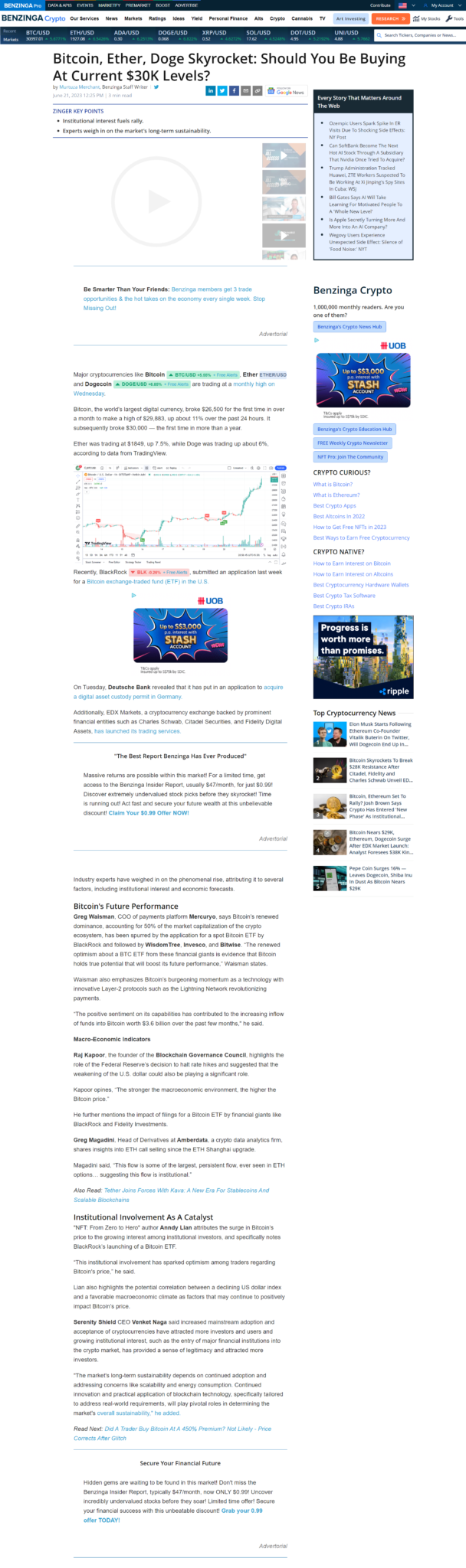
Major cryptocurrencies like Bitcoin Ether and Dogecoin are trading at a monthly high on Wednesday.

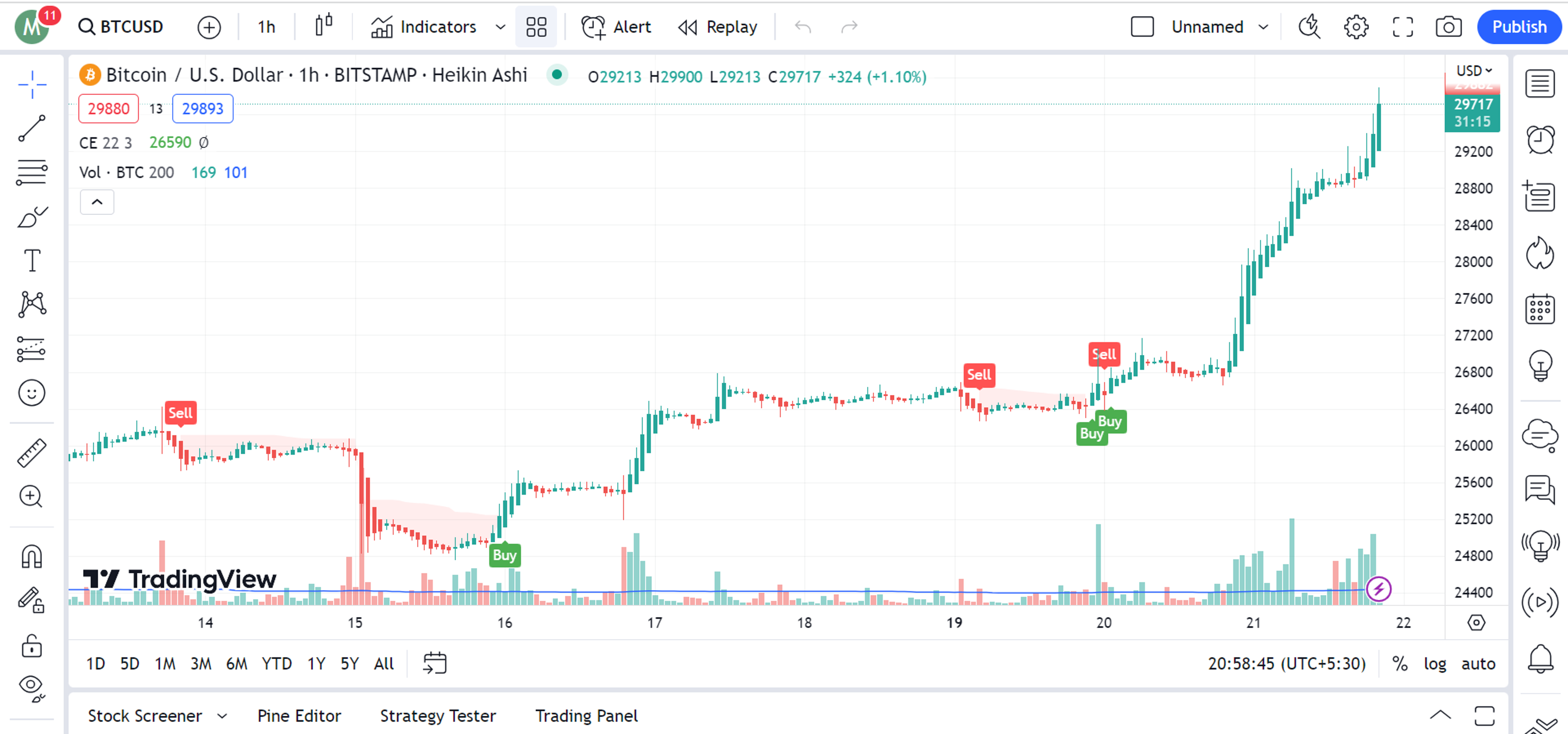
Bitcoin, the world’s largest digital currency, broke $26,500 for the first time in over a month to make a high of $29,883, up about 11% over the past 24 hours. It subsequently broke $30,000 — the first time in more than a year.

Ether was trading at $1849, up 7.5%, while Doge was trading up about 6%, according to data from TradingView.

Recently, BlackRock BLK, submitted an application last week for a Bitcoin exchange-traded fund (ETF) in the U.S.

Additionally, EDX Markets, a cryptocurrency exchange backed by prominent financial entities such as Charles Schwab, Citadel Securities, and Fidelity Digital Assets, has launched its trading services.

Industry experts have weighed in on the phenomenal rise, attributing it to several factors, including institutional interest and economic forecasts.

Bitcoin’s Future Performance

Greg Waisman, COO of payments platform Mercuryo, says Bitcoin’s renewed dominance, accounting for 50% of the market capitalization of the crypto ecosystem, has been spurred by the application for a spot Bitcoin ETF by BlackRock and followed by WisdomTreeInvesco, and Bitwise. “The renewed optimism about a BTC ETF from these financial giants is evidence that Bitcoin holds true potential that will boost its future performance,” Waisman states.

Waisman also emphasizes Bitcoin’s burgeoning momentum as a technology with innovative Layer-2 protocols such as the Lightning Network revolutionizing payments.

“The positive sentiment on its capabilities has contributed to the increasing inflow of funds into Bitcoin worth $3.6 billion over the past few months,” he said.

Macro-Economic Indicators

Raj Kapoor, the founder of the Blockchain Governance Council, highlights the role of the Federal Reserve’s decision to halt rate hikes and suggested that the weakening of the U.S. dollar could also be playing a significant role.

Kapoor opines, “The stronger the macroeconomic environment, the higher the Bitcoin price.”

He further mentions the impact of filings for a Bitcoin ETF by financial giants like BlackRock and Fidelity Investments.

Greg Magadini, Head of Derivatives at Amberdata, a crypto data analytics firm, shares insights into ETH call selling since the ETH Shanghai upgrade.

Magadini said, “This flow is some of the largest, persistent flow, ever seen in ETH options… suggesting this flow is institutional.”

Institutional Involvement As A Catalyst

“NFT: From Zero to Hero” author Anndy Lian attributes the surge in Bitcoin’s price to the growing interest among institutional investors, and specifically notes BlackRock’s launching of a Bitcoin ETF.

“This institutional involvement has sparked optimism among traders regarding Bitcoin’s price,” he said.

Lian also highlights the potential correlation between a declining US dollar index and a favorable macroeconomic climate as factors that may continue to positively impact Bitcoin’s price.

Serenity Shield CEO Venket Naga said increased mainstream adoption and acceptance of cryptocurrencies have attracted more investors and users and growing institutional interest, such as the entry of major financial institutions into the crypto market, has provided a sense of legitimacy and attracted more investors.

“The market’s long-term sustainability depends on continued adoption and addressing concerns like scalability and energy consumption. Continued innovation and practical application of blockchain technology, specifically tailored to address real-world requirements, will play pivotal roles in determining the market’s overall sustainability,” he added.


Source: https://www.benzinga.com/markets/cryptocurrency/23/06/32950439/bitcoin-ether-doge-skyrocket-should-you-be-buying-at-current-30k-levels

Anndy Lian is an early blockchain adopter and experienced serial entrepreneur who is known for his work in the government sector. He is a best selling book author- “NFT: From Zero to Hero” and “Blockchain Revolution 2030”.

Currently, he is appointed as the Chief Digital Advisor at Mongolia Productivity Organization, championing national digitization. Prior to his current appointments, he was the Chairman of BigONE Exchange, a global top 30 ranked crypto spot exchange and was also the Advisory Board Member for Hyundai DAC, the blockchain arm of South Korea’s largest car manufacturer Hyundai Motor Group. Lian played a pivotal role as the Blockchain Advisor for Asian Productivity Organisation (APO), an intergovernmental organization committed to improving productivity in the Asia-Pacific region.

An avid supporter of incubating start-ups, Anndy has also been a private investor for the past eight years. With a growth investment mindset, Anndy strategically demonstrates this in the companies he chooses to be involved with. He believes that what he is doing through blockchain technology currently will revolutionise and redefine traditional businesses. He also believes that the blockchain industry has to be “redecentralised”.

j j j