December Fed cut countdown: The 25 basis point move that will reshape every asset class

December Fed cut countdown: The 25 basis point move that will reshape every asset class

Financial markets stand at a pivotal intersection where technical pressures, valuation concerns, and shifting monetary policy expectations converge to create both opportunity and risk. The S&P 500 index recently breached key moving averages, though the 200-day moving average remains a robust support level. This technical development suggests short-term volatility remains likely, yet it does not warrant abandoning core equity positions.

Instead, prudent risk management through strategic hedging becomes essential as markets digest mixed signals. Professional fund managers currently maintain exceptionally low cash levels, while exchange-traded funds drive the majority of market flows, creating a paradoxical environment of high liquidity and stretched positioning that could amplify any sudden market reversals.

The concentration of market leadership within the Magnificent Seven technology stocks has begun to show signs of fragmentation, with valuations now trading below 30 times earnings and performance dispersion widening significantly. This development marks a crucial transition point where passive indexing strategies may underperform active stock selection.

Investors must avoid crowded trades and instead focus on selective exposure to genuine outperformers within the technology sector. The recent relief rally across US equities on Friday, with the Dow Jones Industrial Average climbing 1.1 per cent, the S&P 500 gaining one per cent, and the Nasdaq Composite rising 0.9 per cent, reflected improving risk sentiment driven by growing expectations of Federal Reserve rate cuts.

Market participants now price in a 62 per cent probability of a December rate cut, with UOB economists maintaining their expectation for a 25 basis point reduction at the upcoming Federal Open Market Committee meeting. The Fed will enter its mandatory blackout period from November 29 to December 12, 2025, limiting official communication during this critical decision window.

Fixed income markets responded to these shifting expectations with Treasury yields edging downward, the 10-year note settling at 4.063 per cent, and the 2-year note at 3.507 per cent. This movement signals growing defensive positioning among institutional investors, supporting the strategic case for maintaining duration exposure in the four to five year range. The spread between equity and bond valuations has widened sufficiently to make quality fixed income increasingly attractive as a portfolio diversifier ahead of anticipated Fed easing.

Simultaneously, currency markets exhibited nuanced behaviour with the US dollar gaining strength for the week while the Japanese yen rose sharply on Friday following Japan’s strongest warning yet regarding recent currency weakness. This intervention risk near the 160 yen per dollar level requires close monitoring as currency volatility could spill over into broader market stability.

Commodity markets reflected geopolitical sensitivity with Brent crude oil dipping on prospects of a potential Russia-Ukraine peace deal, while gold maintained its position above the psychologically significant US$4,000 level. Gold’s resilience underscores its continued role as a defensive hedge against market uncertainty, while oil prices remain acutely sensitive to geopolitical developments that could disrupt supply chains.

Asian equity markets declined on Friday as concerns over stretched artificial intelligence valuations weighed on investor sentiment, though US futures pointed higher at the start of the new week. Within regional allocations, technology exposure combined with dividend-paying stocks appears preferable for maintaining Asian market participation while managing valuation risks.

The cryptocurrency market experienced a modest 1.36 per cent gain over the last 24 hours, rebounding from extreme fear sentiment and oversold technical conditions. However, this recovery appears fragile when viewed against a 6.62 per cent weekly decline and a substantial 19.44 per cent monthly drop. The Relative Strength Index reached an extremely oversold reading of 18.98 before the recent bounce, suggesting technical exhaustion rather than fundamental conviction.

Regulatory developments provided temporary support as Grayscale’s Dogecoin and XRP exchange-traded funds received approval for NYSE Arca listing, scheduled to begin trading on November 24. These approvals, alongside Franklin Templeton’s XRP ETF launch and BlackRock’s staked Ethereum ETF filing, signal institutional demand and regulatory progress that temporarily offset broader market anxiety. XRP and Dogecoin outperformed Bitcoin during this period, with XRP gaining 1.58 per cent compared to Bitcoin’s 1.36 per cent rise, though early trading volumes for the new ETF products will determine whether this optimism sustains.

Binance continued to demonstrate ecosystem strength, maintaining its position as the world’s leading cryptocurrency exchange with over US$2 trillion in monthly trading volume, representing 41.1 per cent of global crypto trades. BNB token rose 1.35 per cent, supported by ecosystem updates including the CMC20 index token launch on BNB Chain. While Binance’s liquidity depth provides price stability benefits, derivatives trading volume fell 52 per cent over 24 hours, indicating cautious leverage usage among sophisticated traders. This mixed signal highlights the market’s transitional nature, where retail enthusiasm meets institutional caution.

From a global asset allocation perspective, US equities appear relatively expensive compared to international value-oriented strategies that have begun showing strong relative performance. This valuation disparity creates a compelling case for strategic diversification beyond US borders while maintaining exposure to high-quality American companies.

Selective non-US value investments and mid-cap strategies offer opportunities to generate alpha as market leadership broadens beyond the narrow technology concentration that dominated recent years. The combination of reasonable valuations in international markets and attractive entry points in quality fixed income creates a unique opportunity for portfolio rebalancing.

My perspective on this market juncture emphasises cautious optimism tempered by rigorous risk management. The technical breakdown in major indices, combined with stretched positioning metrics, suggests near-term volatility will persist, yet the fundamental case for equities remains intact, given anticipated monetary policy easing.

The widening dispersion within technology stocks represents not a warning sign but rather a healthy maturation of the market cycle where stock selection matters more than sector allocation. The approval of cryptocurrency ETFs marks genuine institutional acceptance, though the asset class remains highly speculative and should represent only a small portfolio allocation for most investors.

The most critical factor for investors remains maintaining discipline amid conflicting signals. The 200-day moving average’s resilience as support for the S&P 500 provides a valuable technical anchor, while the 62 per cent probability of December rate cuts offers fundamental justification for maintaining equity exposure.

However, the extremely low cash levels among professional managers and the dominance of ETF flows create vulnerability to sharp reversals that could test even the strongest support levels. Bond markets offer increasingly attractive risk-reward characteristics as yields remain elevated relative to expected inflation and growth trajectories.

Geopolitical risks continue to influence commodity markets disproportionately, with oil prices sensitive to peace negotiations while gold maintains its safe-haven appeal. Currency markets require particular attention as central bank policies diverge, with the yen’s intervention risk near 160 representing a potential flashpoint for global volatility. Asian markets face the dual challenge of high technology valuations and economic growth concerns, making selective exposure to dividend-paying stocks and established technology leaders more prudent than broad regional bets.

The cryptocurrency market’s fragile recovery underscores the importance of distinguishing between regulatory progress and fundamental value. While ETF approvals represent significant milestones, the 19.44 per cent monthly decline and extremely oversold technical conditions suggest caution remains warranted. Binance’s ecosystem strength provides stability, but the 52 per cent drop in derivatives volume reveals underlying caution that contradicts surface-level price gains.

Looking ahead, the Federal Reserve’s December meeting will likely serve as the next major catalyst, with markets already pricing in significant easing. This expectation creates both opportunity and risk, as any deviation from anticipated policy could trigger substantial volatility.

Investors should focus on quality across all asset classes, maintaining core equity exposure while strategically adding high-grade fixed income as yields remain attractive. International diversification offers valuable valuation benefits, particularly in value-oriented strategies that have underperformed during the recent technology-driven rally.

The crossroads markets face today require neither panic nor complacency, but rather thoughtful adaptation to changing conditions. Technical support levels, valuation disparities, and monetary policy expectations all point to a transitional period in which active management and risk-aware positioning will outperform passive approaches.

By maintaining core exposures while hedging downside risks, selectively participating in institutional adoption trends like cryptocurrency ETFs, and diversifying globally toward more attractive valuations, investors can navigate this complex environment while positioning for long-term success. The path forward demands patience and discipline, recognising that market leadership transitions rarely occur smoothly but ultimately create stronger, more sustainable growth foundations.


Source: https://e27.co/december-fed-cut-countdown-the-25-basis-point-move-that-will-reshape-every-asset-class-20251124/

Anndy Lian is an early blockchain adopter and experienced serial entrepreneur who is known for his work in the government sector. He is a best selling book author- “NFT: From Zero to Hero” and “Blockchain Revolution 2030”.

Currently, he is appointed as the Chief Digital Advisor at Mongolia Productivity Organization, championing national digitization. Prior to his current appointments, he was the Chairman of BigONE Exchange, a global top 30 ranked crypto spot exchange and was also the Advisory Board Member for Hyundai DAC, the blockchain arm of South Korea’s largest car manufacturer Hyundai Motor Group. Lian played a pivotal role as the Blockchain Advisor for Asian Productivity Organisation (APO), an intergovernmental organization committed to improving productivity in the Asia-Pacific region.

An avid supporter of incubating start-ups, Anndy has also been a private investor for the past eight years. With a growth investment mindset, Anndy strategically demonstrates this in the companies he chooses to be involved with. He believes that what he is doing through blockchain technology currently will revolutionise and redefine traditional businesses. He also believes that the blockchain industry has to be “redecentralised”.

j j j

Anndy Lian Emphasizes: “Digitalization has struck every government as a priority never before.” at Hong Kong Blockchain Week 2020

Anndy Lian Emphasizes: “Digitalization has struck every government as a priority never before.” at Hong Kong Blockchain Week 2020

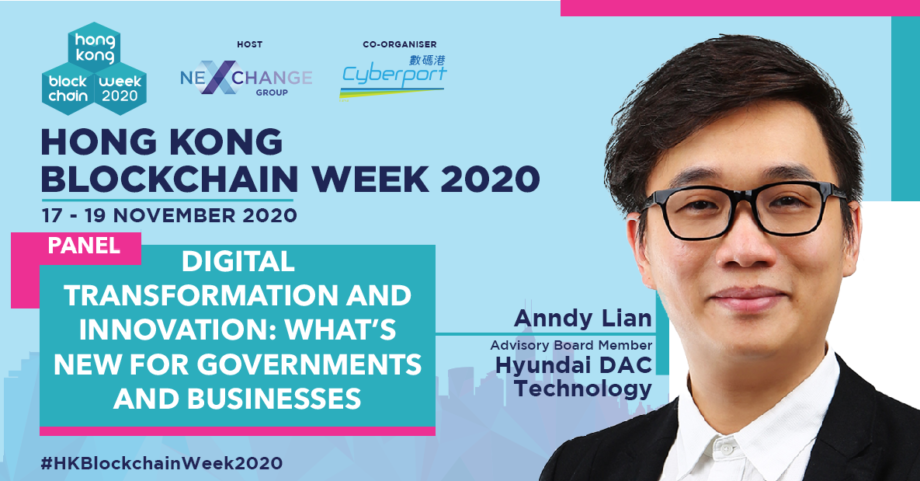
Anndy Lian and a panel of experts spoke on “Digital Transformation and Innovation: What’s New for Governments and Businesses” at the Hong Kong Blockchain Week 2020. This session is timely as COVID19 has accelerated the pace of digital transformation, decision-makers who were reluctant to adopt and adapt have harnessed technology innovation to keep their companies afloat, and governments are relying on digital solutions to respond quickly to the global crisis.

Digitalization has become essential and has brought up its real purpose in such times. According to ASME-Microsoft study 2020, 83% of small and medium enterprises (SMEs) in Singapore now have digital transformation strategies. More than half (54%) reported delays in their digitalization plans due to COVID-19. Also, despite higher digital transformation adoption, only two in five SMEs perceive their efforts to be successful. This study also coincides with what Olga Yaroshevsky, the moderator of this panel, has mentioned in global trends that only 30% of digital projects implemented have exceeded its target value.

“This is not alarming, and this trend has happened long before the COVID19 times. Governments and associations are trying hard to push the technology agenda into businesses. Legacy is not the main issue. It is an excuse. I think human interference is a bigger deferral for the adoption of new technology. “Anndy Lian, Advisory Board Member, Hyundai DAC Technology commented.

Lian added: “Whenever there is a new technology in place such as negativity, I do see much negativity that comes along with it. People do not see the positive aspects of things on such innovation. Many are too relying on government grants, which is a big disadvantage, for example. Take Singapore, for example. In the past decade, companies took advantage of the grants, but the result is that most of them stopped using it after the claims were made. This is mainly because of their mindset, and their starting point when obtaining the grant is not with the correct intention and purpose. For innovation to grow, it has to be a win-win for everybody, companies need to have the right mindset, and a good push from the government will kick start innovation in a much better manner.”

Dr. Toa Charm, Chairman, OpenCertHub & Associate, and Professor, CUHK Business School, agreed with Anndy’s point. “The subsidy is helpful but not sustainable. Companies must appreciate the digital transformation culture and appreciate the digital transformation. In the times of COVID19, governments have placed additional subsidies and grants to SMEs and different programs, but this is only for a short period and may not be sustainable. We have to make it closer to what the companies are doing, embedding the technology in our daily lives seamlessly.”

Last but not least, Anndy emphasized, “Digitalization has struck every government as a priority never before. The move into digital with AI, big data, automation, blockchain & cryptocurrencies will stay with us for a long time.”

This session consists of Anndy Lian, Advisory Board Member, Hyundai DAC Technology, Dr. Ernie Teo, Vice-Chairman, Blockchain Association Singapore, Mohammad Sear, Associate Partner, Digital Government & Public Sector Advisory, EY, Dr. Toa Charm, Chairman, OpenCertHub & Associate and Professor, CUHK Business School and moderated by Olga Yaroshevsky, NexChange Group. The panelists have also shared their insights on the subject matter, and the full recording can be found online at https://youtu.be/3aYJD6hkhKs.

Hong Kong Blockchain Week 2020, hosted by NexChange and led by their Chairman Juwan Lee delivers specialist content and expert discussions directly from industry leaders who are building the future of blockchain technology and digital assets. Professionals from all parts of the ecosystem, including investors, government, start-ups, and enterprises, come together for deep learning, robust discussions, and high-impact networking. This is the largest blockchain virtual event in Hong Kong will see the global blockchain community converge to discuss the latest developments and insights into the evolving, real-world applications of blockchain technology in finance, investment, enterprise, socially essential projects, and the global payment industry.

About Anndy Lian:
Anndy Lian is an early blockchain adopter and experienced serial blockchain entrepreneur known for his work in the government sector. He is a best-selling book author, “Blockchain Revolution 2030” and currently the Advisory Board Member of Hyundai DAC Technology. He plays a pivotal role as the Blockchain Advisor for Asian Productivity Organisation (APO), an intergovernmental organization committed to improving productivity in the Asia-Pacific region. Anndy is also part of the Gyeongsangbuk-do Blockchain Special Committee, the Government of Republic Korea with industry experts such as Brock Pierce. You can read more about Anndy’s work at www.anndy.com.

About Hong Kong Blockchain Week:
Hong Kong Blockchain Week 2020, 17-19 November, delivers specialist content and expert discussions directly from industry leaders who are building the future of blockchain technology and digital assets. Professionals from all parts of the ecosystem, including investors, government, start-ups, and enterprises, come together for deep learning, robust discussions, and high-impact networking. High profile speakers such as Dr. David Chung JP, Under Secretary for Innovation and Technology, Hong Kong; Dan Morehead, CEO & CO-CIO, Pantera Capital; Justin Sun, Founder, TRON & CEO, BITTORRENT; Roger Ver, Founder of BITCOIN.COM and Charles Hoskinson, CEO of IOHK & Founder of CARDANO were present

Anndy Lian is an early blockchain adopter and experienced serial entrepreneur who is known for his work in the government sector. He is a best selling book author- “NFT: From Zero to Hero” and “Blockchain Revolution 2030”.

Currently, he is appointed as the Chief Digital Advisor at Mongolia Productivity Organization, championing national digitization. Prior to his current appointments, he was the Chairman of BigONE Exchange, a global top 30 ranked crypto spot exchange and was also the Advisory Board Member for Hyundai DAC, the blockchain arm of South Korea’s largest car manufacturer Hyundai Motor Group. Lian played a pivotal role as the Blockchain Advisor for Asian Productivity Organisation (APO), an intergovernmental organization committed to improving productivity in the Asia-Pacific region.

An avid supporter of incubating start-ups, Anndy has also been a private investor for the past eight years. With a growth investment mindset, Anndy strategically demonstrates this in the companies he chooses to be involved with. He believes that what he is doing through blockchain technology currently will revolutionise and redefine traditional businesses. He also believes that the blockchain industry has to be “redecentralised”.

j j j