Building a Blockchain Ecosystem: Insights from Crypto Expo 2025

Building a Blockchain Ecosystem: Insights from Crypto Expo 2025

At the Crypto Expo 2025 held in Dubai, a dynamic panel discussion titled Building a Blockchain Ecosystem: Partnerships, Innovation, and Growth brought together industry leaders to explore the pivotal role of partnerships in advancing blockchain technology. Moderated by Anndy Lian, an intergovernmental blockchain advisor, the panel featured Hakim Bousba (Surge Group), Jehanzeb Awan (J. Awan & Partners), Mete AI (ICB Network), and Pratik Gauri (5ire). Their insights illuminated strategies for fostering collaboration, driving mass adoption, and addressing gaps in the blockchain ecosystem. This article synthesizes their perspectives, highlighting actionable strategies and visionary ideas for the future of blockchain.

The Power of Partnerships in Blockchain

The panel unanimously emphasized that partnerships are the backbone of a thriving blockchain ecosystem. Anndy Lian set the tone by sharing his experience as a former partnership chief at Bybit, where collaborations with global brands like Formula 1’s Red Bull and German soccer club Borussia Dortmund (BVB) yielded significant results. “Partnerships always stay very true to us,” Lian remarked, underscoring their enduring value despite market fluctuations.

Hakim Bousba highlighted partnerships as a gateway to mass adoption, particularly through sports and entertainment. He cited examples like Tezos’ collaboration with Red Bull and Chiliz’s partnerships with football clubs such as FC Barcelona and PSG, which leveraged fan bases to introduce crypto through NFTs and tokenized voting rights. Bousba also pointed to Binance’s efforts to integrate stablecoin trading with stock markets, predicting that such moves could attract traditional traders to crypto. “By attracting stock traders to the crypto markets, we can bring a lot of volume and users,” he noted.

Jehanzeb Awan offered a pragmatic perspective, stressing the need for partnerships to deliver mutual economic value. “Behind any strategic initiative, you have to understand why you’re trying to do that,” Awan cautioned, noting that many partnerships fail due to a lack of clear value propositions. He used a vivid analogy: “If I have 50 mangoes and you have 200 apples, I can either plant an apple tree or partner with you to get the apples.” Awan warned against superficial PR-driven partnerships, referencing a $900 million stadium naming deal that fizzled out, and urged a focus on sustainable, value-driven collaborations.

Mete AI emphasized ICB Network’s collaborative approach, particularly with educational institutions. “We are making so many collaborations with universities and ministries of education worldwide,” he said, detailing initiatives to tokenize certificates and KYC processes via NFTs. These partnerships aim to integrate blockchain into e-learning and identity verification, bridging Web2 and Web3 ecosystems. Mete’s vision underscores the potential for blockchain to transform traditional sectors through strategic alliances.

Pratik Gauri, whose 5ire platform champions sustainability, highlighted partnerships as critical for credibility and adoption. He shared 5ire’s collaborations with the World Economic Forum, the Nobel Peace Prize Forum, and the government of India, which trained over a million students in blockchain for free. “Partnerships play a massive role for adoption, credibility, and brand building,” Gauri stated, emphasizing their role in onboarding Web2 users to Web3.

Bridging Web2 and Web3: Strategies for Adoption

A recurring theme was the challenge of transitioning Web2 users to Web3, with panelists offering diverse strategies. Gauri argued that education is key to making Web3 accessible, particularly for retail investors intimidated by crypto’s volatility. “There needs to be an educational toolkit to bring legitimacy and credibility,” he said, advocating for partnerships with banks and governments to normalize crypto. He also noted the growing acceptance of central bank digital currencies (CBDCs) and crypto trading on major exchanges as catalysts for adoption.

Mete AI proposed practical solutions like using NFTs as event tickets to familiarize users with blockchain. “If we can use an NFT as a ticket, it changes a lot of minds,” he said, suggesting that such initiatives could spark curiosity and drive crypto usage. He also envisioned AI-driven education within metaverse platforms to teach blockchain concepts globally, targeting younger generations to build long-term adoption.

Awan took a contrarian view, arguing that expecting mass understanding of blockchain’s technicalities is unrealistic. “How many of you know how the internet works technically?” he asked the audience, drawing parallels to Web3 adoption. “Web3 has to get to a place where nobody thinks about it—you just use it.” Awan identified user interface (UI) simplicity as a critical factor, advocating for platforms that reduce interactions to “three clicks” to buy crypto. He also distinguished between retail and institutional investors, noting that the latter require robust hedging strategies absent in current crypto markets.

Bousba contextualized adoption within market cycles, observing that bull markets drive hype but often lack substance. “During a bear market, everybody is building; during a bull market, everybody is scared,” he said, stressing the need for education to sustain interest beyond market peaks. He also championed technical innovations like account abstraction (ERC-4337), which simplifies blockchain interactions by allowing key recovery and conditional phrases, making Web3 more user-friendly for non-technical users.

Lian reinforced the integration of Web3 into Web2 startup ecosystems. Drawing from his experience in Mongolia, where he advised policymakers, he noted surprise among officials at Web3’s potential. “Merge yourself with startup communities,” he advised, suggesting that demo days and startup events are fertile ground for preaching Web3’s benefits and fostering organic partnerships.

Gaps in the Ecosystem: Education, Regulation, and Trust

The panel identified critical gaps in the blockchain ecosystem, with education and regulation emerging as top priorities. Gauri lamented the lack of university partnerships, particularly in Southeast Asia, where young populations could drive adoption. “The awareness level of younger kids would go higher with university partnerships,” he said, criticizing reliance on influencers as misleading entry points.
Mete AI echoed the education gap, proposing AI as a solution to democratize blockchain knowledge. “With AI, we can educate everyone on blockchain,” he said, envisioning a future where AI-powered platforms teach NFT and crypto applications to kids, fostering a blockchain-literate generation.

Awan highlighted regulatory challenges, noting that regulators face a “lose-lose” scenario: strict rules stifle innovation, while lax ones risk scams. He advocated for balanced regulations that protect investors without stifling growth, citing the high costs of compliance as a barrier for startups. “If you’re not funded, you shouldn’t be in it,” he said, emphasizing the need for robust infrastructure to handle investor funds.

Bousba stressed the need for intra-industry partnerships among layer-1 (L1) and layer-2 (L2) blockchains to standardize technologies like account abstraction. “We need partnerships inside the blockchain industry,” he said, arguing that technical collaboration could streamline user experiences and accelerate adoption.

The Role of Influencers: Opportunity or Obstacle?

The panel debated the role of key opinion leaders (KOLs) and influencers in blockchain adoption. Bousba was skeptical, noting that many KOLs promote multiple projects daily, eroding credibility. “The audience is losing trust because influencers are just trying to make money,” he said, though he acknowledged that celebrities with reputational stakes could drive meaningful adoption.

Awan took a hardline stance, drawing from traditional finance. “If you promote coins that don’t do well or are rug pulls, you should end up in jail,” he asserted, advocating for regulatory oversight of influencer promotions. He distinguished memecoins, often driven by speculation, from utility-driven projects, warning against the “get-rich-quick” mentality.

Mete AI was critical of KOLs, accusing many of exploiting investors. “Mostly, KOLs get money to rob your money,” he said, though he acknowledged their role in memecoin and NFT markets, particularly in Asia. Gauri predicted a diminishing role for KOLs as adoption matures, comparing crypto to stock markets where informed investing reduces reliance on influencers. “Ten years down the line, the role would considerably decrease,” he said.

Lian offered a balanced view, recognizing both “good and bad” influencers. He noted the evolving regulatory landscape, referencing former President Trump’s framing of NFTs as collectibles, which could reshape influencer accountability.

Closing Thoughts: Community and Real-World Impact

In their final remarks, the panelists crystallized their visions for the blockchain ecosystem. Gauri emphasized scale, predicting a $10 trillion industry driven by large-scale partnerships. Mete AI urged startups to prioritize venture capital and blockchain collaborations over wasteful PR spending. Awan advocated for real-world use cases, citing stablecoin-enabled trade finance in Africa as a model for creating tangible value. Bousba saw crypto’s chaos as an opportunity, urging a safe yet innovative approach.

Lian concluded with a powerful reminder: “Community is the best partnership. Without people to use the tech, there will be no future.” His call to treasure communities resonated as a unifying theme, underscoring that partnerships—whether with governments, universities, or startups—must ultimately serve users to drive blockchain’s growth.

Conclusion

The Crypto Expo 2025 panel offered a roadmap for building a robust blockchain ecosystem through strategic partnerships, education, and user-centric innovation. From sports-driven mass adoption to AI-powered education and regulatory balance, the panelists’ insights provide a blueprint for bridging Web2 and Web3. As the industry evolves, their emphasis on community, credibility, and real-world impact will guide blockchain’s journey toward mainstream adoption.

 

Anndy Lian is an early blockchain adopter and experienced serial entrepreneur who is known for his work in the government sector. He is a best selling book author- “NFT: From Zero to Hero” and “Blockchain Revolution 2030”.

Currently, he is appointed as the Chief Digital Advisor at Mongolia Productivity Organization, championing national digitization. Prior to his current appointments, he was the Chairman of BigONE Exchange, a global top 30 ranked crypto spot exchange and was also the Advisory Board Member for Hyundai DAC, the blockchain arm of South Korea’s largest car manufacturer Hyundai Motor Group. Lian played a pivotal role as the Blockchain Advisor for Asian Productivity Organisation (APO), an intergovernmental organization committed to improving productivity in the Asia-Pacific region.

An avid supporter of incubating start-ups, Anndy has also been a private investor for the past eight years. With a growth investment mindset, Anndy strategically demonstrates this in the companies he chooses to be involved with. He believes that what he is doing through blockchain technology currently will revolutionise and redefine traditional businesses. He also believes that the blockchain industry has to be “redecentralised”.

j j j

Panel Discussion at Crypto Expo Asia 2023: The Institutionalisation of Blockchain Staking

Panel Discussion at Crypto Expo Asia 2023: The Institutionalisation of Blockchain Staking

In a panel discussion titled “The Institutionalization of Blockchain,” experts gathered to delve into the topics of blockchain decentralization, the future of Ethereum, and self-regulating technologies. Moderated by Anndy Lian, author of the book “NFT from Zero to Hero,” the panelists shared their insights on these critical subjects. Panelists included Anuj Shankar, CEO (Luganodes); Igneus Terrenus, Head of Communications and Business Development (Mantle Network by BitDAO); Ken Nizam, Founder & CEO (AsiaTokenFund Group); and Zhuling Chen, CEO (RockX).

The panel discussion commenced with a focus on how institutional investors can effectively manage risks when participating in blockchain staking. Ken emphasized the significance of conducting due diligence on the network’s security and governance. He stressed the importance of understanding the team behind the network and its track record in terms of security and resilience. Additionally, Ken highlighted the need for diversification, where institutions choose multiple staking providers to mitigate overall risk. Regulatory compliance was also deemed crucial, with staying updated on the latest regulations being a recommended practice.

Zhuling Chen added that institutional investors must comprehend the fundamental risks associated with crypto staking. These risks include crypto market volatility, network security, and platform safety. He mentioned the potential benefits of employing custodian services as an extra layer of protection, especially for those new to the crypto space. Insurance coverage was also suggested as a means to safeguard assets from hacks or loss.

Igneous Terraneans reiterated the notion that staking is an active contribution to the network’s security. It involves working to secure the network rather than merely earning passive income. Trust in the network’s robustness and team, as well as the proper management of rewards and counterparty risks, were highlighted as critical considerations. Diversification was mentioned as a prudent strategy, particularly for institutional investors with substantial assets.

The conversation then shifted towards zero trust and zero knowledge mechanisms and their applicability to institutional investors. Anndy Lian pointed out that staking is comparable to mining in the proof-of-work world, where physical machines secure the network. Staking, on the other hand, represents a virtual mining process, utilizing tokens and servers to safeguard the network. It was noted that institutions, especially those familiar with mining Bitcoin, may find it easier to understand staking as a form of fixed income derived from the network itself.

The panelists acknowledged that zero trust and zero knowledge principles lie at the core of blockchain technology, offering decentralized and trustless systems. While these mechanisms are not infallible, they are steadily improving, and teams are actively building on them. The power shift from centralized authorities to decentralized systems aligned with the ethos of blockchain. Institutions were encouraged to participate in these systems, contributing to a more distributed and secure network.

To facilitate broader institutional participation, the panelists stressed the need for simplicity in the staking process. Anuj from Luganotes highlighted the technical complexities involved in setting up and maintaining validators. While staking presents significant security considerations, it is crucial to streamline the process for institutional validators, especially newcomers to the space. Simplification would aid mass adoption and allow individuals without extensive technical knowledge to participate.

The panel discussion shed light on essential considerations for institutional investors. Risk management, due diligence, diversification, regulatory compliance, and custodian services were highlighted as crucial elements in managing risks effectively. The panelists emphasized the active role of staking in securing the network and discussed the importance of zero trust and zero knowledge mechanisms. Ultimately, the experts agreed that simplicity and security should be prioritized to encourage broader institutional participation in staking and contribute to the growth and decentralization of blockchain networks.

Crypto Expo Asia 2023 is a premier virtual asset and Blockchain Conference, organized by HQMena announced in Singapore 2023 with its large audience attending globally. Over 100+ Crypto companies are expected to participate in this event, with an estimated 3000+ attendees, Featured conference with 60+ Speakers, and many attendees from 30+ Countries.

Socials:

Facebook: http://www.facebook.com/anndylian
Twitter: http://www.twitter.com/anndylian
Instagram: http://www.instagram.com/liananndy
LinkedIn: https://www.linkedin.com/in/anndylian/
Homepage: http://www.anndy.com
YouTube: https://www.youtube.com/@AnndyLian

Anndy Lian is an early blockchain adopter and experienced serial entrepreneur who is known for his work in the government sector. He is a best selling book author- “NFT: From Zero to Hero” and “Blockchain Revolution 2030”.

Currently, he is appointed as the Chief Digital Advisor at Mongolia Productivity Organization, championing national digitization. Prior to his current appointments, he was the Chairman of BigONE Exchange, a global top 30 ranked crypto spot exchange and was also the Advisory Board Member for Hyundai DAC, the blockchain arm of South Korea’s largest car manufacturer Hyundai Motor Group. Lian played a pivotal role as the Blockchain Advisor for Asian Productivity Organisation (APO), an intergovernmental organization committed to improving productivity in the Asia-Pacific region.

An avid supporter of incubating start-ups, Anndy has also been a private investor for the past eight years. With a growth investment mindset, Anndy strategically demonstrates this in the companies he chooses to be involved with. He believes that what he is doing through blockchain technology currently will revolutionise and redefine traditional businesses. He also believes that the blockchain industry has to be “redecentralised”.

j j j

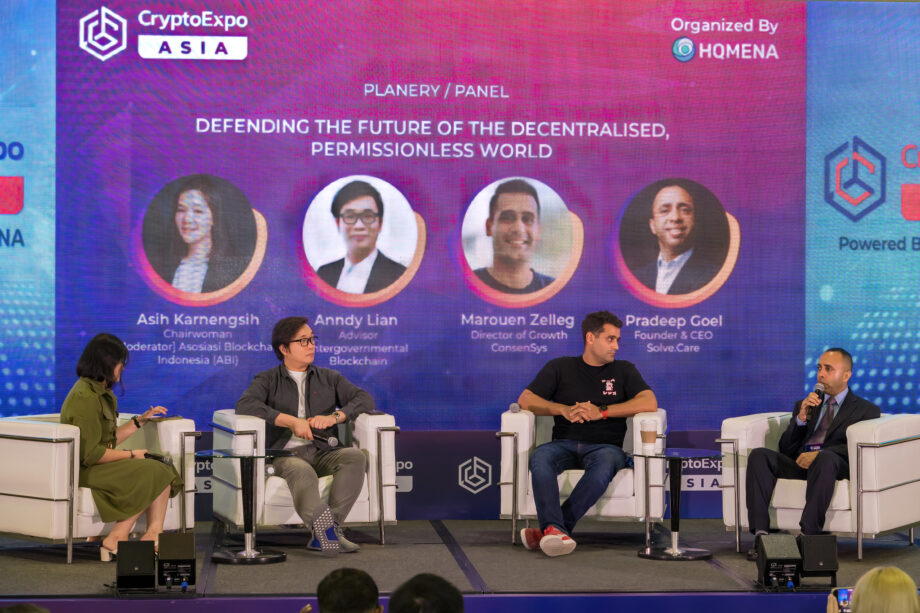
Crypto Expo Asia Panel Discussion: Defending the Future of the Decentralised, Permissionless World

Crypto Expo Asia Panel Discussion: Defending the Future of the Decentralised, Permissionless World

Topic- Defending the Future of the Decentralised, Permissionless World

Crypto Expo Asia, 7-8th June 2023, Singapore

Moderator- Asih Karnengsih, Chairwoman (Asosiasi Blockchain Indonesia)

Panelists:
– Anndy Lian (Intergovernmental Blockchain Advisor)
– Marouen Zelleg, Director of Growth (ConsenSys)
– Pradeep Goel, Founder & CEO (Solve.Care)

Crypto Expo Asia 2023 is a premier virtual asset and Blockchain Conference, organized by HQMena announced in Singapore 2023 with its large audience attending globally. Over 100+ Crypto companies are expected to participate in this event, with an estimated 3000+ attendees, Featured conference with 60+ Speakers, and many attendees from 30+ Countries.

One of the key discussions we have lined up is focused on “Defending the Future of the Decentralized Permissionless World.” This panel discussion brings together experts from different backgrounds to share their perspectives. The panelists include Asih Karnengsih, the moderator, Chairwoman of the Asosiasi Blockchain Indonesia; Anndy Lian, NFT from Zero to Hero book author; Marouen Zelleg, Director of Growth at ConsenSys, and Pradeep Goel, Founder and CEO of Solve Care.

Pradeep Goel emphasized the importance of user-centric security in the blockchain industry. He highlighted the challenges faced by users, especially in regulated industries such as healthcare. According to him, user-friendly solutions that protect identities, assets, and roles are crucial for driving adoption. Pradeep stressed the need for a holistic approach to security that combines nuanced identity management, asset protection, and role-based access.

Marouen Zelleg spoke about his commitment to decentralization. He shared his personal experiences from Tunisia, a country known for its centralized bureaucracy, and the limitations it imposes on individuals and businesses. Marwan expressed his passion for blockchain technology’s potential to transform economies and people’s lives. Consensus, through its software solutions, contributes to this mission by enabling developers to build on the blockchain.

Anndy Lian highlighted his role in advising companies and governments on blockchain adoption. He emphasized the importance of educating governments about the potential of blockchain technology and its benefits. Andy also mentioned his book, “NFT from Zero to Hero,” where he aims to educate people about decentralization and its implications.

The panelists further discussed the role of security in the decentralized world. Pradeep emphasized the significance of tying identity, assets, and roles together to provide a secure user experience. Marouen highlighted the need for a balance between security and decentralization. He drew parallels with the traditional taxi system, showcasing how decentralization can provide security and safety without relying on centralized entities. Anndy emphasized the role of artificial intelligence and blockchain analytics in enhancing security measures.

The conversation also touched upon the involvement of governments in the blockchain space. Anndy shared insights into the diverse perspectives of governments, ranging from concerns about regulation and taxation to promoting innovation and harnessing blockchain’s potential. He mentioned the increasing interest of governments in regulating aspects like wallets and monitoring crypto activities.

The panelists concluded that the implementation of blockchain technology in traditional institutions varies based on use cases and regulatory environments. While some institutions explore blockchain to revamp their infrastructure and benefit from quicker settlement times, others aim to cater to customer demands, such as providing crypto-related services within existing banking systems.

Socials:

Facebook: http://www.facebook.com/anndylian
Twitter: http://www.twitter.com/anndylian
Instagram: http://www.instagram.com/liananndy
LinkedIn: https://www.linkedin.com/in/anndylian/
Homepage: http://www.anndy.com
YouTube: https://www.youtube.com/@AnndyLian


Anndy Lian is an early blockchain adopter and experienced serial entrepreneur who is known for his work in the government sector. He is a best selling book author- “NFT: From Zero to Hero” and “Blockchain Revolution 2030”.

Currently, he is appointed as the Chief Digital Advisor at Mongolia Productivity Organization, championing national digitization. Prior to his current appointments, he was the Chairman of BigONE Exchange, a global top 30 ranked crypto spot exchange and was also the Advisory Board Member for Hyundai DAC, the blockchain arm of South Korea’s largest car manufacturer Hyundai Motor Group. Lian played a pivotal role as the Blockchain Advisor for Asian Productivity Organisation (APO), an intergovernmental organization committed to improving productivity in the Asia-Pacific region.

An avid supporter of incubating start-ups, Anndy has also been a private investor for the past eight years. With a growth investment mindset, Anndy strategically demonstrates this in the companies he chooses to be involved with. He believes that what he is doing through blockchain technology currently will revolutionise and redefine traditional businesses. He also believes that the blockchain industry has to be “redecentralised”.

j j j