ZachXBT Highlights Aster’s Ties to ‘Known Grifters’ Wynn and Shillin Amid Wash-Trading Fallout

ZachXBT Highlights Aster’s Ties to ‘Known Grifters’ Wynn and Shillin Amid Wash-Trading Fallout

Blockchain investigator ZachXBT has criticized defenders of the decentralized exchange Aster amid growing concerns that the platform is inflating its trading volumes through wash trading.

The on-chain sleuth also highlighted the project’s connections to “known grifters,” including James Wynn and Alex “Shillin_Villain,” calling these associations the worst move Aster has made so far.

ZachXBT vs. Anndy Lian

ZachXBT’s comments followed remarks from Singaporean economist Anndy Lian, who defended the exchange and claimed that “all crypto projects have washed trades,” arguing such practices are commonplace in the industry.

“All crypto projects have washed trades. Only those that did not make it are not washed. No one is a saint here. Also, it depends on how much is washed,” Lian wrote on X.

Wash trading occurs when a trader or automated system simultaneously buys and sells the same asset to create the illusion of high trading volume, misleading investors about market liquidity and activity.

In response, ZachXBT wrote, “Such an awful take—normalizing wash trading is bad for the industry.”


He also questioned Lian’s claim of being “an observer,” suggesting bias in his commentary.

ZachXBT shared screenshots showing that Lian had written “zero posts about HYPE and only two posts mentioning Hyperliquid,” while “almost every other post is about Aster,” implying a lack of neutrality.

ZachXBT Calls Out Grifters

ZachXBT further alleged that Aster’s collaboration with “known grifters” in its promotional efforts was “the worst thing” the project could have done. He specifically named crypto traders Wynn and Shillin.

James Wynn, a pseudonymous trader, gained notoriety earlier this year for making massive leveraged bets on perpetual futures exchanges such as Hyperliquid.

His high-risk strategies attracted a large online following but also criticism after several well-documented liquidations reportedly wiped out most of his holdings.

Wynn has also faced accusations of promoting speculative tokens and memecoins without disclosing his potential financial interests.

“Shillin Villain,” another pseudonymous influencer, derives his name from the crypto slang term “shilling,” meaning the undisclosed promotion of a project for personal gain.

Aster’s DefiLlama Delisting

The controversy follows Aster’s delisting from data aggregator DefiLlama amid concerns about potential wash trading.

On Sunday, Oct. 5, DefiLlama’s founder, 0xngmi, wrote on X that the platform’s investigation had found Aster’s trading volumes “starting to mirror Binance perp volumes almost exactly.”

The founder shared charts showing Aster’s volume patterns, closely tracking Binance’s perpetuals market from late Saturday through Sunday.

“Aster doesn’t make it possible to get lower-level data such as who is making and filling orders. Until we can verify if there’s wash trading, Aster’s perpetuals will be delisted,” 0xngmi wrote.


Source: https://www.ccn.com/news/crypto/zachxbt-highlights-asters-grifters-wynn-shillin-wash-trading-fallout/

Anndy Lian is an early blockchain adopter and experienced serial entrepreneur who is known for his work in the government sector. He is a best selling book author- “NFT: From Zero to Hero” and “Blockchain Revolution 2030”.

Currently, he is appointed as the Chief Digital Advisor at Mongolia Productivity Organization, championing national digitization. Prior to his current appointments, he was the Chairman of BigONE Exchange, a global top 30 ranked crypto spot exchange and was also the Advisory Board Member for Hyundai DAC, the blockchain arm of South Korea’s largest car manufacturer Hyundai Motor Group. Lian played a pivotal role as the Blockchain Advisor for Asian Productivity Organisation (APO), an intergovernmental organization committed to improving productivity in the Asia-Pacific region.

An avid supporter of incubating start-ups, Anndy has also been a private investor for the past eight years. With a growth investment mindset, Anndy strategically demonstrates this in the companies he chooses to be involved with. He believes that what he is doing through blockchain technology currently will revolutionise and redefine traditional businesses. He also believes that the blockchain industry has to be “redecentralised”.

j j j

Trump’s Fed firing threat shakes markets: A deep dive into the economic fallout

Trump’s Fed firing threat shakes markets: A deep dive into the economic fallout

The most striking development in this saga is the report that President Trump drafted a letter to fire Federal Reserve Chair Jerome Powell and shared it with House Republicans during a private meeting.

This move, if true, signals a potential escalation in Trump’s long-standing frustration with Powell, whom he has criticised for not aligning Fed policies, particularly interest rate decisions, with his economic agenda. Sources indicate that Trump sought input from the lawmakers, many of whom reportedly supported the idea of ousting Powell.

However, Trump later walked back these reports, stating he’s “not planning on doing anything” and deeming it “highly unlikely” he would fire Powell unless there were extreme circumstances like fraud. He even denied drafting the letter, despite earlier accounts suggesting otherwise.

This episode is more than just political theatre. It raises serious questions about the independence of the Federal Reserve, a cornerstone of US economic stability. The Fed’s autonomy allows it to make monetary policy decisions based on data and long-term economic health, free from short-term political pressures.

If Trump were to follow through on such a threat, it could erode confidence in the Fed’s ability to act impartially, potentially destabilising financial markets and undermining the US dollar’s global standing.

Even the mere suggestion of such an action has already sparked volatility, as markets grapple with the uncertainty of a politically influenced central bank. Trump’s history of clashing with Powell, particularly over his desire for lower interest rates to stimulate growth, adds context to this tension; however, the draft letter, if it exists, marks a bold step toward direct intervention.

On the economic front, several key indicators provide additional layers to this story. US producer prices (PPI) in June 2025 remained flat, missing expectations of a 0.2 per cent increase after a revised 0.3 per cent rise in May. This stagnation was driven by a 0.1 per cent dip in service prices, highlighted by a sharp 4.1 per cent drop in traveler accommodation costs, offset by a 0.3 per cent rise in goods prices, the largest since February, fuelled by an 0.8 per cent jump in communication equipment.

Flat producer prices suggest that inflationary pressures may be cooling at the wholesale level, which could ease some of the Fed’s concerns about overheating. However, this comes on the heels of a hotter-than-expected consumer price index (CPI) reading earlier in the week, creating a mixed inflation picture that complicates the Fed’s next moves.

Across the Atlantic, UK inflation rose to 3.6 per cent in June 2025, the highest level since January 2024, up from 3.4 per cent in May and exceeding forecasts. This spike was primarily driven by a 1.7 per cent increase in transport costs, with motor fuel, airfares, rail fares, and vehicle maintenance all contributing. Rising UK inflation could pressure the Bank of England to tighten monetary policy, potentially strengthening the pound and influencing global capital flows.

Meanwhile, US industrial production rose 0.3 per cent in June, surpassing expectations of a 0.1 per cent gain after two flat months. Manufacturing edged up 0.1 per cent, while utilities surged 2.8 per cent, boosted by a 3.5 per cent rise in electricity generation. This resilience in industrial activity signals underlying economic strength, though trade tensions and tariffs could pose risks to sustained growth.

Equities: A relief rally in the US, struggles elsewhere

The equity markets have responded swiftly to the Trump-Powell saga. In the US, stocks closed higher on Wednesday after Trump quelled fears of removing Powell, offering a soothing balm to investors rattled by earlier reports. The S&P 500 climbed 0.3 per cent, the Dow Jones Industrial Average gained 231 points, and the Nasdaq 100 rose 0.1 per cent to a record close.

This uptick reflects a relief rally, as markets had dipped earlier on concerns that Powell’s ouster could disrupt monetary policy stability and exacerbate inflation and trade worries. The flat PPI data also helped calm nerves after Tuesday’s hotter CPI reading, suggesting that inflationary pressures might not be as intense as feared.

On the corporate side, results were mixed: Goldman Sachs rose one per cent after beating profit estimates, while Johnson & Johnson soared 6.2 per cent on strong earnings and an upgraded outlook. In contrast, Bank of America fell 0.3 per cent on weak revenue, and Morgan Stanley dropped 1.3 per cent despite solid earnings.

In Europe, however, the mood was less upbeat. Frankfurt’s DAX slipped 0.2 per cent to 24,048, marking its fifth consecutive loss amid trade uncertainty and disappointing earnings. Hopes for a softer tariff deal faded as Trump renewed threats to expand tariffs to pharmaceuticals and semiconductors by August 1 under his “reciprocal” tax plan.

The EU Trade Commissioner, Maros Sefcovic, is set to visit Washington to negotiate the US’s proposed 30 per cent tariff, underscoring the high stakes for European exporters. Automakers bore the brunt of the decline, with Volkswagen down 3.7 per cent, Porsche AG off three per cent, and Mercedes-Benz losing 1.9 per cent. Chemical distributor Brenntag also fell 2.6 per cent after a Deutsche Bank downgrade. These losses highlight how Trump’s trade policies are casting a long shadow over European markets.

In Hong Kong, the Hang Seng Index fell 0.3 per cent to 24,518, snapping a four-day winning streak after hitting a four-month high earlier in the session. Traders took profits as US futures weakened following June inflation data, which hinted that tariffs might be pushing prices higher and reducing expectations for Fed rate cuts.

Trump’s signals of potential tariffs on pharmaceuticals by the end of July, with semiconductors possibly next, added further pressure. Notable losers included Pop Mart International (-4.3 per cent), Zhejiang Leapmotor Tech (-3.0 per cent), KE Holdings (-2.7 per cent), and China Longyuan Power (-2.5 per cent). The pullback reflects broader concerns about how US trade policy could disrupt Asian markets, particularly those tied to global supply chains.

FX: Dollar volatility and global currency shifts

The foreign exchange market has been a rollercoaster amid these developments. The US dollar (USD) initially dipped on reports that Trump might fire Powell, as investors worried about the implications for Fed independence and continuity of monetary policy. The dollar index (DXY) fell below 98.40, reflecting this unease.

However, the USD rebounded after Trump denied the claims, and the soft PPI data bolstered confidence that inflation might remain in check. This recovery underscores the dollar’s sensitivity to both political headlines and economic fundamentals.

The euro (EUR) capitalised on the dollar’s early weakness, briefly rising above US$1.17, but later pared its gains as Powell-related uncertainty lingered, settling around US$1.1630. The British pound (GBP) strengthened to above 1.34, buoyed by the softer dollar and a temporary lift from UK inflation data, which hinted at potential Bank of England action.

In Japan, the yen weakened against the dollar, with USDJPY climbing to 148.20, as exports fell 0.5 per cent year-over-year in June, missing expectations of a 0.5 per cent gain. This decline was driven by an 11.4 per cent drop in exports to the US and a 4.7 per cent fall to China, though exports to the EU rose 3.6 per cent. Imports, meanwhile, rose 0.2 per cent year-over-year, defying forecasts of a 1.1 per cent drop. These trade figures highlight the challenges facing export-driven economies amid global trade tensions.

Commodities mixed, yield curve steepens

In the commodities space, gold rose, snapping a two-day slide, as investors sought safety amid the uncertainty surrounding Powell. The metal surged as much as 1.6 per cent before trimming gains after Trump’s denial, reflecting its role as a haven asset. Oil edged higher after a three-day slide, with West Texas Intermediate (WTI) near US$67 and Brent below US$69, driven by mixed US inventory data. Crude stockpiles fell, but distillate inventories rose, amid ongoing trade war concerns.

In the bond market, the spread between 5-year and 30-year US Treasury yields widened to 108 basis points, the steepest since 2021. This steepening yield curve could signal expectations of stronger growth and higher inflation ahead, though it may also reflect uncertainty about the Fed’s future path under political scrutiny.

Cryptocurrencies: Bitcoin and Ethereum in focus

Bitcoin (BTC-USD) is consolidating below US$120,000 after hitting an all-time high of US$123,091 earlier in the week, closing flat at US$118,600. A bearish engulfing candle and declining volume, from US$180 billion on July 14 to below US$100 billion by July 15, suggest market indecision. Support sits at US$117,000, with a potential drop to US$114,400-US$112,000 if breached. Despite this, spot Bitcoin ETF inflows surged to US$799 million on Wednesday, signalling robust long-term demand.

Ethereum (ETH-USD) soared 15 per cent in three days after Peter Thiel disclosed a 9.1 per cent stake in BitMine, a crypto miner holding 164,000 Ether worth US$500 million. This news has electrified the crypto space, underscoring growing institutional interest.

My take: Implications and outlook

Recent developments indicate that we are at a pivotal moment in the global economy. Trump’s suggestion of firing Powell raises concerns about the independence of the Federal Reserve, a move that could lead to long-term market instability if it were to occur.

The current mixed economic signals from flat US Producer Price Index (PPI) and rising inflation in the UK, to solid industrial production, suggest that the global economy is in a state of flux, with unpredictable trade policies adding to the uncertainty.

In the US, equities show resilience, while other markets exhibit vulnerabilities. The fluctuations in the dollar underscore its crucial role in global finance. Commodities and cryptocurrencies present both opportunities and risks, with gold and Ethereum standing out amid this uncertainty.

Looking ahead, the relationship between politics and economic policy will be vital. If Trump decides to back off, the markets may stabilise; however, any renewed pressure could lead to increased volatility.

Key economic data releases, such as US retail sales and the Eurozone Consumer Price Index (CPI), will further influence the situation. For now, the world is watching closely, and I will continue to analyse the data to provide a clear perspective on what lies ahead.


Source: https://e27.co/trumps-fed-firing-threat-shakes-markets-a-deep-dive-into-the-economic-fallout-20250718/

Anndy Lian is an early blockchain adopter and experienced serial entrepreneur who is known for his work in the government sector. He is a best selling book author- “NFT: From Zero to Hero” and “Blockchain Revolution 2030”.

Currently, he is appointed as the Chief Digital Advisor at Mongolia Productivity Organization, championing national digitization. Prior to his current appointments, he was the Chairman of BigONE Exchange, a global top 30 ranked crypto spot exchange and was also the Advisory Board Member for Hyundai DAC, the blockchain arm of South Korea’s largest car manufacturer Hyundai Motor Group. Lian played a pivotal role as the Blockchain Advisor for Asian Productivity Organisation (APO), an intergovernmental organization committed to improving productivity in the Asia-Pacific region.

An avid supporter of incubating start-ups, Anndy has also been a private investor for the past eight years. With a growth investment mindset, Anndy strategically demonstrates this in the companies he chooses to be involved with. He believes that what he is doing through blockchain technology currently will revolutionise and redefine traditional businesses. He also believes that the blockchain industry has to be “redecentralised”.

j j j

Cardano futures: ADA price pressure to persist amid FTX fallout

Cardano futures: ADA price pressure to persist amid FTX fallout

The recent FTX crisis has caused a whirl in the crypto world with many investors pulling out their assets from the market that’s already dominated by bearish sentiment.

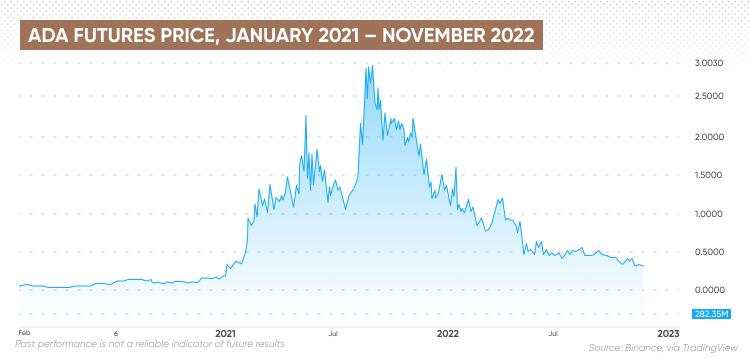
Cardano’s ADA, has been on a bear run in 2022, losing over 89.8% of its gains since the all-time high of $2.9706 on 3 September 2021 to $0.3032 on 21 November 2021.

How do Cardano futures work and where could the cardano futures price be headed? Read on…

What are cardano futures?

Cryptocurrency futures are contracts between two parties that are betting on the future price of a digital asset. When traders purchase a cryptocurrency’s futures contract, they gain exposure without owning the underlying coin, agreeing to pay a certain price for the asset in future. When the futures contract expires, however, the trader has to settle it – in other words, they buy the coin.

The Cardano blockchain was launched in 2017 as a third-generation cryptocurrency platform. It has a Proof-of-Stake (PoS) consensus mechanism and was designed to be a more scalable, sustainable and interoperable version of Ethereum. For this reason, the blockchain’s supporters labelled Cardano the “Ethereum killer”.

In September 2021, Cardano gained smart contract capability, allowing for the creation of decentralised apps (dApps), non-fungible tokens (NFTs), games, new cryptocurrencies and more.

ADA is the blockchain’s native cryptocurrency named after the 19th century mathematician Ada Lovelace. The coins are used as a secure exchange of value and to pay for transaction fees

Cardano futures, therefore, are contracts between two parties that have agreed to buy and sell a specific amount of ADA at a specified price. Cardano futures are often known as Cardano perpetual futures or cardano perpetual swaps.

Traders who purchase ADA futures are betting that the price of the cryptocurrency will surge in the future. If that happens, they will profit from the price increase. If the price of Cardano falls, however, they will lose money.

Cardano futures history

Cardano futures started trading on Binance at the end of January 2021. They enjoyed bullish momentum, jumping by more than 4,100% between January and May 2021. The surge came as Cardano continued development of its smart contract capabilities and launched a peer-to-peer testnet to a small group of users.

After a slight dip in July 2021, the ADA futures price climbed to the all-time high of $2.9706 on 3 September 2021. The rally came ahead of the blockchain’s Alonzo hard fork, which introduced smart contract capabilities to Cardano.

ADA futures price, January 2021 – November 2022

Following the bull run, the ADA futures contract dipped by more than 35% by 27 October 2021 and continued on a downward trend.

Cardano futures price fell  to $0.3032 on 21 November 2022 amid negative market sentiment. The recent news on the downfall of the FTX crypto exchange and its native FTT  token added to the bearish price action.

What is driving cardano futures?

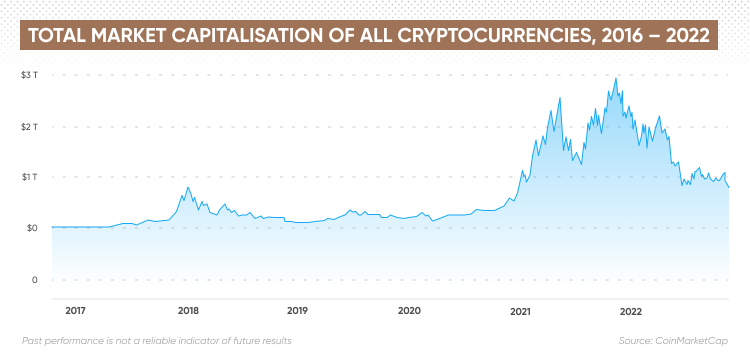
The collapse of the FTX crypto exchange affected many major cryptocurrencies, cooling investor sentiment. CoinMarketCap data showed that the total cryptocurrency market capitalisation fell below $800bn on 11 November, when FTX filed for Chapter 11 bankruptcy, the lowest level since early 2021.

Total market capitalisation of all cryptocurrencies, 2016 – 2022

“Although aftereffects of the FTX shock will still likely surface at some point and the industry will have to adopt more financially transparent operation and come under stricter regulatory oversight, the worst part may have passed,” Bitbank crypto market analyst Yuya Hasegawa said in his weekly view.

Meanwhile, the Cardano blockchain saw a spike in activity between 9 and 14 November as the number of new addresses on the blockchain surged from 0 to 11,240, according to data on Cardano Blockchain Insights.

The network, however, had seen a surge in the number of transactions on 8 November, which surpassed 391,000 as FTX crashed.

Cardano’s founder, Charles Hoskinson, said in a live YouTube stream on 9 November:

“I think this might be the bottom, one of the last ones to deal with. It’s going to be hard to predict how bad it will be, and it could certainly potentially be very bad. There are not many more firms that were like FTX or Alameda or like, Three Arrows Capital, and so forth. At least in this cycle, I truly do hope that this is the last cycle of this nature.”

In other cardano futures news, Hoskinson told CoinDesk on 18 November that Cardano is looking to launch a new privacy blockchain and digital asset which he stated to be something “the enterprise absolutely wants”.

Cardano futures price prediction for 2023 and beyond

Algorithm-based prediction websites did not provide cardano futures forecasts, so let’s have a look at the latest ADA/USD outlook.

In line with the latest downward price action, algorithm-based forecasting service Wallet Investor gave a bearish ADA price prediction at the time of writing (21 November) noting that ADA was “a bad long-term investment”.

Based on its analysis of past price performance, Wallet Investor predicted that the token could fall to $0.01016  in 2023. The site did not provide an ADA price prediction for 2027.

DigitalCoinPrice, on the other hand, gave a bullish ADA to USD price prediction expecting the token to grow to $0.39 by the end of 2022 and reach $1.30 on average in 2025. By 2027, the site predicted that the price of ADA tokens could reach $1.59. Its long-term token forecast showed the cryptocurrency reaching $4.35 by 2030.

Meanwhile,  Anndy Lian, the chief digital advisor at the Mongolian Productivity Organisation and author of ‘NFT: From Zero to Hero’, told Capital.com that mid-term technical indicators looked bearish (as of 21 November). He added:

“Sellers’ pressure increases in the cardano market. I hope the longer term potential factors like Midnight and USDA can change things for the better.”

News that the group behind Cardano, Input Output Global, is planning to release a new privacy-focused blockchain could have a potential effect on ADA futures, Lian added in his cardano futures price prediction.

In addition, the launch of USDA, the first fully fiat-backed regulated stablecoin on Cardano, will start trading in early 2023, could lead to a hike in the cardano futures price.

“If executed well, I see this will help ADA decentralised finance ecosystem, thus bringing in more liquidity and support into the network,” Lian added.

Final thoughts

Remember, analysts’ and algorithm-based predictions can be wrong. If you’re considering entering the cardano futures market, we recommend you always conduct your own due diligence, looking at the latest news, a wide range of analyst commentary, technical and fundamental analysis. Note that past performance does not guarantee future returns and cryptocurrency markets remain extremely volatile. And never trade money you cannot afford to lose.


Source: https://capital.com/cardano-futures-price-prediction-ada

Anndy Lian is an early blockchain adopter and experienced serial entrepreneur who is known for his work in the government sector. He is a best selling book author- “NFT: From Zero to Hero” and “Blockchain Revolution 2030”.

Currently, he is appointed as the Chief Digital Advisor at Mongolia Productivity Organization, championing national digitization. Prior to his current appointments, he was the Chairman of BigONE Exchange, a global top 30 ranked crypto spot exchange and was also the Advisory Board Member for Hyundai DAC, the blockchain arm of South Korea’s largest car manufacturer Hyundai Motor Group. Lian played a pivotal role as the Blockchain Advisor for Asian Productivity Organisation (APO), an intergovernmental organization committed to improving productivity in the Asia-Pacific region.

An avid supporter of incubating start-ups, Anndy has also been a private investor for the past eight years. With a growth investment mindset, Anndy strategically demonstrates this in the companies he chooses to be involved with. He believes that what he is doing through blockchain technology currently will revolutionise and redefine traditional businesses. He also believes that the blockchain industry has to be “redecentralised”.

j j j