
How upcoming CPI data could influence fed policy and cryptocurrency prices

How upcoming CPI data could influence fed policy and cryptocurrency prices

Key points:

– Federal Reserve’s Caution: The Fed, led by Powell, holds rates steady, awaiting CPI data. Strong labor market and slightly high inflation delay rate cut expectations to mid-year.
– Market Shifts: US Treasuries sold off; 10-year yields hit 4.54%, 2-year at 4.28%. US Dollar Index fell 0.3%, gold steady at US$2,900/oz. Consumer staples up 0.9%, Asian markets down.
– Energy Risks: Brent crude rose 1.5% after US inventory increase, but sanctions on Russian oil exports add geopolitical uncertainty.
– Crypto Challenges: Bitcoin at US$97,053.0, down slightly due to tariffs, CPI wait. High US rates pressure crypto; World Liberty Financial’s token reserve aims to stabilize.
– Investment Outlook: Fed caution, trade disputes boost gold, consumer staples. Cryptocurrencies resilient, CPI data key for future strategies.

I watched closely monitoring the global economic landscape and the recent developments, particularly the Federal Reserve’s cautious approach to monetary policy, which provided a compelling narrative regarding the nuanced relationship between central bank decisions, investor sentiment, and the burgeoning sector of digital currencies.

On February 12, 2025, the atmosphere surrounding global risk was notably cautious, a direct consequence of Federal Reserve Chair Jerome Powell’s recent comments suggesting a period of patience before further interest rate reductions would be considered. This stance has set the stage for investors now eagerly awaiting the release of the upcoming Consumer Price Index (CPI) data, which could offer critical insights into inflation trends, potentially influencing the Fed’s next steps in monetary policy.

The Federal Reserve’s choice to maintain current interest rates is a calculated move, aiming to observe more concrete advancements in reducing inflation before taking action. This decision is set against a backdrop where the labor market remains strong, and inflation, while trending downward, still slightly exceeds the Fed’s target.

It’s understandable, therefore, that market participants have adjusted their forecasts, now anticipating a potential rate cut, perhaps not until mid-year. This shift in expectation was reflected in market movements on Tuesday, where US Treasuries saw a sell-off across various maturities, with the yield on the 10-year Treasury note increasing by 3.9 basis points to 4.54 per cent and the two year note by 0.9 basis points to 4.28 per cent. These yield changes indicate that while money markets still anticipate one rate cut by the Fed this year, the timing has become less certain.

The US Dollar Index experienced a modest decrease of 0.3 per cent, signalling a consolidation phase as the market absorbs the implications of the Fed’s policy direction. Traditionally viewed as a refuge during times of uncertainty, gold held steady near US$2,900 per ounce, demonstrating its resilience despite the Fed’s indication of no immediate rate adjustments.

In the energy market, Brent crude oil prices found stability, rising by 1.5 per cent after reports highlighted a significant increase in US crude inventories. However, this stability was somewhat tempered by US sanctions impacting Russian oil exports, introducing an element of geopolitical risk into the equation.

In the equity markets, the MSCI US index concluded the day unchanged, with the consumer staples sector leading the pack with a 0.9 per cent gain, suggesting a move towards sectors considered less volatile in uncertain economic times. Conversely, Asian stock markets started the day on a lower note, indicative of broader global economic concerns, while US equity futures suggested a flat opening, reflecting an indecisive market sentiment.

Shifting the focus to the cryptocurrency sector, Bitcoin, the leading digital currency, saw a slight decrease, trading at US$97,053.0 by mid-morning. This minor decline continues a trend of subdued performance, influenced by the ongoing trade tensions sparked by tariffs from President Donald Trump and the anticipation of the forthcoming inflation data.

Since last week, when concerns about a global trade war escalated due to China’s retaliatory tariffs and Trump’s subsequent tariffs on steel and aluminium, Bitcoin has been confined to tight trading ranges, signalling investor hesitance. The market’s attention is now fixed on the imminent CPI data release, which could provide clarity on the Federal Reserve’s future rate decisions, particularly after its hawkish posture in December.

This cautious environment has somewhat offset the previous optimism that had propelled Bitcoin to a peak above US$108,000, driven by hopes of a more crypto-friendly regulatory environment under Trump.

A recent article by Reuters indicated that the Federal Reserve might postpone additional rate cuts until the following quarter, driven by concerns over inflation potentially rising due to recent trade policies. Economists, who had previously forecasted a rate cut in March, have revised their predictions, suggesting the Fed might adopt a more conservative approach in response to inflation risks.

Elevated US interest rates can have a dampening effect on cryptocurrencies by diminishing the allure of riskier investments, increasing the cost of holding non-interest-bearing assets like Bitcoin, and bolstering the US dollar, which typically exerts pressure on crypto valuations.

In an interesting development, World Liberty Financial (WLF), a new platform in the cryptocurrency space with a financial interest from President Donald Trump, announced the launch of a strategic token reserve. This initiative is designed to support Bitcoin, Ethereum, and other cryptocurrencies, positioning them as pivotal in the transformation of global finance.

WLF’s statement on X highlighted that this reserve would help in mitigating market fluctuations, enable investments in cutting-edge decentralised finance projects, and establish a robust financial reserve. Furthermore, WLF plans to forge strategic alliances with financial institutions to enhance its reserve with tokenised assets.

From my perspective, this cautious economic climate presents a complex scenario for investors. The Federal Reserve’s deliberate approach, combined with uncertainties arising from international trade policies, creates an environment where traditional safe-haven assets like gold and sectors like consumer staples gain traction.

However, initiatives like WLF’s strategic token reserve could signify a maturation in the cryptocurrency market, offering stability against volatility and encouraging innovation in decentralised finance, potentially offsetting some negative impacts of higher interest rates on digital currencies.

Moreover, the ongoing trade disputes highlight the necessity for alternative financial systems, which cryptocurrencies are well-poised to fulfil. Despite its recent subdued performance, Bitcoin’s resilience in facing macroeconomic pressures is noteworthy. It continues to act as a hedge against inflation and currency devaluation, especially in a global economy where traditional financial policies might struggle under geopolitical strains.

In summary, as we approach the release of the CPI data on February 12, 2025, the financial markets are in a state of watchful anticipation, balancing between conventional economic indicators and the potential of digital currencies.

The Fed’s cautious stance, alongside geopolitical manoeuvres, crafts an investment landscape that demands vigilance, flexibility, and an openness to the evolving story of global finance, where cryptocurrencies might increasingly play a significant role. This intricate relationship between policy decisions, market sentiment, and technological innovation continues to redefine investment strategies, presenting both challenges and opportunities.


Source: https://e27.co/how-upcoming-cpi-data-could-influence-fed-policy-and-cryptocurrency-prices-20250212/

Anndy Lian is an early blockchain adopter and experienced serial entrepreneur who is known for his work in the government sector. He is a best selling book author- “NFT: From Zero to Hero” and “Blockchain Revolution 2030”.

Currently, he is appointed as the Chief Digital Advisor at Mongolia Productivity Organization, championing national digitization. Prior to his current appointments, he was the Chairman of BigONE Exchange, a global top 30 ranked crypto spot exchange and was also the Advisory Board Member for Hyundai DAC, the blockchain arm of South Korea’s largest car manufacturer Hyundai Motor Group. Lian played a pivotal role as the Blockchain Advisor for Asian Productivity Organisation (APO), an intergovernmental organization committed to improving productivity in the Asia-Pacific region.

An avid supporter of incubating start-ups, Anndy has also been a private investor for the past eight years. With a growth investment mindset, Anndy strategically demonstrates this in the companies he chooses to be involved with. He believes that what he is doing through blockchain technology currently will revolutionise and redefine traditional businesses. He also believes that the blockchain industry has to be “redecentralised”.

j j j

Bitcoin Price Placid Ahead of Fed Chair Remarks in Jackson Hole

Bitcoin Price Placid Ahead of Fed Chair Remarks in Jackson Hole

Bitcoin is still trading relatively flat as investors turn their attention to Jackson Hole in Wyoming, where Federal Reserve Chair Jerome Powell is slated to give a policy speech at the Fed’s symposium later today.

Experts say his comments will likely set the tone for September, and that close attention should be paid to Powell’s interpretation of market data and any hints about the scale and timing of future cuts.

In the hours leading up to Powell’s address, most major cryptocurrencies—not just Bitcoin—are trading relatively flat.

Bitcoin (BTC), the largest cryptocurrency by market capitalization, is down 0.8% at $60,766.48, while Ethereum (ETH), the second-largest, has gained 0.5% to reach $2,654.94, according to data from CoinGecko.

For the crypto market, any surprises in this announcement could have significant implications. A more aggressive rate cut or a dovish outlook, could fuel a strong bullish momentum, as investors seek higher returns in alternative assets. But a less accommodating stance or a hint of future tightening could trigger volatility, potentially leading to a short term dip as investors reassess risk.

Speaking with Decrypt, Ryan Lee, Bitget Research’s chief analyst said the market might receive signals of “rate cut confidence” and “data dependence.” He expects Powell’s message to be similar to recent communications: the Fed is close to cutting rates, but the extent of easing will depend on upcoming data.

“As of now, the market expects a 73.5% probability of a 25 basis point cut or a 26.5% probability of a 50 basis point cut in September. The 10-year Treasury yield is around 3.85%, and the US Dollar Index is at 101.44,” Lee said.

Outlining potential scenarios, Lee said if dovish statements are made, the dollar index is likely to continue falling, the 10-year Treasury yield may keep declining, and the crypto market could gain momentum. Conversely, the opposite may occur.

In a note sent to Decrypt, Jag Kooner, Head of Derivatives at Bitfinex said Powell’s speech will be scrutinized for clues about the Fed’s rate decisions, especially in light of the significant 818,000 downward revision in US payrolls—the largest since 2009. This revision signals potential labor market weakness that could influence the Fed’s approach—and therefore cause some choppy action for Bitcoin.

While a 25 basis point (bps) rate cut in September is widely expected, with the CME Fedwatch Tool currently showing a 73 percent probability of a rate cut in September, the revised job data raises the possibility of a more aggressive 50 bps cut, as the Fed may act to mitigate faster-than-anticipated economic softening.

“Despite the downward revision, the broader economic indicators, such as GDP and jobless claims, suggest the economy is not in the same dire state as during the 2009 recession,” Kooner said. “This mixed data could result in Powell maintaining a cautious tone, emphasizing the Fed’s data-dependent stance.”

The crypto community is closely watching for any signals that could influence market sentiment.

Providing context on the potential implications for the crypto market, intergovernmental blockchain expert Anndy Lian told Decrypt that based on the current market sentiments, the expectation of a rate cut is inevitable and is already priced in.

If it happens, it will be the first in over four years. Rate cuts generally make riskier asset classes, including cryptocurrencies and stocks, look more attractive to asset managers.

“I believe there will be an increase in liquidity. This happens because lower interest rates encourage borrowing and spending, putting more money into circulation,” Lian said. “Some of this liquidity tends to flow into riskier assets like crypto, seeking potentially higher returns.”

A rate cut can also weaken the U.S. dollar, which could push investors to seek higher yields elsewhere.

A weaker dollar can make dollar-denominated assets, like Bitcoin, more attractive to international buyers, potentially driving up demand and price, Lian said.

However, if inflation persists despite the rate cut, the Fed might be forced to increase interest rates, resulting in reduced market liquidity and lower investor risk appetite.


Source: https://decrypt.co/246094/bitcoin-price-placid-ahead-of-fed-chair-remarks-in-jackson-hole

Anndy Lian is an early blockchain adopter and experienced serial entrepreneur who is known for his work in the government sector. He is a best selling book author- “NFT: From Zero to Hero” and “Blockchain Revolution 2030”.

Currently, he is appointed as the Chief Digital Advisor at Mongolia Productivity Organization, championing national digitization. Prior to his current appointments, he was the Chairman of BigONE Exchange, a global top 30 ranked crypto spot exchange and was also the Advisory Board Member for Hyundai DAC, the blockchain arm of South Korea’s largest car manufacturer Hyundai Motor Group. Lian played a pivotal role as the Blockchain Advisor for Asian Productivity Organisation (APO), an intergovernmental organization committed to improving productivity in the Asia-Pacific region.

An avid supporter of incubating start-ups, Anndy has also been a private investor for the past eight years. With a growth investment mindset, Anndy strategically demonstrates this in the companies he chooses to be involved with. He believes that what he is doing through blockchain technology currently will revolutionise and redefine traditional businesses. He also believes that the blockchain industry has to be “redecentralised”.
j j j

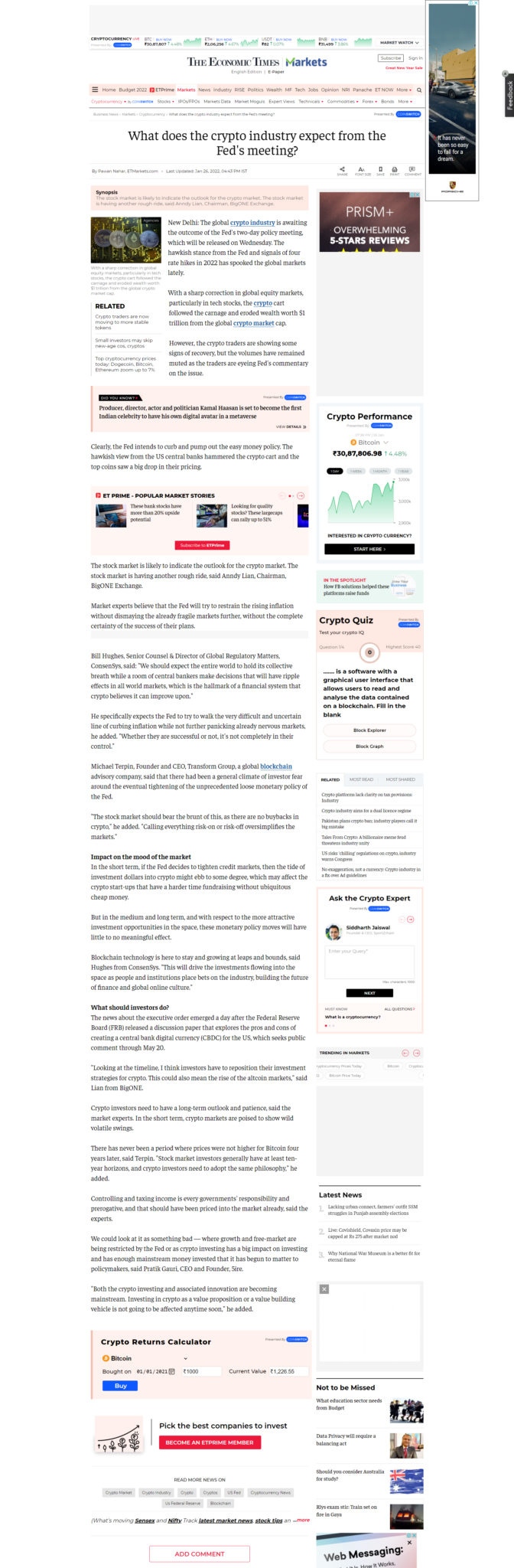
What does the crypto industry expect from the Fed’s meeting?

What does the crypto industry expect from the Fed’s meeting?

Synopsis

The stock market is likely to indicate the outlook for the crypto market. The stock market is having another rough ride, said Anndy Lian, Chairman, BigONE Exchange.​

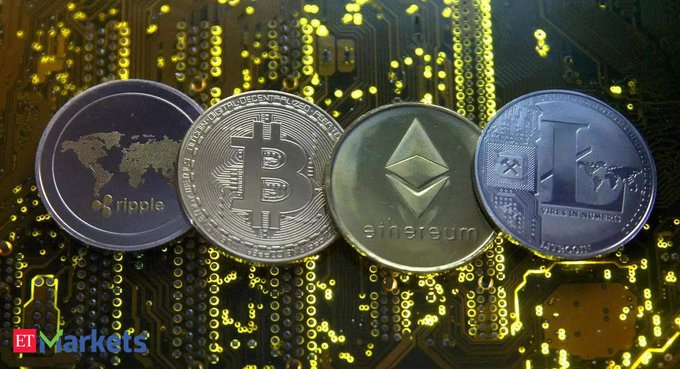
New Delhi: The global crypto industry is awaiting the outcome of the Fed’s two-day policy meeting, which will be released on Wednesday. The hawkish stance from the Fed and signals of four rate hikes in 2022 has spooked the global markets lately.

With a sharp correction in global equity markets, particularly in tech stocks, the crypto cart followed the carnage and eroded wealth worth $1 trillion from the global crypto market cap.

However, the crypto traders are showing some signs of recovery, but the volumes have remained muted as the traders are eyeing Fed’s commentary on the issue.

Clearly, the Fed intends to curb and pump out the easy money policy. The hawkish view from the US central banks hammered the crypto cart and the top coins saw a big drop in their pricing.

The stock market is likely to indicate the outlook for the crypto market. The stock market is having another rough ride, said Anndy Lian, Chairman, BigONE Exchange.

Market experts believe that the Fed will try to restrain the rising inflation without dismaying the already fragile markets further, without the complete certainty of the success of their plans.

Bill Hughes, Senior Counsel & Director of Global Regulatory Matters, ConsenSys, said: “We should expect the entire world to hold its collective breath while a room of central bankers make decisions that will have ripple effects in all world markets, which is the hallmark of a financial system that crypto believes it can improve upon.”

He specifically expects the Fed to try to walk the very difficult and uncertain line of curbing inflation while not further panicking already nervous markets, he added. “Whether they are successful or not, it’s not completely in their control.”

Michael Terpin, Founder and CEO, Transform Group, a global blockchain advisory company, said that there had been a general climate of investor fear around the eventual tightening of the unprecedented loose monetary policy of the Fed.

“The stock market should bear the brunt of this, as there are no buybacks in crypto,” he added. “Calling everything risk-on or risk-off oversimplifies the markets.”

Impact on the mood of the market
In the short term, if the Fed decides to tighten credit markets, then the tide of investment dollars into crypto might ebb to some degree, which may affect the crypto start-ups that have a harder time fundraising without ubiquitous cheap money.

But in the medium and long term, and with respect to the more attractive investment opportunities in the space, these monetary policy moves will have little to no meaningful effect.

Blockchain technology is here to stay and growing at leaps and bounds, said Hughes from ConsenSys. “This will drive the investments flowing into the space as people and institutions place bets on the industry, building the future of finance and global online culture.”

What should investors do?
The news about the executive order emerged a day after the Federal Reserve Board (FRB) released a discussion paper that explores the pros and cons of creating a central bank digital currency (CBDC) for the US, which seeks public comment through May 20.

“Looking at the timeline, I think investors have to reposition their investment strategies for crypto. This could also mean the rise of the altcoin markets,” said Lian from BigONE.

Crypto investors need to have a long-term outlook and patience, said the market experts. In the short term, crypto markets are poised to show wild volatile swings.

There has never been a period where prices were not higher for Bitcoin four years later, said Terpin. “Stock market investors generally have at least ten-year horizons, and crypto investors need to adopt the same philosophy,” he added.

Controlling and taxing income is every governments’ responsibility and prerogative, and that should have been priced into the market already, said the experts.

We could look at it as something bad — where growth and free-market are being restricted by the Fed or as crypto investing has a big impact on investing and has enough mainstream money invested that it has begun to matter to policymakers, said Pratik Gauri, CEO and Founder, 5ire.

“Both the crypto investing and associated innovation are becoming mainstream. Investing in crypto as a value proposition or a value building vehicle is not going to be affected anytime soon,” he added.


Original Source: https://economictimes.indiatimes.com/markets/cryptocurrency/what-does-the-crypto-industry-expect-from-the-feds-meeting/articleshow/89136991.cms


Anndy Lian is an early blockchain adopter and experienced serial entrepreneur who is known for his work in the government sector. He is a best selling book author- “NFT: From Zero to Hero” and “Blockchain Revolution 2030”.

Currently, he is appointed as the Chief Digital Advisor at Mongolia Productivity Organization, championing national digitization. Prior to his current appointments, he was the Chairman of BigONE Exchange, a global top 30 ranked crypto spot exchange and was also the Advisory Board Member for Hyundai DAC, the blockchain arm of South Korea’s largest car manufacturer Hyundai Motor Group. Lian played a pivotal role as the Blockchain Advisor for Asian Productivity Organisation (APO), an intergovernmental organization committed to improving productivity in the Asia-Pacific region.

An avid supporter of incubating start-ups, Anndy has also been a private investor for the past eight years. With a growth investment mindset, Anndy strategically demonstrates this in the companies he chooses to be involved with. He believes that what he is doing through blockchain technology currently will revolutionise and redefine traditional businesses. He also believes that the blockchain industry has to be “redecentralised”.
j j j