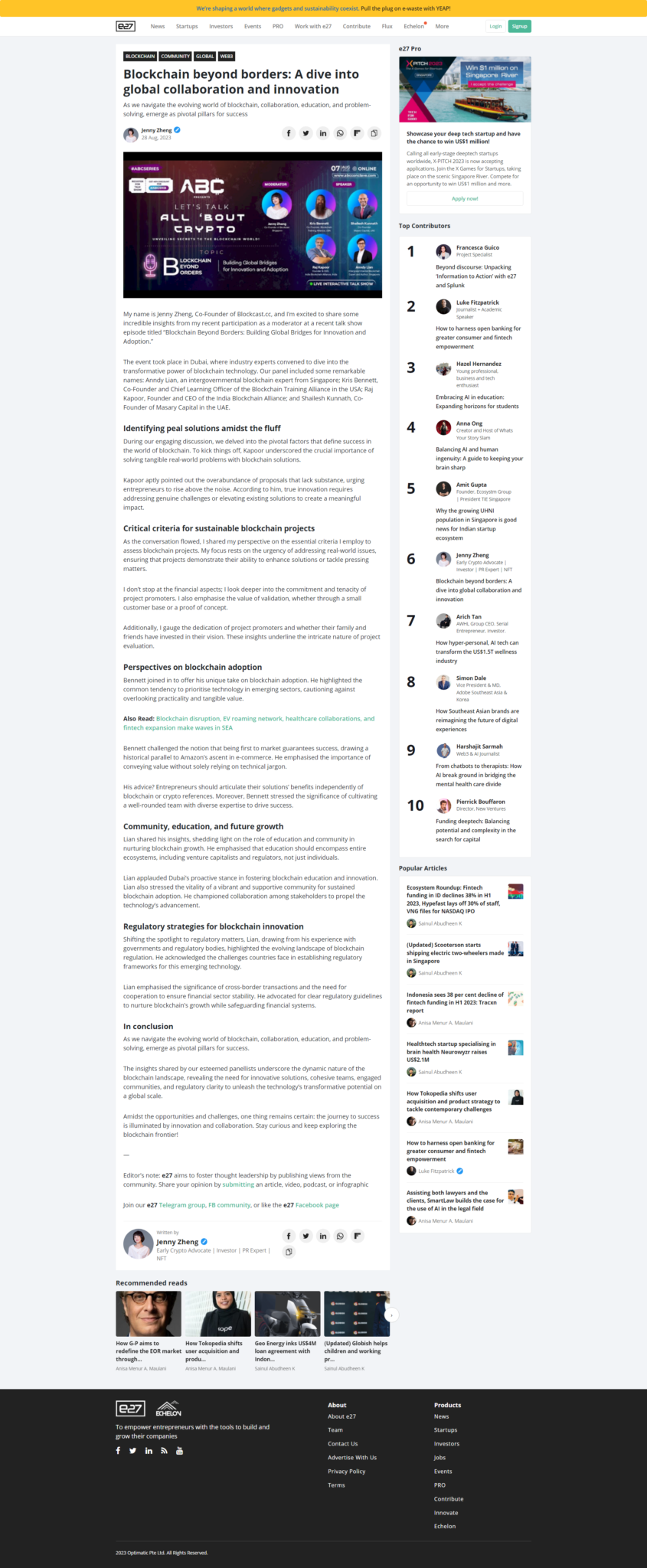
Blockchain beyond borders: A dive into global collaboration and innovation

Blockchain beyond borders: A dive into global collaboration and innovation

My name is Jenny Zheng, Co-Founder of Blockcast.cc, and I’m excited to share some incredible insights from my recent participation as a moderator at a recent talk show episode titled “Blockchain Beyond Borders: Building Global Bridges for Innovation and Adoption.”

The event took place in Dubai, where industry experts convened to dive into the transformative power of blockchain technology. Our panel included some remarkable names: Anndy Lian, an intergovernmental blockchain expert from Singapore; Kris Bennett, Co-Founder and Chief Learning Officer of the Blockchain Training Alliance in the USA; Raj Kapoor, Founder and CEO of the India Blockchain Alliance; and Shailesh Kunnath, Co-Founder of Masary Capital in the UAE.

Identifying peal solutions amidst the fluff

During our engaging discussion, we delved into the pivotal factors that define success in the world of blockchain. To kick things off, Kapoor underscored the crucial importance of solving tangible real-world problems with blockchain solutions.

Kapoor aptly pointed out the overabundance of proposals that lack substance, urging entrepreneurs to rise above the noise. According to him, true innovation requires addressing genuine challenges or elevating existing solutions to create a meaningful impact.

Critical criteria for sustainable blockchain projects

As the conversation flowed, I shared my perspective on the essential criteria I employ to assess blockchain projects. My focus rests on the urgency of addressing real-world issues, ensuring that projects demonstrate their ability to enhance solutions or tackle pressing matters.

I don’t stop at the financial aspects; I look deeper into the commitment and tenacity of project promoters. I also emphasise the value of validation, whether through a small customer base or a proof of concept.

Additionally, I gauge the dedication of project promoters and whether their family and friends have invested in their vision. These insights underline the intricate nature of project evaluation.

Perspectives on blockchain adoption

Bennett joined in to offer his unique take on blockchain adoption. He highlighted the common tendency to prioritise technology in emerging sectors, cautioning against overlooking practicality and tangible value.

Bennett challenged the notion that being first to market guarantees success, drawing a historical parallel to Amazon’s ascent in e-commerce. He emphasised the importance of conveying value without solely relying on technical jargon.

His advice? Entrepreneurs should articulate their solutions’ benefits independently of blockchain or crypto references. Moreover, Bennett stressed the significance of cultivating a well-rounded team with diverse expertise to drive success.

Community, education, and future growth

Lian shared his insights, shedding light on the role of education and community in nurturing blockchain growth. He emphasised that education should encompass entire ecosystems, including venture capitalists and regulators, not just individuals.

Lian applauded Dubai’s proactive stance in fostering blockchain education and innovation. Lian also stressed the vitality of a vibrant and supportive community for sustained blockchain adoption. He championed collaboration among stakeholders to propel the technology’s advancement.

Regulatory strategies for blockchain innovation

Shifting the spotlight to regulatory matters, Lian, drawing from his experience with governments and regulatory bodies, highlighted the evolving landscape of blockchain regulation. He acknowledged the challenges countries face in establishing regulatory frameworks for this emerging technology.

Lian emphasised the significance of cross-border transactions and the need for cooperation to ensure financial sector stability. He advocated for clear regulatory guidelines to nurture blockchain’s growth while safeguarding financial systems.

In conclusion

As we navigate the evolving world of blockchain, collaboration, education, and problem-solving, emerge as pivotal pillars for success.

The insights shared by our esteemed panellists underscore the dynamic nature of the blockchain landscape, revealing the need for innovative solutions, cohesive teams, engaged communities, and regulatory clarity to unleash the technology’s transformative potential on a global scale.

Amidst the opportunities and challenges, one thing remains certain: the journey to success is illuminated by innovation and collaboration. Stay curious and keep exploring the blockchain frontier!


Source: https://e27.co/blockchain-beyond-borders-a-dive-into-global-collaboration-and-innovation-20230823/
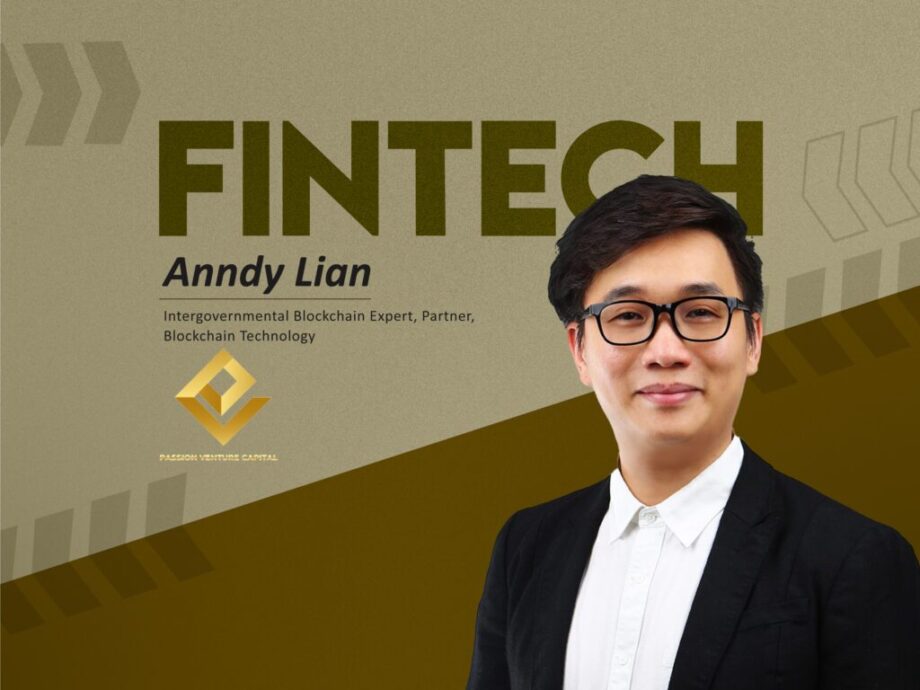
Anndy Lian is an early blockchain adopter and experienced serial entrepreneur who is known for his work in the government sector. He is a best selling book author- “NFT: From Zero to Hero” and “Blockchain Revolution 2030”.

Currently, he is appointed as the Chief Digital Advisor at Mongolia Productivity Organization, championing national digitization. Prior to his current appointments, he was the Chairman of BigONE Exchange, a global top 30 ranked crypto spot exchange and was also the Advisory Board Member for Hyundai DAC, the blockchain arm of South Korea’s largest car manufacturer Hyundai Motor Group. Lian played a pivotal role as the Blockchain Advisor for Asian Productivity Organisation (APO), an intergovernmental organization committed to improving productivity in the Asia-Pacific region.

An avid supporter of incubating start-ups, Anndy has also been a private investor for the past eight years. With a growth investment mindset, Anndy strategically demonstrates this in the companies he chooses to be involved with. He believes that what he is doing through blockchain technology currently will revolutionise and redefine traditional businesses. He also believes that the blockchain industry has to be “redecentralised”.
j j j

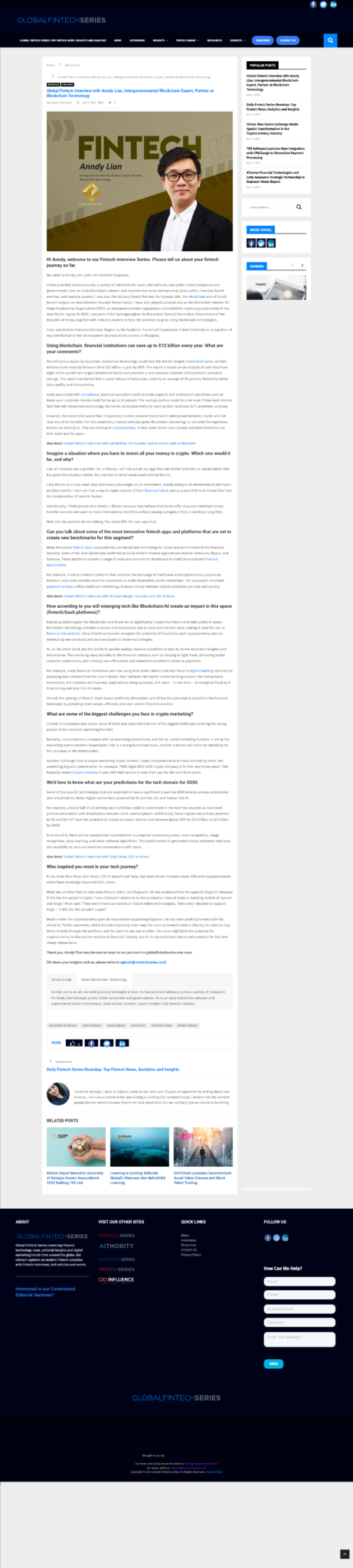
Global Fintech Interview with Anndy Lian, Intergovernmental Blockchain Expert, Partner at Blockchain Technology

Global Fintech Interview with Anndy Lian, Intergovernmental Blockchain Expert, Partner at Blockchain Technology

Hi Anndy, welcome to our Fintech Interview Series. Please tell us about your fintech journey so far.

My name is Anndy Lian, and I am based in Singapore.

I have provided advisory across a variety of industries for local, international, and public-listed companies and governments. I am an early blockchain adopter and experienced serial entrepreneur, book author, investor, board member, and keynote speaker. I was also the Advisory Board Member for Hyundai DAC, the blockchain arm of South Korea’s largest car manufacturer Hyundai Motor Group. I have also played a pivotal role as the Blockchain Advisor for Asian Productivity Organisation (APO), an intergovernmental organization committed to improving productivity in the Asia-Pacific region. In 2018, I was part of the Gyeongsangbuk-do Blockchain Special Committee, Government of the Republic of Korea, together with industry experts to help the province to grow using blockchain technologies.

I was awarded an Honorary Doctoral Degree by the Academic Council of Ulaanbaatar Erdem University in recognition of my contribution to the development of productivity science in Mongolia.

Using blockchain, financial institutions can save up to $12 billion every year. What are your comments?

According to a report by Accenture, blockchain technology could help the world’s largest investment banks cut their infrastructure costs by between $8 to $12 billion a year by 2025. The report is based on an analysis of cost data from eight of the world’s ten largest investment banks and provides a rare concrete estimate of blockchain’s potential savings. The report mentioned that it could reduce infrastructure costs by an average of 30 percent, helped by better data quality and transparency.

Costs associated with compliance, business operations such as trade support, and centralized operations such as know-your-customer checks could fall by up to 50 percent. The savings portion could be a lot more if they look into the fact that with blockchain technology, the banks could potentially be running their business 24/7, anywhere, anytime.

However, the report also warns that if regulatory hurdles prevent blockchain’s widespread adoption, banks will not reap any of its benefits. For this statement, I cannot entirely agree. Blockchain technology is not what the regulatory bodies are looking at. They are looking at cryptocurrency. In fact, some banks have already adopted blockchain on their back end for years.

Imagine a situation where you have to invest all your money in crypto. Which one would it be, and why?

I am an investor, not a gambler. So, in theory, I will not put all my eggs into one basket and take on uncalculated risks. But given the situation above, the only top-of-mind recall would still be Bitcoin.

I see Bitcoin as a new asset class with many advantages as an investment, mainly owing to its decentralized and hyper-portable profile. I also see it as a way to regain control of their financial future and as a sound form of money free from the manipulation of outside factors.

Additionally, I think people who invest in Bitcoin because they believe that banks offer slow and outdated money transfer services and want to make international transfers without paying outrageous fees or waiting a long time.

Well, lets the markets do the talking. The latest BRC-20 craze says it all.

Can you talk about some of the most innovative fintech apps and platforms that are set to create new benchmarks for this segment?

Many innovative fintech apps and platforms use blockchain technology to create new benchmarks in the financial industry. Some of the best blockchain platforms to build modern finance applications include Ethereum, Ripple, and Cardano. These platforms provide a range of tools and services for developers to build decentralized financial applications.

For example, Circle is a fintech platform that oversees the exchange of traditional and cryptocurrency payments between users and provides tools for businesses to build themselves on the blockchain. The company’s merchant payment services utilize stablecoin technology to move money between digital currencies securely and quickly.

How according to you will emerging tech like Blockchain/AI create an impact in this space (fintech/SaaS platforms)?

Emerging technologies like Blockchain and AI are set to significantly impact the fintech and SaaS platform space. Blockchain technology provides a secure and transparent way to store and transfer data, making it ideal for use in financial transactions. Many fintech companies recognize the potential of blockchain and cryptocurrency and are developing new products and services based on these technologies.

AI, on the other hand, has the ability to quickly analyze massive quantities of data to derive important insights and information. This can bring many benefits to the financial industry, such as helping to fight fraud, delivering better customer experiences, and creating new efficiencies and conveniences when it comes to payments.

For example, many financial institutions are now using AI to better detect and stop fraud in digital banking channels by analyzing data streams from the user’s device, their behavior during the online banking session, the transactions themselves, the channels and business applications being accessed, and more – in real-time – to recognize fraud as it is occurring and stop it in its tracks.

Overall, the synergy of fintech, SaaS-based platforms, blockchain, and AI has the potential to transform the financial landscape by providing more secure, efficient, and user-centric financial services.

What are some of the biggest challenges you face in crypto marketing?

I invest in companies and advise some of them and observed that one of the biggest challenges is hiring the wrong people in the incorrect marketing function.

Recently, I encountered a company with no marketing department, and the so-called marketing function is led by the marketing communication department. This is a wrong functional move, and the outcome will never be satisfying for the company or the stakeholders.

Another challenge I see in crypto marketing is bad content. Crypto companies tend to make something small into something big and unbelievable. For example, “AWS Signs MOU with Crypto Company A for the next three years”. This basically means Crypto Company A uses AWS Web service to host their app for the next three years.

We’d love to know what are your predictions for the tech domain for 2030.

Some of the specific technologies that are expected to have a significant impact by 2030 include process automation and virtualization, faster digital connections powered by 5G and the IoT, and human-like AI.

For example, around half of all existing work activities could be automated in the next few decades as next-level process automation and virtualization become more commonplace1. Additionally, faster digital connections powered by 5G and the IoT have the potential to unlock economic activity and increase global GDP by $1.2 trillion to $2 trillion by 20301.

In terms of AI, there will be exponential improvements in computer processing power, voice recognition, image recognition, deep learning, and other software algorithms. This could lead to AI-generated virtual assistants that have the capability to carry out nuanced conversations with users.

Who inspired you most in your tech journey?

It has to be Elon Musk. Elon Musk, CEO of SpaceX and Tesla, has been known to tweet about different cryptocurrencies which have seemingly impacted their prices.

Musk has clarified that he only owns Bitcoin, Ether, and Dogecoin. He has explained that he supports Dogecoin because it felt like the people’s crypto. “Lots of people I talked to on the production lines at Tesla or building rockets at SpaceX own Doge,” Musk said. “They aren’t financial experts or Silicon Valley technologists. That’s why I decided to support Doge — it felt like the people’s crypto”.

Musk’s vision for cryptocurrency goes far beyond just supporting Dogecoin. He has been pushing forward with his vision for Twitter payments, which includes exploring more ways for users to reward creators directly, for users to buy items directly through the platform, and for users to pay one another. His vision highlights the potential for cryptocurrency to disrupt the traditional financial industry due to its decentralized nature and potential for fast and cheap transactions.

Thank you, Anndy! That was fun and we hope to see you back on globalfintechseries.com soon.


Source: https://globalfintechseries.com/blockchain/global-fintech-interview-with-anndy-lian-intergovernmental-blockchain-expert-partner-at-blockchain-technology/


Anndy Lian is an early blockchain adopter and experienced serial entrepreneur who is known for his work in the government sector. He is a best selling book author- “NFT: From Zero to Hero” and “Blockchain Revolution 2030”.

Currently, he is appointed as the Chief Digital Advisor at Mongolia Productivity Organization, championing national digitization. Prior to his current appointments, he was the Chairman of BigONE Exchange, a global top 30 ranked crypto spot exchange and was also the Advisory Board Member for Hyundai DAC, the blockchain arm of South Korea’s largest car manufacturer Hyundai Motor Group. Lian played a pivotal role as the Blockchain Advisor for Asian Productivity Organisation (APO), an intergovernmental organization committed to improving productivity in the Asia-Pacific region.

An avid supporter of incubating start-ups, Anndy has also been a private investor for the past eight years. With a growth investment mindset, Anndy strategically demonstrates this in the companies he chooses to be involved with. He believes that what he is doing through blockchain technology currently will revolutionise and redefine traditional businesses. He also believes that the blockchain industry has to be “redecentralised”.

j j j

EU AI Act: A Significant Step Toward Global AI Governance

EU AI Act: A Significant Step Toward Global AI Governance

In recent years, Artificial Intelligence (AI) has emerged as a powerful tool that has transformed many aspects of modern life, including creating and consuming content. Using generative AI tools like ChatGPT has opened up new possibilities for content creation but has also raised new challenges and questions around copyright. The issue of copyright and AI-generated content is complex, involving various legal and ethical considerations.

As AI technologies become more prevalent in content creation, it is essential to address the questions of ownership, attribution, and compensation for AI-generated works. One of the primary challenges is that existing copyright laws are struggling to keep up with the rapid advancements in AI technology. The current legal framework, designed for traditional forms of content creation, may not be adequately equipped to address the unique aspects of AI-generated content.

Moreover, as AI-generated content becomes more prevalent, it is crucial to consider the ethical implications, particularly around issues such as bias, privacy, and accountability. AI algorithms can amplify existing biases, leading to unfair treatment of certain groups or individuals. Additionally, AI-generated content can raise privacy concerns as it may involve the use of personal data.

To address these challenges, policymakers, industry leaders, and other stakeholders are working to establish clear guidelines and regulations that balance the interests of creators, users, and AI technologies while considering the ethical implications of AI-generated content. For instance, the European Union (EU) is currently drafting the AI Act, a new law aimed at regulating the use of AI technologies in the EU. We will talk more about this in this article.

What is EU AI Act?

The European Union (EU) introduced the EU AI Act in April 2021, proposing a comprehensive legal and regulatory framework for AI. The proposed regulation covers all types of AI in various sectors, including entities that use AI systems professionally. The regulation aims to tackle challenges and risks linked to AI development and deployment, including discriminatory and rights-violating AI.

The EU AI Act primarily puts the responsibility on AI system providers to create a legal framework for developing, distributing, and using AI. The regulation includes broad and general articles to ensure its application across different industries and use cases. The EU AI Act is currently undergoing the legislative process and is subject to the ordinary legislative procedure for the EU. Members of the European Parliament agreed on the AI Act preliminarily in April 2023, and the text is scheduled to proceed to a plenary vote in June 2023. Upon approval, the EU AI Act will be among the first AI-specific regulations in the world.

It is essential to note that the EU AI Act is a significant development in regulating AI systems as it comprehensively and uniformly addresses the associated risks and challenges comprehensively and uniformly. The regulation’s general nature ensures adaptability and applicability across different industries and use cases, marking a significant step towards AI regulation in the EU.

How would EU AI Act help with generative works?

The EU AI Act, a proposed regulation for the use of AI technology, may also help regulate the use of generative works. The act includes provisions on transparency, data quality, and human oversight, which are relevant to developing and using generative AI models such as ChatGPT. In particular, the act would require companies that use AI tools to disclose any copyrighted materials employed in developing their systems. This could help prevent the unauthorized use of intellectual property in generative works. Additionally, the EU proposes requiring companies that provide generative AI services to explain the reasons and ethical standards for their decisions.

It’s worth noting that generative AI tools, like ChatGPT, have also come under scrutiny in other areas. For example, the US Consumer Financial Protection Bureau (CFPB) examines how generative AI tools could propagate bias or misinformation and create risks in the financial services sector. Some experts have pointed out that algorithms used by generative AI tools like ChatGPT could be subject to legal protections similar to those that govern the content on social media platforms like YouTube.

Generative AI was not prominently featured in the original proposal for the AI Act, as it only had one mention of “chatbot” in the 108-page document. However, the act has been revised to include stricter rules for “foundation model” systems, which include generative AI systems like ChatGPT. The revised text also emphasizes the importance of developing European standards for AI, which could help ensure that generative AI models meet the act’s essential requirements for different levels of risk.

Risks and challenges associated with the development and deployment of AI

The development and deployment of AI come with various risks and challenges that must be addressed to ensure its ethical use. One of the main concerns is that AI systems, if not implemented correctly, can violate human rights and discriminate against marginalized communities. Discriminatory AI systems can lead to biased decision-making processes that disproportionately affect certain groups, such as migrants, refugees, and asylum seekers.

Moreover, AI systems that interact with physical objects, such as autonomous vehicles and robots, have the potential to cause harm, making safety and security a significant ethical concern in AI development. The development of AI-generated code can also lead to unintended consequences, and LLMs’ ability to generate functional code is limited, making them powerful tools for answering high-level but specific technical questions.

To address these challenges, the Asilomar AI Principles recommend that AI systems be developed and employed to reduce the risk of unintentional harm to humans. It is also important to ensure that AI systems are designed to be inclusive and transparent and to minimize the risk of unintentional harm to human users.

As the EU and the US are jointly pivotal to the future of global AI governance, it is crucial to ensure that EU and US approaches to AI risk management are generally aligned to facilitate bilateral trade. At the same time, AI developers need to establish safeguards that protect users from potential risks. OpenAI, for instance, has established AI safeguards and has a vision for AI’s ethical and responsible development.

How is the United States looking at AI copyright?

The topic of AI copyright rules in the United States is a complex and evolving issue. Several recent legal cases and proposed regulations shed light on the current state of the law.

One major concern is whether AI-generated works can be protected by copyright law. Currently, most countries, including the US, require a human author for copyright protection to arise. However, ongoing discussions and proposed legislation may change this requirement in the future.

Another issue is the use of copyrighted material in training AI models. Some AI tools are trained on massive datasets that contain copyrighted works without obtaining specific licensing for this use. This raises questions about whether this use constitutes copyright infringement.

Recent legal cases also shed light on the issue of AI copyright rules. For example, Getty Images filed a lawsuit against Stability AI in February 2023, alleging copyright, trademark infringement, and trademark dilution.

In April 2023, the US Supreme Court heard a case that could have implications for AI-generated works. The case concerns fair use law and whether AI tools can be protected under it.

Proposed regulations in the European Union may also have an impact on AI copyright rules in the US. The EU is drafting the AI Act to regulate emerging AI technology, including copyright and intellectual property issues.

In conclusion

In conclusion, EU lawmakers have agreed that companies using generative AI tools like ChatGPT will have to disclose any copyrighted material used in developing their systems as part of a larger draft law known as the AI Act. It is a big move in my opinion.

The complex issue of AI-generated content and copyright requires attention from both legal and ethical perspectives. While debates and lawsuits continue regarding the use of generative AI tools in content creation, it is apparent that current copyright laws are struggling to keep up with technological advancements.

As AI continues to revolutionize content production and consumption, policymakers and industry leaders must collaborate to establish guidelines that balance the interests of creators, users, and AI technologies. These guidelines should provide clarity on issues like ownership, attribution, and compensation for AI-generated content.

It is also essential to consider the ethical implications of AI-generated content, including issues like bias, privacy, and accountability. As AI-generated content becomes more prevalent, it is crucial to ensure responsible and transparent production and use.

To address this issue, policymakers, industry leaders, and other stakeholders must work together to establish clear guidelines and regulations. These regulations should balance the interests of all parties involved and take into account the ethical implications of AI-generated content. This effort is critical in ensuring that AI continues transforming content creation and consumption fairly, equitably, and responsibly.


Source: https://www.securities.io/eu-ai-act-a-significant-step-toward-global-ai-governance/

Anndy Lian is an early blockchain adopter and experienced serial entrepreneur who is known for his work in the government sector. He is a best selling book author- “NFT: From Zero to Hero” and “Blockchain Revolution 2030”.

Currently, he is appointed as the Chief Digital Advisor at Mongolia Productivity Organization, championing national digitization. Prior to his current appointments, he was the Chairman of BigONE Exchange, a global top 30 ranked crypto spot exchange and was also the Advisory Board Member for Hyundai DAC, the blockchain arm of South Korea’s largest car manufacturer Hyundai Motor Group. Lian played a pivotal role as the Blockchain Advisor for Asian Productivity Organisation (APO), an intergovernmental organization committed to improving productivity in the Asia-Pacific region.

An avid supporter of incubating start-ups, Anndy has also been a private investor for the past eight years. With a growth investment mindset, Anndy strategically demonstrates this in the companies he chooses to be involved with. He believes that what he is doing through blockchain technology currently will revolutionise and redefine traditional businesses. He also believes that the blockchain industry has to be “redecentralised”.

j j j