Panel Discussion: Web3 Industry & AI Rapid Growth: Unleashing Innovation and Potential

Panel Discussion: Web3 Industry & AI Rapid Growth: Unleashing Innovation and Potential

We have witnessed a remarkable surge in growth and development in both the Web3 industry and the field of Artificial Intelligence (AI). This convergence has brought forth a wave of innovative technologies, revolutionizing various sectors and opening doors to endless possibilities.

The panel of experts at the Brand Launchpad Event held on 29 May 2023 at Ho Chi Minh, Vietnam, delve into the impressive progress observed in the Web3 industry and the accelerated growth of AI, shedding light on their profound impact on society and the immense potential they hold for the future. Tienee Huynh, Founder of Tinker Academy, Thanh Dao, Founder of Jung Von Matt, Jake Zheng, Growth Evangelist of Chainklink, Anndy Lian, Advisor of Bybit and Tony Tong, Chairman of HKBA were present to share their insights.

Unleashing the Power of Web3:
The emergence of Web3 signifies a significant departure from the conventional centralized web towards a decentralized and more user-centric ecosystem. By leveraging blockchain technology as its foundation, Web3 empowers individuals with greater control over their digital assets, enhanced privacy and security, and the ability to engage in peer-to-peer interactions without intermediaries. This decentralized architecture fosters trust, transparency, and immutability, making it an ideal framework for a wide range of applications. Anndy Lian emphasized that what we should all focus on is that ” Web3 is for the creators.”. He explains how Web3 “ushers in a fresh type of economy that empowers users and communities to make more informed and advantageous business choices.”

Revolutionizing Industries:
Web3 has unleashed its transformative potential across diverse industries. In the realm of finance, decentralized finance (DeFi) has emerged as a prominent use case, offering decentralized lending, borrowing, and trading options. This decentralized approach disrupts traditional financial systems, granting individuals access to a more inclusive and efficient financial landscape.

Jake Zheng mentioned earning from using their own work and data in the Web3 era. Web3 has revolutionized the realm of digital content and entertainment. Non-Fungible Tokens (NFTs) have gained immense popularity, empowering artists, musicians, and creators to tokenize their work and directly sell it to consumers. This not only benefits artists by providing new revenue streams, but also ensures traceability and provenance of digital assets.

The Expanding Horizon of AI:
Concurrently, the field of Artificial Intelligence has been experiencing rapid advancements, fundamentally transforming the way we live and work. AI encompasses a broad spectrum of technologies, including machine learning, natural language processing, computer vision, and robotics. These technologies have facilitated automation, enhanced decision-making processes, and enabled personalized experiences across various industries. Tony Tong explained that we should not be afraid of AI and should find ways to learn more about it.

The Synergy of Web3 and AI:
The convergence of Web3 and AI has unleashed a new wave of possibilities. Web3’s decentralized nature provides an ideal environment for AI systems, ensuring data privacy, security, and transparency. On the other hand, AI augments the capabilities of Web3 by providing intelligent decision-making algorithms and automation. Together, they create a powerful synergy that has the potential to redefine industries and drive innovation.

Future Implications:
As the Web3 industry and AI continue to flourish, their implications for the future are profound. The integration of Web3 and AI technologies holds the power to revolutionize various sectors, including finance, healthcare, supply chain, and governance. Decentralized AI systems can ensure data privacy while empowering individuals with personalized experiences and decision-making capabilities. This symbiotic relationship has the potential to democratize access to services, increase efficiency, and foster greater trust in systems.

In conclusion, the rapid growth of the Web3 industry and AI has ushered in a new era of technological advancement. The decentralized nature of Web3, combined with the transformative power of AI, has created an ecosystem ripe with innovation and boundless possibilities. Embracing this convergence can lead to groundbreaking solutions, improved efficiencies, and a more inclusive digital landscape. To fully realize the potential of these emerging technologies, it is crucial to support and nurture their growth through collaboration and exploration.

Anndy Lian is an early blockchain adopter and experienced serial entrepreneur who is known for his work in the government sector. He is a best selling book author. The latest book is Web4: The Age of Autonomous Intelligence.


j j j

Can the Metaverse Facilitate Sustainable Growth of Defi Systems?

Can the Metaverse Facilitate Sustainable Growth of Defi Systems?
  • Users could earn and spend virtual currency within the metaverse to buy and sell goods and services.
  • The metaverse could also support the creation and trade of unique digital assets.

The development of the metaverse, as a virtual world that combines elements of the real world with digital creations and experiences, has the potential to generate a new economy. The metaverse could offer users various activities and applications, including social interaction, entertainment, education, commerce, and more. These activities could generate value and economic opportunities for individuals, businesses, and other entities within the metaverse.

Users could earn and spend virtual currency within the metaverse to buy and sell goods and services or use decentralized finance (DeFi) tools and platforms to manage and trade their assets.

The metaverse could also support the creation and trade of unique digital assets, such as non-fungible tokens (NFTs), which could have value within and outside the metaverse. In addition, businesses and other organizations could use the metaverse for marketing, advertising, and other activities that generate revenue.

In my humble opinion, I think it is possible that the development of the metaverse could facilitate the growth of sustainable decentralized finance (DeFi) ecosystems. The metaverse is a virtual world that combines elements of the real world with digital creations and experiences, and it has the potential to support a wide range of activities and applications, including financial ones.

DeFi’s Future

These tools and platforms allow users to access and interact with financial services and assets more openly, transparent, and securely, potentially enabling greater financial inclusion and autonomy. DeFi is still a largely nascent and evolving field, and its potential impact and limitations are still being explored and debated. Since both metaverse and DeFi are new and debatable. It has potential upsides.

In a metaverse context, DeFi could potentially offer users a more immersive and interactive experience for managing and using their assets, as well as access to a wider range of financial services and opportunities. This could potentially lead to more sustainable DeFi ecosystems, as the increased accessibility and user engagement could drive adoption and growth.

Thoughts on How Decentralization Can Be Used in Metaverses:

1. Use decentralized exchanges to trade assets within the metaverse.

2. Use decentralized lending and borrowing platforms to access credit and earn interest on assets within the metaverse.

3. Use decentralized insurance platforms to protect against risks within the metaverse.

4. Use decentralized prediction markets to speculate on events within the metaverse.

5. Use decentralized governance mechanisms to make decisions and govern communities within the metaverse.

6. Use decentralized identity systems to securely manage and verify identities within the metaverse.

7. Use decentralized reputation systems to assess the trustworthiness of individuals and entities within the metaverse.

8. Use decentralized oracles to provide reliable data and information for use within the metaverse.

9. Use decentralized storage and data management systems to securely store and manage data within the metaverse.

10. Use decentralized automation and smart contract platforms to facilitate and automate transactions and interactions within the metaverse.

In theory, a metaverse could facilitate the growth of decentralized finance (DeFi) systems by providing a platform for people to access and interact with these systems in a more intuitive and user-friendly way.

One potential benefit of a metaverse is that it could make it easier for people to understand and use DeFi systems, which can sometimes be complex and difficult to navigate. By providing a visual representation of DeFi protocols and networks, a metaverse could help to demystify these systems and make them more accessible to a wider audience.

Another potential benefit of a metaverse is that it could provide a more engaging and immersive experience for users of DeFi systems. By allowing people to interact with each other and with digital assets in a virtual environment, a metaverse could make DeFi more fun and engaging, potentially increasing user adoption and participation in these systems.

Will Decentralization Work Better in the Metaverse?

Well, decentralization has the potential to offer several benefits in the context of the metaverse, a virtual world that combines elements of the real world with digital creations and experiences. Decentralization could enable users to have greater control and autonomy over their assets and activities within the metaverse, and it could provide a more resilient and secure infrastructure for the metaverse.

Decentralized finance (DeFi) tools and platforms could enable users to manage and trade their assets within the metaverse without relying on a central authority. Decentralized governance mechanisms could allow communities within the metaverse to make decisions and coordinate their activities in a decentralized manner. Decentralized identity systems could provide users with secure and verifiable identities within the metaverse.

It could provide a more resilient and secure infrastructure for the metaverse. Because decentralized systems are distributed across multiple nodes, they are less vulnerable to single points of failure and can continue to operate even if one or more nodes go offline. This could make the metaverse more resilient and less susceptible to attacks or other disruptions. Thus making the metaverse environment a good testing ground for decentralization.

DEXs on Metaverse: The Potential is Big

This could be a really crazy thought here. Centralized exchanges (CEXs) are already under the microscope of many regulators. Their first action is to go decentralized, forming new decentralized exchanges (DEXs). This is not a safe option too, the regulators are not blind, and they know that the operators behind the DEXs are from the same group of people.

Because a metaverse is a virtual shared space, DEXs could operate within it without being subject to the same regulatory constraints as they would in the real world. This could give DEXs greater freedom to innovate and experiment with new business models and technologies.

Operating within a metaverse could provide DEXs with access to a larger and more diverse user base. Because a metaverse is a virtual environment, it could potentially attract users from around the world, regardless of their physical location. This could give DEXs access to a larger and more diverse pool of users, potentially increasing their reach and user adoption.

Perhaps operating from a metaverse can give them a longer pathway.

Conclusion

The global metaverse market size was valued at USD 22.79 billion in 2021 and is expected to grow at a compound annual growth rate (CAGR) of 39.8% during 2022-2030. This is a big market. The potential is enormous.

However, I got to emphasize this again. The development and realization of the metaverse as an economic engine is still a largely untested and evolving concept. It will likely require significant advancements in technology and infrastructure, as well as the coordination and cooperation of various stakeholders, to fully realize the potential of this virtual world.

Summarizing my thoughts with a quote:

“The combination of metaverse and decentralized finance is an enormous potential for the future. Investors have put it in the spotlight as they consider it a great long-term investment opportunity. Many of us see this as one of the megatrends of the coming years. I believe it coming. Do you?” – Anndy Lian

Source: https://www.financemagnates.com/cryptocurrency/can-the-metaverse-facilitate-sustainable-growth-of-decentralized-finance-defi-systems/

Anndy Lian is an early blockchain adopter and experienced serial entrepreneur who is known for his work in the government sector. He is a best selling book author. The latest book is Web4: The Age of Autonomous Intelligence.

j j j

SOL /BTC prediction: Can Solana arrest year-long decline, return to growth?

SOL /BTC prediction: Can Solana arrest year-long decline, return to growth?

Solana’s SOL has been seeing a surge in investor interest as it continues to expand its network with more exciting projects coming up. Despite dipping by 87.8% since its all-time high in November 2021, experts are saying that a rebound is near while bitcoin (BTC) is down by around 70% since November 2021 gains.

How do the two coins trade against each other and what does the SOL to BTC forecast suggest amid a bear market? Let’s take a look at the SOL/BTC pair and some of the factors that may shape its exchange rate.

What is SOL/BTC?

SOL/BTC is the exchange rate between SOL, the native cryptocurrency of the Solana blockchain platform, and BTC, the native token of the Bitcoin Network.

Bitcoin was first mined in 2009 by its creator or group of creators who prefer to keep their identity a secret using the pseudonym Satoshi Nakamoto. It is also the first ever platform to use a blockchain to build, exchange, store and distribute the digital coin.

The cryptocurrency is used as a peer-to-peer payments method, and over the last 10 years it has also become an investment vehicle.

Bitcoin uses a Proof-of-Work (PoW) consensus mechanism. The cryptocurrency is given as a reward to miners who solve mathematical equations to prove the legitimacy of BTC transactions.

The maximum number of newly mined bitcoins is limited at 21 million. After every 210,000 mined BTC blocks (this takes around four years), the blockchain experiences a halving event, which cuts the number of BTC coins in circulation by half.

Solana is a public, open-source blockchain that hosts a number of projects in the likes of decentralised finance (DeFi) applications, non-fungible tokens (NFTs) and Web3.

It prides itself in its low transaction costs (at less than $0.01), fast speed (at 400 milliseconds per block) and security (it is censorship resistant). The blockchain was nicknamed the ‘Ethereum killer’, as it aims to improve what the Ethereum blockchain is lacking.

It was founded in 2017 by a former Qualcomm (QCOM) employee and Dropbox software engineer Anatoly Yakovenko and his colleague Greg Fitzgerald. In contrast to BTC, Solana uses a Proof of History (PoH) consensus mechanism for verifying transactions on the blockchain, which uses an alternative method for calculating time.

Some of the network’s key functions allow users to mint, sell and trade NFTs, create their own DeFi projects, write smart contracts, build Web3 games and accept payments in crypto form.

SOL coins are ERC-20 standard, meaning that they were developed on the Ethereum (ETH) network and are primarily used for interacting on the blockchain.

SOL to BTC price history

Since SOL’s launch in 2020, the SOL to BTC rate struggled to pick up momentum, moving sideways for around 10 months before starting to gain speed at the end of February 2021.

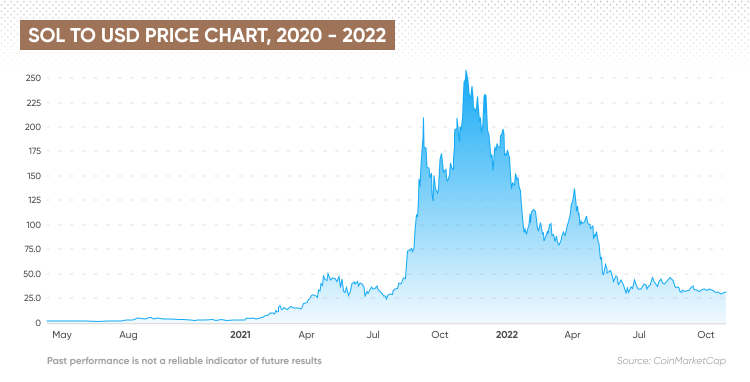
Between late February 2021 and mid-August 2021 the pairing fluctuated between values as low as 0.0001781BTC and as high as 0.001179BTC. The SOL to USD price chart followed a similar trend, fluctuating between $13 and $49.

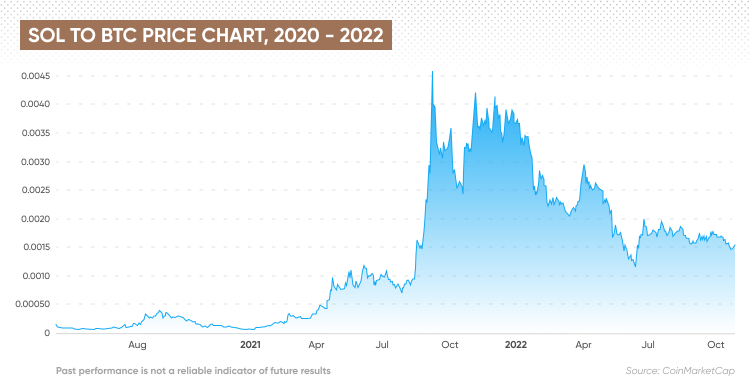
SOL to BTC price chart, 2020 - 2022

Between 15 August 2021 and 9 September 2021, however, the SOL/BTC pair surged, rising by more than 385%, up from 0.0009374BTC to 0.004576BTC as Solana was being discovered by a number of celebrities, such as Mike Tyson and Jason Derulo. This was also the time when the SOL to BTC reached its all-time high, as seen on the price chart above.

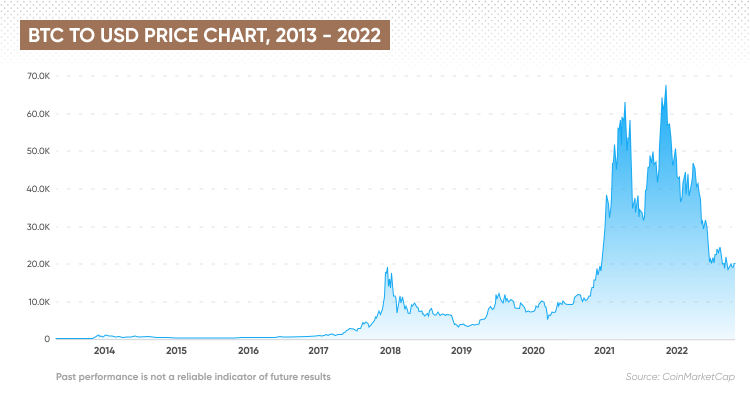
Between 9 September 2021 and 20 October 2021 the SOL/BTC price lost nearly 50% of its gains, dropping to 0.002425BTC as the BTC price in US dollars started to see major gains, surging by around 39% within the period from $46,000 to $64,000.

BTC to USD price chart, 2013 - 2022

In line with other major cryptocurrencies, the SOL/BTC rate regained a big portion of its losses as it rose to 0.004202BTC by 7 November 2021, at the time when the SOL value in USD reached its all-time high of $258.78.

SOL to USD price chart, 2020 - 2022

Up until the start of January 2022, the SOL to BTC exchange rate was fluctuating between 0.004000BTC and 0.003000BTC before falling more than 60% to 0.001149BTC on 13 June 2022, amid overall broad negative investor sentiment.

In terms of technical analysis, the chief digital advisor at the Mongolian Productivity Organisation and author of NFT: From Zero to Hero, Anndy Lian, told Capital.com that the SOL price could be headed towards a trend reversal, as of 28 October.

“The Relative Strength Index (RSI) indicates that the token is in the overbought zone, signalling a reversal could be on the way,” he said.

The pairing’s current exchange rate (28 October) is 0.00151BTC, up by 31.4% since its 13 June 2022 dip.

What is driving SOL/BTC?

On 30 September 2022, the Solana Mainnet Beta cluster experienced an outage, which led to a temporary collapse in the blockchain. This saw the SOL to BTC exchange rate drop by 3.1% within a week, down to 0.001682BTC by 7 October 2022, from 0.001735BTC on the day of the outage.

Dr. Pooja Lekhi, professor of global financial institutions, risk management approach and financial management at University Canada West, told Capital.com:

“Solana has experienced several recent network outages and failures. In the beginning of June, validators in the network stopped processing new blocks for several hours and apps built on Solana’s blockchain were taken offline, which sent its price down more than 12%.”

Projects built on Solana have potential to affect the token’s future price. On 27 October, the Web3 platforms built on Solana Decentralised Engineering Corporation (DEC) and Teleport announced that they have raised funding to bring a Web3 Uber rival (TRIP) to the Solana blockchain, something Ethereum co-creator Vitalik Buterin theorised a while back.

Lian noted that bringing the ridesharing industry to the Solana ecosystem “would surely put SOL into a high utility mode”.

In addition, Solana had partnered with artist Nancy Baker Cahill. She launched her first NFT collection on the blockchain that was shown across 90 billboards on Times Square. Metaplex, an NFT ecosystem built on Solana, also announced it was bringing a new asset class that will allow “creators to enforce royalties at the protocol level by extending the Token Metadata program, which powers 99%+ of all NFTs on Solana.”

Dr. Lekhi noted that until Solana network’s upgrade, “stability will remain a major concern for the SOL, adding:

“It is expected that the Mainnet version will stop the power outage issue. The SOL market had set higher benchmarks for its prices, along with developments in decentralised exchanges, Solana NFT marketplace, Yield aggregators and online games.”

The date for the upgrade launch is yet to be announced.

The enthusiasm surrounding Solana also comes following the news about Saga, its flagship Android phone, which will start shipping in 2023, Lian noted. Solana announced that Saga will have its first mint event on 28 October, which will only be available to those who pre-ordered the phone.

SOL/BTC price prediction

Based on the analysis of past performance, as of 28 October, algorithm-based forecasting service Wallet Investor predicted that SOL/USD could fall to $2.947 in 2023. The platform did not provide a price prediction for 2027.

In terms of its BTC value forecast, the site saw BTC/USD trade at $23,107.27 in 2023 and reach $36,574.97 by 2027.

While Wallet Investor did not provide a direct SOL to BTC forecast, data suggested that the exchange rate could be 0.00012754BTC in 2023.

DigitalCoinPrice predicted that SOL/USD could rise to $36.55 by the end of 2022. The site’s data, as of 28 October, showed that the coin was expected to trade at $49.68 in 2023 and $80.94 in 2025. Its long-term prediction saw the coin reaching $169.10 in 2030.

The site also gave an upbeat BTC/USD forecast, as of 28 October, expecting the coin to grow to $25,646.42 by the end of 2022, reach $33,474.34 in 2023, $53,010.14 in 2025 and surpass $112,000 in 2030.

DigitalCoinPrice’s SOL to BTC forecast for 2022 expected the pair to reach 0.0014252BTC and 0.0014841BTC in 2023. The site’s SOL/BTC forecast for 2025 stood at 0.0015269BTC. Its long-term SOL/BTC forecast for 2030 was 0.0015098BTC.

Dr. Lekhi noted that 2022 was not a good year for SOL, however, the coin may observe a steady growth in the coming months as a rebound in SOL’s price is anticipated.

Lian added that interest in SOL is “extremely high” which could mean that its future movement could be “overall positive”, adding that “with the strong ecosystem backing its value, the rebound can be promising.”

Remember that analysts’ and algorithm-based predictions can be wrong and shouldn’t be used as a substitute for your own research.

Always conduct your own due diligence on a cryptocurrency project before trading, looking at the latest news, a wide range of analyst commentary and technical analysis. Note that past performance does not guarantee future returns. And never trade money you cannot afford to lose.


Source: https://capital.com/sol-btc-prediction-solana-bitcoin-exchange

Anndy Lian is an early blockchain adopter and experienced serial entrepreneur who is known for his work in the government sector. He is a best selling book author. The latest book is Web4: The Age of Autonomous Intelligence.
j j j