
Positive Crypto Signs from U.K. and Hong Kong: Who is the New Crypto Hub?

Positive Crypto Signs from U.K. and Hong Kong: Who is the New Crypto Hub?

U.K. has a new pro-crypto PM and a new name for stablecoins

At the point of the news on the vote to recognize Crypto as regulated financial instruments, Bitcoin just spiked to $21,170. This aligns with the new crypto developments in the U.K. market. As part of the Financial Services and Markets Bill, the U.K. House of Commons, the lower house of Parliament, agreed on Tuesday to regulate cryptocurrency assets as financial instruments. The House of Lords, the upper house, will vote on the bill before it becomes law. This occurs as Rishi Sunak, who on Monday was appointed as the nation’s next prime minister, has a history of endorsing cryptocurrencies.

The local cryptocurrency sector, which recently celebrated Rishi Sunak’s election as the nation’s new prime minister, will likely applaud moves to grant legal legitimacy to digital assets. When Sunak served as the Boris Johnson administration’s finance minister, he presented the markets bill, which indirectly led to the stablecoin regulations.

The bill expands upon current stablecoin regulating provisions and uses the term “Digital Settlement Assets” (DSA) in place of “crypto assets,” moving away from the use of the phrase “crypto assets.” Stablecoins with a focus on payments that are cryptocurrencies tethered to the value of other assets like the U.S. dollar or gold were already covered by elements in the draft bill that would have extended existing restrictions to them.

According to Griffith, the financial services and city minister, the crypto provision “clarifies that crypto assets could be brought within the scope of the existing provisions” of the Financial Services and Markets Act 2000 relating to regulated financial activities. The crypto provision depends on the definition of “crypto asset” inserted by a new clause 14. The regulations might control cryptocurrency advertising and ban businesses that aren’t allowed to operate nationwide.

“The Treasury will consult on its approach with industry and stakeholders ahead of using the powers to ensure the framework reflects the unique benefits and risks posed by crypto activities,” Griffith said. He added: “The Treasury will consult on its approach with industry and stakeholders ahead of using the powers to ensure the framework reflects the unique benefits and risks posed by crypto activities,”

The Crypto and Digital Assets All Party Parliamentary Group (APPG) provides a forum for parliamentarians, regulators and the U.K government to discuss challenges and opportunities relating to the crypto sector. This group, chaired by Scottish National Party member of Parliament (MP) Lisa Cameron, has issued a written statement to the media seeking regulatory clarity and business certainty. “U.K. crypto and digital asset firms desperately need clarity over the U.K.’s approach to crypto policy and for the government to deliver on its vision for the U.K. crypto sector,” Cameron said in the statement.

The legalization of cryptocurrencies and digital assets as financial instruments is still pending. Important requirements that must be met for the Bill include: Before the Bill receives final royal sanction from the next king, King Charles III, the House of Lords will need to accept or change it.

The U.K. government can assure financial stability and strong regulatory standards by recognizing the promise of this technology and regulating it at this time, allowing these new technologies to be employed in the future reliably and safely.

Hong Kong wants to be positioned as crypto hub, while Singapore pivots

A few years back, Hong Kong was on the right track to becoming a crypto hub. Then Hong Kong’s regulator, the Securities Futures Commission (SFC) knocked on doors. Exchanges were questioned about listing tokens that seemed like securities and also issued warnings about high leverages.

Fast forward to 2022, October 31, the Hong Kong government is exploring legalizing retail crypto trades. Financial Secretary Paul Chan announced in a keynote speech at the Hong Kong Fintech Week conference that authorities would begin a consultation process on providing retail investors with “a suitable degree of access” to virtual assets. “We want to make our policy stance clear to the global market, to demonstrate our determination to explore fintech with the global virtual asset community,” he added.

In contrast, Singapore is significantly restricting access to cryptocurrencies for individual investors after last year’s market collapse brought down several digital asset companies with ties to the Southeast Asian country and caused much greater losses throughout the industry. If you remember, many of the huger crypto companies moved from Singapore to Dubai, and now the same thing is happening again. Hong Kong appears to be the next hotspot for digital-asset enterprises, entrepreneurs, and investment.

Even the head of the central bank, Ravi Menon, admitted in a Bloomberg Television interview that some crypto enterprises with a retail concentration would leave the city-state, stating plainly, “We wish them good luck.”

Cryptocurrencies “play a supporting role in the broader digital asset ecosystem, and it would not be feasible to ban them,” the Monetary Authority of Singapore (MAS) stated in a media statement. Singapore’s stand is very firm and has made it clear that they are not banning cryptocurrencies and is working towards reducing risks.

Positive signs

I see all these are positive signs. Singapore is planning ahead. Hong Kong is leaving some room going forward. U.K.’s plan is ambitious. Hong Kong seems like walking on a different path than China which has banned cryptocurrencies completely. People on the ground are now speculating that Hong Kong could be the outflow channel for the Chinese to start trading cryptocurrencies again.

The recognition of cryptocurrencies under proper regulations would go very far. I am optimistic about the outcomes. #anndylian


Source: https://www.benzinga.com/22/11/29572049/positive-crypto-signs-from-u-k-and-hong-kong-who-is-the-new-crypto-hub

Anndy Lian is an early blockchain adopter and experienced serial entrepreneur who is known for his work in the government sector. He is a best selling book author- “NFT: From Zero to Hero” and “Blockchain Revolution 2030”.

Currently, he is appointed as the Chief Digital Advisor at Mongolia Productivity Organization, championing national digitization. Prior to his current appointments, he was the Chairman of BigONE Exchange, a global top 30 ranked crypto spot exchange and was also the Advisory Board Member for Hyundai DAC, the blockchain arm of South Korea’s largest car manufacturer Hyundai Motor Group. Lian played a pivotal role as the Blockchain Advisor for Asian Productivity Organisation (APO), an intergovernmental organization committed to improving productivity in the Asia-Pacific region.

An avid supporter of incubating start-ups, Anndy has also been a private investor for the past eight years. With a growth investment mindset, Anndy strategically demonstrates this in the companies he chooses to be involved with. He believes that what he is doing through blockchain technology currently will revolutionise and redefine traditional businesses. He also believes that the blockchain industry has to be “redecentralised”.

j j j

Hong Kong Regulator Steps Up Awareness Campaign on NFTs

Hong Kong Regulator Steps Up Awareness Campaign on NFTs

My original comments to the reporter look like this. I have added additional insights.

“The Securities and Futures Commission (SFC) must do this ASAP as I do see numerous NFT projects started in Hong Kong that are wrapping securities and derivatives around NFTs. In fact, I have said numerous times in my public speeches that such an act is not grey, it is totally illegal.

Tencent and Ant Group changed the descriptions of NFTs on their platforms to ‘digital collectibles’ to play down their links to cryptocurrencies last year. The bigger boys did their homework way beforehand to avoid any possible issues with regulators in China and Hong Kong.

I urge SFC to take put a hard stop to all the bad actors who are trying to operate regulated activities in Hong Kong or targeting Hong Kong investors using NFT as a workaround.”

Hong Kong Regulator Steps Up Awareness Campaign on NFTs

The Hong Kong Securities and Futures Commission (SFC) has stepped up its awareness campaign on non-fungible tokens (NFTs), cautioning investors against investing in them if they do not fully understand the risks.

“As with other virtual assets, NFTs are exposed to heightened risks including illiquid secondary markets, volatility, opaque pricing, hacking, and fraud. Investors should be mindful of these risks, and if they cannot fully understand them and bear the potential losses, they should not invest in NFTs,” the SFC stated.

The SFC noted that there are a number of NFTs that represent the digital representation of an underlying asset and in which case, it has little role to play in the trading of those assets.

However, the financial regulator said, there are NFTs that are portrayed as securities and these types must be licensed before it is offered to residents.

Assets that push the boundary between collectibles and financial assets, such as fractionalized or fungible NFTs structured as securities or collective investment schemes (CIS) in NFTs, do fall under the SFC’s mandate.

A CIS is an investment arrangement, to pool money around a certain asset or property. The Hong Kong Securities and Futures Ordinance (SFO) requires CIS to be managed in escrow, and its participants do not have day-to-day control over its management. They however are subject to receive profits, income, or other returns.

The solicitation of Hong Kong residents by companies engaged in these activities requires the issuer to obtain a license from the SFC unless an exemption applies.

SFC has mandated a license from Hong Kong residents who wish to issue fractionalized NFTs or to target local investors or be subject to certain authorization requirements under the SFO.

Anndy Lian, chairman, BigONE exchange, says a few well-known corporations that are based in China changed the descriptions of NFTs on their platforms to ‘digital collectibles’ to play down their links to cryptocurrencies last year.

“They did their homework way beforehand to avoid any possible issues with regulators in China and Hong Kong. I urge SFC to put a hard stop to all the bad actors who are trying to operate regulated activities in Hong Kong or target Hong Kong investors using NFT as a workaround,” Lian says.

Raj Kapoor, chief advisor of crypto advisory firm Acryptoverse says security issues are just a major legal concern when it comes to NFTs and that each different NFT model presents a unique legal issue.

“License uncertainty is another risk while IP ownership many a time is opaque. Copyright Infringement raises concerns as well. Deceptive and unlawful trade practices for misrepresentation of ownership of the work underlying an NFT is also a deep risk factor,” he added.

Money Laundering including self laundering is another as potential criminals purchase an NFT with illicit funds, transact with themselves to create records of sales on the blockchain, then sell to another party using clean funds.


Original Source: https://uk.investing.com/news/cryptocurrency-news/hong-kong-regulator-steps-up-awareness-campaign-on-nfts-2665065

Anndy Lian is an early blockchain adopter and experienced serial entrepreneur who is known for his work in the government sector. He is a best selling book author- “NFT: From Zero to Hero” and “Blockchain Revolution 2030”.

Currently, he is appointed as the Chief Digital Advisor at Mongolia Productivity Organization, championing national digitization. Prior to his current appointments, he was the Chairman of BigONE Exchange, a global top 30 ranked crypto spot exchange and was also the Advisory Board Member for Hyundai DAC, the blockchain arm of South Korea’s largest car manufacturer Hyundai Motor Group. Lian played a pivotal role as the Blockchain Advisor for Asian Productivity Organisation (APO), an intergovernmental organization committed to improving productivity in the Asia-Pacific region.

An avid supporter of incubating start-ups, Anndy has also been a private investor for the past eight years. With a growth investment mindset, Anndy strategically demonstrates this in the companies he chooses to be involved with. He believes that what he is doing through blockchain technology currently will revolutionise and redefine traditional businesses. He also believes that the blockchain industry has to be “redecentralised”.
j j j

Anndy Lian Emphasizes: “Digitalization has struck every government as a priority never before.” at Hong Kong Blockchain Week 2020

Anndy Lian Emphasizes: “Digitalization has struck every government as a priority never before.” at Hong Kong Blockchain Week 2020

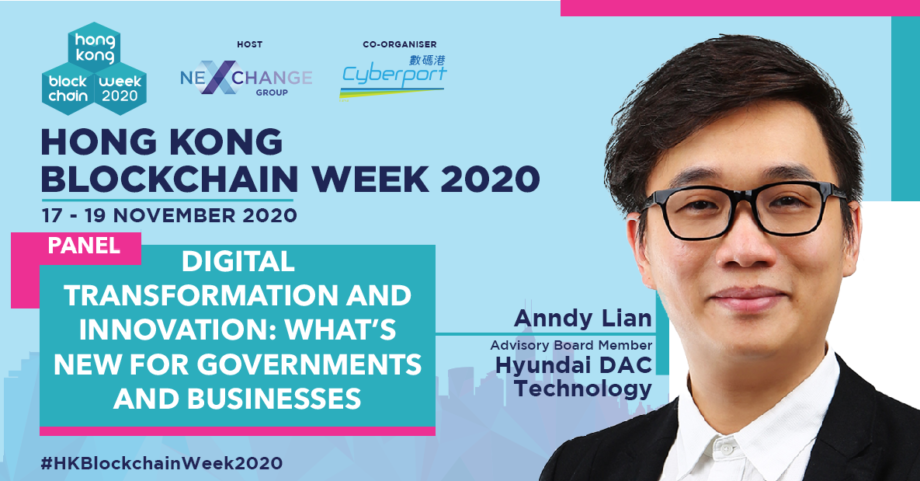
Anndy Lian and a panel of experts spoke on “Digital Transformation and Innovation: What’s New for Governments and Businesses” at the Hong Kong Blockchain Week 2020. This session is timely as COVID19 has accelerated the pace of digital transformation, decision-makers who were reluctant to adopt and adapt have harnessed technology innovation to keep their companies afloat, and governments are relying on digital solutions to respond quickly to the global crisis.

Digitalization has become essential and has brought up its real purpose in such times. According to ASME-Microsoft study 2020, 83% of small and medium enterprises (SMEs) in Singapore now have digital transformation strategies. More than half (54%) reported delays in their digitalization plans due to COVID-19. Also, despite higher digital transformation adoption, only two in five SMEs perceive their efforts to be successful. This study also coincides with what Olga Yaroshevsky, the moderator of this panel, has mentioned in global trends that only 30% of digital projects implemented have exceeded its target value.

“This is not alarming, and this trend has happened long before the COVID19 times. Governments and associations are trying hard to push the technology agenda into businesses. Legacy is not the main issue. It is an excuse. I think human interference is a bigger deferral for the adoption of new technology. “Anndy Lian, Advisory Board Member, Hyundai DAC Technology commented.

Lian added: “Whenever there is a new technology in place such as negativity, I do see much negativity that comes along with it. People do not see the positive aspects of things on such innovation. Many are too relying on government grants, which is a big disadvantage, for example. Take Singapore, for example. In the past decade, companies took advantage of the grants, but the result is that most of them stopped using it after the claims were made. This is mainly because of their mindset, and their starting point when obtaining the grant is not with the correct intention and purpose. For innovation to grow, it has to be a win-win for everybody, companies need to have the right mindset, and a good push from the government will kick start innovation in a much better manner.”

Dr. Toa Charm, Chairman, OpenCertHub & Associate, and Professor, CUHK Business School, agreed with Anndy’s point. “The subsidy is helpful but not sustainable. Companies must appreciate the digital transformation culture and appreciate the digital transformation. In the times of COVID19, governments have placed additional subsidies and grants to SMEs and different programs, but this is only for a short period and may not be sustainable. We have to make it closer to what the companies are doing, embedding the technology in our daily lives seamlessly.”

Last but not least, Anndy emphasized, “Digitalization has struck every government as a priority never before. The move into digital with AI, big data, automation, blockchain & cryptocurrencies will stay with us for a long time.”

This session consists of Anndy Lian, Advisory Board Member, Hyundai DAC Technology, Dr. Ernie Teo, Vice-Chairman, Blockchain Association Singapore, Mohammad Sear, Associate Partner, Digital Government & Public Sector Advisory, EY, Dr. Toa Charm, Chairman, OpenCertHub & Associate and Professor, CUHK Business School and moderated by Olga Yaroshevsky, NexChange Group. The panelists have also shared their insights on the subject matter, and the full recording can be found online at https://youtu.be/3aYJD6hkhKs.

Hong Kong Blockchain Week 2020, hosted by NexChange and led by their Chairman Juwan Lee delivers specialist content and expert discussions directly from industry leaders who are building the future of blockchain technology and digital assets. Professionals from all parts of the ecosystem, including investors, government, start-ups, and enterprises, come together for deep learning, robust discussions, and high-impact networking. This is the largest blockchain virtual event in Hong Kong will see the global blockchain community converge to discuss the latest developments and insights into the evolving, real-world applications of blockchain technology in finance, investment, enterprise, socially essential projects, and the global payment industry.

About Anndy Lian:
Anndy Lian is an early blockchain adopter and experienced serial blockchain entrepreneur known for his work in the government sector. He is a best-selling book author, “Blockchain Revolution 2030” and currently the Advisory Board Member of Hyundai DAC Technology. He plays a pivotal role as the Blockchain Advisor for Asian Productivity Organisation (APO), an intergovernmental organization committed to improving productivity in the Asia-Pacific region. Anndy is also part of the Gyeongsangbuk-do Blockchain Special Committee, the Government of Republic Korea with industry experts such as Brock Pierce. You can read more about Anndy’s work at www.anndy.com.

About Hong Kong Blockchain Week:
Hong Kong Blockchain Week 2020, 17-19 November, delivers specialist content and expert discussions directly from industry leaders who are building the future of blockchain technology and digital assets. Professionals from all parts of the ecosystem, including investors, government, start-ups, and enterprises, come together for deep learning, robust discussions, and high-impact networking. High profile speakers such as Dr. David Chung JP, Under Secretary for Innovation and Technology, Hong Kong; Dan Morehead, CEO & CO-CIO, Pantera Capital; Justin Sun, Founder, TRON & CEO, BITTORRENT; Roger Ver, Founder of BITCOIN.COM and Charles Hoskinson, CEO of IOHK & Founder of CARDANO were present

Anndy Lian is an early blockchain adopter and experienced serial entrepreneur who is known for his work in the government sector. He is a best selling book author- “NFT: From Zero to Hero” and “Blockchain Revolution 2030”.

Currently, he is appointed as the Chief Digital Advisor at Mongolia Productivity Organization, championing national digitization. Prior to his current appointments, he was the Chairman of BigONE Exchange, a global top 30 ranked crypto spot exchange and was also the Advisory Board Member for Hyundai DAC, the blockchain arm of South Korea’s largest car manufacturer Hyundai Motor Group. Lian played a pivotal role as the Blockchain Advisor for Asian Productivity Organisation (APO), an intergovernmental organization committed to improving productivity in the Asia-Pacific region.

An avid supporter of incubating start-ups, Anndy has also been a private investor for the past eight years. With a growth investment mindset, Anndy strategically demonstrates this in the companies he chooses to be involved with. He believes that what he is doing through blockchain technology currently will revolutionise and redefine traditional businesses. He also believes that the blockchain industry has to be “redecentralised”.

j j j