Interview/Anndy Lian – The Future of Crypto Airdrops: Hype or Hope?

Interview/Anndy Lian – The Future of Crypto Airdrops: Hype or Hope?

From Bitcoin’s humble beginnings – where free coins were given away to early adopters – to today’s multi-million dollar airdrop extravaganzas, the landscape of crypto giveaways has transformed dramatically.  As the industry matures, we’re left with critical questions about the long-term viability and ethical implications of these events.

To get a handle on these complex issues, we turned to Anndy Lian, a leading voice in the blockchain world. As an intergovernmental expert, best-selling author, investor, board member, and sought-after speaker, Lian brings a wealth of knowledge and a unique perspective to the table. His insights into the evolving world of crypto airdrops are both compelling and thought-provoking.

The Shib: What is the most significant impact airdrops have had on the crypto industry thus far?

Lian: In my opinion, it’s Notcoin. They are very decentralized. No VC. Well distributed.

The Shib: Do you believe airdrops are a sustainable and ethical method for wealth distribution or primarily a marketing tactic?

Lian: I think it is a sustainable and ethical marketing strategy that can help gather users in the beginning.

The Shib: What are the potential risks and downsides associated with airdrops for both projects and participants?

Lian: Distributing free tokens can lead to an oversupply in the market, potentially diluting the value of the tokens.

The Shib: How can projects ensure that their airdrops genuinely benefit the community and align with their long-term goals?

Lian: Be transparent about the eligibility criteria for the airdrop. This helps set clear expectations and fosters trust within the community.

The Shib: What regulatory challenges or concerns might arise from the increasing popularity of airdrops?

Lian: There is significant uncertainty regarding the tax treatment of airdropped tokens. Tax authorities in various countries have different guidelines on how to treat these tokens, which can complicate compliance for recipients.

The Shib: How do airdrops influence investment decisions, and what factors should investors consider when evaluating airdropped tokens?

Lian: Evaluate the long-term viability of the project behind the airdrop. A strong project with clear goals is more likely to succeed.

The Shib: What are the red flags or warning signs that investors should look for in airdrops that might indicate potential scams or unsustainable projects?

Lian: Scammers often provide limited or vague project details. A legitimate project should have a well-documented whitepaper, clear information about the team, and token distribution. The one thing I hate is that some scammy projects can “give birth” to new tokens from unknown wallets.

The Shib: How do you think the rise of airdrops has impacted the broader crypto market and investor sentiment?

Lian: Airdrops are never negative. Receiving free tokens can bolster investor confidence. It creates a positive sentiment as investors feel rewarded and may become more active in the crypto space.

The Shib: What long-term trends do you see emerging in the airdrop space, and how might they shape the future of crypto investing?

Lian: One recommendation is that projects should stop using bad middlemen to do their airdrops. They should find good platforms that are really sending the free tokens to the right target audiences. A shift from broad, public airdrops to more targeted distributions aimed at rewarding early adopters and significant contributors to the project.

The Shib: What advice would you give to other projects considering an airdrop as a way to engage their community and distribute tokens?

Lian: Do your math properly.

Crypto airdrops remain a powerful tool for both project growth and individual enrichment. But as the space becomes more sophisticated, so too do the strategies of both legitimate projects and opportunistic scammers. Lian’s insights underscore the importance of informed decision-making, careful risk assessment, and a focus on long-term value over short-term hype.  Airdrops can be a part of a balanced crypto portfolio, but they should not be the sole focus of any serious investor.


Source: https://news.shib.io/2024/06/26/interview-anndy-lian-the-future-of-crypto-airdrops-hype-or-hope/

Anndy Lian is an early blockchain adopter and experienced serial entrepreneur who is known for his work in the government sector. He is a best selling book author- “NFT: From Zero to Hero” and “Blockchain Revolution 2030”.

Currently, he is appointed as the Chief Digital Advisor at Mongolia Productivity Organization, championing national digitization. Prior to his current appointments, he was the Chairman of BigONE Exchange, a global top 30 ranked crypto spot exchange and was also the Advisory Board Member for Hyundai DAC, the blockchain arm of South Korea’s largest car manufacturer Hyundai Motor Group. Lian played a pivotal role as the Blockchain Advisor for Asian Productivity Organisation (APO), an intergovernmental organization committed to improving productivity in the Asia-Pacific region.

An avid supporter of incubating start-ups, Anndy has also been a private investor for the past eight years. With a growth investment mindset, Anndy strategically demonstrates this in the companies he chooses to be involved with. He believes that what he is doing through blockchain technology currently will revolutionise and redefine traditional businesses. He also believes that the blockchain industry has to be “redecentralised”.

j j j

How to Profit Off the Bitcoin ETF Hype: A Guide for Crypto Traders

How to Profit Off the Bitcoin ETF Hype: A Guide for Crypto Traders

Bitcoin ETFs are one of the hottest topics in the crypto space right now. These are exchange-traded funds that track the price of Bitcoin (BTC) and allow investors to gain exposure to the cryptocurrency without having to buy or store it directly.

Bitcoin ETFs are seen as a way to bring more legitimacy, liquidity, and institutional adoption to the crypto market and lower the barriers of entry for retail investors.

However, Bitcoin ETFs are not yet approved in the U.S., the world’s largest and most influential financial market.

The Securities and Exchange Commission (SEC) has been reluctant to give the green light to any of the dozens of applications that have been filed over the years, citing concerns over market manipulation, investor protection, and regulatory oversight.

The signs are the first batch of Bitcoin ETF proposals are likely to get approval as early as this week, which include ETFs from BlackRock, Fidelity, and Grayscale.

The anticipation and speculation around the possible approval of Bitcoin ETFs have created a lot of hype and volatility in the crypto market, especially for Bitcoin, which surged past $47,000 in the last day.

Many analysts and investors believe that the approval of Bitcoin ETFs could trigger a massive rally for the cryptocurrency, as it would attract billions of dollars of inflows from institutional and retail investors looking for a regulated and convenient way to access the crypto space.

But how can crypto traders profit off this hype? What are the best trading strategies and focus to adopt in this scenario? In this article, I will explore some of the options and considerations that crypto traders should keep in mind when dealing with the Bitcoin ETF hype.

Strategy #1: Buy the Rumor, Sell the News

One of the most common and simple trading strategies that can be applied to the Bitcoin ETF hype is to buy the rumor and sell the news.

This means that traders should buy Bitcoin when there is positive speculation and anticipation about the approval of Bitcoin ETFs and sell it when the actual news or decision is announced.

This strategy is based on the assumption that the market tends to price in the expected outcome of an event before it happens and that the actual outcome may not live up to the hype or may already be reflected in the price. Therefore, traders can take advantage of the price movements that are driven by the market sentiment and expectations rather than by the fundamental facts.

For example, if the market expects that the SEC will approve a Bitcoin ETF, the price of Bitcoin may rise in anticipation of this event, as more investors buy Bitcoin in hopes of benefiting from the increased demand and exposure that an ETF would bring.

However, when the SEC actually announces its decision, the price of Bitcoin may drop, as some investors may sell their Bitcoin to lock in profits, or as the market may realize that the approval of a Bitcoin ETF is not as bullish or impactful as expected.

Conversely, if the market expects that the SEC will reject a Bitcoin ETF, the price of Bitcoin may fall in anticipation of this event, as more investors sell in fear of losing value or missing out on other opportunities.

However, when the SEC actually announces its decision, the price of Bitcoin may rise, as some investors may buy back at a lower price or as the market may realize that the rejection of an ETF is not as bearish or detrimental as expected.

Therefore, traders who follow this strategy should monitor the market sentiment and expectations around the Bitcoin ETF approval and buy or sell Bitcoin accordingly before the actual news or decision is announced. They should also set a clear exit plan and take profit or stop loss targets, as the Bitcoin price may reverse quickly after the news or decision is announced.

Strategy #2: Trade the Breakouts and Pullbacks

Another trading strategy that can be applied to the Bitcoin ETF hype is to trade the breakouts and pullbacks. This means that traders should buy or sell Bitcoin when it breaks out of a certain price range or level and when it pulls back to retest that range or level.

This strategy is based on the assumption that the market tends to move in trends and that the breakouts and pullbacks are signals of the strength and direction of the trend. Therefore, traders can take advantage of the price movements that are driven by the momentum and trend-following behavior of the market.

For example, if the price of Bitcoin is trading in a sideways range and it breaks out of the upper boundary of the range, this may indicate that the market is bullish and that a new uptrend has started. Traders who follow this strategy should buy Bitcoin when it breaks out of the range and set a stop loss below the range.

They should also look for a pullback to the upper boundary of the range, which may act as a support level, and buy more Bitcoin when it bounces off that level.

Conversely, if the price of Bitcoin is trading in a sideways range and it breaks out of the lower boundary of the range, this may indicate that the market is bearish and that a new downtrend has started.

Traders who follow this strategy should sell Bitcoin when it breaks out of the range and set a stop loss above the range. They should also look for a pullback to the lower boundary of the range, which may act as a resistance level, and sell more Bitcoin when it rejects that level.

Therefore, traders who follow this strategy should monitor the price action and trend of Bitcoin and buy or sell accordingly when it breaks out or pulls back to a certain price range or level.

They should also use technical indicators, such as moving averages, trend lines, and Fibonacci retracements, to identify the potential breakout and pullback levels and to confirm the direction and strength of the trend.

Strategy #3: Hedge with Bitcoin Futures and Options

A third trading strategy that can be applied to the Bitcoin ETF hype is to hedge with Bitcoin futures and options. This means that traders should use Bitcoin derivatives, such as futures and options contracts, to reduce their risk and exposure to the price fluctuations of Bitcoin.

This strategy is based on the assumption that the market is uncertain and volatile and that the outcome of the ETF approval is unpredictable and impactful.

Therefore, traders can use Bitcoin derivatives to protect their existing positions or to speculate on the price movements of Bitcoin without having to buy or sell the underlying asset.

For example, if a trader is holding a long position in Bitcoin and expects that the SEC will approve a Bitcoin ETF but is not sure when or how the market will react, the trader can hedge their position by buying a put option on Bitcoin.

A put option is a contract that gives the buyer the right, but not the obligation, to sell the underlying asset at a specified price and time. By buying a put option, the trader can lock in a minimum selling price for their Bitcoin in case the price drops after the approval of the ETF.

The trader can also profit from the put option if the price of Bitcoin falls below the strike price of the option minus the premium paid for the option.

Conversely, if a trader is holding a short position in Bitcoin and expects that the SEC will reject a Bitcoin ETF but is not sure when or how the market will react, the trader can hedge their position by buying a call option on Bitcoin.

A call option is a contract that gives the buyer the right, but not the obligation, to buy the underlying asset at a specified price and time. By buying a call option, the trader can lock in a maximum buying price for their Bitcoin if the price rises after the Bitcoin ETF is rejected. The trader can also profit from the call option if the price of Bitcoin rises above the strike price of the option plus the premium paid for the option.

Therefore, traders who follow this strategy should use Bitcoin derivatives to hedge their positions or to speculate on the price movements, depending on their expectations and risk appetite.

They should also understand the mechanics and risks of Bitcoin derivatives, such as leverage, margin, expiration, and liquidity, and choose the appropriate contract type, size, and duration for their trading objectives.

Focus: Short-Term Profits or Long-Term Position?

The final question that crypto traders should ask themselves when dealing with the Bitcoin ETF hype is whether they should focus on short-term profits or long-term position.

This depends on their trading style, goals, and risk tolerance, as well as on their view and outlook on the crypto market and the Bitcoin ETF approval.

Traders who are looking for short-term profits should focus on capturing the price movements and volatility that are generated by the Bitcoin ETF hype and use strategies such as buying the rumor and selling the news or trading the breakouts and pullbacks.

These traders should be agile and flexible and be ready to enter and exit the market quickly and frequently, as the market conditions and sentiment may change rapidly and unpredictably. These traders should also use technical analysis, indicators, and tools to identify the entry and exit points and manage their risk and reward.

Traders who are looking for a long-term position should focus on building and holding their exposure to Bitcoin and use strategies such as hedging with futures and options or dollar-cost averaging.

These traders should be patient and disciplined, and be ready to withstand the price fluctuations and volatility that are inherent to the crypto market and use fundamental analysis, research, and news to support their view and outlook. These traders should also use risk management techniques, such as diversification, portfolio rebalancing, and stop loss orders, to protect their capital and profits.

The Bottom Line

The Bitcoin ETF hype is a major catalyst and driver for the crypto market, and it offers many opportunities and challenges for crypto traders.

Depending on their expectations, objectives, and risk appetite, crypto traders can use different strategies and focus to profit off the Bitcoin ETF hype, such as buying the rumor and selling the news, trading the breakouts and pullbacks, or hedging with Bitcoin futures and options.

However, crypto traders should also be aware of the uncertainty and volatility that surround the Bitcoin ETF approval and be prepared for any possible outcome and scenario.

We will end this article with an important reminder that a trading strategy or a cryptocurrency’s past performance does not guarantee future returns.

With this in mind, we urge readers to do their own research (DYOR) and to be mindful of fear-of-missing-out (FOMO) when investing in cryptocurrencies. Remember, cryptocurrencies are extremely volatile and considered risky investments.

This article should not be considered investment advice and is for information purposes only.


Source: https://www.techopedia.com/how-to-profit-off-the-bitcoin-etf-hype-a-guide-for-crypto-traders

FAQ

What are Bitcoin ETFs, and why are they significant in the crypto market?

Bitcoin ETFs, or exchange-traded funds, track the price of Bitcoin, allowing investors exposure to the cryptocurrency without directly buying or storing it. They are seen as a means to bring legitimacy, liquidity, and institutional adoption to the crypto market, lowering entry barriers for retail investors.

What trading strategies can crypto traders adopt during the Bitcoin ETF hype?

Traders can consider strategies like 'Buy the Rumor, Sell the News,' 'Trade the Breakouts and Pullbacks,' and 'Hedge with Bitcoin Futures and Options.' The choice between focusing on short-term profits or long-term positions depends on individual trading styles and risk tolerance. However, it's crucial to be aware of the uncertainty and volatility surrounding the Bitcoin ETF approval.


Anndy Lian is an early blockchain adopter and experienced serial entrepreneur who is known for his work in the government sector. He is a best selling book author- “NFT: From Zero to Hero” and “Blockchain Revolution 2030”.

Currently, he is appointed as the Chief Digital Advisor at Mongolia Productivity Organization, championing national digitization. Prior to his current appointments, he was the Chairman of BigONE Exchange, a global top 30 ranked crypto spot exchange and was also the Advisory Board Member for Hyundai DAC, the blockchain arm of South Korea’s largest car manufacturer Hyundai Motor Group. Lian played a pivotal role as the Blockchain Advisor for Asian Productivity Organisation (APO), an intergovernmental organization committed to improving productivity in the Asia-Pacific region.

An avid supporter of incubating start-ups, Anndy has also been a private investor for the past eight years. With a growth investment mindset, Anndy strategically demonstrates this in the companies he chooses to be involved with. He believes that what he is doing through blockchain technology currently will revolutionise and redefine traditional businesses. He also believes that the blockchain industry has to be “redecentralised”.

j j j

Exploring The Meme Coin Craze: Risk, Hype, And Online Communities

Exploring The Meme Coin Craze: Risk, Hype, And Online Communities

Over the past weeks, social media platforms have been buzzing with tales of traders who seemingly hit the jackpot by investing in the PEPE meme coin. These stories of overnight success raise an important question: Can meme coins truly be relied upon as a means to accumulate wealth, or are they akin to playing the lottery and relying on luck?

To find the answer, we must explore the diverse strategies employed by various socio-economic classes when engaging with the lottery. The comparison between meme coins and lotteries sheds light on the different perspectives towards wealth accumulation.

Meme coins, for those unfamiliar, are digital currencies inspired by internet memes. Unlike traditional cryptocurrencies, meme coins typically lack practical applications beyond being traded and shared among users. Their value is heavily influenced by social media sentiment and other factors, leading to substantial price swings and the potential for market manipulation. While meme coins carry significant risks, they have amassed a substantial following of individuals who see them as a means of challenging established financial systems and connecting with like-minded communities online.

The PEPE meme coin, in particular, experienced a staggering 9,071% surge in value prior to its listing on Binance, reaching an astounding market capitalization of $1.8 billion. However, cautionary advice is now being shared among traders due to the coin’s recent breach of crucial trend and support levels. Meme coins, especially those developed by anonymous teams, are susceptible to “rug pulls,” where developers abandon the project, leading to a collapse in value. Additionally, price volatility tends to be most pronounced during Asian trading hours.

On the other hand, we have the allure of the lottery, where the promise of instant wealth with minimal effort and investment proves irresistible to many. Despite the astronomical odds of winning a jackpot (1 in 300 million for Powerball), the average player spends close to $200 per year, which accumulates to a significant sum over time. Surprisingly, research suggests that those who fall into the lower socio-economic class tend to play the lottery regardless of the odds, while wealthier individuals only participate when the jackpot offers substantial returns. For the wealthy, a $10 million win may not make a significant impact, but a jackpot exceeding $100 million piques their interest.

In essence, the PEPE meme coin and the lottery represent two sides of the same coin. Both offer the allure of swift wealth with minimal investment, but both carry substantial risks. While Buffet’s investment strategy prioritizes safety and is grounded in long-term schemes, playing the lottery or investing in meme coins resembles a game of chance, hoping for the best outcome.

What Other Meme Coins Are Making Waves?

The surge in popularity of meme coins can be attributed to various factors, including the growing fascination with cryptocurrencies and the relative ease of creating new digital currencies. Several meme coins have garnered attention for their clever branding and incorporation of popular culture references, which have fueled interest and speculation. The social media-driven aspect of meme culture has also played a significant role, with influencers and online communities endorsing their preferred coins and spreading the word to their followers.

This has created a frenzied environment of buying and selling, as investors aim to capitalize on the hype and take advantage of the unpredictability of these highly speculative assets.

Here are several meme coins that have gained popularity and attention:

  • AiDoge: AiDoge positions itself as a new web3 platform for meme creation and sharing using AI technology. The project has gained significant attention, with its presale reportedly raising over $5.5 million.
  • Ordi: Ordi is a meme coin paying homage to the Ordinals protocol, which is currently the largest with a value of $400 million.
  • BOB: BOB is an AI bot that provides tweet summaries to Twitter users who reply with “@ExplainThisBob”. Its programming includes automatic responses to tweets made by Elon Musk, which have earned BOB praise from Musk himself and garnered a large following of several thousand users.
  • MONG: MONG is a recently launched meme cryptocurrency project in 2023. What sets MONG Coin apart from other meme cryptocurrencies is its association with an established NFT collection called MONGS NFT, which was created in January 2022. The collection features 6,943 NFTs, with each NFT portraying a distinct mungo (mongoose).
  • TURBO: TURBO is an innovative cryptocurrency with a unique token economy that aims to become the meme coin of the future. Unless many other meme coins, TURBO is developed almost exclusively using ChatGPT.
  • LADYS: Milady Meme Coin has its native token called LADYS, which can be utilized to pay for online goods and services. The token’s value received a lot of attention after Elon Musk tweeted about the Milady NFT meme. Currently, the market capitalization of this meme token has exceeded $100 million.
  • WOJAK: WOJAK is a new ERC-20 token, inspired by the famous Wojak meme. Since its inception, the token has gained massive momentum and at its peak, it has surged over 1000%.
  • Floki: Floki is a cryptocurrency that initially started as a meme coin inspired by the dog of Elon Musk. However, it has now transformed into a complete Web3 ecosystem that comprises NFTs, DeFi, a metaverse, and prepaid gift cards for Visa and Mastercard. The project has gained a lot of attention as it was recently added to the list of cryptocurrencies on Binance.
  • XRdoge: XRdoge  is a meme coin on the XRP ledger. Similar to Floki, they are not a new meme coin. The reason why they are mentioned is that I felt that XRP needs to have their own doge and have some fun. The fun elements could bring more hype to the Ripple ecosystem.

The newer memes that are trying to ride on the PEPE waves, like BIBI, BOBO, PEPO, and PIPI would need to find their own niche very soon. Other Chinese-themed coins like Pogai and LowB got to gather more mandarin speaking communities to join in the fun. If you are a Cate, SquidGrow, TSUKA or Renewable coin and not part of the frog or dog craze, you just got to wait for your turn to shine.

It is worth mentioning that while newer meme coins have recently gained significant popularity, older meme coins such as Doge, Shiba Inu, Pitbull, RichQuack, Saitama, Baby Doge, Safemoon continue to thrive by actively maintaining their community and working on their projects. This demonstrates their commitment to longevity and a sustained presence in the ever-changing world of cryptocurrency. The level of dedication and perseverance displayed by these coins is a positive indication for the meme coin industry, as it suggests that some of these coins may have staying power beyond just a momentary hype cycle. The continued relevance and demand for these older meme coins highlight their ability to maintain a loyal following and leave a lasting impact, even in the midst of emerging trends and shifting market conditions.

In conclusion

It should be noted, however, that meme coins are known for their strong online communities, driven by hype and speculation, and may not necessarily have serious real-world use cases or underlying technology.

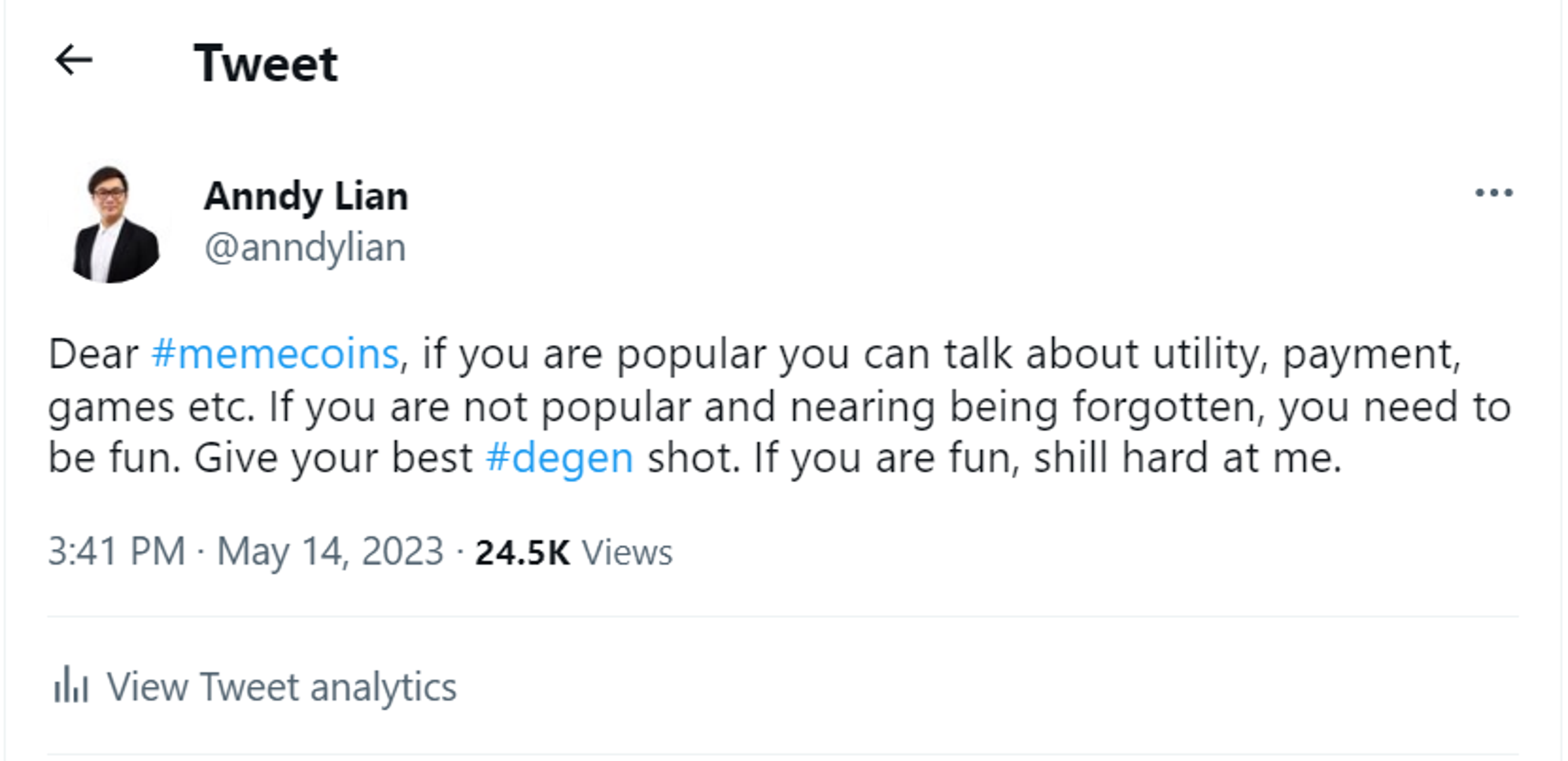
Like what I have mentioned on Twitter“Dear #memecoins, if you are popular you can talk about utility, payment, games etc. If you are not popular and nearing being forgotten, you need to be fun…”

The underlying for its success would still be community and having fun together. If a meme coin survives the initial stages and gains support from its community, its games, NFTs, or even metaverse would have a much higher chance of success. Their new revenue streams would be vital for them to survive in the bear market and beyond.

It’s essential to consider the risks and rewards of any investment opportunity carefully. While the promise of quick wealth might be tempting, long-term, low-risk investments are the safest and most reliable way to accumulate wealth.


Source: https://www.benzinga.com/23/05/32628423/exploring-the-meme-coin-craze-risk-hype-and-online-communities

Anndy Lian is an early blockchain adopter and experienced serial entrepreneur who is known for his work in the government sector. He is a best selling book author- “NFT: From Zero to Hero” and “Blockchain Revolution 2030”.

Currently, he is appointed as the Chief Digital Advisor at Mongolia Productivity Organization, championing national digitization. Prior to his current appointments, he was the Chairman of BigONE Exchange, a global top 30 ranked crypto spot exchange and was also the Advisory Board Member for Hyundai DAC, the blockchain arm of South Korea’s largest car manufacturer Hyundai Motor Group. Lian played a pivotal role as the Blockchain Advisor for Asian Productivity Organisation (APO), an intergovernmental organization committed to improving productivity in the Asia-Pacific region.

An avid supporter of incubating start-ups, Anndy has also been a private investor for the past eight years. With a growth investment mindset, Anndy strategically demonstrates this in the companies he chooses to be involved with. He believes that what he is doing through blockchain technology currently will revolutionise and redefine traditional businesses. He also believes that the blockchain industry has to be “redecentralised”.

j j j