Anndy Lian on decentralization and the potential impact of Web4

Anndy Lian on decentralization and the potential impact of Web4

In this interview, Anndy Lian discusses Web4 and its potential societal impact. He explores the evolving relationship between decentralization and artificial intelligence, the role of governments in a Web4 world and offers advice on navigating this emerging landscape.

In this interview, we cover:

  • Discover Anndy Lian’s vision for Web4, an intelligent and autonomous web that promises to revolutionize digital governance and create new business models.
  • Learn about the exciting intersection of Web4 and AI, which could lead to increased efficiency, better decision-making, and improved user experiences.
  • Delve into the potential use cases for blockchain technology in a decentralized Web4 world, such as DeFi, digital identity management, and supply chain management.
  • Gain insight into the evolving role of governments in a decentralized Web4 world and the challenges they face in striking the right balance between innovation and protection.
  • Learn how individuals and businesses can best navigate the rapidly changing landscape of decentralization and Web4, positioning themselves for success in this groundbreaking era.

Interview with Anndy Lian, Mongolian Productivity Organization Chief Digital Advisor

Q: Hi Anndy, can you give an introduction of yourself?

Hello, I’m Anndy Lian, an early crypto guy who has been involved in the blockchain and cryptocurrency industry since its early days. I have over 15 years of experience in the technology industry, and I was one of the earlier few individuals to interact with the government on crypto-related matters in Asia.

I have worked with several government agencies and regulators, providing my expertise on blockchain and cryptocurrency regulations. My early involvement with the government helped shape the regulatory landscape of the industry and allowed me to play a significant role in driving the adoption of blockchain technology. I am also a published author and have written several books on blockchain and its potential impact on various industries. I am a regular speaker at international conferences and events, sharing my insights on the latest developments in technology and blockchain.

In addition to my professional work, I am actively involved in the startup community and serve as an advisor and investor to several blockchain and technology startups. I am passionate about leveraging technology to drive innovation and create positive change in the world.

Q: Can you explain what decentralization is and why it’s important?

Decentralization refers to the distribution of power and decision-making authority away from a central authority or entity, and towards a more distributed network of participants. In the context of blockchain technology, decentralization means that there is no single point of control or failure in the network. This is important because it reduces the risk of censorship, fraud, and corruption, and promotes greater transparency and accountability.

Q: How do you see Web4 evolving from Web3, and what do you think will be the key differences?

Web4 is still a nascent concept, but it’s expected to build on the principles of Web3 and take them further. While Web3 focused on decentralization and the creation of a more peer-to-peer web, Web4 is likely to focus on creating a more intelligent and autonomous web that is able to make decisions on behalf of users. This will require a greater degree of interoperability between different blockchain protocols and systems, as well as the development of advanced AI and machine learning algorithms.

Q: What impact do you think Web4 will have on society and the economy?

The impact of Web4 on society and the economy is likely to be significant. It will enable the creation of new decentralized applications and platforms that are more intelligent, autonomous, and efficient. This could lead to new forms of digital governance, new business models, and new ways of organizing and collaborating. However, it’s also likely to pose new challenges, such as the need for new regulatory frameworks to govern the use of AI and machine learning, and the potential for new forms of inequality and exclusion.

Q: How do you see the relationship between Web4 and artificial intelligence (AI) evolving, and what are some potential benefits and risks of this relationship?

Web4 and AI are likely to become increasingly intertwined, with AI playing a critical role in creating more intelligent and autonomous decentralized systems. Some potential benefits of this relationship include increased efficiency, better decision-making, and improved user experience. However, there are also potential risks, such as the potential for AI to perpetuate biases and discrimination, and the need for new regulatory frameworks to govern the use of AI in decentralized systems.

Q: What are some of the key use cases for blockchain technology in a decentralized Web4 world?

Blockchain technology has many potential use cases in a decentralized Web4 world. Some examples include decentralized finance (DeFi), digital identity management, supply chain management, voting and governance systems, and content distribution. By leveraging the unique features of blockchain, such as immutability, transparency, and security, these applications can be more efficient, secure, and trustworthy than their centralized counterparts and the current Web3.

Q: How do you think governments and regulators will respond to the rise of Web4 and decentralized technologies more broadly?

Governments and regulators are already grappling with the rise of decentralized technologies, and this is likely to continue as Web4 becomes more mainstream. There is a need for greater collaboration and dialogue between the public and private sectors to ensure that the benefits of these technologies are maximized, while also addressing any potential risks or negative externalities. It’s important to strike the right balance between promoting innovation and protecting consumers and society as a whole.

Q: How do you envision the role of government in a decentralized Web4 world, and what are some of the key challenges that need to be addressed?

The role of government in a decentralized Web4 world is a complex and evolving issue. On the one hand, governments will need to adapt to the new decentralized paradigm, which could lead to new forms of digital governance and regulation. On the other hand, governments will need to balance the need for innovation with the need to protect consumers and society as a whole. Some of the key challenges that need to be addressed include the development of new regulatory frameworks, the management of data privacy and security, and the need for greater collaboration and dialogue between the public and private sectors.

Q: How do you see the relationship between decentralized and centralized systems evolving, and what are some potential benefits and risks of this relationship?

The relationship between decentralized and centralized systems is likely to be complex and multifaceted. While decentralized systems offer many benefits, such as greater transparency, security, and efficiency, there are also some areas where centralized systems may be more appropriate. For example, centralized systems may be better suited for certain types of data processing and decision-making. The key is to strike the right balance between decentralized and centralized systems, based on the specific needs of each application and use case.

Q: How can individuals and businesses best navigate the evolving landscape of decentralization and Web4?

To navigate the evolving landscape of decentralization and Web4, individuals and businesses need to be proactive, adaptable, and forward-thinking. This means staying up-to-date with the latest developments in the field, investing in new technologies and skill sets, and being aware of the potential risks and challenges. It also means engaging with other experts and thought leaders, and being willing to experiment and innovate. By taking a proactive and collaborative approach, individuals and businesses can position themselves for success in the decentralized Web4 era.


Source: https://cryptoslate.com/anndy-lian-on-decentralization-and-the-potential-impact-of-web4/
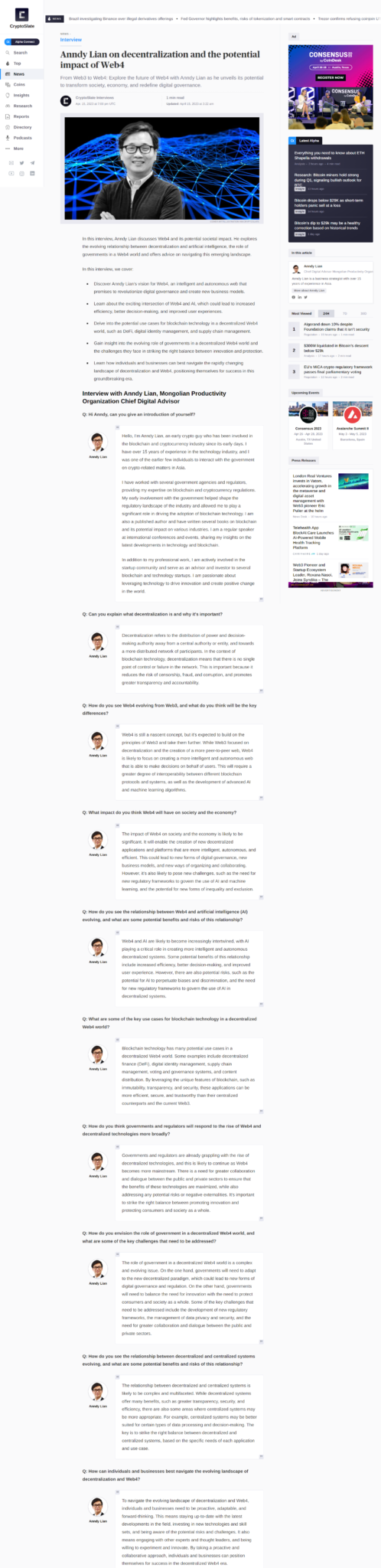
Anndy Lian is an early blockchain adopter and experienced serial entrepreneur who is known for his work in the government sector. He is a best selling book author- “NFT: From Zero to Hero” and “Blockchain Revolution 2030”.

Currently, he is appointed as the Chief Digital Advisor at Mongolia Productivity Organization, championing national digitization. Prior to his current appointments, he was the Chairman of BigONE Exchange, a global top 30 ranked crypto spot exchange and was also the Advisory Board Member for Hyundai DAC, the blockchain arm of South Korea’s largest car manufacturer Hyundai Motor Group. Lian played a pivotal role as the Blockchain Advisor for Asian Productivity Organisation (APO), an intergovernmental organization committed to improving productivity in the Asia-Pacific region.

An avid supporter of incubating start-ups, Anndy has also been a private investor for the past eight years. With a growth investment mindset, Anndy strategically demonstrates this in the companies he chooses to be involved with. He believes that what he is doing through blockchain technology currently will revolutionise and redefine traditional businesses. He also believes that the blockchain industry has to be “redecentralised”.

j j j

Ethereum Merge’s impact on NFTs- Coming back? Maybe? Or maybe not?

Ethereum Merge’s impact on NFTs- Coming back? Maybe? Or maybe not?

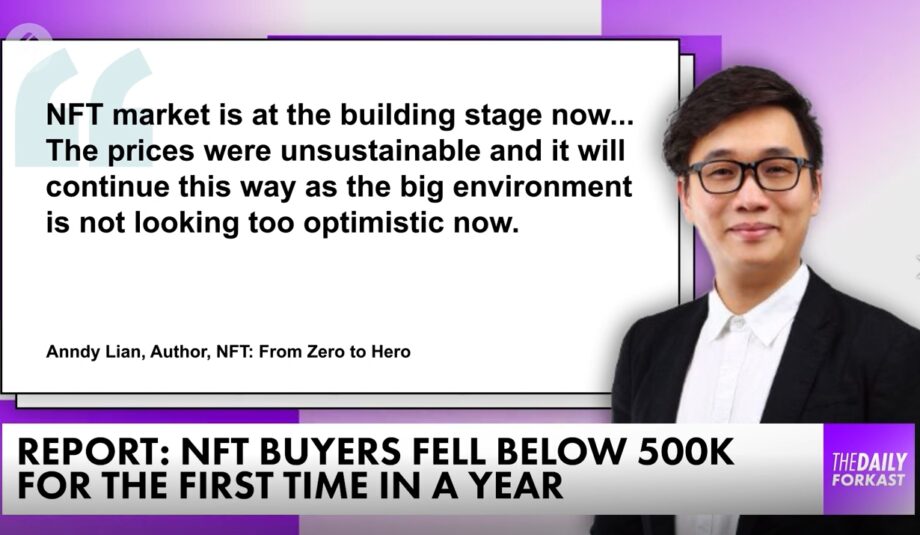
The number of unique NFT buyers falls below 500,000. It seems like #EthereumMerge is the savior.

Ethereum merge and transition from proof-of-work to proof-of-stake (PoS) will further deliver changes to the NFT market. The Ethereum merge is expected to increase the diversification of Ethereum and revamp the tokenomics of the entire market. We could also see a short-term increase in NFT’s pricing.

Anndy Lian commented on his previous post on Anndy.com: The core message that I was trying to say is that the NFT market is at the rebuilding stage right now. The previous highs that were in the bull market are in a challenging stage. The prices were unsustainable, and it will continue this way as the macro environment is not looking too optimistic now.

There are many contributing factors to this current state but is this the end of the NFT markets? It is not.

Right now there are more projects in the markets working hard behind the scene working on content, books, music, and better gaming assets and experiences. The speculation market has died down, and this is actually very healthy for all of us to grow.

This is a time to go back to basics. We can look at the 5Ps of marketing- Product, Price, Promotion, Place, and People.

When we are in the bull market, whatever products can sell without doing anything. But in the current times, we need to look at the product. Is it value for money?

Pricing is another factor to look at. PFP in the good times can start at a 1 ETH floor price. We should watch our pricing more carefully right now. Take my NFT book, for example, I choose to launch it on Bybit NFT Marketplace at $2.99, not $29.99. This decision was made after looking at the market and the demand from my communities.

Lastly, I think people and community are what we should be building too. If you do not have this, this is the best time to look into it now. This will also help you to get better results when the market turns better.

Source: The Daily Forkast – September 2, 2022, presented by Joel Flynn.


Anndy Lian is an early blockchain adopter and experienced serial entrepreneur who is known for his work in the government sector. He is a best selling book author- “NFT: From Zero to Hero” and “Blockchain Revolution 2030”.

Currently, he is appointed as the Chief Digital Advisor at Mongolia Productivity Organization, championing national digitization. Prior to his current appointments, he was the Chairman of BigONE Exchange, a global top 30 ranked crypto spot exchange and was also the Advisory Board Member for Hyundai DAC, the blockchain arm of South Korea’s largest car manufacturer Hyundai Motor Group. Lian played a pivotal role as the Blockchain Advisor for Asian Productivity Organisation (APO), an intergovernmental organization committed to improving productivity in the Asia-Pacific region.

An avid supporter of incubating start-ups, Anndy has also been a private investor for the past eight years. With a growth investment mindset, Anndy strategically demonstrates this in the companies he chooses to be involved with. He believes that what he is doing through blockchain technology currently will revolutionise and redefine traditional businesses. He also believes that the blockchain industry has to be “redecentralised”.

j j j

Tax on virtual digital assets a concern for NFTs; impact may be short term: Experts

Tax on virtual digital assets a concern for NFTs; impact may be short term: Experts

A slowdown in cryptocurrency trading may have an impact on NFT transactions as well, although it could be a temporary phenomenon as investors await more clarity from the government.

The 30 percent tax on income from the transfer of virtual digital assets (VDAs) that came into effect from April 1 is a cause of concern not only for cryptocurrencies, which have seen a drop in trading volumes, but also for non-fungible tokens (NFTs) that gathered steam in India in the past year with the entry of sports and Bollywood celebrities.

“The immediate scenario is bleak for crypto and even bleaker for NFTs in India,” Raj Kapoor, strategic advisor at Acryptoverse, a crypto-marketing firm, told Moneycontrol. “NFTs in India will face a fallout with only unique models surviving. NFT creators here are popping up daily while collectors remain non-existent.”

Anndy Lian, Chairman, BigONE Exchange, a crypto trading platform, said the tax on VDAs in India will impact NFT sales.

“The overall market condition is not favourable. NFT sales will drop further and only the better assets will have a place in the crypto-verse,” he said.

He added that NFTs that are more speculative in nature and driven by profit will suffer hard when it comes to tax.

Vinu Peter Immanuel, a partner at Link Legal who tracks NFTs, said that with average trading volumes on top cryptocurrency exchanges dropping 80 to 90 percent from a few months ago, the impact will also be seen on NFTs.

“Since NFTs are traded mostly by using cryptocurrencies, any slowdown in cryptocurrency trading may have an impact on NFT transactions as well. Although it could be a temporary phenomenon where cryptocurrency investors have taken a step back and are waiting for more clarity from the government,” he said.

Short-term impact

However, Hitesh Malviya, founder of IBC (It’s Blockchain) DAO (decentralised autonomous organisation) said NFTs in India are not even a $10 million market in terms of daily sales.

“We have got limited traction here if we compare it to the west. In the US, marketplaces are doing over a billion dollar sales volume every month. Since it’s a limited market, I don’t see many people have got affected as we have less than 1 lakh Indians who have bought any NFTs,” Immanuel said.

Siddharth Jaiswal, founder of Sportzchain, said the new taxation policy will have a short-term impact on NFTs.

“For all of us, this is the first year for the cryptocurrency and NFT tax framework. For many, 30 percent may seem a lot, but if you see the kind of exponential returns, 30 percent may seem less. There have been exponential gains as well, to the tune of 300 to 500 percent, so 30 percent (tax) seems less. However, the same is subjective,” he said.

Malviya noted that while it’s a tough law for short-term traders as they will be required to pay 1 percent on each NFT trade, it would be fine for a long-term value investor like him.

“I don’t mind paying 30 percent tax on my crypto or NFT assets,” he said.

The government said a 1 percent tax would be deducted at source on the transfer of VDAs starting July 1.

“The TDS (tax deducted at source) on its own is causing major havoc for crypto exchanges because the high-volume daily traders have disappeared and these are the guys that provide liquidity to the exchanges. But this impact has so far just appeared on cryptocurrencies,” said Pratik Gauri, founder of 5ire. “Still, I think it’ll become more widespread and show up on all VDAs, precisely because the tax has some mandates, like not being able to write off losses from one deal into another that will have a significant impact on the trading on VDAs, be it cryptos, NFTs, or other VDAs.”

Positive outlook

While Lian and Jaiswal said the tax will have an effect on NFTs, they also believe the outlook for digital collectibles is positive.

“Utility-based NFTs should expect an increase. This increase would be in favour for the India market as they will help the industry to hit a new level of adoption,” said Lian.

He expects India to triple its NFT sales in the next year.

Sportzchain’s Jaiswal noted that NFT marketplaces are coming up with new strategies to smoothen the entire buying process, with less reliance on cryptocurrencies as the medium for buying these NFTs.

“For example, NFT marketplaces in India have introduced UPI as one of the payment modes to buy these NFTs. So a drop in the trading volumes will not adversely impact the market for NFTs,” he said.

Unified Payments Interface (UPI) is a real-time payment system that facilitates instant transfer of funds between bank accounts.

Acryptoverse’s Kapoor said NFT stakeholders should really look at India’s gaming sector for a strong product market fit with NFTs as this sector has exploded in the past year, recording 170 percent growth. Jaiswal also anticipates NFTs on game merchandise to see an upswing.

“Additionally, with metaverse applications also gaining momentum, the uptake of NFTs will only increase in the future,” he said.

However, Malviya said that in India, fan collectible NFTs are emerging with entertainment companies and actors launching digital assets to promote their movies or brands.

“While NFTs will be used as an emerging tool of branding by many lifestyle and entertainment firms, such NFTs will not value over time. These are hype-driven assets that might never get any value in the secondary markets,” he said.


Original Source: https://www.moneycontrol.com/news/trends/tax-on-virtual-digital-assets-a-concern-for-nfts-impact-may-be-short-term-experts-8378261.html

Anndy Lian is an early blockchain adopter and experienced serial entrepreneur who is known for his work in the government sector. He is a best selling book author- “NFT: From Zero to Hero” and “Blockchain Revolution 2030”.

Currently, he is appointed as the Chief Digital Advisor at Mongolia Productivity Organization, championing national digitization. Prior to his current appointments, he was the Chairman of BigONE Exchange, a global top 30 ranked crypto spot exchange and was also the Advisory Board Member for Hyundai DAC, the blockchain arm of South Korea’s largest car manufacturer Hyundai Motor Group. Lian played a pivotal role as the Blockchain Advisor for Asian Productivity Organisation (APO), an intergovernmental organization committed to improving productivity in the Asia-Pacific region.

An avid supporter of incubating start-ups, Anndy has also been a private investor for the past eight years. With a growth investment mindset, Anndy strategically demonstrates this in the companies he chooses to be involved with. He believes that what he is doing through blockchain technology currently will revolutionise and redefine traditional businesses. He also believes that the blockchain industry has to be “redecentralised”.

j j j