Play-To-Earn Games: The Current State of the GameFi Industry

Play-To-Earn Games: The Current State of the GameFi Industry

As cryptocurrency and DeFi continue to impact the world, several industries are working hard on ways to innovate with decentralized technology. The gaming industry is one of the latest to integrate blockchain, crypto, and NFTs, especially with the growth of the metaverse. The technology has transformed the way gamers trade in-game assets, characters, rewards, and so much more by integrating DeFi, NFT technology, and fundamental blockchain concepts.


The new play-to-earn (also known as ‘GameFi’) concept allows users to convert their in-game assets and rewards to real money that can be spent in the real world. The GameFi world has grown significantly, and it is predicted to have a huge impact on the worldwide gaming market, which is expected to reach $314.40 billion by 2026. Reputable investment firms are interested in investing in GameFi initiatives because they perceive it as a viable entry point for new consumers into the worlds of blockchain and Web 3.0. During Electronic Arts’ recent earnings call, CEO Andrew Wilson suggested that while the market for NFTs and play-to-earn was still early, it did point to the future development of gaming. “The play-to-earn or the NFT conversation is still really, really early…there’s at some level, a lot of hype about it. I do think it will be an important part of the future of our industry on a go-forward basis,” Wilson added.


Solana Ventures, FTX, and Lightspeed recently announced the formation of a $100 million joint GameFi fund. This fund will be intended to invest in GameFi initiatives that utilize the Solana blockchain. BigONE would like to discuss the current condition of the GameFi industry with our users in this article and how the play-to-earn model can help onboard the next 1 billion people to blockchain and the metaverse.


The Rise of ‘Play-to-Earn’ Games

Play-to-earn games have disrupted the traditional gaming market by allowing users to earn money for completing pre-determined objectives while playing games. According to a study, more than 75% of online gamers wished to exchange their virtual assets for a currency that could be utilized across multiple platforms. The ‘play-to-earn’ model has altered the structure of the gaming industry. Players can trade and exchange their virtual assets on various exchange platforms.


Prior to the advent of the Play-to-Earn model, in-game tokens and assets had no real-world value. Because the reality is that the commercial first movers in gaming had their own proprietary currencies. What makes GameFi so attractive to the new wave of gaming developers is that it can be automated without any centralized intervention. This means that the play-to-earn model has long-term attractions, allowing game developers and players to invest time and money, knowing the underlying blockchain platform won’t change without community consensus. “Today, only a tiny fraction of online users and gamers even have a crypto wallet, and almost no brands and games issue NFTs. But irrespective of multi-month dips in the blockchain/crypto/NFT economy, we see more of these groups embrace blockchain-based experiences each month. This produces a virtual cycle that drives more users to register a wallet, mint an NFT, or integrate crypto assets”, concluded metaverse expert Michael Ball. In other words, the incorporation of cryptocurrency allows users to add value to their in-game assets. Traditional games were only for entertainment and thrills; the play-to-earn model introduced the benefit of earning money while still having fun.


Axie Infinity’s Leading Role

The ‘play-to-earn’ games have become a popular entry point for users new to the cryptocurrency space, thereby promoting the adoption of blockchain technology. The third quarter of 2021 saw a rapid increase in GameFi revenue thanks to Axie Infinity’s gross income of $781.6 million. The Axie Infinity token also reached an all-time high of $155 after starting the year with a value of $0.54.


The metaverse-powered gaming project enables players to breed, raise, and trade cute digital pets called Axies. The idea of the game is to get small love potions (SLP) to create new Axies. In turn, SLP is itself a crypto token that can be sold on an exchange, with top players earning up to 1,500 SLPs a day. As a further revenue stream, the game also allows you Axie can also be sold as an NFT, plus other in-game items. The monthly trading volume of all Axie Infinity NFTs is around $170 million. Finally, there is another cryptocurrency from the game called the Axie Infinity shard (AXS). Holders of AXS can vote on governance, allowing Axie Infinity players to vote on proposed upgrades, and players can also use it to stake in the community treasury.


What’s more, the business’s core revenue and the performance of AXS are closely correlated. “The interplay between own Axie’s revenues and AXS price is noticeable,” wrote Jeremy Ong and Jayden Andrew, analysts at crypto-focused research firm Delphi Digital. “This makes sense given the majority of revenues come from Axie breeding fees paid in AXS to the treasury, which significantly decreases the circulating supply of AXS – causing a supply-side squeeze.” Data intelligence firm IntoTheBlock noted that the number of Axie Infinity token holders has grown by 400% since November 2020 – up from zero to over 16,000 addresses.


The rapid growth of the GameFi sector has piqued the interest of various investors, who want to profit by contributing funding to develop ‘play-to-earn’ games, most notably the Solana-based GameFi fund. While Facebook’s name change to Meta and its vision for a metaverse future is also driving the gaming market. It appears that AngelONE, the crypto venture investment arm of BigONE Exchange, has gone a little ‘meta’ itself by listing Enjinstarter (EJS), a GameFi launchpad dedicated to growing “a thriving ecosystem for blockchain gaming.” The aim of Enjinstarter, built on Enjin’s jumpnet blockchain, is firmly grounded in the play-to-earn global community, designed to introduce new ways for players to earn crypto in a fun, engaging way. The Enjinstarter listing successfully raised 100% of its target on November 8. AngelONE partner Susu Gu, said that supporting GameFi projects such as Enjinstarter was nothing new, as it fell into their mission to find quality investments for crypto investors. However, the success of games such as Axie Infinity, coupled with the long-term vision of a gaming-led interoperable metaverse, had prompted investor interest. “While this will, in turn, bring in more funds into this field, as the $100 million joint GameFi fund shows, it’s not a return to the days of ICOs in 2017 and 2018 where a white paper and a website was enough to attract funding.”


Chairman of BigONE Exchange, Anndy Lian, said that with so much money invested in GameFi projects, it would soon evolve from a sector to an industry in its own right. “Not surprisingly, there are companies attempting to jump on the GameFi bandwagon to cash on it. At BigONE we believe that GameFi is not a passing fad but integral to the way the gaming-led metaverse will evolve by providing a better gaming experience for players due to its increased level of security and the opportunity to make money.” Lian added that despite the recent Naavik study detailing the slowdown in the average earnings of players, the game was likely to lock in long-term user retention so long as it could continue to deliver GameFi earnings to players.


The GameFi space is ever changing. New challenges and new projects pop up daily for example DeFi Kingdoms, a game built on the blockchain, designed with useable NFTs has been a strong contender to Axie’s supremacy. Or game platform enabler like PlanckX who is able to help traditional games get into the play-to-earn space.


I am hopeful to see more growth in 2022. Let’s review this in December to see if it comes true.


Original Source: https://hackernoon.com/play-to-earn-games-the-current-state-of-the-gamefi-industry

Anndy Lian is an early blockchain adopter and experienced serial entrepreneur who is known for his work in the government sector. He is a best selling book author- “NFT: From Zero to Hero” and “Blockchain Revolution 2030”.

Currently, he is appointed as the Chief Digital Advisor at Mongolia Productivity Organization, championing national digitization. Prior to his current appointments, he was the Chairman of BigONE Exchange, a global top 30 ranked crypto spot exchange and was also the Advisory Board Member for Hyundai DAC, the blockchain arm of South Korea’s largest car manufacturer Hyundai Motor Group. Lian played a pivotal role as the Blockchain Advisor for Asian Productivity Organisation (APO), an intergovernmental organization committed to improving productivity in the Asia-Pacific region.

An avid supporter of incubating start-ups, Anndy has also been a private investor for the past eight years. With a growth investment mindset, Anndy strategically demonstrates this in the companies he chooses to be involved with. He believes that what he is doing through blockchain technology currently will revolutionise and redefine traditional businesses. He also believes that the blockchain industry has to be “redecentralised”.
j j j

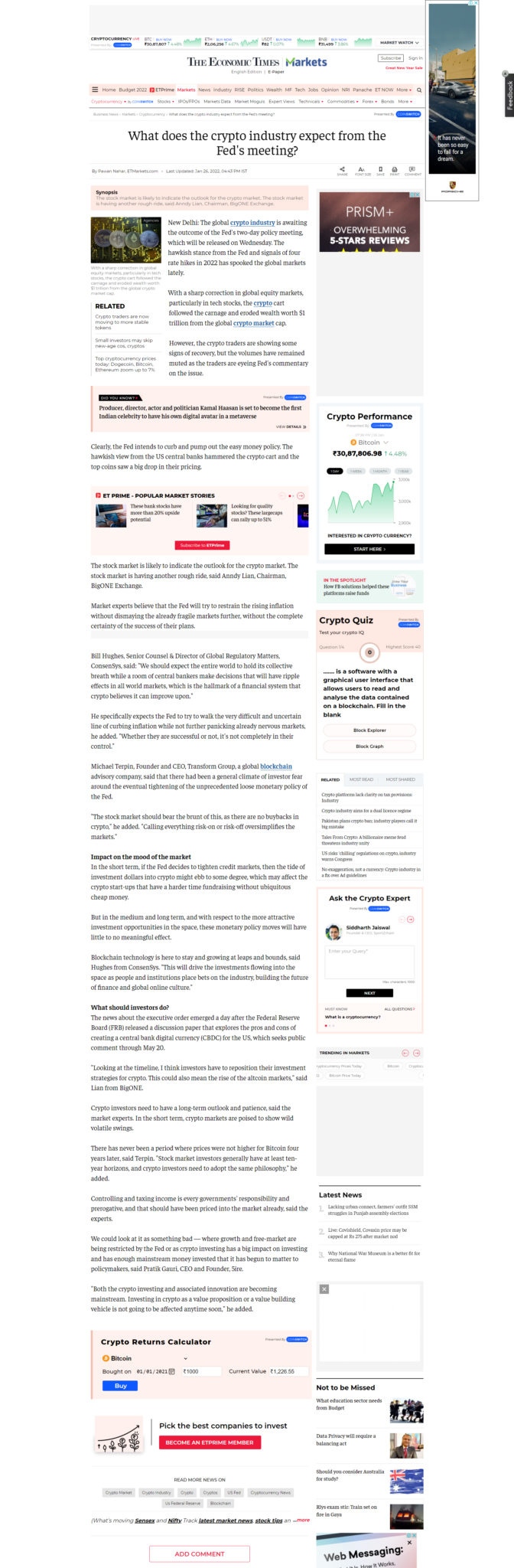
What does the crypto industry expect from the Fed’s meeting?

What does the crypto industry expect from the Fed’s meeting?

Synopsis

The stock market is likely to indicate the outlook for the crypto market. The stock market is having another rough ride, said Anndy Lian, Chairman, BigONE Exchange.​

New Delhi: The global crypto industry is awaiting the outcome of the Fed’s two-day policy meeting, which will be released on Wednesday. The hawkish stance from the Fed and signals of four rate hikes in 2022 has spooked the global markets lately.

With a sharp correction in global equity markets, particularly in tech stocks, the crypto cart followed the carnage and eroded wealth worth $1 trillion from the global crypto market cap.

However, the crypto traders are showing some signs of recovery, but the volumes have remained muted as the traders are eyeing Fed’s commentary on the issue.

Clearly, the Fed intends to curb and pump out the easy money policy. The hawkish view from the US central banks hammered the crypto cart and the top coins saw a big drop in their pricing.

The stock market is likely to indicate the outlook for the crypto market. The stock market is having another rough ride, said Anndy Lian, Chairman, BigONE Exchange.

Market experts believe that the Fed will try to restrain the rising inflation without dismaying the already fragile markets further, without the complete certainty of the success of their plans.

Bill Hughes, Senior Counsel & Director of Global Regulatory Matters, ConsenSys, said: “We should expect the entire world to hold its collective breath while a room of central bankers make decisions that will have ripple effects in all world markets, which is the hallmark of a financial system that crypto believes it can improve upon.”

He specifically expects the Fed to try to walk the very difficult and uncertain line of curbing inflation while not further panicking already nervous markets, he added. “Whether they are successful or not, it’s not completely in their control.”

Michael Terpin, Founder and CEO, Transform Group, a global blockchain advisory company, said that there had been a general climate of investor fear around the eventual tightening of the unprecedented loose monetary policy of the Fed.

“The stock market should bear the brunt of this, as there are no buybacks in crypto,” he added. “Calling everything risk-on or risk-off oversimplifies the markets.”

Impact on the mood of the market
In the short term, if the Fed decides to tighten credit markets, then the tide of investment dollars into crypto might ebb to some degree, which may affect the crypto start-ups that have a harder time fundraising without ubiquitous cheap money.

But in the medium and long term, and with respect to the more attractive investment opportunities in the space, these monetary policy moves will have little to no meaningful effect.

Blockchain technology is here to stay and growing at leaps and bounds, said Hughes from ConsenSys. “This will drive the investments flowing into the space as people and institutions place bets on the industry, building the future of finance and global online culture.”

What should investors do?
The news about the executive order emerged a day after the Federal Reserve Board (FRB) released a discussion paper that explores the pros and cons of creating a central bank digital currency (CBDC) for the US, which seeks public comment through May 20.

“Looking at the timeline, I think investors have to reposition their investment strategies for crypto. This could also mean the rise of the altcoin markets,” said Lian from BigONE.

Crypto investors need to have a long-term outlook and patience, said the market experts. In the short term, crypto markets are poised to show wild volatile swings.

There has never been a period where prices were not higher for Bitcoin four years later, said Terpin. “Stock market investors generally have at least ten-year horizons, and crypto investors need to adopt the same philosophy,” he added.

Controlling and taxing income is every governments’ responsibility and prerogative, and that should have been priced into the market already, said the experts.

We could look at it as something bad — where growth and free-market are being restricted by the Fed or as crypto investing has a big impact on investing and has enough mainstream money invested that it has begun to matter to policymakers, said Pratik Gauri, CEO and Founder, 5ire.

“Both the crypto investing and associated innovation are becoming mainstream. Investing in crypto as a value proposition or a value building vehicle is not going to be affected anytime soon,” he added.


Original Source: https://economictimes.indiatimes.com/markets/cryptocurrency/what-does-the-crypto-industry-expect-from-the-feds-meeting/articleshow/89136991.cms


Anndy Lian is an early blockchain adopter and experienced serial entrepreneur who is known for his work in the government sector. He is a best selling book author- “NFT: From Zero to Hero” and “Blockchain Revolution 2030”.

Currently, he is appointed as the Chief Digital Advisor at Mongolia Productivity Organization, championing national digitization. Prior to his current appointments, he was the Chairman of BigONE Exchange, a global top 30 ranked crypto spot exchange and was also the Advisory Board Member for Hyundai DAC, the blockchain arm of South Korea’s largest car manufacturer Hyundai Motor Group. Lian played a pivotal role as the Blockchain Advisor for Asian Productivity Organisation (APO), an intergovernmental organization committed to improving productivity in the Asia-Pacific region.

An avid supporter of incubating start-ups, Anndy has also been a private investor for the past eight years. With a growth investment mindset, Anndy strategically demonstrates this in the companies he chooses to be involved with. He believes that what he is doing through blockchain technology currently will revolutionise and redefine traditional businesses. He also believes that the blockchain industry has to be “redecentralised”.

j j j

CNBC- NFTs: Revolutionising and democratising the film industry

CNBC- NFTs: Revolutionising and democratising the film industry
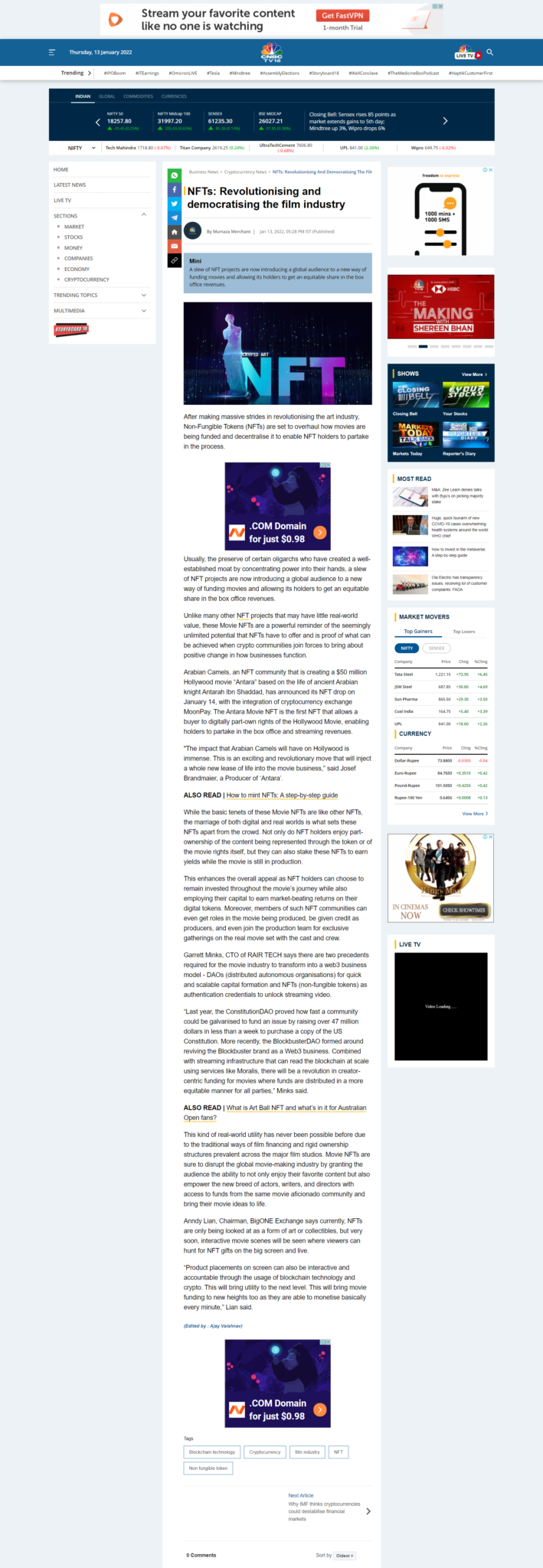
After making massive strides in revolutionising the art industry, Non-Fungible Tokens (NFTs) are set to overhaul how movies are being funded and decentralise it to enable NFT holders to partake in the process.
Unlike many other NFT projects that may have little real-world value, these Movie NFTs are a powerful reminder of the seemingly unlimited potential that NFTs have to offer and is proof of what can be achieved when crypto communities join forces to bring about positive change in how businesses function.
Arabian Camels, an NFT community that is creating a $50 million Hollywood movie “Antara” based on the life of ancient Arabian knight Antarah Ibn Shaddad, has announced its NFT drop on January 14, with the integration of cryptocurrency exchange MoonPay. The Antara Movie NFT is the first NFT that allows a buyer to digitally part-own rights of the Hollywood Movie, enabling holders to partake in the box office and streaming revenues.
“The impact that Arabian Camels will have on Hollywood is immense. This is an exciting and revolutionary move that will inject a whole new lease of life into the movie business,” said Josef Brandmaier, a Producer of ‘Antara’.
While the basic tenets of these Movie NFTs are like other NFTs, the marriage of both digital and real worlds is what sets these NFTs apart from the crowd. Not only do NFT holders enjoy part-ownership of the content being represented through the token or of the movie rights itself, but they can also stake these NFTs to earn yields while the movie is still in production.
This enhances the overall appeal as NFT holders can choose to remain invested throughout the movie’s journey while also employing their capital to earn market-beating returns on their digital tokens. Moreover, members of such NFT communities can even get roles in the movie being produced, be given credit as producers, and even join the production team for exclusive gatherings on the real movie set with the cast and crew.
Garrett Minks, CTO of RAIR TECH says there are two precedents required for the movie industry to transform into a web3 business model – DAOs (distributed autonomous organisations) for quick and scalable capital formation and NFTs (non-fungible tokens) as authentication credentials to unlock streaming video.
“Last year, the ConstitutionDAO proved how fast a community could be galvanised to fund an issue by raising over 47 million dollars in less than a week to purchase a copy of the US Constitution. More recently, the BlockbusterDAO formed around reviving the Blockbuster brand as a Web3 business. Combined with streaming infrastructure that can read the blockchain at scale using services like Moralis, there will be a revolution in creator-centric funding for movies where funds are distributed in a more equitable manner for all parties,” Minks said.
This kind of real-world utility has never been possible before due to the traditional ways of film financing and rigid ownership structures prevalent across the major film studios. Movie NFTs are sure to disrupt the global movie-making industry by granting the audience the ability to not only enjoy their favorite content but also empower the new breed of actors, writers, and directors with access to funds from the same movie aficionado community and bring their movie ideas to life.
Anndy Lian, Chairman, BigONE Exchange says currently, NFTs are only being looked at as a form of art or collectibles, but very soon, interactive movie scenes will be seen where viewers can hunt for NFT gifts on the big screen and live.
“Product placements on screen can also be interactive and accountable through the usage of blockchain technology and crypto. This will bring utility to the next level. This will bring movie funding to new heights too as they are able to monetise basically every minute,” Lian said.

Anndy Lian is an early blockchain adopter and experienced serial entrepreneur who is known for his work in the government sector. He is a best selling book author- “NFT: From Zero to Hero” and “Blockchain Revolution 2030”.

Currently, he is appointed as the Chief Digital Advisor at Mongolia Productivity Organization, championing national digitization. Prior to his current appointments, he was the Chairman of BigONE Exchange, a global top 30 ranked crypto spot exchange and was also the Advisory Board Member for Hyundai DAC, the blockchain arm of South Korea’s largest car manufacturer Hyundai Motor Group. Lian played a pivotal role as the Blockchain Advisor for Asian Productivity Organisation (APO), an intergovernmental organization committed to improving productivity in the Asia-Pacific region.

An avid supporter of incubating start-ups, Anndy has also been a private investor for the past eight years. With a growth investment mindset, Anndy strategically demonstrates this in the companies he chooses to be involved with. He believes that what he is doing through blockchain technology currently will revolutionise and redefine traditional businesses. He also believes that the blockchain industry has to be “redecentralised”.
j j j