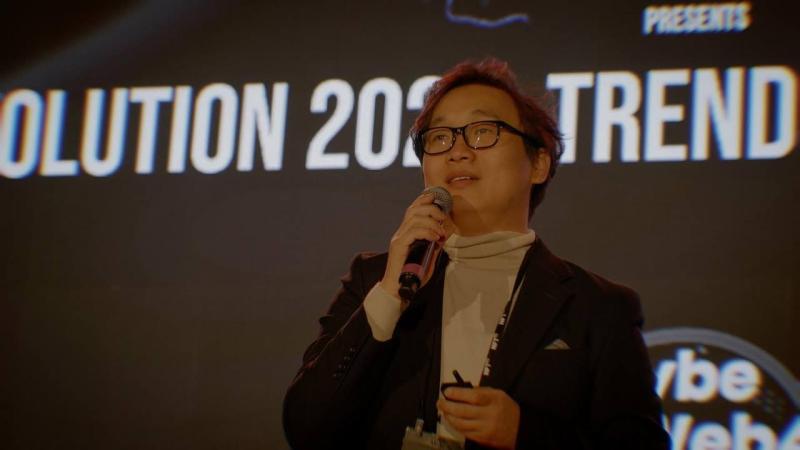
Anndy Lian: BNB emerges as confidence proxy in crypto infrastructure

Anndy Lian: BNB emerges as confidence proxy in crypto infrastructure

Anndy Lian, a prominent figure in the cryptocurrency space, emphasizes the evolving role of BNB. He notes that its value is no longer limited to its utility on exchanges.

Instead, BNB is increasingly seen as a measurement of faith in the broader non-U.S. crypto infrastructure. This shift reflects changing investor sentiments and the growing relevance of decentralized technologies.


Lian’s outlook parallels his previous guidance to crypto users to strengthen security practices, as evidenced by his focus on the critical importance of cold wallets and robust passphrases. Moreover, his recent remarks on BNB’s evolving role recall his critique of the sector’s reliance on crypto exchange listings, where he advocated for prioritizing genuine innovation over short-term financial incentives.


Source: https://tradersunion.com/news/market-voices/show/627916-bnb-confidence-proxy/

Anndy Lian is an early blockchain adopter and experienced serial entrepreneur who is known for his work in the government sector. He is a best selling book author- “NFT: From Zero to Hero” and “Blockchain Revolution 2030”.

Currently, he is appointed as the Chief Digital Advisor at Mongolia Productivity Organization, championing national digitization. Prior to his current appointments, he was the Chairman of BigONE Exchange, a global top 30 ranked crypto spot exchange and was also the Advisory Board Member for Hyundai DAC, the blockchain arm of South Korea’s largest car manufacturer Hyundai Motor Group. Lian played a pivotal role as the Blockchain Advisor for Asian Productivity Organisation (APO), an intergovernmental organization committed to improving productivity in the Asia-Pacific region.

An avid supporter of incubating start-ups, Anndy has also been a private investor for the past eight years. With a growth investment mindset, Anndy strategically demonstrates this in the companies he chooses to be involved with. He believes that what he is doing through blockchain technology currently will revolutionise and redefine traditional businesses. He also believes that the blockchain industry has to be “redecentralised”.

j j j

Decentralizing the Next Layer of Ethereum Infrastructure with Anti-Slashing & ZK-Readiness

Decentralizing the Next Layer of Ethereum Infrastructure with Anti-Slashing & ZK-Readiness

At the Scaling Summit Singapore, a pivotal conversation unfolded on the Ethereum Stage, where builders, researchers, and visionaries gathered to confront one of the ecosystem’s most pressing dilemmas: How do we scale Ethereum without sacrificing its foundational ethos of decentralization? Moderated by Luca Donno, a researcher at L2Beat, the panel featuring Amir (Puffer Finance), Mike Massari (Redstone), Ian Wallis (Linea), and Anndy Lian (Intergovernmental Blockchain Advisor) delved into the tension between idealism and pragmatism in blockchain infrastructure.

The Centralization Conundrum

The discussion opened with a stark reality: while decentralization remains Ethereum’s “biggest asset,” market forces often incentivize centralization for speed and user experience. As Amir of Puffer Finance noted, “If you look at where biggest asset holders are now parking their assets… they’re trusting Ethereum for a reason.” He pointed to USDT and USDC 45% and nearly 100% of their supplies, respectively, reside on Ethereum precisely because of its trustless nature.

The path to mass adoption is rarely pure. Luca framed the dilemma: “We were very much in a situation in which decentralization was the most important thing… Now it’s not anymore. That is not the focus of institutions.” This shift demands a recalibration. Anndy Lian, speaking from a macroeconomic lens, admitted bluntly: “Most users, including VCs like myself, you know, we don’t really care [about decentralization]… we want to make money.” His candid remark underscored a broader truth user incentives today prioritize yield and UX over ideological purity.

But the panelists agreed: decentralization must remain the north star, even if the journey begins with centralized stepping stones. “It is okay to start slightly more centralized,” Amir argued, “but having decentralization on the roadmap as the main goal is the only way we can scale the entire blockchain to its full capacity.”

Anti-Slashing: Guardrails for a Risky Landscape

A key innovation discussed was anti-slashing a critical safeguard in the era of liquid staking tokens (LSTs). With LSTs now dominating Ethereum’s staking landscape, systemic risk looms large. As Luca observed, many protocols hold more LSTs than native ETH, creating concentration points that threaten network security.

Amir explained how Puffer Finance addresses this: “We didn’t stop at permissionless restaking. We launched bonded validators operators must stake their own capital. If slashing occurs, it’s their money on the line.” This “skin in the game” model, combined with hardware-based anti-slashing modules (like trusted execution environments, or TEEs), prevents malicious or accidental validator misbehavior. “These modules act like a Ledger wallet,” Amir said, “but even more restricted you can only sign permitted transactions.”

Mike Massari echoed the sentiment: “The moment you detach risk from the person managing the capital, you create systemic risk.” Anti-slashing, therefore, isn’t just technical it’s economic alignment.

Ian Wallis added context from Linea’s perspective, noting their plan for a “native yield” bridge that stakes ETH directly, reducing reliance on dominant LST providers like Lido. “We’re consulting closely with the Ethereum Foundation,” he said, emphasizing collaboration over competition in securing the ecosystem.

ZK: Promise, Peril, and Patience

The conversation then turned to zero-knowledge (ZK) technology the cornerstone of Ethereum’s scaling roadmap. While optimistic about ZK’s potential, the panelists acknowledged its immaturity. “ZK is still experimental,” Luca warned, citing recent bugs in foundational libraries like Circom and Halo2. “A multi-billion-dollar bug on Ethereum L1 could shatter trust in the entire paradigm.”

Amir, however, offered a solution in progress: “We’re researching 2FA for ZK running a full Ethereum client inside a TEE alongside the ZK prover. If outputs mismatch, you halt the transaction.” This dual-verification approach could catch bugs before they cascade.

Ian, whose team at Linea operates a ZK-EVM rollup, remained bullish: “Compare where we were five years ago to now we’re light years ahead. ZK improvements are coming quarterly.” He pointed to Swift’s recent partnership with Linea as validation: “If the kings of centralized finance see potential here, that’s an endorsement.”

Anndy Lian urged patience: “Give the technology time. The big boys are coming. Adoption will follow.”

Toward a Redistributed Future

Ultimately, the panel converged on a shared vision: Ethereum must evolve progressively. As Luca summarized, “We shouldn’t decentralize for decentralization’s sake but where user funds are at stake, decentralization equals security, and security equals good UX.”

The road ahead involves balancing short-term pragmatism with long-term principles. Whether through anti-slashing economics, ZK verifiability, or middleware that enforces decentralization standards, the goal remains clear: build infrastructure that can onboard trillions not just billions without compromising Ethereum’s soul.

As Amir put it: “If we want to bring repo markets or supply chains onchain, it has to be fully decentralized and secure. Hyperliquid won’t cut it for JP Morgan.”

In that spirit, the Scaling Summit didn’t just showcase technology it reaffirmed a covenant: scale with integrity, or don’t scale at all.


Anndy Lian is an early blockchain adopter and experienced serial entrepreneur who is known for his work in the government sector. He is a best selling book author- “NFT: From Zero to Hero” and “Blockchain Revolution 2030”.

Currently, he is appointed as the Chief Digital Advisor at Mongolia Productivity Organization, championing national digitization. Prior to his current appointments, he was the Chairman of BigONE Exchange, a global top 30 ranked crypto spot exchange and was also the Advisory Board Member for Hyundai DAC, the blockchain arm of South Korea’s largest car manufacturer Hyundai Motor Group. Lian played a pivotal role as the Blockchain Advisor for Asian Productivity Organisation (APO), an intergovernmental organization committed to improving productivity in the Asia-Pacific region.

An avid supporter of incubating start-ups, Anndy has also been a private investor for the past eight years. With a growth investment mindset, Anndy strategically demonstrates this in the companies he chooses to be involved with. He believes that what he is doing through blockchain technology currently will revolutionise and redefine traditional businesses. He also believes that the blockchain industry has to be “redecentralised”.

j j j

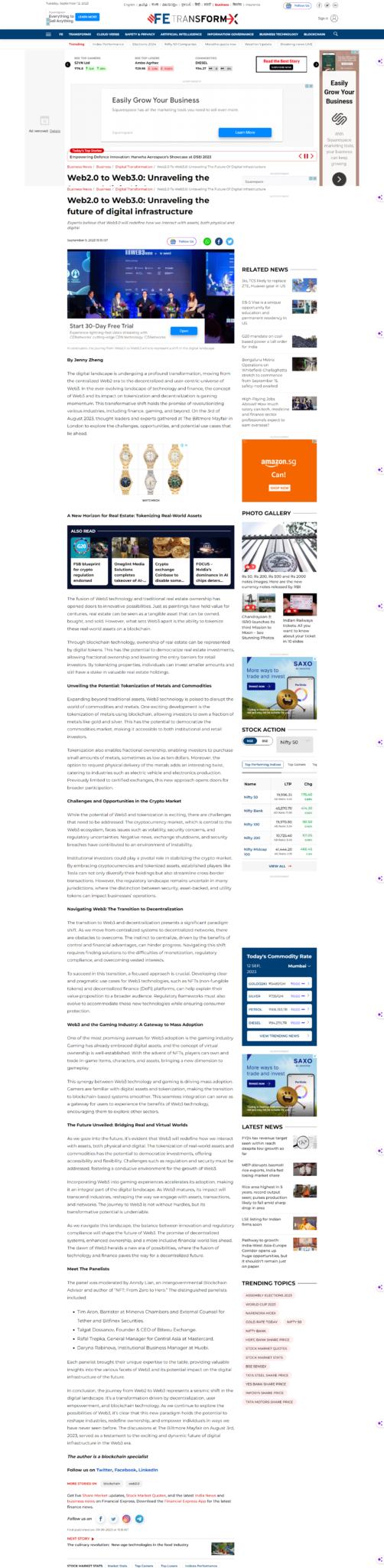
Web2.0 to Web3.0: Unraveling the future of digital infrastructure

Web2.0 to Web3.0: Unraveling the future of digital infrastructure

The digital landscape is undergoing a profound transformation, moving from the centralized Web2 era to the decentralized and user-centric universe of Web3. In the ever-evolving landscape of technology and finance, the concept of Web3 and its impact on tokenization and decentralization is gaining momentum. This transformative shift holds the promise of revolutionizing various industries, including finance, gaming, and beyond. On the 3rd of August 2023, thought leaders and experts gathered at The Biltmore Mayfair in London to explore the challenges, opportunities, and potential use cases that lie ahead.

A New Horizon for Real Estate: Tokenizing Real-World Assets

The fusion of Web3 technology and traditional real estate ownership has opened doors to innovative possibilities. Just as paintings have held value for centuries, real estate can be seen as a tangible asset that can be owned, bought, and sold. However, what sets Web3 apart is the ability to tokenize these real-world assets on a blockchain.

Through blockchain technology, ownership of real estate can be represented by digital tokens. This has the potential to democratize real estate investments, allowing fractional ownership and lowering the entry barriers for retail investors. By tokenizing properties, individuals can invest smaller amounts and still have a stake in valuable real estate holdings.

Unveiling the Potential: Tokenization of Metals and Commodities

Expanding beyond traditional assets, Web3 technology is poised to disrupt the world of commodities and metals. One exciting development is the tokenization of metals using blockchain, allowing investors to own a fraction of metals like gold and silver. This has the potential to democratize the commodities market, making it accessible to both institutional and retail investors.

Tokenization also enables fractional ownership, enabling investors to purchase small amounts of metals, sometimes as low as ten dollars. Moreover, the option to request physical delivery of the metals adds an interesting twist, catering to industries such as electric vehicle and electronics production. Previously limited to certified exchanges, this new approach opens doors for broader participation.

Challenges and Opportunities in the Crypto Market

While the potential of Web3 and tokenization is exciting, there are challenges that need to be addressed. The cryptocurrency market, which is central to the Web3 ecosystem, faces issues such as volatility, security concerns, and regulatory uncertainties. Negative news, exchange shutdowns, and security breaches have contributed to an environment of instability.

Institutional investors could play a pivotal role in stabilizing the crypto market. By embracing cryptocurrencies and tokenized assets, established players like Tesla can not only diversify their holdings but also streamline cross-border transactions. However, the regulatory landscape remains uncertain in many jurisdictions, where the distinction between security, asset-backed, and utility tokens can impact businesses’ operations.

Navigating Web3: The Transition to Decentralization

The transition to Web3 and decentralization presents a significant paradigm shift. As we move from centralized systems to decentralized networks, there are obstacles to overcome. The instinct to centralize, driven by the benefits of control and financial advantages, can hinder progress. Navigating this shift requires finding solutions to the difficulties of monetization, regulatory compliance, and overcoming vested interests.

To succeed in this transition, a focused approach is crucial. Developing clear and pragmatic use cases for Web3 technologies, such as NFTs (non-fungible tokens) and decentralized finance (DeFi) platforms, can help explain their value proposition to a broader audience. Regulatory frameworks must also evolve to accommodate these new technologies while ensuring consumer protection.

Web3 and the Gaming Industry: A Gateway to Mass Adoption

One of the most promising avenues for Web3 adoption is the gaming industry. Gaming has already embraced digital assets, and the concept of virtual ownership is well-established. With the advent of NFTs, players can own and trade in-game items, characters, and assets, bringing a new dimension to gameplay.

This synergy between Web3 technology and gaming is driving mass adoption. Gamers are familiar with digital assets and tokenization, making the transition to blockchain-based systems smoother. This seamless integration can serve as a gateway for users to experience the benefits of Web3 technology, encouraging them to explore other sectors.

The Future Unveiled: Bridging Real and Virtual Worlds

As we gaze into the future, it’s evident that Web3 will redefine how we interact with assets, both physical and digital. The tokenization of real-world assets and commodities has the potential to democratize investments, offering accessibility and flexibility. Challenges such as regulation and security must be addressed, fostering a conducive environment for the growth of Web3.

Incorporating Web3 into gaming experiences accelerates its adoption, making it an integral part of the digital landscape. As Web3 matures, its impact will transcend industries, reshaping the way we engage with assets, transactions, and networks. The journey to Web3 is not without hurdles, but its transformative potential is undeniable.

As we navigate this landscape, the balance between innovation and regulatory compliance will shape the future of Web3. The promise of decentralized systems, enhanced ownership, and a more inclusive financial world lies ahead. The dawn of Web3 heralds a new era of possibilities, where the fusion of technology and finance paves the way for a decentralized future.

Meet The Panelists

The panel was moderated by Anndy Lian, an Intergovernmental Blockchain Advisor and author of “NFT: From Zero to Hero.” The distinguished panelists included:

  • Tim Aron, Barrister at Minerva Chambers and External Counsel for Tether and Bitfinex Securities.
  • Talgat Dossanov, Founder & CEO of Biteeu Exchange.
  • Rafal Trepka, General Manager for Central Asia at Mastercard.
  • Daryna Rabinova, Institutional Business Manager at Huobi.

Each panelist brought their unique expertise to the table, providing valuable insights into the various facets of Web3 and its potential impact on the digital infrastructure of the future.

In conclusion, the journey from Web2 to Web3 represents a seismic shift in the digital landscape. It’s a transformation driven by decentralization, user empowerment, and blockchain technology. As we continue to explore the possibilities of Web3, it’s clear that this new paradigm holds the potential to reshape industries, redefine ownership, and empower individuals in ways we have never seen before. The discussions at The Biltmore Mayfair on August 3rd, 2023, served as a testament to the exciting and dynamic future of digital infrastructure in the Web3 era.


Source: https://www.financialexpress.com/business/digital-transformation-web2-0-to-web30-unraveling-the-future-of-digital-infrastructure-3237275/
Anndy Lian is an early blockchain adopter and experienced serial entrepreneur who is known for his work in the government sector. He is a best selling book author- “NFT: From Zero to Hero” and “Blockchain Revolution 2030”.

Currently, he is appointed as the Chief Digital Advisor at Mongolia Productivity Organization, championing national digitization. Prior to his current appointments, he was the Chairman of BigONE Exchange, a global top 30 ranked crypto spot exchange and was also the Advisory Board Member for Hyundai DAC, the blockchain arm of South Korea’s largest car manufacturer Hyundai Motor Group. Lian played a pivotal role as the Blockchain Advisor for Asian Productivity Organisation (APO), an intergovernmental organization committed to improving productivity in the Asia-Pacific region.

An avid supporter of incubating start-ups, Anndy has also been a private investor for the past eight years. With a growth investment mindset, Anndy strategically demonstrates this in the companies he chooses to be involved with. He believes that what he is doing through blockchain technology currently will revolutionise and redefine traditional businesses. He also believes that the blockchain industry has to be “redecentralised”.

j j j