Navigating the Privacy Paradox in Web3: Insights from DeCC Day at Consensus 2024

Navigating the Privacy Paradox in Web3: Insights from DeCC Day at Consensus 2024

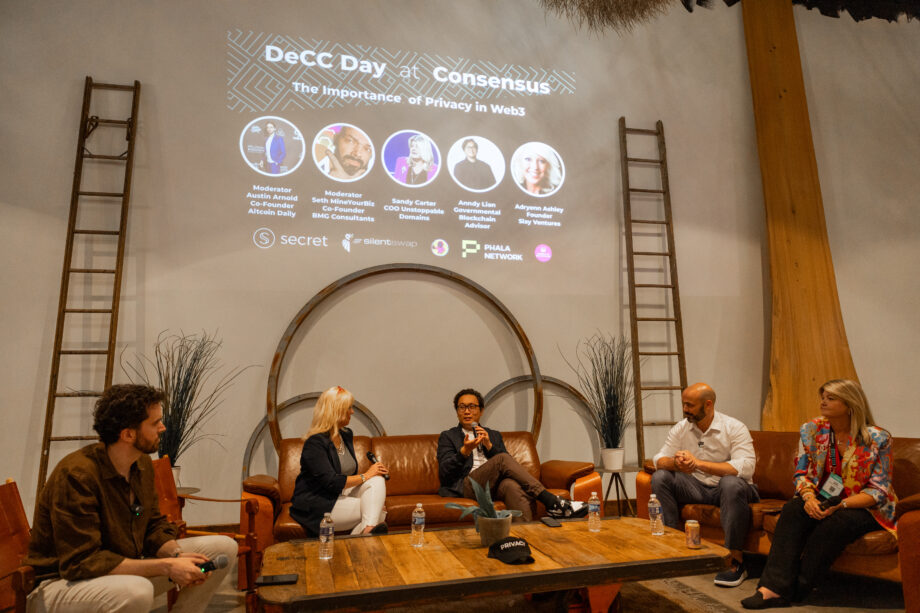
Web3 privacy emerges as a central theme, often heralded as a fundamental human right yet paradoxically elusive in the digital realm. The DeCC Day panel at Consensus 2024, titled “The Importance of Privacy in Web3,” brought together a diverse group of experts to unravel this complex issue.

Adryenn Ashley, a venture capitalist and founder of Slay Ventures, opened the discussion with a provocative introduction, highlighting her background in creating a dating app that prioritized privacy and consent, leveraging blockchain technology. Her energetic tone set the stage for a dynamic exchange of ideas.

Anndy Lian, a book author and fund manager from Singapore, expressed his passion for privacy, emphasizing its significance in various conferences he attends. His perspective as an author and investor provided a unique lens through which to view the privacy debate.

Seth, known in the crypto community as ‘MineyourBiz,’ identified himself as a privacy advocate to the point of affliction. His commitment to evaluating technologies for market viability and technological soundness has led him to monitor major waves in privacy tech, interviewing many privacy-oriented founders.

Sandy Carter, COO of Unstoppable Domains and founder of Unstoppable Women of Web3 in AI, shared her company’s efforts in creating a digital identity platform that empowers users to control their personal information. She underscored the importance of allowing individuals to decide what they disclose, framing privacy as a choice rather than a given.

The panellists engaged in a spirited debate over the nature of privacy and its perception among individuals and governments. Seth argued that privacy is a universal human desire, transcending cultural and political boundaries. However, Adryenn countered that while individuals crave privacy for themselves, they are equally curious about others’ lives, driven by a systematic craving for information.

The conversation took a turn when Anndy brought up the consumer’s role in the privacy equation. He posited that consumers must care about their privacy for it to be effectively protected, citing the use of Zero-Knowledge Proofs (ZKPs) in blockchain applications as a means to preserve user anonymity while enhancing user experience.

Sandy expanded on this by discussing the role of digital identities in managing privacy settings, allowing users to selectively share information with applications. This approach, she argued, respects the individual’s right to privacy while acknowledging the varying degrees of openness each person is comfortable with.

The panelists also tackled the thorny issue of government surveillance and regulation. Seth highlighted the lack of consideration for privacy in government discussions, often viewed as an inconvenience rather than a necessity. Andy shared insights from his direct advisory role with governments, revealing that while on-chain activities might be challenging to trace, off-chain actions, particularly cashing out to fiat, are transparent and traceable.

As the discussion drew to a close, the panellists agreed on the paramount importance of trust in the relationship between privacy, governments, and the public. Austin Arnold, Co-founder of Altcoin Daily closed the panel by emphasizing that privacy builds confidence and trust, which are crucial for market movement and engagement.

In the digital tapestry of Web3, privacy stands as a beacon of individual autonomy, a principle ardently debated and fiercely defended. The DeCC Day panel at Consensus 2024 illuminated the intricate dance between personal discretion and societal transparency. The discourse traversed the spectrum of privacy—from a fundamental human yearning to a nuanced societal construct, challenging the audience to reconsider their own stances on the matter.

The panellists, each a vanguard in their respective fields, unravelled the privacy paradox with eloquence and insight. They painted a world where privacy is not a relic of the past but a cornerstone of the future—a future where trust is the currency and privacy its mint. The dialogue underscored the imperative for privacy to be more than an afterthought in the Web3 narrative; it must be the plot itself.

As the conversation drew to a close, the consensus was clear: privacy in Web3 is not just about the right to secrecy but the right to agency. It is about crafting a digital realm where individuals navigate with confidence, empowered by the sovereignty over their data. The panel at DeCC Day did not just discuss privacy; they championed it, urging us to envision a Web3 ecosystem that is as secure as it is open, as private as it is communal.

In this era of technological renaissance, the panel’s insights serve as a compass, guiding us toward a more equitable and private digital future. The importance of privacy in Web3, as articulated by these thought leaders, is a clarion call to action—a call to protect what makes us human in a world that is increasingly digital.

Anndy Lian is an early blockchain adopter and experienced serial entrepreneur who is known for his work in the government sector. He is a best selling book author- “NFT: From Zero to Hero” and “Blockchain Revolution 2030”.

Currently, he is appointed as the Chief Digital Advisor at Mongolia Productivity Organization, championing national digitization. Prior to his current appointments, he was the Chairman of BigONE Exchange, a global top 30 ranked crypto spot exchange and was also the Advisory Board Member for Hyundai DAC, the blockchain arm of South Korea’s largest car manufacturer Hyundai Motor Group. Lian played a pivotal role as the Blockchain Advisor for Asian Productivity Organisation (APO), an intergovernmental organization committed to improving productivity in the Asia-Pacific region.

An avid supporter of incubating start-ups, Anndy has also been a private investor for the past eight years. With a growth investment mindset, Anndy strategically demonstrates this in the companies he chooses to be involved with. He believes that what he is doing through blockchain technology currently will revolutionise and redefine traditional businesses. He also believes that the blockchain industry has to be “redecentralised”.

j j j

Embracing the NFT revolution: Insights from Anndy Lian’s NFT.NYC speech

Embracing the NFT revolution: Insights from Anndy Lian’s NFT.NYC speech

In the rapidly evolving world of blockchain and digital assets, non-fungible tokens (NFTs) have emerged as a revolutionary force. Anndy Lian, a seasoned business strategist, author, and advisor to governments, recently addressed an enthusiastic crowd at NFT.NYC 2024, shedding light on the trajectory of NFTs and their impact across various industries.

NFT.NYC is a conference that brings together the global NFT community to New York City. The event was founded in 2018 by members of the NFT community and the first event was held in February 2019. NFT.NYC is considered a mature event for those interested in the Web3 space, and a conference for web3 professionals. The event features speakers, partners, networking, conversation, and learning. Some call it the “Super Bowl of NFTs” and the “burning man for non-fungible digital asset heads”.

Lian’s session was on 4 April 2024, at the main stage, his topic titled “NFT Revolution 2024: Trends & Future Predictions”.

The evolution of NFTs: From scepticism to mainstream adoption

Lian’s journey with NFTs has been marked by early scepticism, which has now turned into widespread acceptance.

His books, “Blockchain Revolution 2030” and “NFT: From Zero to Hero,” have become essential reads for understanding the potential of NFTs. He urged the NFT.NYC audience to “think bigger” last year, and the market has responded with a significant increase in value from US$737 million in April 2023 to over US$1.2 billion in February 2024. This surge not only reflects the burgeoning interest in NFTs but also underscores the growing recognition of their economic significance.

Decoding the trends: The future predicted at NFT.NYC 2024

Lian outlined six key trends that are expected to drive the NFT revolution:

  • ERC 404: The Hybrid Token Standard The introduction of ERC 404 marks a significant innovation in the blockchain world. This new standard aims to blend the best of both worlds: the versatility of fungible tokens (ERC-20) with the uniqueness of non-fungible tokens (ERC-721). This hybrid approach could potentially unlock new functionalities and use cases for digital assets, making them more adaptable and valuable across various applications.
  • RWA NFT: Digitising the Physical World Real-World Asset (RWA) NFTs are set to transform tangible assets like real estate, intellectual property, and fine art into liquid digital formats. This trend is not just about tokenisation; it’s about enhancing accessibility and creating new markets. For instance, Nexum.ai is leveraging NFTs to revolutionise supply chain financing, showcasing the practical benefits of this technology in traditional industries.
  • NFT ETFs: Diversification and Institutional Involvement NFT Exchange-Traded Funds (ETFs) are emerging as a game-changer for investors. By offering a diversified portfolio of NFTs, these ETFs provide a level of exposure similar to institutional-grade assets. Backed by credible entities, NFT ETFs could democratise access to the NFT market, allowing for broader participation and investment.
  • AI NFTs: The Convergence of Technology and Accessibility AI NFTs represent a fusion of artificial intelligence with the NFT ecosystem. Platforms like copx.ai are at the forefront, wrapping NFTs around exclusive AI trading tools. This integration makes NFTs more accessible and functional, providing users with exclusive market insights and trades, thus adding a layer of intelligence to the NFT experience.
  • Meme with a twist: The Squid Bros, a collection of 10K PFPs by SquidGrow created by renowned artist Mike S. Miller, known for his work with Marvel, DC, and Game of Thrones, exemplifies the power of community and intellectual property. This project demonstrates how strong community backing and robust IP can elevate a meme-inspired NFT collection to new heights, creating value and engagement.
  • Photographs as NFTs: Capturing Authenticity Seed.Photo’s selective process has led to a unique collection of photographs minted as NFTs. This approach appeals to major brands seeking authenticity and artistic value. By curating real photographs as NFTs, Seed.Photo is setting a new standard for quality and exclusivity in the NFT marketplace.

Blockchain networks fueling the NFT boom

Lian emphasised the role of blockchain networks such as Solana and Binance Smart Chain in the current NFT boom. These platforms offer the necessary infrastructure and community support for the development and trade of NFTs. I spoke to him off the stage and these are his comments.

  • Solana: High Throughput and Low Fees for NFTs Solana stands out with its high throughput and low transaction fees, making it an ideal environment for NFT creation and trade. It supports a fully decentralised on-chain experience for artists and collectors, with features like auctions and perpetual royalties coded directly into the NFTs. Solana’s NFT standard and minting program offer extreme customizability, backed by a suite of tools which empower creators to launch their NFT storefronts and engage with their audience directly.
  • BNB Chain: EVM Compatibility and Community Support BNB Chain, powered by the Binance ecosystem, offers EVM compatibility, which allows for the utilisation of Ethereum’s well-established standards and tools. This compatibility has positioned them as a competitive alternative for NFT creators, especially those seeking lower fees and a supportive community. Their marketplace provides a high liquidity platform for users to launch and trade NFTs, further bolstered by multi-chain support for seamless transfers between BSC and other networks.

He highlighted that a synergistic ecosystem for NFTs is important. The synergy between these blockchain networks and the NFT marketplace is undeniable. Solana and BNB Chain have each carved out a niche, offering distinct advantages that cater to the diverse needs of the NFT community.

As the NFT landscape continues to evolve, the contributions of these networks will remain integral to the development, trade, and overall success of NFTs in the digital economy. He has also mentioned other chains too. Lian’s emphasis on these platforms underscores their importance and the expectation that they will continue to fuel the NFT boom for the foreseeable future.

Conclusion: The transformative power of NFTs

Lian’s insights at NFT.NYC are a profound reflection of the transformative power inherent in non-fungible tokens (NFTs). His vision extends beyond the mere adoption of new technology; it heralds the creation of a secure and inclusive ecosystem that embraces participants from diverse backgrounds, fostering a community where digital ownership and creativity know no bounds.

As we peer into the future, it’s clear that NFTs are poised to continue their trajectory of redefining the very essence of ownership and artistic expression in the digital realm. The implications of this transformation are vast, touching upon various facets of our lives, from the way we perceive value to how we interact with the digital world.

Lian’s perspective is not limited to the technological advancements that NFTs bring. It encompasses a broader ambition to cultivate an environment that is not only safe and reliable but also equitable and accessible to individuals regardless of their technical expertise or geographic location. This democratisation of digital assets is a cornerstone of Lian’s vision, ensuring that the benefits of NFTs can be enjoyed by all.

In fact, Lian did a poll on X before his speech. The results are very promising. NFTs will continue to do well in 2024.

The article capturing the essence of Lian’s speech serves as a comprehensive guide to the current landscape and future prospects of NFTs. It provides readers with a valuable resource for navigating the complexities and opportunities that lie ahead in the NFT space. For those intrigued by the potential of NFTs, Lian’s work offers a foundational understanding of the challenges and promises that await us as we delve deeper into this exciting frontier.

In conclusion, the transformative power of NFTs, as articulated by Lian, is not just a testament to the evolution of technology but a beacon for a future where digital ownership and creativity flourish in a secure, inclusive, and innovative ecosystem. As we move forward, the principles and insights shared by Lian will undoubtedly serve as guiding lights in the ever-evolving narrative of NFTs.


Source: https://e27.co/embracing-the-nft-revolution-insights-from-anndy-lians-nft-nyc-speech-20240503/

Anndy Lian is an early blockchain adopter and experienced serial entrepreneur who is known for his work in the government sector. He is a best selling book author- “NFT: From Zero to Hero” and “Blockchain Revolution 2030”.

Currently, he is appointed as the Chief Digital Advisor at Mongolia Productivity Organization, championing national digitization. Prior to his current appointments, he was the Chairman of BigONE Exchange, a global top 30 ranked crypto spot exchange and was also the Advisory Board Member for Hyundai DAC, the blockchain arm of South Korea’s largest car manufacturer Hyundai Motor Group. Lian played a pivotal role as the Blockchain Advisor for Asian Productivity Organisation (APO), an intergovernmental organization committed to improving productivity in the Asia-Pacific region.

An avid supporter of incubating start-ups, Anndy has also been a private investor for the past eight years. With a growth investment mindset, Anndy strategically demonstrates this in the companies he chooses to be involved with. He believes that what he is doing through blockchain technology currently will revolutionise and redefine traditional businesses. He also believes that the blockchain industry has to be “redecentralised”.

j j j

Top 5 Decentralized Finance Trends to Expect in 2024: Analyst Insights

Top 5 Decentralized Finance Trends to Expect in 2024: Analyst Insights

The decentralized finance (DeFi) space is leaving the bear winter behind and entering a bull summer as industry interest continues to pick up and the market moves into incentive-driven growth that focuses on real utility and technological innovations.

Or at least, that is what experts in the DeFi space are saying.

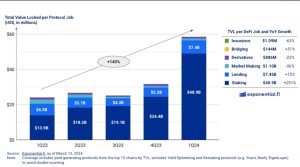
A recent report published by Exponential found that the “latest indicators signal not just growth but a transformative shift” within the DeFi space with significant growth in interest in DeFi yields.

The total value locked (TVL) in yield-generating DeFi protocols has steadily increased from $26.5 billion in the third quarter of 2023 to $59.7 billion in the first quarter of 2024, according to the report.

Total Value Locked per Protocol Job.
Total Value Locked per Protocol Job. Source: Exponential.fi

This growth signifies a return of confidence and liquidity to the DeFi markets.

We spoke to experts to find out the latest DeFi trends for 2024.

Key Takeaways

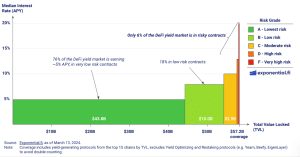
  • The DeFi industry continues to evolve with $43 billion already locked in low-risk yield contracts, indicating a shift towards more stable and reliable investment avenues.
  • The merging of traditional financial systems with DeFi is a significant trend, with financial institutions expected to use DeFi innovations such as smart contracts and decentralized lending to improve their services.
  • The DeFi space faces potential regulatory hurdles, exemplified by the SEC’s actions against Uniswap.
  • The development of Layer-2 scaling solutions and crypto bridges are pivotal in enhancing transaction speeds and reducing costs, thus supporting the broader adoption of DeFi.
  • Increased international regulatory cooperation is likely to result in a unified global framework for digital assets, balancing innovation with financial stability and opening up new opportunities for the DeFi sector.

DeFi Industry Is Maturing

As central banks signal towards more rate cuts, the DeFi yields space is gaining significant popularity as an attractive investment form with DeFi markets maturing, Anndy Lian, an inter-governmental blockchain advisor, told Techopedia.

This was also backed by the Exponential report, which noted that over $43 billion were locked into very low-risk DeFi yield contracts.

75% of DeFi total value locked (TVL) is currently in pools offering 0-5% of annual percentage yield (APY).

Total Value Locked in DeFi Yield Markets.
Total Value Locked in DeFi Yield Markets. Source: Exponential.fi

Additionally, new trends in the market are pointing towards more mainstream adoption, with DeFi projects continuing to grow and integrate more and more with traditional finance.

Lian said:

“The focus [of the DeFi space in 2024] seems to be on sustainable growth, improved security, and real-world applications that could lead to wider acceptance and use of DeFi platforms.”

Igor Telyatnikov, CEO and co-founder of AlphaPoint, a digital asset and cryptocurrency trading and investing platform, added that with over $90 billion locked in DeFi protocols, the DeFi market could very much reach and even surpass previous heights of $150 billion locked as previously seen in 2021. He said:

“Despite the challenges faced, DeFi has continued to attract both developers and users, showcasing its ability to innovate and adapt. We are seeing a maturing ecosystem with more robust infrastructure, improved user experiences, and increasing collaboration among projects.”

Decentralized Finance Trends 2024

Over the last year, DeFi applications have undergone significant changes, with a number of new trends starting to show up in the industry, stemming from crypto bridges to a number of Layer-2 (L2) scaling solutions.

Here are some of the biggest DeFi trends experts are paying attention to in the second half of 2024.

1. Traditional Finance Integration

The traditional finance market entering the DeFi space is perhaps the biggest trend in the current DeFi landscape.

Lian noted that the integration of traditional markets into the DeFi space could become a “significant step towards a more inclusive and efficient financial ecosystem,” with traditional financial institutions expected to collaborate more closely with the DeFi space, utilizing features like smart contractstokenization, and decentralized lending to enhance their products and services.

Lian said:

“A growing number of financial institutions are projected to adopt DeFi solutions, with significant investments to streamline operations and offer innovative services. The 24/7 operational model of DeFi breaks down traditional barriers of time and geography, offering constant accessibility and borderless transaction capabilities.”

Telyatnikov added that as regulatory clarity improves, the DeFi space could see a lot of exploration of new use cases in collaboration with more traditional institutions.

“Furthermore, the lines between DeFi and centralized finance will blur, leading to hybrid solutions that combine the best of both worlds.”

2. Layer-2 Scaling Solutions

Layer-2 scaling solutions are a prominent tech DeFi example that is expected to play a crucial role in the second half of 2024, AlphaPoint’s Telyatnikov noted. These solutions will enable faster and cheaper transactions while also maintaining the security of the underlying blockchain.

Lian added that the ability of L2 solutions to enhance the scalability and efficiency of blockchain networks is also vital for the growth of DeFi technology.

3. Crypto Bridges

However, major DeFi platforms have seen other emerging trends in the past year, including the development of crypto bridges and Know Your Customer (KYC’d) DeFi, according to Lian. He said:

“The emergence of crypto bridges has facilitated asset transitions to faster layer 2 networks like Arbitrum and Polygon, enhancing ERC-20 token trading while maintaining exposure to Ethereum.”

4. Regulation

AlphaPoint’s Telyatnikov added that over the past year, one of the most significant changes in the DeFi landscape was the heightened regulatory scrutiny.

One example is recent enforcement actions by the U.S. Securities and Exchange Commission (SEC) aimed at Uniswap Labs, which noted that the commission was planning to recommend legal action against the company.

Telyatnikov said:

“The recent Wells notice issued to Uniswap, the largest decentralized exchange by volume, and the ongoing Tornado Cash case have sent shockwaves and warning signals through the DeFi community, particularly in the US. Uniswap, being a significant utility in the DeFi ecosystem, is now facing a direct attack from regulators, creating uncertainty that may take a long time to resolve, similar to the Coinbase lawsuit.”

5. KYC’d DeFi

Such lawsuit cases bring direct challenges to the legal status of DeFi products, their tokens and use cases, which is why there could also be a potential rise of KYC’d DeFi. Know Your Customer procedures are known to align with regulatory standards and reduce illegal activities, which could serve as a limelight for a number of DeFi platforms.

For example, Singularity, a startup developing a protocol to provide institutions with confidential access to DeFi, attracted $2.2 million to develop a KYC-compliant DeFi platform for institutions.

Miko Matsumura, the managing partner at Gumi Cryptos Capital, said in a press release on February 22, 2024:

“Singularity addresses a crucial need in the market, providing institutional users with both the compliance and the commercial confidentiality necessary to participate in DeFi.”

Additionally, the SEC’s new regulatory definitions have the potential to bring decentralized exchanges (DEXs) within the scope of regulations for US broker-dealers, affecting their operations, which could also play a significant impact on the future of the DeFi space in the coming year.

However, global regulatory cooperation and the balance between innovation and safeguarding against financial stability risks will be crucial for further development of the DeFi space.

“The [current] focus seems to be on creating a regulatory environment that supports innovation while ensuring the security and integrity of the financial system,” Lian said.

The Bottom Line

As DeFi transitions from its speculative phase into a more mature and stable environment, the integration with traditional finance and the adoption of advanced technologies like Layer-2 solutions signify a robust future.

Despite facing regulatory challenges, the sector’s innovative response showcases its resilience and potential for sustained growth.

The growing acceptance and implementation of KYC procedures in DeFi could further enhance its legitimacy and foster broader adoption.

Overall, the future of DeFi looks promising, poised to redefine financial landscapes globally as it bridges the gap between traditional and decentralized finance while navigating regulatory challenges.


Source: https://www.techopedia.com/decentralized-finance-trends

Anndy Lian is an early blockchain adopter and experienced serial entrepreneur who is known for his work in the government sector. He is a best selling book author- “NFT: From Zero to Hero” and “Blockchain Revolution 2030”.

Currently, he is appointed as the Chief Digital Advisor at Mongolia Productivity Organization, championing national digitization. Prior to his current appointments, he was the Chairman of BigONE Exchange, a global top 30 ranked crypto spot exchange and was also the Advisory Board Member for Hyundai DAC, the blockchain arm of South Korea’s largest car manufacturer Hyundai Motor Group. Lian played a pivotal role as the Blockchain Advisor for Asian Productivity Organisation (APO), an intergovernmental organization committed to improving productivity in the Asia-Pacific region.

An avid supporter of incubating start-ups, Anndy has also been a private investor for the past eight years. With a growth investment mindset, Anndy strategically demonstrates this in the companies he chooses to be involved with. He believes that what he is doing through blockchain technology currently will revolutionise and redefine traditional businesses. He also believes that the blockchain industry has to be “redecentralised”.
j j j