On-chain data and Web3 security: Insights from industry experts

On-chain data and Web3 security: Insights from industry experts

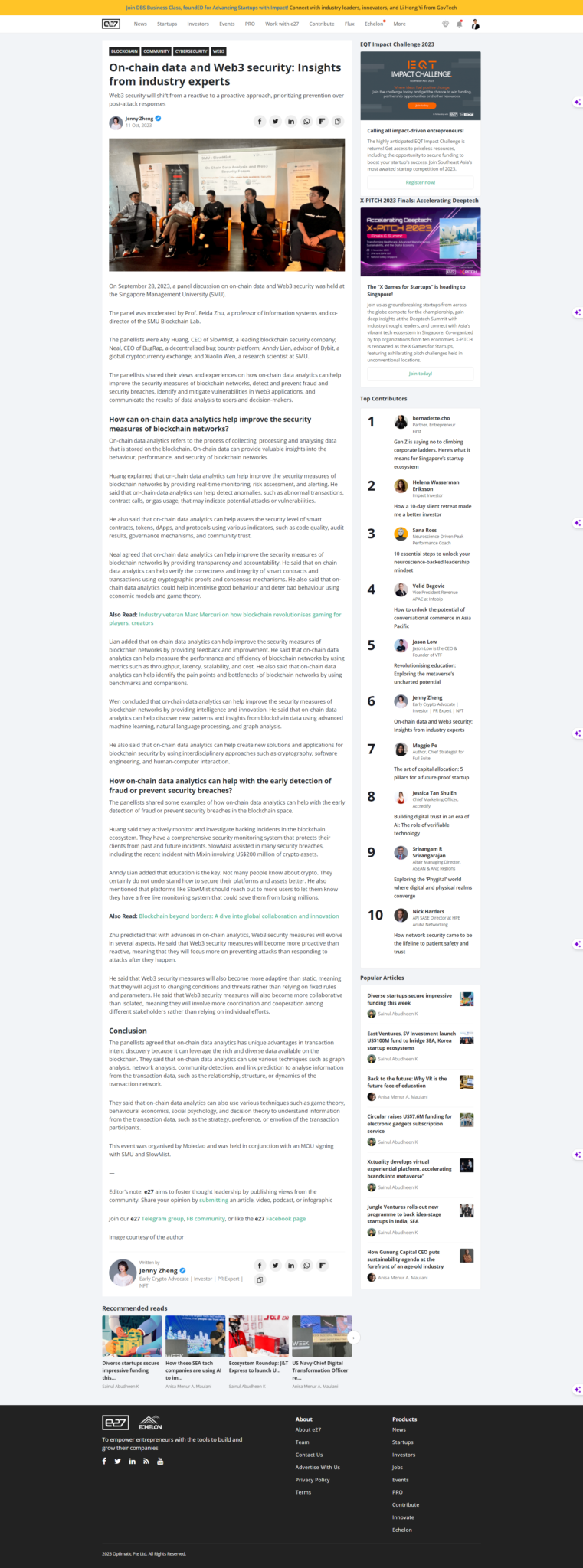
On September 28, 2023, a panel discussion on on-chain data and Web3 security was held at the Singapore Management University (SMU).

The panel was moderated by Prof. Feida Zhu, a professor of information systems and co-director of the SMU Blockchain Lab.

The panellists were Aby Huang, CEO of SlowMist, a leading blockchain security company; Neal, CEO of BugRap, a decentralised bug bounty platform; Anndy Lian, advisor of Bybit, a global cryptocurrency exchange; and Xiaolin Wen, a research scientist at SMU.

The panellists shared their views and experiences on how on-chain data analytics can help improve the security measures of blockchain networks, detect and prevent fraud and security breaches, identify and mitigate vulnerabilities in Web3 applications, and communicate the results of data analysis to users and decision-makers.

How can on-chain data analytics help improve the security measures of blockchain networks?

On-chain data analytics refers to the process of collecting, processing and analysing data that is stored on the blockchain. On-chain data can provide valuable insights into the behaviour, performance, and security of blockchain networks.

Huang explained that on-chain data analytics can help improve the security measures of blockchain networks by providing real-time monitoring, risk assessment, and alerting. He said that on-chain data analytics can help detect anomalies, such as abnormal transactions, contract calls, or gas usage, that may indicate potential attacks or vulnerabilities.

He also said that on-chain data analytics can help assess the security level of smart contracts, tokens, dApps, and protocols using various indicators, such as code quality, audit results, governance mechanisms, and community trust.

Neal agreed that on-chain data analytics can help improve the security measures of blockchain networks by providing transparency and accountability. He said that on-chain data analytics can help verify the correctness and integrity of smart contracts and transactions using cryptographic proofs and consensus mechanisms. He also said that on-chain data analytics could help incentivise good behaviour and deter bad behaviour using economic models and game theory.

Lian added that on-chain data analytics can help improve the security measures of blockchain networks by providing feedback and improvement. He said that on-chain data analytics can help measure the performance and efficiency of blockchain networks by using metrics such as throughput, latency, scalability, and cost. He also said that on-chain data analytics can help identify the pain points and bottlenecks of blockchain networks by using benchmarks and comparisons.

Wen concluded that on-chain data analytics can help improve the security measures of blockchain networks by providing intelligence and innovation. He said that on-chain data analytics can help discover new patterns and insights from blockchain data using advanced machine learning, natural language processing, and graph analysis.

He also said that on-chain data analytics can help create new solutions and applications for blockchain security by using interdisciplinary approaches such as cryptography, software engineering, and human-computer interaction.

How on-chain data analytics can help with the early detection of fraud or prevent security breaches?

The panellists shared some examples of how on-chain data analytics can help with the early detection of fraud or prevent security breaches in the blockchain space.

Huang said they actively monitor and investigate hacking incidents in the blockchain ecosystem. They have a comprehensive security monitoring system that protects their clients from past and future incidents. SlowMist assisted in many security breaches, including the recent incident with Mixin involving US$200 million of crypto assets.

Anndy Lian added that education is the key. Not many people know about crypto. They certainly do not understand how to secure their platforms and assets better. He also mentioned that platforms like SlowMist should reach out to more users to let them know they have a free live monitoring system that could save them from losing millions.

Zhu predicted that with advances in on-chain analytics, Web3 security measures will evolve in several aspects. He said that Web3 security measures will become more proactive than reactive, meaning that they will focus more on preventing attacks than responding to attacks after they happen.

He said that Web3 security measures will also become more adaptive than static, meaning that they will adjust to changing conditions and threats rather than relying on fixed rules and parameters. He said that Web3 security measures will also become more collaborative than isolated, meaning they will involve more coordination and cooperation among different stakeholders rather than relying on individual efforts.

Conclusion

The panellists agreed that on-chain data analytics has unique advantages in transaction intent discovery because it can leverage the rich and diverse data available on the blockchain. They said that on-chain data analytics can use various techniques such as graph analysis, network analysis, community detection, and link prediction to analyse information from the transaction data, such as the relationship, structure, or dynamics of the transaction network.

They said that on-chain data analytics can also use various techniques such as game theory, behavioural economics, social psychology, and decision theory to understand information from the transaction data, such as the strategy, preference, or emotion of the transaction participants.

This event was organised by Moledao and was held in conjunction with an MOU signing with SMU and SlowMist.


Source: https://e27.co/on-chain-data-and-web3-security-insights-from-industry-experts-20231006/
Anndy Lian is an early blockchain adopter and experienced serial entrepreneur who is known for his work in the government sector. He is a best selling book author- “NFT: From Zero to Hero” and “Blockchain Revolution 2030”.

Currently, he is appointed as the Chief Digital Advisor at Mongolia Productivity Organization, championing national digitization. Prior to his current appointments, he was the Chairman of BigONE Exchange, a global top 30 ranked crypto spot exchange and was also the Advisory Board Member for Hyundai DAC, the blockchain arm of South Korea’s largest car manufacturer Hyundai Motor Group. Lian played a pivotal role as the Blockchain Advisor for Asian Productivity Organisation (APO), an intergovernmental organization committed to improving productivity in the Asia-Pacific region.

An avid supporter of incubating start-ups, Anndy has also been a private investor for the past eight years. With a growth investment mindset, Anndy strategically demonstrates this in the companies he chooses to be involved with. He believes that what he is doing through blockchain technology currently will revolutionise and redefine traditional businesses. He also believes that the blockchain industry has to be “redecentralised”.

j j j

Crypto trading landscape: Insights from Bybit, CEX.IO, Huobi and GoodCrypto

Crypto trading landscape: Insights from Bybit, CEX.IO, Huobi and GoodCrypto

According to key CEX players, success in the crypto industry hinges on adapting to client needs, navigating regulatory changes and prioritizing mass crypto education.

The virtual roundtable, hosted by Cointelegraph on Twitter Spaces, brought together key team members from the largest centralized exchanges (CEXs), including Bybit, CEX.IO and Huobi, to discuss current industry challenges and trends in crypto trading. Speakers also included Maksim Hramadtsou, co-founder of GoodCrypto, an all-in-one trading and portfolio management app and member of the Cointelegraph Accelerator.

All speakers noted that the challenges they’re facing are the result of a complicated regulatory landscape, especially in some parts of the world such as the United States, a loss of user confidence due to FTX and other major industry events, liquidity drying up and the consequences of a bear market. They shared strategies for navigating through the uncertainty of the current state of the industry.

Becky Sarwate, head of communications at CEX.IO, doesn’t see increased regulation as an obstacle, as she believes regulation is the key to global crypto adoption. She emphasized the importance of educating users not only on how to use CEX but also on the basics of crypto and the processes behind crypto, without technical terms or detailed descriptions of use cases. “If we really want to welcome newcomers to space, we need to limit the jargon and techno-speak to show the possibilities that really exist in space,” Sarwate said. “In our case, we teach people through the university within our platform, our leadership and values, which we’ve been nurturing throughout CEX.IO’s history.”

Edward Chen, general manager of the Asset and Commercial Center at Huobi, noted the lack of use cases related to the application layer. “Everyone is talking about infrastructure, but not the application layer, where we’ve only seen a few projects. There’s still a lot to be done there from the traditional world, such as crypto and fiat off-ramp solutions, so we provide a bridge between these scenarios to support trading demand,” he said. Among Huobi’s strategies to maintain its position in the market, Chen cites partnerships with traditional finance (TradFi) players, a strong research team to detect market trends ahead of competitors and risk management tools for users.

Bybit takes a different approach, as its adviser, Anndy Lian, pointed out with the example of its recent collaboration with Oracle Red Bull Racing: “Together we launched an NFT collection ‘Velocity Pass’ almost three weeks ago, which has sold quite well despite the fact that the NFT market is not performing strongly. I think whatever the market, bull or bear, as long as you have a good product, you will always be on the right track.” Lian said Bybit has managed to stay ahead of the competition by correctly anticipating the regulatory framework, working closely with various communities and stakeholders at the government and business levels, and constantly supporting customers, including providing artificial intelligence (AI) services. “In the longer term, it turns into a trust when done on a daily basis,” he said.

Maksim Hramadtsou of GoodCrypto noted the shift in traders’ preferences, which are now more toward decentralized exchanges (DEXs). “It’s not only because of FTX but also liquidity, which is not having the best times. Maybe over time, they [users] will change their minds because CEXs are faster, have better liquidity and lower fees. But we try to be with our customers where they are now.” Hramadtsou mentioned that GoodCrypto supports over 35 exchanges and offers tools that are not native to these exchanges but are commonly used by many traders, especially those from TradFi. These tools include trading stops, dollar-cost averaging (DCA) and grid trading bots, as well as the ability to activate any order via webhooks. “So for those who use multiple platforms at the same time, which is absolutely standard practice and creates interesting dynamics in the market, GoodCrypto is a good option as traders can easily switch between exchanges,” said Hramadtsou.

In terms of current trends that will remain and shape the future of the industry, Sarwate highlighted the growing synchronicity between TradFi and decentralized finance (DeFi), which will continue, while Hramadtsou predicted the growth of DEXs built on layer 2. Lian added: “I hope to see more tokenized products in the space, such as securities, commodities, derivatives or equities because it can bring more traditional players into crypto and therefore bring competitiveness and a variety of products. It can take us to new heights.”


Source: https://cointelegraph.com/news/crypto-trading-landscape-insights-from-bybit-cexio-huobi-and-goodcrypto


Anndy Lian is an early blockchain adopter and experienced serial entrepreneur who is known for his work in the government sector. He is a best selling book author- “NFT: From Zero to Hero” and “Blockchain Revolution 2030”.

Currently, he is appointed as the Chief Digital Advisor at Mongolia Productivity Organization, championing national digitization. Prior to his current appointments, he was the Chairman of BigONE Exchange, a global top 30 ranked crypto spot exchange and was also the Advisory Board Member for Hyundai DAC, the blockchain arm of South Korea’s largest car manufacturer Hyundai Motor Group. Lian played a pivotal role as the Blockchain Advisor for Asian Productivity Organisation (APO), an intergovernmental organization committed to improving productivity in the Asia-Pacific region.

An avid supporter of incubating start-ups, Anndy has also been a private investor for the past eight years. With a growth investment mindset, Anndy strategically demonstrates this in the companies he chooses to be involved with. He believes that what he is doing through blockchain technology currently will revolutionise and redefine traditional businesses. He also believes that the blockchain industry has to be “redecentralised”.

j j j

Unveiling Insights of NFT World: A Conversation with Anndy Lian, Author of NFT: From Zero to Hero

Unveiling Insights of NFT World: A Conversation with Anndy Lian, Author of NFT: From Zero to Hero

In the vast realm of NFTs (Non-Fungible Tokens), a prominent figure emerges, none other than Anndy Lian, the author behind the comprehensive guide, ‘NFT: From Zero to Hero.’ Through an engaging dialogue, we delve into Anndy’s journey, his thoughts on the recent market fluctuations, and the significance of his book in shedding light on the true essence of NFTs.

Surviving the Current Bear Market:

In the opening moments of our conversation, the spotlight turns to the current bear market. Anndy Lian imparts his wisdom on navigating this challenging terrain. He emphasizes the strategy of holding onto investments while actively seeking out promising projects. This approach, he suggests, is the key to weathering the storm and finding opportunities amidst the market’s ups and downs.

Anndy’s Evolution as a Thought Leader:

Anndy Lian’s remarkable evolution from a project participant to a trusted advisor for both government and corporate entities is a testament to his expertise. Hailing from Singapore, Anndy embarked on this journey back in 2017-18. His involvement spans from project engagement to advisory roles for governmental and corporate entities. An avid user of social media platforms such as Twitter and Instagram, Anndy underscores the significance of community engagement, which he believes is pivotal for achieving success in this space.

The Book ‘NFT: From Zero to Hero’:

A pivotal topic that surfaces is Anndy Lian’s book itself. Why should one consider acquiring it? The author expresses his confidence in the content, delivered with his distinct voice. He jests that beyond self-promotion, the book genuinely elucidates the essence of NFTs. Anndy’s mission transcends book sales; he aims to educate more individuals about NFTs and drive away fraudulent consultants that plague the space. Through reading his book, individuals can grasp the essence of NFTs and gain the insights needed to embark on their own projects.

Parting Thoughts:

As our conversation comes to a close, it’s clear that Anndy Lian’s journey is a reflection of the holistic nature of the NFT world. From surviving market fluctuations to becoming a thought leader and authoring an impactful book, his influence reverberates throughout this space. Anndy’s insights underscore the importance of community engagement and education, paving the way for a more informed and innovative NFT ecosystem.

In a world of constant change and innovation, the NFT realm finds guidance in individuals like Anndy Lian, whose commitment to sharing knowledge and promoting authenticity is truly commendable.


Anndy Lian is an early blockchain adopter and experienced serial entrepreneur who is known for his work in the government sector. He is a best selling book author- “NFT: From Zero to Hero” and “Blockchain Revolution 2030”.

Currently, he is appointed as the Chief Digital Advisor at Mongolia Productivity Organization, championing national digitization. Prior to his current appointments, he was the Chairman of BigONE Exchange, a global top 30 ranked crypto spot exchange and was also the Advisory Board Member for Hyundai DAC, the blockchain arm of South Korea’s largest car manufacturer Hyundai Motor Group. Lian played a pivotal role as the Blockchain Advisor for Asian Productivity Organisation (APO), an intergovernmental organization committed to improving productivity in the Asia-Pacific region.

An avid supporter of incubating start-ups, Anndy has also been a private investor for the past eight years. With a growth investment mindset, Anndy strategically demonstrates this in the companies he chooses to be involved with. He believes that what he is doing through blockchain technology currently will revolutionise and redefine traditional businesses. He also believes that the blockchain industry has to be “redecentralised”.

j j j