Interview with Anndy Lian: Role of DAO and its Future

Interview with Anndy Lian: Role of DAO and its Future

– An Ukrainian DAO raised about 8 million dollar for the war effort? How do you see the role of DAO in international financing for economically ravaged/weaker countries?

There’s certainly potential in quickly and securely using DAOs (decentralized autonomous organizations) for financing for troubled parts of the world. The case of the Ukraine DAO shows that such a decentralized structure can be spun up quickly and cheaply and engage with a community around issues of concern to individuals around the world. You can also see from the growing use of crypto donations in the NGO and charity sector that DAOS could become a more formal means to channel funds and with less cost in terms of money transfer fees, and with less issues with government bureaucracy by directing funds straight into the pockets of those most in need. In addition, as a collectively owned and managed entity with a set of rules written in computer code, the DAO offers the potential couple with good governance, to avoid corruption that can damage already economically weakened countries.


– Russia has now been imposed multiple economic sanctions. How will DAO in particular play a role in Russian economy now that it will largely be cut off from the international financial system?

It may well be that civil society groups and civilian organizations faced with the impact of economic sanctions will use DAOs to bypass central government restrictions and appeal directly to people across the world for financial help. That will pose problems for the DAO as a model for co-operation as it raises pertinent questions about governance, how do you prove governance and how do you resist your funds being secured by state organizations. However, with the likely collapse of the Russian economy cryptocurrency gives ordinary Russians the opportunity to safeguard funds, as well as to use DAOs to pool resources to meet the needs for housing and heating to name two essential requirements for societal infrastructure to sustain the fabric of civil society in the face of the possible collapse of central government.


– Do you the ongoing Ukraine-Russia war as an inflection point in the mass adoption of DAO system? and how?

In fact, the rise of the DAO is closely tied to the emergence of cryptocurrency with the launch of Bitcoin back in 2008. It set the template, where typically the DAO founder has no workplace and no employees, but the project continues to run quietly because a group of people who believe in the project contribute to it.

More than a decade later, this DAO-based project has a market value of $1.3 trillion, making it one of the world’s top five company in terms of market value. Yes, Bitcoin is the most successful DAO right now, and its founder is the anonymous Satoshi Nakamoto. There is no boss or employees to manipulate, and all such organizations operate autonomously and anonymously. This is DAO’s core value.

More recently, the trend in using DAOs specifically to raise money for campaigns with a political theme have also emerged, in the lead up to the war in Ukraine. Notably ConstitutionDAO was founded on November 11, 2021, by a group of cryptocurrency enthusiasts. Its creators hoped to raise funds through the DAO method in order to purchase a copy of the US Constitution to realize the great dream of “putting the Constitution in the hands of the people,” and attracting over 17,000 donors. ConstitutionDAO took just nine days to raise approximately 11,000 ETH, which is worth more than $47 million.

While in December 2021 a DAO created to raise money for Ross Ulbricht, the jailed founder of Silk Road, announced that over 1,320 people raised over 2,800 ETH in to win the auction for Ross’s NFT. In short, the main reasons for FreeRossDAO’s popularity are its association with NFTs and people’s sympathy for the unfair treatment of Ross.

Taken in this context the mass adoption of DAOs to raise money to support the Ukrainian people is part of a growing trend, highlighted by the urgent need for resources to help refugees and civilian organizations. Indeed, the inspiration for the Ukraine DAO, the leading DAO which has raised over $13 million in crypto donations to date, came from a UK-based Ukrainian activist Alona Shevchenko who works with FreeRossDAO. Connecting to her network of friends led to the connection to Nadya Tolokonnikova of Pussy Riot, who launched the DAO on February 25 along with Trippy Labs and members of PleasrDAO, which was behind FreeRossDAO.

Therefore, the launch of the Ukraine DAO is in many ways simply a recognition of the already growing use of DAOs to raise funds for specific causes; the Russian invasion was the catalyst but whether it is a ‘tipping point’ remains to be seen. Some of the previous issues such as concerns about crypto scammers using the situation to fraudulently raise funds have emerged concerning published crypto addresses when queried by Ethereum’s founder Vitalik Butelin. Which is why the use of the DAO mechanism, which provides greater transparency has proved so popular as well as the means to organize collectively around it. As stated on the Ukraine DAO website, similar to a direct P2P crypto donation method using a DAO coupled with crypto as the funding mechanism means that: “Decentralized Autonomous Organizations are a model for the world to witness how people with a common purpose can join and work together quickly to distribute funds to present humanitarian causes.”

The speed and global reach of the Ukraine DAO, bypassing the problems caused by using conventional funding means whether through central funding institutions such as the banks or examples such as the Patreon startup, which returned money raised for the Ukrainian army, certainly shows their power for future fundraising in Ukraine. Whether this will mean that DAOs will work as a broader model for organizational structure is another question. DAOS have also caught the imagination of the startup community in the US for example, with VC money following suit. That entrepreneurial interest includes celebrity crypto owner Mark Cuban, who added a note of caution in highlighting the importance of good governance to provide long-term benefit to DAO members. “The future of corporations could be very different as DAOs take on legacy businesses,” he is quoted as saying. “Entrepreneurs that enable DAOs can make money. If the community excels at governance, everyone shares in the upside.”


– DAO, largely speaking, is legally still undefined. In the sense, there is a lot of gray area when it comes to DAO. Do you see DAO as a tool to channel the wealth of people who have been sanctioned?

It’s correct to say that DAOs can be used by any group of people with a collective purpose in mind, harnessing the power of cryptocurrency and guided by a set of principles embedded into the smart contracts that regulate the DAO’s operations. However, as recently outlined by the industry organisation CryptoUK, the converse is that by the nature of crypto its very possible to track any illegal funds coming out of Russia. For example, that are a lot of coin swap pools that are trackable, which can be monitored. So, when it comes to trying to evade sanctions it shows that the crypto industry has the capability to react and mobilize in real time to freeze or block funds and also to trace transactions to a single wallet where required. “Crypto transactions are not anonymous and untraceable. Through Public / Private sector collaboration we can quickly inform the criminal world (or those looking to circumvent sanctions) that this technology is exactly the opposite of what they are looking for in terms of anonymity and lack of traceability,” confirmed CryptoUK.


– How can DAO become more legally secured across the world, in order to make sure it is not misused by non-state actors?

While DAOs offer an alternative to organizing a corporation with decision making baked into the code, funding via the Dao’s token, and decisions decided by the whole community, in practice they currently lack the legal status of a corporate entity and a consistent regulatory framework. The token itself depending on the country’s regulations may be deemed as a security and come under tight legal regulations of its own, potentially opening up members of a DAO to liability. At least in the US as unincorporated entities, DAOs do not need to follow the legal formalities of incorporation such as registration, bylaws, and contracts. As a result, DAOs are treated as unincorporated partnerships. In a partnership, each individual has unlimited liability. Therefore, if the DAO is hacked or declares bankruptcy, each member is exposed to liability for the entire amount of funds. This key aspect of the legal status of DAOs for fund raising would need to be resolved to ensure they are not misused by non-state actors. It maybe that a lead would need to be taken at an international level, such as through the United Nations, as well as by individual nation states if the DAO is to prove sustainable from a regulatory standpoint, therefore.


Original Source: https://newslookout.com/feature/interview-with-anndy-lian-role-of-dao-and-its-future/

Anndy Lian is an early blockchain adopter and experienced serial entrepreneur who is known for his work in the government sector. He is a best selling book author- “NFT: From Zero to Hero” and “Blockchain Revolution 2030”.

Currently, he is appointed as the Chief Digital Advisor at Mongolia Productivity Organization, championing national digitization. Prior to his current appointments, he was the Chairman of BigONE Exchange, a global top 30 ranked crypto spot exchange and was also the Advisory Board Member for Hyundai DAC, the blockchain arm of South Korea’s largest car manufacturer Hyundai Motor Group. Lian played a pivotal role as the Blockchain Advisor for Asian Productivity Organisation (APO), an intergovernmental organization committed to improving productivity in the Asia-Pacific region.

An avid supporter of incubating start-ups, Anndy has also been a private investor for the past eight years. With a growth investment mindset, Anndy strategically demonstrates this in the companies he chooses to be involved with. He believes that what he is doing through blockchain technology currently will revolutionise and redefine traditional businesses. He also believes that the blockchain industry has to be “redecentralised”.

j j j

Anndy Lian, Metaverse, and Cryptocurrency: The Nitty Gritty – An Interview with Stashaway

Anndy Lian, Metaverse, and Cryptocurrency: The Nitty Gritty – An Interview with Stashaway

Metaverse has been talk of the town ever since Facebook CEO Mark Zuckerberg rebranded Facebook into Meta and shared with the world his aspirations and goals in this “metaverse”. But what exactly is metaverse? What does the future hold for us?

Anndy Lian, Chairman of BigONE Exchange gets into the nitty gritty of metaverse with Stashaway,  an intelligent wealth management platform run by roboadvisors.

Metaverse, much like NFTs, is not something new in 2021. It has been talked about seriously since 2018 in a book that Anndy wrote – Blockchain Revolution 2030. Dating further back, ‘metaverse’ was known as a ‘virtual world’ and its origins are mostly credited to Author Neal Stephenson’s 1992 dystopic, sci-fi novel Snow Crash, and many see a more recent inspiration in Earnest Cline’s 2011 novel Ready Player One.

“Metaverse,”, says Anndy, “is more like a bridge between the virtual world and the real world.”. It is speculated that everything that can be done in the real world can be mimicked and reproduced in the metaverse – and maybe even more. It is not as minuscule as having meetings, or creating a cute profile or meme in the metaverse. Imagine what you can do in real life – work, earn your keep, enjoy entertainment – these are what the metaverse promises.

There is a hype around metaverse right now and with the help of Facebook and a few other big companies, people are looking at tech stocks and good crypto companies to invest in. It’s only been a couple of months since the topic of metaverse surfaced and many may argue that it is too early to start investing or paying attention to the market. One concern is that users who are into the metaverse are buying land – digital land – and keeping them. It is of no surprise that they will must have been quite hefty. “It may look like an investment now but you are really just gambling because there is no clear indication right now which metaverse is going to be the next big thing. There are a lot of things to uncover and discover,”, Anndy explains.

The media features news that are trending and people often just listen to them without doing their own research. It is imperative that these people understand that we are only in the beginning phase of metaverse. Taking Google and Yahoo as an example, in the past, everyone thought that Yahoo would be the biggest leader in search engine, but despite both of them being billion-dollar companies, Google clearly has the biggest advantage right now. “Whoever is the leader now may not be the leader at the end,”, emphasises Anndy. There a lot of building blocks that we have not seen and as we progress on, we will get a clearer investment perspective and that would be a better time to invest.

Decentraland (MANA) and The Sandbox (SAND) are the two biggest players in the metaverse right now and the competition has extended to its users – much like Apple versus Samsung. In terms of metaverse, Anndy believes that it is good for everyone to work together and unite such that there would be one metaverse for the whole world. “Ideally, I hope everyone can be united and do what’s needed to build the metaverse up,”, says Anndy.

It is a common misconception that the metaverse is all about cryptocurrency. It is without a doubt that cryptocurrency is one of the aspects of metaverse that connects everyone, however, looking at it from a deeper level, there is also a tech aspect. One of which is Web3.0 that will be coming to improve engagement and enhance safety. Apart from cryptocurrency, NFTs are definitely a part of the concept as well. We may have seen virtual galleries showcasing NFT artworks around the world – and this is only the beginning.

Another common misconception of the metaverse is that it is closely interlinked with virtual reality (VR) and augmented reality (AR). Due to the portrayal of Ready Player One, many believe that we have to wear headsets or sit in a special chair to experience the metaverse in 5D. Thinking back to a conversation with a friend, Anndy brought up that we are all restricted by our physical bodies where we grow old and sick. “If it continues to be like that, how about connecting our mind into the metaverse?”, questions Anndy. This may not be too far-fetched an idea either. Greg Daniel’s 2020 sci-fi television series Upload portrayed Anndy’s thoughts perfectly. The premise of the series is that humans are able to “upload” themselves into a virtual afterlife of their choosing. Now isn’t it wonderful to be able to live even after death?

In a metaverse, there are a few foundational aspects needed to flourish. First and foremost is the ability to let people earn money. Many games such as Axie Infinity have been released where players can play to earn and this attracted the attention of billions of people. Secondly, is the formation of a strong community. With a community, bigger and more valuable things can be built upon as long as they play their part. The third and final point is that whatever is earned from within the metaverse can be brought out and utilised in the real world. “Great importance should be put on these 3 points. I’ve yet to see the 2nd point happen so I’m really looking forward to it,”, says Anndy.

We certainly hope that adoption of cryptocurrencies will be boosted in 2022 as it is a very good opportunity for things to mature. Due to COVID-19, things will definitely have to open up across borders and across different worlds. “As adoption increases, there’ll be new money and new people. The metaverse will be very very different,”, says Anndy. The metaverse that we all imagine should not be something that is too far away. In Anndy’s words, “Let’s shoutout to Elon Musk; maybe he could help to boost the development of the metaverse.”. Cheers to that!


Podcast:

https://www.stashaway.sg/podcast/entering-the-metaverse


YouTube Video:

Anndy Lian is an early blockchain adopter and experienced serial entrepreneur who is known for his work in the government sector. He is a best selling book author- “NFT: From Zero to Hero” and “Blockchain Revolution 2030”.

Currently, he is appointed as the Chief Digital Advisor at Mongolia Productivity Organization, championing national digitization. Prior to his current appointments, he was the Chairman of BigONE Exchange, a global top 30 ranked crypto spot exchange and was also the Advisory Board Member for Hyundai DAC, the blockchain arm of South Korea’s largest car manufacturer Hyundai Motor Group. Lian played a pivotal role as the Blockchain Advisor for Asian Productivity Organisation (APO), an intergovernmental organization committed to improving productivity in the Asia-Pacific region.

An avid supporter of incubating start-ups, Anndy has also been a private investor for the past eight years. With a growth investment mindset, Anndy strategically demonstrates this in the companies he chooses to be involved with. He believes that what he is doing through blockchain technology currently will revolutionise and redefine traditional businesses. He also believes that the blockchain industry has to be “redecentralised”.

j j j

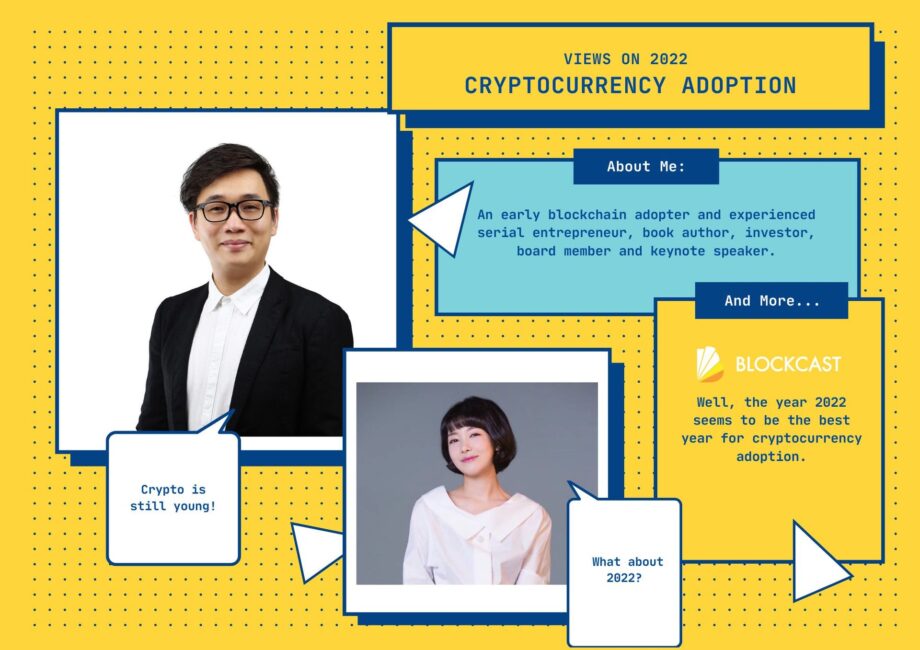
Interview with Anndy Lian: Views on 2022 Cryptocurrency Adoption – What Is Coming Next

Interview with Anndy Lian: Views on 2022 Cryptocurrency Adoption – What Is Coming Next

Anndy Lian is an all-rounded business strategist in Asia. He has provided advisory across a variety of industries for local, international, public listed companies and governments. He is an early blockchain adopter and experienced serial entrepreneur, book author, investor, board member and keynote speaker. Currently, he is appointed as the Chief Digital Advisor at Mongolia Productivity Organization, championing national digitization. He is also the Chairman, Asia for BigONE Exchange.

Being an Asian, I would like to hear Anndy’s perspectives on how he sees cryptocurrency adoption for 2022.


Jenny Zheng: Now that the SEC appears to have dropped its resistance to (certain) Bitcoin ETFs, do you expect we’ll see increased institutional adoption of bitcoin/crypto as an investment vehicle and/or inflation hedge?


Anndy Lian: It’s certainly welcome news to exchange-traded fund managers with the launch of the first Bitcoin futures ETF this week, with the ProShares’ Bitcoin Strategy ETF, to first and foremost provide their clients with the option to diversify their portfolio with cryptocurrencies, a testament to the maturation of the market.


Plus, the news that Interactive Brokers announced they will empower Registered Investment Advisors across the United States to invest in bitcoin and cryptocurrencies means hundreds of billions of dollars can now enter the market more easily.


It’s true that big institutional investors have been looking for a regulated way to trade Bitcoin for a while, and that’s all the more so considering the real concerns about high inflation, and the debasement of the dollar due to the US Fed’s quantitative easing program.


Part of that crypto adoption process however is being able to convince the regulator, the SEC in the US being the prime example, that proposed funds will be able to cover the risks for investors. For example, Bitwise, which originally filed for regulatory approval for a bitcoin ETF in 2019 before withdrawing the application after an initial rejection, has been revising its filing for more than a year.


But it’s also clear that since the recent Chinese mining and crypto ban the US has become a little more receptive to crypto regulation. Certainly, regulators in other countries have approved ETFs, Canada’s Purpose Bitcoin ETF, which started trading in February, ballooned to more than $1bn in assets under management in less than two months.


Jenny Zheng: 2021 was notable for witnessing El Salvador’s adoption of bitcoin as legal tender. To what extent do you think 2022 will involve more nations following such an example, or will at least involve more nations/governments using crypto in various ways?


Anndy Lian: The rollout of Bitcoin in El Salvador certainly captured the headlines worldwide, It raised the profile of the country and has no doubt attracted the attention of other countries. By the same token, the speed at which it happened, without the opportunity to enlighten citizens across the country as to the pros and cons of using the cryptocurrency will also have given them food for thought. This caution is supported by the case of Panama, which while also passing a law to increase the use of bitcoin and Ethereum as a payment option did not decree that businesses had to accept cryptocurrency.


In 2022 however, the real crypto push from governments will be more likely to come in the form of central bank digital currencies, most notably in China. There the central bank is looking to use blockchain at the issuance layer for its digital yuan system, which is centralized. The Chinese version of the CBDC is not yet a distributed approach due to issues around performance and scalability; though the wider ecosystem does provide solutions in the form of sidechains and oracles to enable off-chain data to connect with blockchains this seems unlikely to be adopted any time soon.


However, the real impetus to action by the government whether in South America or Southeast Asia may come with the rollout of Facebook’s Novi wallet later this year, with the Diem cryptocurrency to follow shortly after. The reason being that most deserving of crypto aims, to service the ‘unbanked’ citizens who lack banking services. If the Facebook initiatives take off then this could spur governments to action, if not creating their own digital currency, in supporting the growth of private-sector solutions with improved regulations and support.


A good example of this approach is in Ukraine, which voted almost unanimously to legalize and regulate cryptocurrency just a day after El Salvador’s official bitcoin adoption. As reported in Yahoo Finance: “This is with hopes of developing a new industry that will attract transparent investments and boost the country’s reputation as a high-tech state.” No doubt this model for adoption will prove attractive to other governments in 2022.


Jenny Zheng: Lastly, the end of 2021 seems primed to witness a renewed bull market. However, do you think 2022 will witness an increase in people actually using bitcoin and cryptocurrency to make payments?


Anndy Lian: The trend towards greater use of crypto for payments has already started, with the recent news in the US that US-based cinema chain AMC will soon be accepting cryptocurrency payments. It comes just a few months after PayPal decided to allow US consumers to use crypto to make purchases and news that Mastercard would be supporting cryptocurrency payments across its network.


While in the retail sector, Walmart and Amazon’s crypto recruitment announcements have raised awareness that these retail behemoths may be planning to open their doors to cryptocurrencies. At Amazon, it appears the plans are well advanced, as a “full-on, well-discussed, integral part of the future mechanism of how Amazon will work,” according to a City AM report.


While there are certainly challenges in accepting Bitcoin for payments, especially when the price volatility is factored in, more and more merchants are looking to add crypto purchasing to their business. According to a survey last year by BitPay, “up to 40% of customers that pay with crypto are new to the merchant. Second, purchase amounts are twice that of credit card purchases. Third, crypto is less expensive than credit cards, and lastly, there are no fraud-related chargebacks”.


A clear use case for cryptocurrency also comes with international money transfers, for example, with low transfer fees and fast transfer speeds, and anyone can use it. “However, Bitcoin has become less attractive for remittances due to the increasing cost of Bitcoin transactions. Some competing cryptocurrencies, such as Ripple and Dash, are also targeting the remittance market with substantially lower fees,” suggested a recent report in Investopedia.


Jenny Zheng: Any final words?


Anndy Lian: Well, the year 2022 seems to be the best year for cryptocurrency adoption. If you looked at the crypto innovation curve that I have shared on Twitter. You have not missed anything. Crypto is still young.


by Jenny Zheng @jennyzheng.Early crypto advocate | Investor | PR Expert | Cofounder of Blockcast.cc


Original Source: https://hackernoon.com/interview-with-anndy-lian-views-on-2022-cryptocurrency-adoption-what-is-coming-next

Anndy Lian is an early blockchain adopter and experienced serial entrepreneur who is known for his work in the government sector. He is a best selling book author- “NFT: From Zero to Hero” and “Blockchain Revolution 2030”.

Currently, he is appointed as the Chief Digital Advisor at Mongolia Productivity Organization, championing national digitization. Prior to his current appointments, he was the Chairman of BigONE Exchange, a global top 30 ranked crypto spot exchange and was also the Advisory Board Member for Hyundai DAC, the blockchain arm of South Korea’s largest car manufacturer Hyundai Motor Group. Lian played a pivotal role as the Blockchain Advisor for Asian Productivity Organisation (APO), an intergovernmental organization committed to improving productivity in the Asia-Pacific region.

An avid supporter of incubating start-ups, Anndy has also been a private investor for the past eight years. With a growth investment mindset, Anndy strategically demonstrates this in the companies he chooses to be involved with. He believes that what he is doing through blockchain technology currently will revolutionise and redefine traditional businesses. He also believes that the blockchain industry has to be “redecentralised”.

j j j