Canary Capital launches Axelar Trust targeting institutional investors

Canary Capital launches Axelar Trust targeting institutional investors

Digital asset investment firm Canary Capital has launched a new Axelar private investment fund, giving institutional investors direct access to the interoperability network’s native token, AXL.

According to a Feb. 20 announcement, the Canary AXL Trust will be available to institutional and accredited investors. Currently, Axelar has a market capitalization of more than $444 million and nearly $1 billion in total value locked (TVL), according to Flipside Crypto.

Axelar’s interoperability stack went live in October, allowing decentralized applications to connect with various blockchains, including Solana, Stellar and Sui. Axelar’s technology also allows developers to tokenize real-world assets, including real estate, commodities and intellectual property.

Canary cited Axelar’s major institutional partnerships with Apollo Global Management, JPMorgan and Deutsche Bank as one of the reasons for launching an AXL fund.

“In addition to evaluating top 20 market cap protocols, we are evaluating a handful of top 100 market cap protocols that have strong teams of developers that are building real applications and platforms [and] have the potential, based on developer interest along with launching product, to win in their category and make it to a large market cap,” Canary Capital CEO Steven McClurg told Cointelegraph.

“Axelar qualifies in the category of interoperability,” said McClurg. “There is already demand for AXL among qualified investors.”

Institutional demand for crypto is growing

The launch of Canary’s new trust coincides with a boom in institutional demand for crypto assets. Unlike the closed-ended AXL Trust, Canary is also pursuing open-ended exchange-traded funds (ETFs) with exposure to Solana, Litecoin and XRP.

The applications were submitted following the overwhelming success of the US spot Bitcoin ETFs, which sucked in nearly $40 billion in net assets in 2024. Bitwise’s Matt Hougan believes the US Bitcoin funds could attract more than $50 billion in investor inflows this year.

Increased regulatory clarity in the United States under President Donald Trump is expected to see more institutional uptake of digital assets in the near future, Chainalysis CEO Jonathan Levin told Cointelegraph in January.

Industry executives have also cited President Trump’s executive order banning the creation of a central bank digital currency as a major driver of institutional adoption.

“This move tells you where Trump stands: He’s betting on the existing crypto market rather than creating government-backed digital dollars. It’s a vote of confidence in Bitcoin, Ethereum and others, potentially giving them a boost in legitimacy and market value,” Anndy Lian, an intergovernmental blockchain adviser, told Cointelegraph.

Representatives from the crypto and institutional investment industries recently met with President Trump’s Crypto Task Force to discuss ways to open up the market to more established players. They requested clearer guidelines around exchange-traded products and protocol staking, among others.


Source: https://cointelegraph.com/news/canary-capital-launches-institutional-axelar-fund

Anndy Lian is an early blockchain adopter and experienced serial entrepreneur who is known for his work in the government sector. He is a best selling book author- “NFT: From Zero to Hero” and “Blockchain Revolution 2030”.

Currently, he is appointed as the Chief Digital Advisor at Mongolia Productivity Organization, championing national digitization. Prior to his current appointments, he was the Chairman of BigONE Exchange, a global top 30 ranked crypto spot exchange and was also the Advisory Board Member for Hyundai DAC, the blockchain arm of South Korea’s largest car manufacturer Hyundai Motor Group. Lian played a pivotal role as the Blockchain Advisor for Asian Productivity Organisation (APO), an intergovernmental organization committed to improving productivity in the Asia-Pacific region.

An avid supporter of incubating start-ups, Anndy has also been a private investor for the past eight years. With a growth investment mindset, Anndy strategically demonstrates this in the companies he chooses to be involved with. He believes that what he is doing through blockchain technology currently will revolutionise and redefine traditional businesses. He also believes that the blockchain industry has to be “redecentralised”.

j j j

Investors claim Tether’s $118B reserves may face audit and liquidity risks

Investors claim Tether’s $118B reserves may face audit and liquidity risks

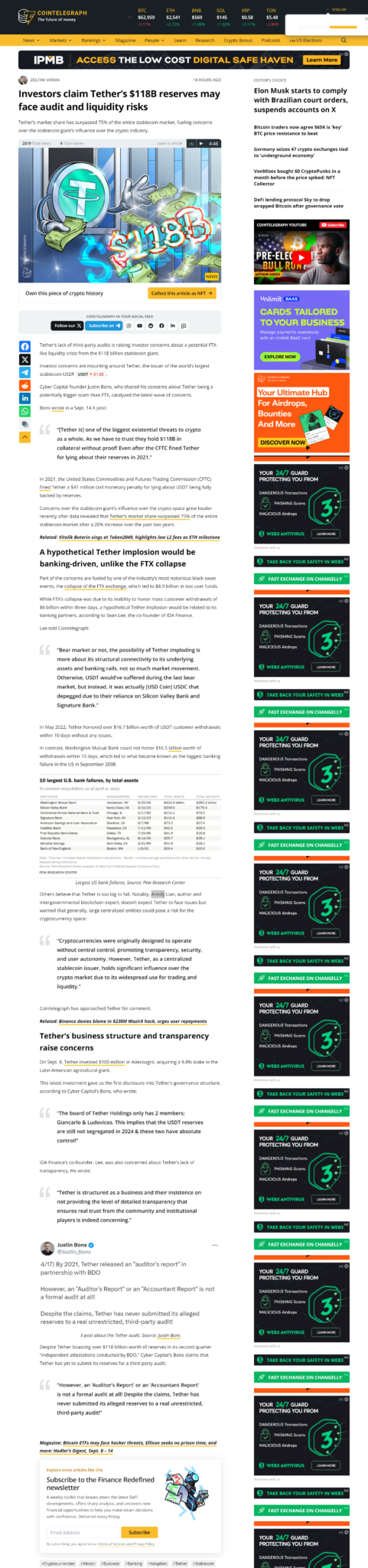
Tether’s lack of third-party audits is raising investor concerns about a potential FTX-like liquidity crisis from the $118 billion stablecoin giant.

Investor concerns are mounting around Tether, the issuer of the world’s largest stablecoin USD₮.

Cyber Capital founder Justin Bons, who shared his concerns about Tether being a potentially bigger scam than FTX, catalyzed the latest wave of concerns.

Bons wrote in a Sept. 14 X post:

“[Tether is] one of the biggest existential threats to crypto as a whole. As we have to trust they hold $118B in collateral without proof! Even after the CFTC fined Tether for lying about their reserves in 2021.”

In 2021, the United States Commodities and Futures Trading Commission (CFTC) fined Tether a $41 million civil monetary penalty for lying about USDT being fully backed by reserves.

Concerns over the stablecoin giant’s influence over the crypto space grew louder recently after data revealed that Tether’s market share surpassed 75% of the entire stablecoin market after a 20% increase over the past two years.

A hypothetical Tether implosion would be banking-driven, unlike the FTX collapse

Part of the concerns are fueled by one of the industry’s most notorious black swan events, the collapse of the FTX exchange, which led to $8.9 billion in lost user funds.

While FTX’s collapse was due to its inability to honor mass customer withdrawals of $6 billion within three days, a hypothetical Tether implosion would be related to its banking partners, according to Sean Lee, the co-founder of IDA Finance.

Lee told Cointelegraph:

“Bear market or not, the possibility of Tether imploding is more about its structural connectivity to its underlying assets and banking rails, not so much market movement.  Otherwise, USDT would’ve suffered during the last bear market, but instead, it was actually [USD Coin] USDC that depegged due to their reliance on Silicon Valley Bank and Signature Bank.”

In May 2022, Tether honored over $16.7 billion worth of USDT customer withdrawals within 10 days without any issues.

In contrast, Washington Mutual Bank could not honor $16.5 billion worth of withdrawals within 10 days, which led to what became known as the biggest banking failure in the US in September 2008.

Others believe that Tether is too big to fail. Notably, Anndy Lian, author and intergovernmental blockchain expert, doesn’t expect Tether to face issues but warned that generally, large centralized entities could pose a risk for the cryptocurrency space:

“Cryptocurrencies were originally designed to operate without central control, promoting transparency, security, and user autonomy. However, Tether, as a centralized stablecoin issuer, holds significant influence over the crypto market due to its widespread use for trading and liquidity.”

Cointelegraph has approached Tether for comment.

Tether’s business structure and transparency raise concerns

On Sept. 8, Tether invested $100 million in Adecoagro, acquiring a 9.8% stake in the Latin American agricultural giant.

This latest investment gave us the first disclosure into Tether’s governance structure, according to Cyber Capital’s Bons, who wrote:

“The board of Tether Holdings only has 2 members; Giancarlo & Ludovicos. This implies that the USDT reserves are still not segregated in 2024 & these two have absolute control!”

IDA Finance’s co-founder, Lee, was also concerned about Tether’s lack of transparency. He wrote:

“Tether is structured as a business and their insistence on not providing the level of detailed transparency that ensures real trust from the community and institutional players is indeed concerning.”

Despite Tether boasting over $118 billion worth of reserves in its second quarter “independent attestations conducted by BDO,” Cyber Capital’s Bons claims that Tether has yet to submit its reserves for a third-party audit:

“However, an ‘Auditor’s Report’ or an ‘Accountant Report’ is not a formal audit at all! Despite the claims, Tether has never submitted its alleged reserves to a real unrestricted, third-party audit!”


Source: https://cointelegraph.com/news/tether-transparency-business-structure-118b-ftx-concern

Anndy Lian is an early blockchain adopter and experienced serial entrepreneur who is known for his work in the government sector. He is a best selling book author- “NFT: From Zero to Hero” and “Blockchain Revolution 2030”.

Currently, he is appointed as the Chief Digital Advisor at Mongolia Productivity Organization, championing national digitization. Prior to his current appointments, he was the Chairman of BigONE Exchange, a global top 30 ranked crypto spot exchange and was also the Advisory Board Member for Hyundai DAC, the blockchain arm of South Korea’s largest car manufacturer Hyundai Motor Group. Lian played a pivotal role as the Blockchain Advisor for Asian Productivity Organisation (APO), an intergovernmental organization committed to improving productivity in the Asia-Pacific region.

An avid supporter of incubating start-ups, Anndy has also been a private investor for the past eight years. With a growth investment mindset, Anndy strategically demonstrates this in the companies he chooses to be involved with. He believes that what he is doing through blockchain technology currently will revolutionise and redefine traditional businesses. He also believes that the blockchain industry has to be “redecentralised”.
j j j

Chinese Investors Face Heavy Losses in Crypto Investments Amid Market Downturn

Chinese Investors Face Heavy Losses in Crypto Investments Amid Market Downturn

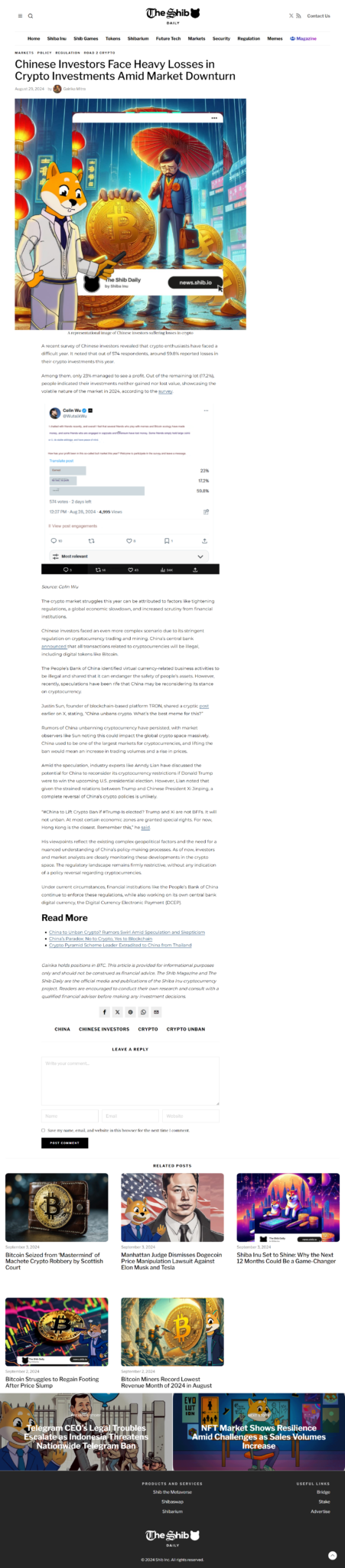
A recent survey of Chinese investors revealed that crypto enthusiasts have faced a difficult year. It noted that out of 574 respondents, around 59.8% reported losses in their crypto investments this year.

Among them, only 23% managed to see a profit. Out of the remaining lot (17.2%), people indicated their investments neither gained nor lost value, showcasing the volatile nature of the market in 2024, according to the survey.

The crypto market struggles this year can be attributed to factors like tightening regulations, a global economic slowdown, and increased scrutiny from financial institutions.

Chinese investors faced an even more complex scenario due to its stringent regulation on cryptocurrency trading and mining. China’s central bank announced that all transactions related to cryptocurrencies will be illegal, including digital tokens like Bitcoin.

The People’s Bank of China identified virtual currency-related business activities to be illegal and shared that it can endanger the safety of people’s assets. However, recently, speculations have been rife that China may be reconsidering its stance on cryptocurrency.

Justin Sun, founder of blockchain-based platform TRON, shared a cryptic post earlier on X, stating, “China unbans crypto. What’s the best meme for this?”

Rumors of China unbanning cryptocurrency have persisted, with market observers like Sun noting this could impact the global crypto space massively. China used to be one of the largest markets for cryptocurrencies, and lifting the ban would mean an increase in trading volumes and a rise in prices.

Amid the speculation, industry experts like Anndy Lian have discussed the potential for China to reconsider its cryptocurrency restrictions if Donald Trump were to win the upcoming U.S. presidential election. However, Lian noted that given the strained relations between Trump and Chinese President Xi Jinping, a complete reversal of China’s crypto policies is unlikely.

“#China to Lift Crypto Ban if #Trump Is elected? Trump and Xi are not BFFs. It will not unban. At most certain economic zones are granted special rights. For now, Hong Kong is the closest. Remember this,” he said.

His viewpoints reflect the existing complex geopolitical factors and the need for a nuanced understanding of China’s policy-making processes. As of now, investors and market analysts are closely monitoring these developments in the crypto space. The regulatory landscape remains firmly restrictive, without any indication of a policy reversal regarding cryptocurrencies.

Under current circumstances, financial institutions like the People’s Bank of China continue to enforce these regulations, while also working on its own central bank digital currency, the Digital Currency Electronic Payment (DCEP).


Source: https://news.shib.io/2024/08/29/chinese-investors-face-heavy-losses-in-crypto-investments-amid-market-downturn/


Anndy Lian is an early blockchain adopter and experienced serial entrepreneur who is known for his work in the government sector. He is a best selling book author- “NFT: From Zero to Hero” and “Blockchain Revolution 2030”.

Currently, he is appointed as the Chief Digital Advisor at Mongolia Productivity Organization, championing national digitization. Prior to his current appointments, he was the Chairman of BigONE Exchange, a global top 30 ranked crypto spot exchange and was also the Advisory Board Member for Hyundai DAC, the blockchain arm of South Korea’s largest car manufacturer Hyundai Motor Group. Lian played a pivotal role as the Blockchain Advisor for Asian Productivity Organisation (APO), an intergovernmental organization committed to improving productivity in the Asia-Pacific region.

An avid supporter of incubating start-ups, Anndy has also been a private investor for the past eight years. With a growth investment mindset, Anndy strategically demonstrates this in the companies he chooses to be involved with. He believes that what he is doing through blockchain technology currently will revolutionise and redefine traditional businesses. He also believes that the blockchain industry has to be “redecentralised”.

j j j