
$PEPE Leads Meme Сoin Frenzy as Investors Search for the Next DOGE

$PEPE Leads Meme Сoin Frenzy as Investors Search for the Next DOGE

Additional Insights


Ethereum-based meme coin PEPE surged over 150% in the last week of February 2024 to lead a meme coin frenzy as fear-of-missing-out (FOMO) trading kicked in after bellwether Bitcoin (BTC) neared all-time highs.

In this article, we talk about the PEPE token price, analyze the ongoing meme coin frenzy, understand why people invest in meme coins, and ask experts how to find the “next DOGE.”

Key Takeaways

  • PEPE outperforms older rivals DOGE, SHIB, and BONK.
  • 2023-created meme coins like Solana’s WIF and Donald Trump-themed TRUMP posted outsized gains.
  • Whales began taking PEPE profits as one whale converted their position from PEPE to SHIB.
  • Social forces and attempts to find the next 100x meme coin fuel the market frenzy.
  • Crypto expert Anndy Lian shares methodology to “find the next DOGE.”
Finding the Next Dogecoin
Table of Contents

The Latest Price Analysis: PEPE Outperforms Popular DOGE and SHIB

On February 28, 2024, the PEPE crypto price rose to $0.00000362, its highest since May 2023. Pepe the Frog-inspired meme coin regained its billion-dollar market cap for the first time since its debut. Only Dogecoin (DOGE), Shiba Inu (SHIB), and Bonk (BONK) had a higher market cap than PEPE at the time of writing.

This week, PEPE has become the top performer among the biggest meme coin names. The three dog-themed meme coins DOGE, SHIB, and BONK posted gains of 50%, 45%, and 74% in the last seven days, respectively – as of February 29, 2024 – only to be trumped by PEPE, which rose over 150% in the same period.

PEPE is a newer meme coin compared to DOGE and SHIB. PEPE debuted less than 12 months ago, in late April 2023, while DOGE is over ten years old, and SHIB came to prominence in the 2020-2021 bull cycle.

The freshness of PEPE certainly plays a part in its outperformance against the old dogs. Supporting this thesis is the explosion in the price of meme coins that debuted in 2023 and 2024.

Take Solana’s new meme coin darling, for example. Dogwifhat (WIF) is one of the hottest new cryptos in town, which has gained nearly 400% since its December 2023 debut and over 150% in the last seven days as of February 29, 2024.

Another 2023-launched meme coin that has outperformed its peers is a Donald Trump-themed crypto called MAGA (TRUMP). The TRUMP meme coin has ballooned nearly 3,000% since the start of 2024.

However, there were warning signs that PEPE price movement was getting overheated. Blockchain analytics firm Lookonchain revealed that a whale sold all of their 1.9 trillion PEPE tokens on Binance for a cool $3.49 million profit on February 29, 2024. The whale later changed his position from PEPE to SHIB – the latter has been underperforming PEPE.


Meme Coin Frenzy Takes Over 2024 Crypto Bull Run

In this section, we explain meme coin investing through the following points:

1. Meme Coin Degens Do Not Care About Utility or Fundamentals

For an outsider, the price movement of meme coins tends to make zero sense. Fundamental analysts are often baffled by the large sums of money invested in these crypto tokens with zero utility.

Non-crypto-natives should understand that crypto degens rarely look for utility or strong fundamentals. They want to find the next Dogecoin to possibly 10x-100x their crypto investment, well knowing the high volatility and risks involved.


2. Crypto Traders Seek Outperformance in Bull Markets

Battle-hardened crypto natives tend to invest in cryptocurrencies through bear markets, making them well-prepared to take hefty profits early when bull markets return. In search of market outperformance, experienced traders have shown a tendency to shift funds out of large market cap coins like BTC, which tend to lead crypto bull runs, to smaller market cap tokens that follow.

As quoted in Techopedia’s Bitcoin bull run 2024 article, crypto hedge fund Pantera Capital said in a report:

“While one of the highest sources of alpha has historically come from a perfectly timed rotation from Bitcoin into altcoins as phase 2 commences, that relationship won’t necessarily always hold true, nor is timing that rotation perfectly a reality for any trader.”

The meme coin frenzy that we are witnessing at the moment is an indicator that traders are now looking to altcoins for “alpha” as Bitcoin nears all-time highs.

3. The Importance of Social Forces in Meme Coin Investing

Social forces play an incredibly important role in driving meme coin price gains. Meme coins are inspired by internet memes, jokes, and satire. They bank on community participation, humor, and virality to attract followers and investors.

Elon Musk’s ‘comeback’ in the game could add flames to the meme coin frenzy.


Top meme coins like DOGE, SHIB, and PEPE have loyal followers who enjoy sparkling conversations about their beloved meme coins on social media platforms like Discord and X.

This vibrant social buzz tends to attract newcomers, many of whom end up swapping their fiat for meme coins.

Anndy Lian, an intergovernmental blockchain expert, told Techopedia: “Meme coins can create a sense of community and belonging among their fans, who often use memes and jokes to communicate and promote their favorite coins.”

“Social forces play a crucial role in meme coin investing, as they can generate demand, influence sentiment, and create network effects for these coins.”

Finding the Next Dogecoin

New meme coins may come and go, but none has been able to usurp the king of meme coins – DOGE. The Elon Musk-endorsed token is the ninth biggest crypto in the world with a market cap of over $18.64 billion. At the time of writing, Dogecoin price stood at $0.13, having returned a whopping 23,200% since its debut in December 2013, CoinMarketCap data showed.

In this section, we talk to crypto expert Anndy Lian on how to find the next DOGE.

“Investors should look at the next DOGE in a “fun” manner. Personally, I hunt for them on X (formerly known as Twitter). This is the same place where I spotted $RATS, $FLOKI, $WIF, $GROK, and many more.”

Investors should look for the following traits when evaluating the potential of meme coins:

  1. Catchy and memorable name, logo, and theme, based on a popular or trending meme.
  2. Strong and engaged community that is active on social media, sharing memes, jokes, and news about their coin.
  3. Supportive and influential network of core community/team members or celebrity endorsements (e.g., Musk and DOGE) that can boost a coin’s visibility and credibility.
  4. Clear and fair tokenomics.

The Bottom Line

Meme coin is an interesting sector to uncover. The best place to discover and analyze the social fever created by meme coins is on X. There, you will find opinions about meme coins from incredibly passionate community members as well as rational crypto traders.

However, we want to highlight that meme coins are highly volatile and risky cryptocurrencies. Most meme coin projects enjoy a short period of fame and may become irrelevant after the market loses interest in them.


Source: https://www.techopedia.com/pepe-leads-meme-coin-frenzy-as-investors-search-for-the-next-dogecoin

Anndy Lian is an early blockchain adopter and experienced serial entrepreneur who is known for his work in the government sector. He is a best selling book author- “NFT: From Zero to Hero” and “Blockchain Revolution 2030”.

Currently, he is appointed as the Chief Digital Advisor at Mongolia Productivity Organization, championing national digitization. Prior to his current appointments, he was the Chairman of BigONE Exchange, a global top 30 ranked crypto spot exchange and was also the Advisory Board Member for Hyundai DAC, the blockchain arm of South Korea’s largest car manufacturer Hyundai Motor Group. Lian played a pivotal role as the Blockchain Advisor for Asian Productivity Organisation (APO), an intergovernmental organization committed to improving productivity in the Asia-Pacific region.

An avid supporter of incubating start-ups, Anndy has also been a private investor for the past eight years. With a growth investment mindset, Anndy strategically demonstrates this in the companies he chooses to be involved with. He believes that what he is doing through blockchain technology currently will revolutionise and redefine traditional businesses. He also believes that the blockchain industry has to be “redecentralised”.

j j j

What Investors Need to Know About BRC-20 Tokens

What Investors Need to Know About BRC-20 Tokens

Previously, I have talked about Ordinal inscriptions and what it means for the future of Bitcoin. Here’s an update on the BRC-20 token.

BRC-20 is a new experimental fungible token standard designed for the Bitcoin blockchain, inspired by Ethereum’s ERC-20 token. In the last few weeks, you may have heard this term from your friends or seen posts on social media about BRC-20 memes and NFTs.

As of May 2, the combined market capitalization of over 8,800 BRC-20 tokens was $137 million, a remarkable 682% increase from $17.5 million just a week ago. But a week after, as of May 9, the market capitalization of BRC-20 Bitcoin tokens had exceeded $1 billion, and within the previous 24 hours, there was a total trading volume of $207.7 million. These tokens can be tracked on brc-20.io or traded on Ordswap. Some of them are also available on Gate. As more wallet providers and more centralized exchanges integrate, I believe there will be more movements within their ecosystem.

What is BRC-20?

This standard was created for the Bitcoin blockchain by an anonymous on-chain analyst called Domo. It is being used to issue and transfer fungible tokens on the Bitcoin blockchain. BRC-20 is similar to the ERC-20 token standard used on the Ethereum blockchain but specifically designed for Bitcoin. BRC-20 uses Ordinal inscriptions of JavaScript Object Notation to deploy token contracts and mint and transfer tokens.

BRC-20 tokens are stored on the Bitcoin base chain and built with the help of Ordinals and Inscriptions. An Inscription or Ordinal is a unique number attached to a specific piece of digital content, such as an image, video, or text, stored on the Bitcoin blockchain. Inscriptions are generated using a special protocol that ensures their uniqueness and immutability, making them valuable digital assets that can be bought, sold, and traded just like NFTs. These tokens can be attributed to satoshis and then traded or swapped with others, just like other tokens.

Adding on to the above points and to give some context, BRC-20 tokens were made possible by a loophole in Bitcoin’s 2021 Taproot upgrade, which allowed for the attachment of small amounts of arbitrary data to each transaction to limit the amount of data stored on the blockchain. BRC-20 tokens use this feature to add additional data to individual satoshis, which can then be used to create various types of assets and tokens.

How different are BRC-20 and ERC-20?

The BRC-20 token standard utilizes the proof of work (PoW) mechanism, while the ERC-20 uses the proof of stake (PoS) mechanism. PoW is a consensus mechanism in blockchain networks to validate transactions and add new blocks to the chain.

In PoW, miners compete against one another to solve complex mathematical problems using high-powered computational devices. PoS protocols are a class of consensus mechanisms for blockchains that work by selecting validators in proportion to their quantity of holdings in the associated cryptocurrency.

Unlike PoW, which relies on solving complex computational problems, PoS requires validators to stake a certain amount of cryptocurrency before participating in the consensus process. Validators are chosen based on the amount of cryptocurrency they have staked, with those who have staked more having a higher probability of being selected to validate transactions.

The significant difference between the two networks is EVM (Ethereum virtual machine) compatibility. The BRC-20 token standard does not support smart contracts, which limits the ability of developers to create different programmable tokens and financial products.

Understanding memecoins popularity

Due to the explosive growth of the BRC-20 token standard, particularly with the introduction of memecoins such as Pepe and Memetic, these coins are becoming increasingly popular on BRC-20. In just four days, the BRC-20 token market capitalization has soared from $95 million to $279 million, with over 13,530 tokens currently in circulation. The top five BRC-20 tokens, Ordi, Pepe, Piza, Memetic, and Moon, make up 86.55% of the total market capitalization.

Memecoins may be moving to BRC-20 due to the Ethereum network becoming congested by these coins. One notable meme token, Pepe, has contributed significantly to this congestion. BRC-20 tokens, which are an experimental token standard on the Bitcoin blockchain modeled after Ethereum’s ERC-20 tokens, enable developers to create and transmit fungible tokens through the Ordinals protocol. The rise of memecoins has made BRC-20 tokens more popular in the cryptocurrency community.


It’s important to note that the number of daily transactions on the Bitcoin network hit a new record of 682,000 recently, up from 250,000 daily transactions at the beginning of 2023. As a result, all BRC-20 transactions must take place on-chain, which has rapidly filled up the limited space in Bitcoin blocks. Due to memecoins and BRC-20s, Bitcoin and Ethereum fees have soared.


What to look out for on BRC-20


The surge in memecoins’ popularity on BRC-20 can be attributed to the explosive growth of the BRC-20 token standard and the congestion on the Ethereum network caused by memecoins. This is like teaser marketing in my point of view.


One of the primary use cases for BRC-20 tokens is in the area of decentralized finance (DeFi). BRC-20 tokens have found utility in decentralized finance applications like lending, borrowing, and yield farming. Unlike rigid Bitcoin, BRC-20 tokens are more flexible and can be used in various decentralized financial applications.

Another use case for BRC-20 tokens is peer-to-peer transfers. BRC-20 tokens utilize the Bitcoin network and can be moved between wallets on the network. The most basic thing one could do with a BRC-20 token is to transfer it to their peers as a representation of value. In the future, I would foresee that the demand for real asset tokenization on BRC-20 will continue to grow.

The development of BRC-20 tokens is continuing at a rapid pace, and it is likely that more use cases will emerge in the future. The impact of BRC-20 tokens has been significant, considering they began as an experiment. The tokens have exploded in popularity in the crypto community, and over 14,000 BRC-20 tokens are deployed on Bitcoin compared to an estimated 400 million on Ethereum. This means that there is still lots of room for growth.


Source: https://intpolicydigest.org/what-investors-need-to-know-about-brc-20-tokens/

Anndy Lian is an early blockchain adopter and experienced serial entrepreneur who is known for his work in the government sector. He is a best selling book author- “NFT: From Zero to Hero” and “Blockchain Revolution 2030”.

Currently, he is appointed as the Chief Digital Advisor at Mongolia Productivity Organization, championing national digitization. Prior to his current appointments, he was the Chairman of BigONE Exchange, a global top 30 ranked crypto spot exchange and was also the Advisory Board Member for Hyundai DAC, the blockchain arm of South Korea’s largest car manufacturer Hyundai Motor Group. Lian played a pivotal role as the Blockchain Advisor for Asian Productivity Organisation (APO), an intergovernmental organization committed to improving productivity in the Asia-Pacific region.

An avid supporter of incubating start-ups, Anndy has also been a private investor for the past eight years. With a growth investment mindset, Anndy strategically demonstrates this in the companies he chooses to be involved with. He believes that what he is doing through blockchain technology currently will revolutionise and redefine traditional businesses. He also believes that the blockchain industry has to be “redecentralised”.
j j j

Understanding the Blockchain Space: Opportunities and Challenges for Investors – Anndy Lian

Understanding the Blockchain Space: Opportunities and Challenges for Investors – Anndy Lian

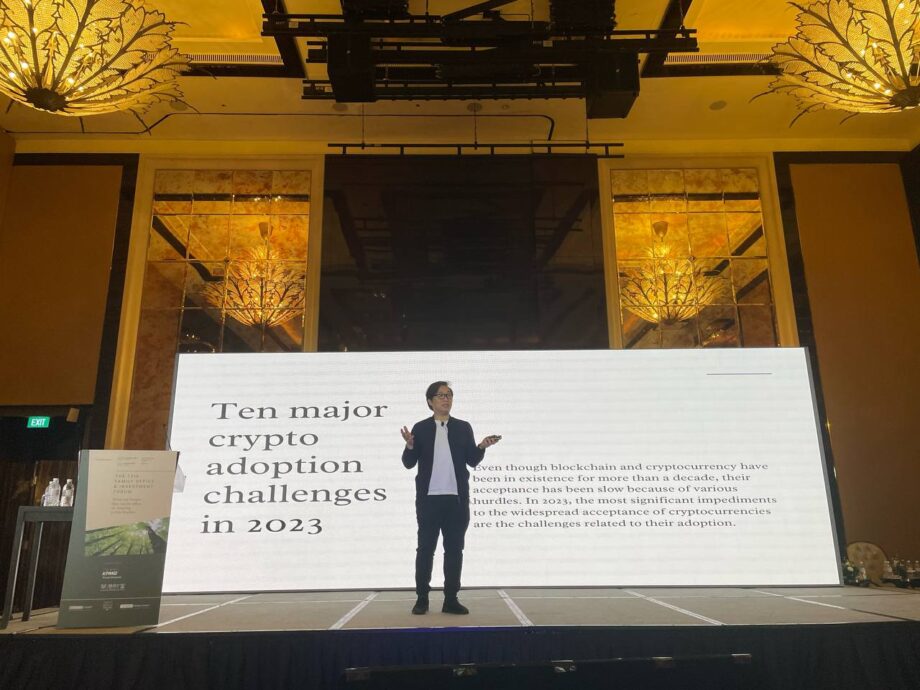
Anndy Lian, intergovernmental blockchain advisor spoke at the 12th Family Office & Investment Forum in Singapore organized by Campden Club. The theme for the event is “Thrive and Prosper: How Family Office are Adapting to New Realities”.

The global pandemic has brought about a new set of challenges for family offices, which are private wealth management firms that cater to the ultra-wealthy. The economic uncertainty and market volatility have forced family offices to adapt to new realities and change their strategies to protect their clients’ wealth and ensure long-term prosperity.

One of the key ways family offices are adapting is by embracing technology. Blockchain and cryptocurrency are two topics that are widely discussed in the investment space.

Blockchain technology and cryptocurrency have been making headlines for over a decade now, and yet their widespread adoption has been slow due to various challenges. In 2023, the most significant hurdles facing the adoption of cryptocurrencies are related to their acceptance. Anndy highlighted the top ten major crypto adoption challenges in 2023 that investors should be aware of during his keynote speech.

1. Lack of Understanding of What Cryptocurrency is and How it Works.
This lack of understanding can lead to a lack of trust in the technology, which makes it difficult for people to adopt it as a means of payment or investment.

2. Volatility.
The value of cryptocurrencies can change rapidly, making it difficult for investors to make informed decisions.

3. Lack of Regulatory Frameworks.
Governments and regulatory bodies have been slow to develop policies that govern the use of cryptocurrencies, which makes investors wary of investing in them.

4. Uncertainty Regarding Taxation.
This uncertainty can discourage investors from investing in cryptocurrencies.

5. Security Risks.
Hacking and other cyberattacks can lead to the loss of cryptocurrencies, which can be devastating for investors.

6. Transaction Irreversibility.
Transactions on the blockchain are irreversible, which means that if a mistake is made, it cannot be reversed. This makes it essential for investors to be careful when making transactions.

7. Scalability Issues.
As the number of transactions on the blockchain increases, the network can become congested, leading to slow transaction times and increased fees.

8. Lack of Merchant Adoption.
Without merchants accepting cryptocurrencies as payment, it is challenging for people to use them as a means of payment.

9. Network Congestion.
It can lead to slow transaction times and increased fees. This can discourage investors from using cryptocurrencies for transactions.

10. Lack of Trust in Digital Currencies.
Finally, a lack of trust in digital currencies is a significant hurdle to their widespread adoption.

Lian also explored ten different ways to make money from cryptocurrency.

1. Crypto Saving.
Many blockchain projects and decentralized finance (DeFi) platforms offer high-interest rates for users who deposit their cryptocurrencies.

2. Protocol Tokens.
Protocol tokens are cryptocurrencies that are used to power decentralized applications (dApps) and blockchain protocols.

3. Application Tokens.
Application tokens are cryptocurrencies that are used to access and use specific dApps.

4. Staking.
Staking is a process that involves holding cryptocurrencies in a wallet to support the network’s operations.

5. Yield Farming.
Yield farming involves providing liquidity to DeFi platforms in exchange for rewards.

6. Crypto Stocks.
Several publicly traded companies offer exposure to the cryptocurrency market through their stock offerings.

7. Other Crypto Securities.
These include exchange-traded funds (ETFs), futures, and options.

8. Exchange-Traded Products.
Exchange-traded products (ETPs) are investment vehicles that allow investors to gain exposure to cryptocurrencies through their brokerage accounts.

9. Bitcoin Proxy Stocks.
Bitcoin proxy stocks are stocks of publicly traded companies that have exposure to the cryptocurrency market.

10. Web4.
Web4 is a new concept that aims to create a decentralized internet that is owned and controlled by users.

The Campden Club is a global membership organization that brings together family offices, ultra-high net worth individuals, and private investors to network, share knowledge and expertise, and discuss issues related to family wealth management and preservation. Founded in 1987, the club has over 200 member families from around the world and hosts regular events and forums to facilitate discussions on various topics, including wealth management, philanthropy, investment opportunities, family governance, and succession planning. Members of the Campden Club gain access to a network of like-minded individuals and family offices, as well as exclusive content, research, and resources related to family wealth management.

Anndy Lian is an early blockchain adopter and experienced serial entrepreneur who is known for his work in the government sector. He is a best selling book author- “NFT: From Zero to Hero” and “Blockchain Revolution 2030”.

Currently, he is appointed as the Chief Digital Advisor at Mongolia Productivity Organization, championing national digitization. Prior to his current appointments, he was the Chairman of BigONE Exchange, a global top 30 ranked crypto spot exchange and was also the Advisory Board Member for Hyundai DAC, the blockchain arm of South Korea’s largest car manufacturer Hyundai Motor Group. Lian played a pivotal role as the Blockchain Advisor for Asian Productivity Organisation (APO), an intergovernmental organization committed to improving productivity in the Asia-Pacific region.

An avid supporter of incubating start-ups, Anndy has also been a private investor for the past eight years. With a growth investment mindset, Anndy strategically demonstrates this in the companies he chooses to be involved with. He believes that what he is doing through blockchain technology currently will revolutionise and redefine traditional businesses. He also believes that the blockchain industry has to be “redecentralised”.

j j j