
China investors call it quits as Xi, ‘zero COVID’ sap confidence

China investors call it quits as Xi, ‘zero COVID’ sap confidence

Taipei, Taiwan – For months, Singaporean investor Anndy Lian has been selling off Chinese stocks to reduce his portfolio’s exposure to the world’s second-largest economy.

Once a regular investor in Chinese tech companies, Lian now views  China as an increasingly risky bet as the country’s autocratic turn under Xi Jinping and ongoing “zero COVID” lockdowns cast a cloud over the economy.

“I started gradually lowering my exposure since last year as that was when the downward trend became obvious, but I’ve increasingly sold off my holdings this year as things have gotten worse,” Lian told Al Jazeera,

“The instability is my biggest concern as an investor. The overall environment in China is uncertain right now, and it goes way beyond the financial sector.”

Lian is among a growing number of international investors who are pulling back from China after years of record inflows.

Overseas investors shed more than $150bn in China-based yuan-denominated assets in the first quarter of this year, the largest decline on record. Chinese bonds alone saw a $61bn sell-off between February and May. Roughly $300bn could exit the country this year, more than double last year’s outflow of $129bn, according to forecasts by the Washington-based Institute of International Finance.

Overseas investors shed more than $150bn in China-based yuan-denominated assets in the first quarter of this year, the largest decline on record [File: Qilai Shen/Bloomberg]

China’s economy barely avoided contraction in the second quarter, expanding just 0.4 percent, a dramatic decline from 4.8 percent growth during the first quarter.

Lian said the effects of last year’s crackdown on the tech sector, which decimated the stock prices of major players such as Alibaba, Tencent and Didi, are still being felt.

In one of the most prominent episodes of China’s “techlash”, ride-hailing app Didi lost 80 percent of its market cap – more than $60bn in value – within a year of going public after Chinese regulators accused the firm of violating data security rules. Facing mounting scrutiny at home, Didi delisted itself from the New York Stock Exchange last month.

“Chinese tech companies may be great performers, but they need to be in the best possible environment to achieve the best returns,” Lian said.

“If you look at the tech crackdown last year, and how the value of a whole company like Didi can be virtually wiped out, it makes you nervous.”

Ride-hailing app Didi lost 80 percent of its market cap after Chinese regulators accused the firm of violating data security rules

Other investors, though, see room to adapt to Beijing’s tightening grip on the economy.

“Investors understand what the goals of the tech crackdown were, taking aim at inequality and related social issues, so I think that makes the sector still very investible,” Ker Gibbs, former president of AmCham Shanghai and a veteran China investor, told Al Jazeera.

“There’s always policy risk in China, and regulation moves much faster than in the US. That is something people must be accustomed to.”

Nonetheless, Gibbs said the lingering uncertainty around the Chinese economy has been a significant concern.

“For me, it’s all about the uncertainty of the lockdowns and zero-COVID and not knowing when it will all end,” he said. “Investors just can’t see where it’s headed. People don’t know what environment they’re in now.”

Beijing has given mixed signals to investors about what to expect.

While Chinese officials have promised to tweak pandemic restrictions for the sake of the economy, Xi has repeatedly ruled out shifting from “zero COVID” to living with the virus.

China has opened up new offerings of asset classes to foreign investors but also stepped up supervision of institutional investors in the country.

This month, authorities announced the launch of Swap Connect, a mechanism to allow overseas investors to participate in mainland China’s financial derivatives market.

Meanwhile, more than 80 Shanghai- and Shenzen-listed exchange-traded funds will be made available to investors in Hong Kong. Beijing has also announced it will substantially raise its currency swap with the territory to new levels to provide extra liquidity for the offshore yuan.

“There is a dramatic opening of China’s securities, insurance broking, and wealth management markets going on,” Duncan Clark, founder of Beijing-based investment advisory firm BDA, told Al Jazeera.

“The transition isn’t going to be easy, though, from N-shares [shares of Chinese companies listed in New York] to onshore Chinese listings or even Hong Kong listings. Investor confidence is shaken and Chinese issuers can’t meet face to face,” Clark added.

Lian said Swap Connect is unlikely to turn the tide of investors exiting the Chinese market.

“On the one hand, it may help attract new investors to China, but I doubt it will do much to retain those who are already moving away, and that is a bigger issue,” he said.

“It will take time to turn the tide. There will probably be a two or three-year trial phase until they get the settings right. Another question investors will ask is ‘How do we exit?’ Can they be assured they can withdraw their stock when they wish? We will have to see what the final details are when it comes out.”

Even as Beijing courts more foreign investors, it is also seeking to monitor them more closely. Last month, the China Securities Regulatory Commission formally issued guidelines mandating the establishment of communist party cells within global hedge funds that operate in China.

“I think it will be problematic, but mostly because of the optics back at headquarters in the US,” Gibbs said, noting that many hedge fund managers specifically asked him about the measures at a recent conference he attended in San Francisco.

“Those of us who operate in China long term understand the role the party plays and the importance of aligning with their goals for society. Actually, the conversations they have with you are often about issues of social compliance, like labour standards or equality, which is not necessarily a bad thing,” Gibbs added, describing the scrutiny as comparable to “Chinese-style ESG [Environmental, social and governance]”.

“But in the US, we see the CCP [Chinese Communist Party] and think of the whole party apparatus, and so the idea of a party official in the boardroom sounds much scarier from an American perspective.”
China’s handling of the pandemic has widened the perception gap between the country and global markets, according to some observers [File: China Daily via Reuters]

Some observers say that the perception gap between China and global markets has only widened since the pandemic.

“Many in China don’t realise how dramatically perceptions have changed overseas about their country,” Clark said. “The wall of zero-COVID and the Great Firewall works both ways: they keep capital out and information skewed on both sides. China will have to hustle much more to raise funds going forward. The penny hasn’t dropped yet.”

Beijing may need to work harder at retaining local capital as well.

“We need to remember this is not just about foreign capital and foreigners leaving China. It impacts everyone,” Gibbs said. “Many Chinese investors are heading out, too, to places like Singapore.”

Lian said he has noticed an increasing number of Chinese tech entrepreneurs setting up in Singapore, especially those working on blockchain-based applications.

“It depends a lot on their business structure, but I believe those who can move will continue to do so,” he said.

“So you have these startups that were founded in China, the largest market of all, by Chinese entrepreneurs, and now they are here in Singapore, and now they are bringing their capital with them. To me, that says it all.”


Original Source: https://www.aljazeera.com/economy/2022/7/21/china-investors-call-it-quits-as-xi-zero-covid-rattle-markets

Anndy Lian is an early blockchain adopter and experienced serial entrepreneur who is known for his work in the government sector. He is a best selling book author- “NFT: From Zero to Hero” and “Blockchain Revolution 2030”.

Currently, he is appointed as the Chief Digital Advisor at Mongolia Productivity Organization, championing national digitization. Prior to his current appointments, he was the Chairman of BigONE Exchange, a global top 30 ranked crypto spot exchange and was also the Advisory Board Member for Hyundai DAC, the blockchain arm of South Korea’s largest car manufacturer Hyundai Motor Group. Lian played a pivotal role as the Blockchain Advisor for Asian Productivity Organisation (APO), an intergovernmental organization committed to improving productivity in the Asia-Pacific region.

An avid supporter of incubating start-ups, Anndy has also been a private investor for the past eight years. With a growth investment mindset, Anndy strategically demonstrates this in the companies he chooses to be involved with. He believes that what he is doing through blockchain technology currently will revolutionise and redefine traditional businesses. He also believes that the blockchain industry has to be “redecentralised”.

j j j

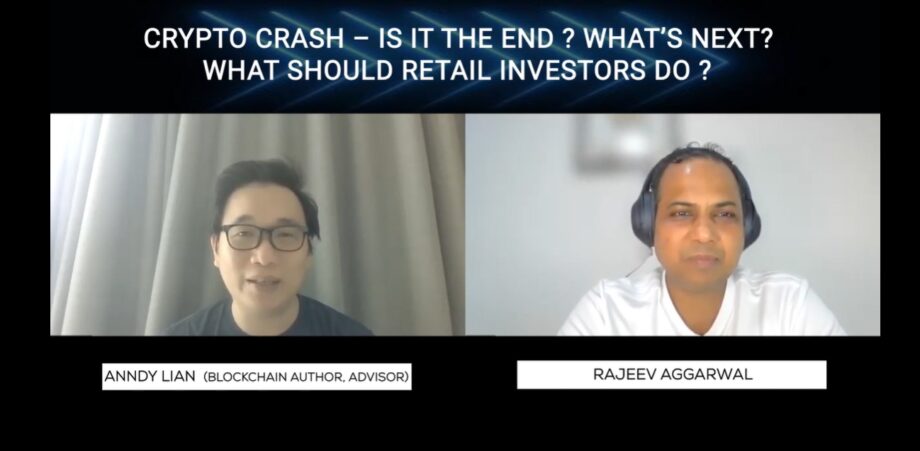
Crypto Crash: Is it the end and what should retail investors do?

Crypto Crash: Is it the end and what should retail investors do?

The Crypto market is in tatters.  The global cryptocurrency market cap moved up to the $961 billion mark, rising about 3 per cent in the last 24 hours. Several big players in the cryptocurrency markets have had difficulties, and further declines could force other crypto investors to sell out.

Rajeev who is kind enough to host me and brought up the following topics.
a) How long this bear market or correction go?
b) How to save your crypto capital now
c) Who / which exchanges could be next to fall?
d) Should you buy the crypto dip?
e) Staking, stablecoins

00:00:00 Introduction
00:00:59 What lead to the bear market in Crypto.
00:02:16 The worst is not yet over for Crypto markets
00:04:38 What exchanges can fall next?
00:08:10 How should retail investors save their capital? Buy a cold wallet and withdraw from the exchange?
00:09:14 Could Binance be under threat?
00:10:26 Does the current bear market affect the long-term bullish thesis of Crypto?
00:12:55 How to use spare cash when crypto prices are low? What are possibly good coins?
00:20:35 View on Luna? Why did Luna fail and why Anndy was one of Luna’s skeptics?
00:23:33 Are stablecoins here to stay?
00:27:09 What should retail investors do in this scenario?
00:29:19 Should investors stake their coins now?
00:32:15 Investors should be careful of crypto influencers!
00:34:50 Thank you

Anndy Lian is an early blockchain adopter and experienced serial entrepreneur who is known for his work in the government sector. He is a best selling book author- “NFT: From Zero to Hero” and “Blockchain Revolution 2030”.

Currently, he is appointed as the Chief Digital Advisor at Mongolia Productivity Organization, championing national digitization. Prior to his current appointments, he was the Chairman of BigONE Exchange, a global top 30 ranked crypto spot exchange and was also the Advisory Board Member for Hyundai DAC, the blockchain arm of South Korea’s largest car manufacturer Hyundai Motor Group. Lian played a pivotal role as the Blockchain Advisor for Asian Productivity Organisation (APO), an intergovernmental organization committed to improving productivity in the Asia-Pacific region.

An avid supporter of incubating start-ups, Anndy has also been a private investor for the past eight years. With a growth investment mindset, Anndy strategically demonstrates this in the companies he chooses to be involved with. He believes that what he is doing through blockchain technology currently will revolutionise and redefine traditional businesses. He also believes that the blockchain industry has to be “redecentralised”.

j j j

Crypto carnage continues! Investors lose over $2 trillion in eight months + Additional insights

Crypto carnage continues! Investors lose over $2 trillion in eight months + Additional insights

I have also added more insights to what I was quoted in The Economic Times.

Anndy Lian said: “The key weakness to crypto is that we are too closely linked to traditional assets. This weakness is amplified by traditional institutions that were here just for short-term gains. The quick outflow of money left us high and dry.

I think the major tokens contributing to this fall started off with the TERRA LUNA and UST saga last month. Then we saw a global economic slow down choked amid inflation and war, which then resulted in weaker demand in Bitcoin from long-term holders on top of higher selling pressure from the short-term holders. This added pressure to Ethereum too, which has fallen close to 28% in the last 7 days. The downstream issues have snowball effects as the two big brothers continue to fall. Today we saw Celsius tanking 70% in 1 hour after they stop withdrawals citing extreme market conditions. Withdrawals also cause liquidity issues and could result in unsustainable APY.

We need to understand that the whole crypto market is tightly knitted together. While many out there are spreading FUDs about Ethereum for instance. They are also indirectly killing themselves. At such times, we need to stay united and make relevant decisions to reduce losses to the investments made in the most logical manner.

The recovery will not be anything soon based on the current market sentiments and statistics. This could be a start to another crypto winter which could last for another 2 years or so.”


Crypto carnage continues! Investors lose over $2 trillion in eight months

New Delhi: The carnage in the crypto market has gathered pace with no near-term respite in sight. Considering the latest slide, investors have lost over $2 trillion (about Rs 15.65 lakh crore) over eight months.

If we compare the notional value lost, only eight countries have a GDP more than what the crypto market eroded in less than three quarters. Countries like Canada and Italy have a GDP of little more than $2 trillion, whereas Brazil’s GDP stood at $1.83 trillion.

The total market capitalization (m-cap) of the digital market is marginally above the $1 trillion mark, which was more than $3 trillion at its peak in November 2021.

Bitcoin, the largest crypto token, is barely above the $25,000 level. It has dropped more than 20 per cent over the weekend, with its market cap slipping below $500 billion or half a trillion.

Its largest peer, Ethereum, has barely managed to hold the $1,300 mark, with total valuation just above $160 billion.

Both the tokens are down about 70 per cent from their peaks. Bitcoin’s dominance in the total market cap has been about 47.25 per cent, which shows that altcoins are left with value worth merely a few billion dollars.

Market participants are linking the weakness in the crypto market closely with the traditional asset class.

Shivam Thakral, CEO, BuyUcoin said after the consumer price index reported the highest inflation since 1981, financial markets across the globe have seen a sharp downturn. The rising food, gas, and energy prices are putting tremendous pressure on the crypto market, he added.

“The market is expected to remain choppy in the coming weeks and the globe continues to report high inflation numbers.”

Anndy Lian, Chairman, BigONE Exchange said the weakness is amplified by traditional institutions who were here just for short term gains. The quick outflow of money left us high and dry, he added.

“We saw a global economic slowdown amid inflation and war, which then resulted in weaker demand. There are liquidity issues and could result in unsustainable annual per cent yield.”

Among the altcoins, Curve Dao Token, Nexo, Fantom, Stepn, Waves, Kava and THORChain have taken a big hit. These tokens are down by 20 per cent in the last 24 hours.

On a weekly basis, Convex Finance, ApeCoin, Avalanche, Near Protocol, Axis Infinity, Harmony and The Graph are down by 35-50 per cent. The major part of this correction has been witnessed over this weekend.

Praveen Kumar, Founder & CEO, Belfrics Group said the volatility in the market would continue which would have a significant impact on the valuation of other coins including Ripple, Cardano, Tether, Solana, among others.

The recovery will not be anything soon based on the current market sentiments and statistics, said Lian from BigONE Exchange. “This could be a start to another crypto winter which could last for another 2 years,” he adds.

On the other hand, some experts are suggesting investors to buy the dips to average out their cost and make gains in the longer term. Going forward, I believe the volatility would continue and there would be immense pressure on Bitcoin and other key altcoins as well, said Kumar of Belfrics.

Thukral from BuyUcoin said that the current dip in the crypto prices allows investors to buy crypto at 2021 prices and we expect the seasoned investors to take advantage of the dip.

(Disclaimer: Recommendations, suggestions, views and opinions given by the experts are their own. These do not represent the views of Economic Times)


Original Source: https://economictimes.indiatimes.com//markets/cryptocurrency/crypto-carnage-continues-investors-lose-over-2-trillion-in-eight-months/articleshow/92179178.cms?utm_source=contentofinterest&utm_medium=text&utm_campaign=cppst

Anndy Lian is an early blockchain adopter and experienced serial entrepreneur who is known for his work in the government sector. He is a best selling book author- “NFT: From Zero to Hero” and “Blockchain Revolution 2030”.

Currently, he is appointed as the Chief Digital Advisor at Mongolia Productivity Organization, championing national digitization. Prior to his current appointments, he was the Chairman of BigONE Exchange, a global top 30 ranked crypto spot exchange and was also the Advisory Board Member for Hyundai DAC, the blockchain arm of South Korea’s largest car manufacturer Hyundai Motor Group. Lian played a pivotal role as the Blockchain Advisor for Asian Productivity Organisation (APO), an intergovernmental organization committed to improving productivity in the Asia-Pacific region.

An avid supporter of incubating start-ups, Anndy has also been a private investor for the past eight years. With a growth investment mindset, Anndy strategically demonstrates this in the companies he chooses to be involved with. He believes that what he is doing through blockchain technology currently will revolutionise and redefine traditional businesses. He also believes that the blockchain industry has to be “redecentralised”.

j j j