Hong Kong isn’t the loophole Chinese crypto firms think it is

Hong Kong isn’t the loophole Chinese crypto firms think it is

China’s crypto ban has been in place since 2021, but that hasn’t stopped companies from chasing what they believe are ways to reenter.

Hyped-up stablecoin announcements in Hong Kong and overseas listings that hint at digital assets are just some of the ways companies are testing boundaries. Each time, Beijing responds with fresh warnings — a stark reminder that China’s crypto U-turn isn’t around the corner.
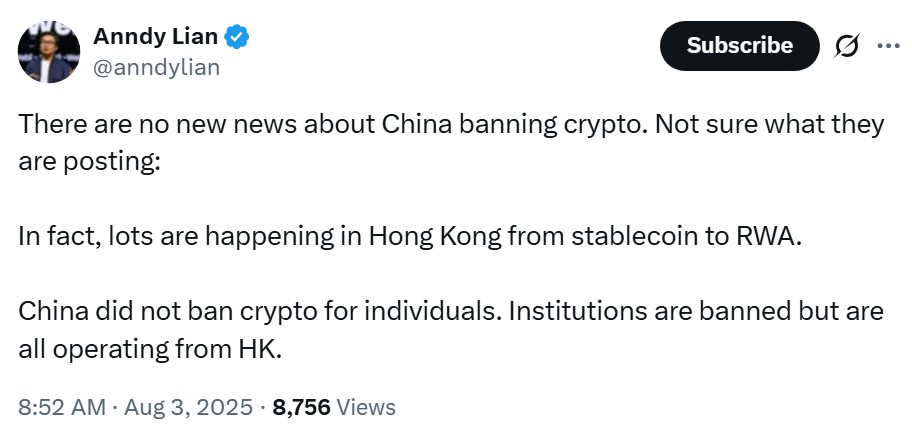
Crypto industry watcher observes RWA and stablecoin activity rising in Hong Kong
Hong Kong’s RWA and stablecoin activity picked up as new licensing rules took effect. (Anndy Lian)

The latest warning reportedly came from the China Securities Regulatory Commission, which advised companies to pause real-world asset ventures in Hong Kong. It followed a state-owned company scrubbing announcements about tokenizing bonds and other enterprises revealing RWA projects, piling on recent warnings against stablecoins after Hong Kong introduced its licensing framework.

To understand why these illusions of loopholes keep appearing — and why they collapse — Magazine spoke with Joshua Chu, co-chair of the Hong Kong Web3 association.

This conversation has been edited for clarity and length.

Magazine: Crypto has been banned for years in China, so why do regulators keep issuing fresh warnings?

China crypto ban reversal rumor
Countless social media accounts predicted Beijing would reverse its crypto ban, but it hasn’t moved so far. (DeFiMadara)

Chu: The challenge is that many new lawyers in Hong Kong moving into Web3 don’t have much experience with cross-border issues. That’s created fragmentation and a lot of confusion. Some journalists and lawyers even claimed there was a 180-degree reversal on crypto policy. China doesn’t do 180-degree turns in policy. The only U-turn in recent memory was the rollback of COVID-19 mandates.

The crypto ban from 2021 is a good example: Speculative assets are not meant for the retail sector. The People’s Republic of China is still a communist country, and if an unsophisticated investor loses money gambling on crypto, in the government’s view, that’s losing money for the state. That’s why the only entities we’ve seen handling crypto assets are the government or state-owned enterprises.

Magazine: How do you explain this cycle where Chinese firms repeatedly attempt to enter a trendy crypto venture through Hong Kong, only for mainland regulators to push back?

Chu: The issue is how they’re doing it. Even big companies with money can act in a less-than-sophisticated way. There’s a difference between state-owned enterprises and private institutions. The government is comfortable with blockchain infrastructure and foreign direct investment. What it won’t tolerate is speculation because speculation equals bubbles.

That’s why regulators crack down on projects designed to hype markets or pull value from retail investors. It’s the same logic behind China’s real estate policy: Buying to live in is fine, but speculation isn’t. You can think of it as a parental style of governance: Just as parents wouldn’t let children gamble with family savings, the state won’t let retail investors gamble away wealth in crypto.

Crypto Is Alive and Well, Though Skeptics Say It’s ‘Not Money’

At the end of the day, companies see profit potential, which is why they want in. But regulators will only support ventures that are sophisticated, compliant and responsible. That’s also why Hong Kong can hold itself out as one of the world’s top three financial hubs — its reputation depends on keeping the system clean, and the same principle applies to virtual assets.
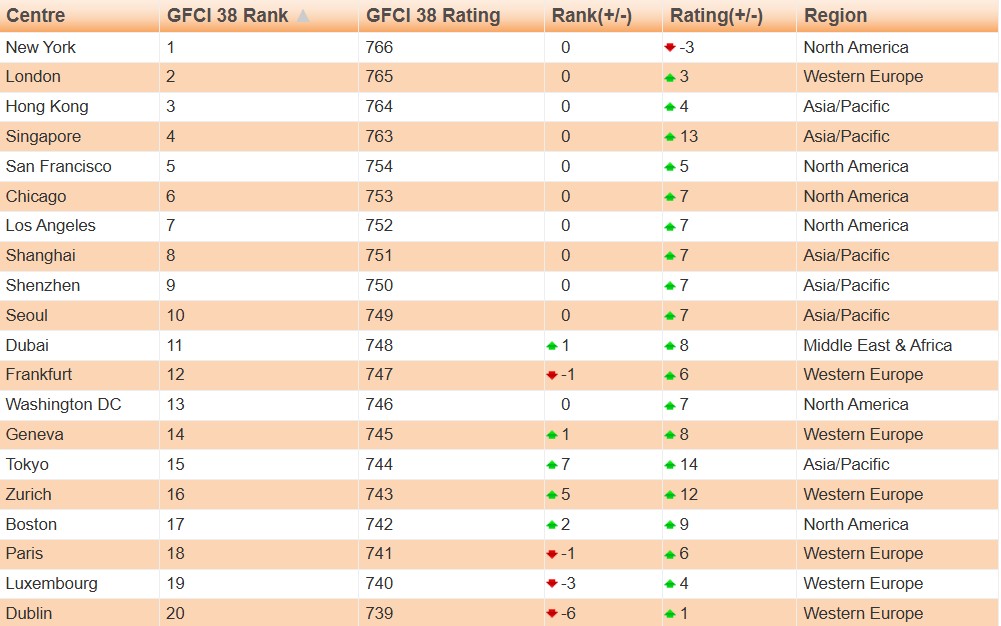
New York tops Long Finance's 2025 Global Financial Centres Index, followed by London, then Hong Kong
Hong Kong aims to strengthen its financial center rating through cryptocurrencies. (Long Finance)

Magazine: Isn’t the real problem that Chinese firms are hunting for loopholes and Hong Kong lawyers aren’t equipped to stop them?

Chu: Unfortunately, that happens a lot. If your whole business is founded on loopholes, you’re already on shaky ground. Regulators don’t create loopholes for you to exploit; they expect you to build something sustainable and compliant.

But because of the 2021 crypto ban, you have an entire market that’s been shut out. Human psychology kicks in, and people think: “Maybe this is my way back in.” That’s why you see companies making loud announcements before they’ve even filed an application. Take the stablecoin regime: Some firms were hyping plans to apply for licenses just to pump their stock price. Naturally, regulators step in.
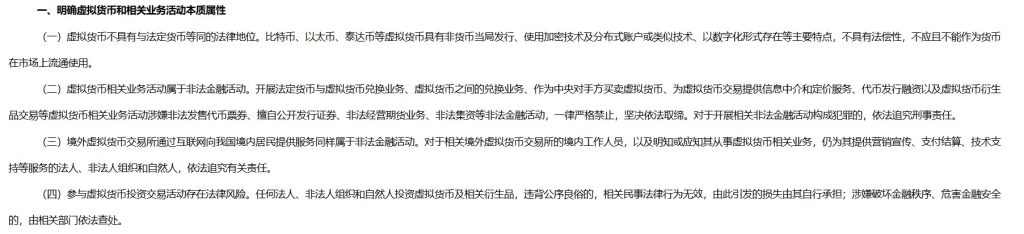
A screenshot of China's crypto ban statement in mandarin
China’s 2021 crypto ban defines crypto-related businesses as illegal financial activities. (China State Administration of Foreign Exchange)

We’ve seen this pattern before. When initial coin offerings were being sold as a cheaper alternative to initial public offerings, companies said you didn’t need a prospectus or compliance. But there’s a reason those safeguards exist: to protect investors. So, when players start cutting corners and shouting about it, it draws scrutiny. And that’s when clampdowns happen.

Magazine: When Chinese firms listed in Hong Kong or the US gain crypto exposure, is this regulatory arbitrage?

Chu: When a Chinese company lists on Nasdaq, it’s absorbing foreign investment, which triggers a different response than if it were raising funds domestically. The real question is how they structure these RWA or tokenization projects.

If they’re putting Chinese corporate data on a public blockchain, that creates cross-border data transfer issues. Remember, even listed companies have run into problems with US auditors because of China’s strict rules on what information can leave the country. Blockchain raises those concerns all over again.

There’s also the financial side. Many of these treasury strategies look risky, especially when driven by institutional FOMO at the peak of a bull cycle. Without strong internal risk controls, volatility can overwhelm the market cap of these firms. That’s exactly the kind of contagion risk regulators want to avoid.

If that happens, the scrutiny won’t just come from Beijing; it will come from the SEC as well.


Source: https://cointelegraph.com/magazine/hong-kong-isnt-loophole-chinese-crypto-firms-think/

Anndy Lian is an early blockchain adopter and experienced serial entrepreneur who is known for his work in the government sector. He is a best selling book author- “NFT: From Zero to Hero” and “Blockchain Revolution 2030”.

Currently, he is appointed as the Chief Digital Advisor at Mongolia Productivity Organization, championing national digitization. Prior to his current appointments, he was the Chairman of BigONE Exchange, a global top 30 ranked crypto spot exchange and was also the Advisory Board Member for Hyundai DAC, the blockchain arm of South Korea’s largest car manufacturer Hyundai Motor Group. Lian played a pivotal role as the Blockchain Advisor for Asian Productivity Organisation (APO), an intergovernmental organization committed to improving productivity in the Asia-Pacific region.

An avid supporter of incubating start-ups, Anndy has also been a private investor for the past eight years. With a growth investment mindset, Anndy strategically demonstrates this in the companies he chooses to be involved with. He believes that what he is doing through blockchain technology currently will revolutionise and redefine traditional businesses. He also believes that the blockchain industry has to be “redecentralised”.

j j j

Crypto Isn’t The Real Threat – It’s Regulatory Chaos

Crypto Isn’t The Real Threat – It’s Regulatory Chaos

The Crypto Crossroads: How Fragmented Regulation Threatens A Global Financial Revolution

Last spring, I was watching a young entrepreneur named Chinedu send $500 to his family in rural countryside using Bitcoin. “This is how I survive,” he said, tapping his phone. “Traditional banks charge too much, and our currency is falling daily.” Just weeks later, I was told he was detained by authorities for operating an unlicensed crypto exchange.

This duality, crypto as both lifeline and liability, defines the global debate.

The Surging Adoption: A Silent Revolution

Between 2023 and 2025, the number of people globally using cryptocurrency has significantly increased. In 2023, there are approximately 420 million people who own cryptocurrency. In 2024, this number grew to 562 million people, and in 2025, the total is estimated to be around 580 million users, potentially reaching as high as 861 million by other reports.

This explosive growth has been driven not by speculative frenzy alone, but by real-world utility: remittances, inflation hedging, and access to financial services for the unbanked. In 2024 alone, global crypto adoption surged by 172%, with India, Nigeria, and Indonesia leading the charge.

  • The United States and European Union have seen steady growth, but the most dramatic shifts are happening in the Global South.
  • Nigeria’s 33 million crypto users, the highest per capita in Africa, rely on digital assets to bypass a collapsing currency and banking system.
  • In Vietnam, peer-to-peer trading volume has exploded as citizens use Bitcoin to shield themselves from inflation and currency controls.
  • Even in India, where a 30% tax on crypto gains and 1% TDS have created regulatory uncertainty, over 100 million people trade digital assets, a testament to the demand for financial sovereignty.

The numbers tell a clear story: crypto is no longer a fringe phenomenon. It’s a global movement reshaping how people store value, send money, and access financial services. Yet for every success story, there’s a cautionary tale.

The Regulatory Maze: Progress Amidst Paralysis

A recent report analyzing 24 jurisdictions, representing 70% of global crypto exposure, found that 70% made regulatory progress in 2025. But “progress” is a relative term.

While Switzerland’s “Crypto Valley” offers clear frameworks for blockchain businesses, and the UAE’s VARA licenses over 100 firms, the United States remains a fractured landscape where the SEC, CFTC, and state regulators each stake competing claims of jurisdiction. In China, a total ban has driven crypto underground, while El Salvador’s bold Bitcoin-as-legal-tender experiment has faced IMF criticism for its economic risks.

The European Union’s Markets in Crypto-Assets (MiCA) regulation, implemented in 2024, has created a unified framework for stablecoins and asset-referenced tokens. This has attracted firms like Coinbase and Binance to establish European headquarters, but critics argue MiCA’s strict compliance requirements stifle innovation. Meanwhile, the U.S. remains stuck in regulatory limbo. The SEC’s aggressive stance against crypto exchanges has led to lawsuits against giants like Coinbase and Binance, while the CFTC claims authority over Bitcoin as a commodity. This ambiguity has created a “regulatory chill,” where startups avoid the U.S. market entirely.

The UAE, however, has emerged as a model for balanced regulation. Dubai’s Virtual Assets Regulatory Authority (VARA) requires strict AML checks, licensing, and transparency, yet also offers tax incentives and clear guidelines for businesses. As a result, over 100 crypto firms now operate in Dubai, creating thousands of jobs and positioning the UAE as a global crypto hub. This success proves that regulation doesn’t have to mean restriction; it can foster innovation while protecting consumers.

The Double-Edged Sword: Inclusion vs. Instability

Critics argue crypto fuels crime, but data tells a different story: the UN estimates less than 1% of illicit finance involves cryptocurrency, compared to 2-5% in traditional banking. The real danger isn’t the technology, it’s the lack of coherent regulation. When countries ban crypto outright, they push users into unregulated spaces where scams and fraud thrive. When they regulate too strictly, they stifle innovation.

El Salvador’s 2021 Bitcoin law promised financial inclusion for the unbanked, but today only 12% of Salvadorans regularly use it. The government’s Chivo wallet has been plagued by security breaches, and the IMF warns that Bitcoin’s volatility threatens economic stability. Salvadorans still rely on crypto for remittances; 80% of the population receives money from abroad, and traditional remittance fees can exceed 10%.

In Nigeria, the Central Bank’s ambiguous stance has created a gray zone where legitimate businesses operate in fear of sudden crackdowns. While crypto adoption has soared, the lack of clear regulations leaves users vulnerable to scams. A report found that 35% of crypto-related fraud cases stemmed from unregulated exchanges, a direct consequence of regulatory uncertainty.

Conversely, countries like Singapore and Switzerland have struck a balance. Singapore’s Payment Services Act requires crypto exchanges to register with the Monetary Authority, ensuring consumer protection while fostering innovation. Switzerland’s “Crypto Valley” in Zug offers clear tax guidelines and business-friendly policies, attracting over 1,000 blockchain companies. These nations prove that regulation can be both rigorous and enabling.

The Path Forward: Toward Harmonized Global Standards

The path forward lies in global cooperation. The Financial Action Task Force (FATF) has issued guidelines for crypto regulation, but adoption is inconsistent. Meanwhile, the EU’s MiCA framework and the U.S.’s push for stablecoin legislation show promise. As PwC’s 2025 report notes, “countries that develop balanced regulatory frameworks will lead the next wave of financial innovation.”

Stablecoins, digital assets pegged to fiat currencies, are becoming a critical focus. The U.S., UK, and several Asian countries are developing regulatory frameworks for stablecoins, recognizing their potential to revolutionize payments while mitigating volatility risks.

The EU’s MiCA regulation has already set standards for stablecoin issuers, requiring reserves to be fully backed and audited. This could pave the way for stablecoins to become a bridge between traditional finance and crypto.

The U.S. remains a key player in this evolution. With Bitcoin ETFs approved in 2024 and growing bipartisan support for clearer regulations, Washington has finally established a coherent framework of crypto-friendly legislation. But without coordination with global partners, the U.S. risks becoming a regulatory outlier, driving innovation overseas while losing its competitive edge.

My Perspective: The Real Threat Isn’t Crypto, It’s Regulatory Chaos

Having been involved in this space for over a decade, I’ve seen crypto’s potential to empower the unbanked and disrupt monopolistic financial systems. I’ve also seen how regulatory chaos creates winners and losers. In India, a 30% tax on crypto gains has driven traders to offshore exchanges, while in Nigeria, regulatory ambiguity has left users vulnerable to scams. Meanwhile, the UAE’s clear rules have attracted global firms, creating jobs and economic growth.

The solution isn’t bans or blind enthusiasm, it’s collaboration. The global crypto market cap reached $1.2 trillion in early 2024, rebounding from the volatility of 2022. As of the time of writing, the current market cap is $4.05 trillion. This is 3 to 4 times more than the previous year. Also, bear this in mind, I think this is not the peak of this current bull run. The figures could double at their peak. In my humble opinion, this isn’t a bubble waiting to burst; it’s a foundational shift in how money works.

Consider this: 40% of the world’s population remains unbanked. For them, crypto isn’t a speculative asset; it’s a lifeline. In Venezuela, citizens use Bitcoin to buy groceries as the bolivar collapses. In Kenya, mobile crypto platforms enable microloans for small businesses. In the Philippines, remittances sent via crypto cost 80% less than traditional channels. These aren’t fringe cases, they’re the future of finance.

Of course, for every success story, there’s a cautionary tale. China’s total ban has driven mining operations underground, creating environmental and security risks. El Salvador’s Bitcoin experiment has strained public finances in 2022, with the government losing hundreds of millions on its Bitcoin holdings. These are the past, its value has rocketed. But will this happen again? These issues aren’t due to crypto itself; they’re due to poor implementation and lack of foresight.

The Choice Before Us

The crypto revolution isn’t coming, it’s here. The question isn’t whether we’ll embrace it, but how we’ll govern it. As the world watches India, Nigeria, and the UAE navigate this new landscape, one truth is clear: the countries that get regulation right will reap the rewards. The rest will be left behind.

Global adoption is growing at an unprecedented pace, but fragmented regulation is the real threat. When governments prioritize fear over innovation, they sacrifice economic opportunity for their citizens. When they embrace collaboration and balance, they unlock a future where finance is inclusive, efficient, and resilient.

“Crypto isn’t the problem. The problem is when governments don’t understand it.”

In 2025, the world has a choice: to let regulatory chaos stifle a financial revolution, or to harness its potential for the benefit of all. The time for decisive action is now.


Source: https://www.benzinga.com/markets/cryptocurrency/25/09/47787445/crypto-isnt-the-real-threat-its-regulatory-chaos

Anndy Lian is an early blockchain adopter and experienced serial entrepreneur who is known for his work in the government sector. He is a best selling book author- “NFT: From Zero to Hero” and “Blockchain Revolution 2030”.

Currently, he is appointed as the Chief Digital Advisor at Mongolia Productivity Organization, championing national digitization. Prior to his current appointments, he was the Chairman of BigONE Exchange, a global top 30 ranked crypto spot exchange and was also the Advisory Board Member for Hyundai DAC, the blockchain arm of South Korea’s largest car manufacturer Hyundai Motor Group. Lian played a pivotal role as the Blockchain Advisor for Asian Productivity Organisation (APO), an intergovernmental organization committed to improving productivity in the Asia-Pacific region.

An avid supporter of incubating start-ups, Anndy has also been a private investor for the past eight years. With a growth investment mindset, Anndy strategically demonstrates this in the companies he chooses to be involved with. He believes that what he is doing through blockchain technology currently will revolutionise and redefine traditional businesses. He also believes that the blockchain industry has to be “redecentralised”.

j j j

Liquidity dreams meet reality: How the Fed’s 25-basis-point cut is (and isn’t) changing everything

Liquidity dreams meet reality: How the Fed’s 25-basis-point cut is (and isn’t) changing everything

Global risk sentiment demonstrated resilience on Thursday, September 18, following the Federal Reserve’s anticipated 25 basis point reduction in its benchmark interest rate during the FOMC meeting that concluded the previous day. The decision passed with an 11-1 vote, a move that aligned with market expectations amid signs of a softening labour market in the US. Investors absorbed the news without much disruption, as the central bank navigated a delicate balance between supporting economic growth and guarding against persistent inflation pressures.

This adjustment brought the federal funds rate target range down to 4.00 per cent to 4.25 per cent, marking the first cut in the current easing cycle. The lone dissenter, Stephen Miran, whom President Donald Trump recently appointed to the Federal Reserve Board, pushed for a more aggressive 50 basis point reduction instead. Miran’s position reflected a bolder approach to monetary policy, one that prioritised quicker stimulus to bolster employment and consumer spending in the face of recent job market weaknesses, such as the unemployment rate ticking up to 4.2 per cent in August data released earlier in the month. His vote highlighted internal divisions within the Fed, particularly as Trump’s influence shapes the board’s composition with appointees who favour looser policy to align with the administration’s pro-growth agenda.

Fed Chair Jerome Powell addressed the media in a press conference after the announcement, and his remarks carried a subtly hawkish undertone that tempered immediate enthusiasm for further easing. Powell emphasised the economy’s underlying strength, pointing to robust consumer spending and a solid corporate sector as reasons to proceed cautiously with rate adjustments. He avoided committing to a rapid series of cuts, instead stressing the need for data-dependent decisions amid uncertainties like potential trade tariffs and geopolitical tensions. This stance contrasted with more dovish expectations from some analysts who anticipated a clearer path toward sub-3 per cent rates by mid-2026. The Fed’s updated economic projections reinforced this measured approach, forecasting two additional quarter-point cuts by the end of 2025 and just one more in 2026, a trajectory that fell short of the market’s hopes for deeper relief.

Participants in the Summary of Economic Projections median outlook saw the federal funds rate ending 2025 at 3.875 per cent, with inflation projected to hover around 2.5 per cent, slightly above the central bank’s long-term target. In my view, Powell’s comments serve as a prudent reminder that the Fed prioritises stability over knee-jerk reactions, even if it disappoints those betting on aggressive easing to fuel asset rallies. This hawkish lean could cap upside in equities and commodities in the near term, but it also prevents the kind of overheated markets that led to past bubbles.

Wall Street wrapped up trading on Wednesday, September 17, with a mixed performance that reflected the nuanced Fed outcome. The Dow Jones Industrial Average climbed 0.57 per cent, buoyed by gains in cyclical sectors like industrials and financials that stand to benefit from lower borrowing costs. In contrast, the S&P 500 dipped 0.10 per cent, while the Nasdaq Composite shed 0.33 per cent, dragged down by technology stocks sensitive to interest rate shifts.

Big tech names such as Apple and Nvidia posted modest declines, as investors rotated out of high-valuation growth plays toward value-oriented sectors. This rotation underscores a broader market dynamic where the Fed’s tempered guidance prompted a reassessment of risk premiums, with the VIX volatility index easing slightly to 15.2, indicating subdued fear levels. Overall, the session’s close suggested that while the rate cut provided a tailwind, Powell’s hawkish signals introduced caution, preventing a broad rally.

US Treasury yields moved higher on Wednesday, signalling that bond investors viewed the Fed’s path as less accommodative than hoped. The 10-year Treasury yield rose four basis points to settle at 4.07 per cent, while the two-year yield also increased by four basis points to 3.54 per cent. This uptick flattened the yield curve slightly, with the spread between the 10-year and two-year notes narrowing to 0.53 percentage points, a level that hints at lingering concerns over future growth without aggressive policy support. Higher yields typically pressure equities by raising the cost of capital, but they also attract foreign inflows to US debt, bolstering the dollar. In this context, the modest rise appears justified, as it aligns with the Fed’s projection of slower rate convergence to neutral levels.

The US dollar index advanced 0.25 per cent to 96.87, gaining ground against a basket of major currencies as the Fed’s decision reinforced the relative strength of the American economy. The dollar’s uptick came despite the rate cut, driven by expectations of shallower easing compared to peers like the European Central Bank, which has signalled more cuts ahead. This resilience in the greenback could weigh on exporters and emerging markets, but it also curbs imported inflation, giving the Fed more room to manoeuvre.

Gold prices pulled back 0.2 per cent to US$3,681.39 per ounce after touching a record high earlier in the session, as the dollar’s strength and higher yields diminished the metal’s appeal as a safe-haven asset. Despite the retreat, gold has surged over 40 per cent year-to-date, fueled by central bank purchases and geopolitical risks. The Fed cut typically supports non-yielding assets like gold by improving liquidity, but Powell’s cautious tone introduced profit-taking. I see gold’s pullback as temporary, with its long-term bullish case intact given ongoing uncertainties around elections and trade policies.

Asian equities showed strength on Wednesday, rallying on anticipation of the Fed’s rate cut, with Hong Kong’s Hang Seng Index leading the charge by jumping 1.78 per cent to its highest level since November 2021. This surge is tied directly to Chief Executive John Lee’s policy address, where he outlined ambitious initiatives to invigorate the economy. Lee pledged enhanced support for artificial intelligence development through tax incentives and R&D funding, alongside measures to stabilise the property sector via relaxed stamp duties and increased land supply targets for the next decade. He also accelerated plans for the Northern Metropolis project, aiming to create a tech hub with improved infrastructure and talent attraction programs. These announcements addressed key pain points like high housing costs and sluggish innovation, boosting investor confidence in Hong Kong’s post-pandemic recovery. Mainland Chinese stocks followed suit, with the CSI 300 up 1.2 per cent, while Japan’s Nikkei 225 gained 0.8 per cent on export optimism.

In early trading on September 18, Asian markets traded mixed, with some profit-taking after the prior day’s gains. Tokyo’s Nikkei edged up 0.6 per cent to a fresh record, driven by real estate and tech advances, while Shanghai Composite held flat amid caution over US-China trade rhetoric. Hong Kong’s HSI dipped 0.3 per cent initially, consolidating after the policy boost. US equity index futures pointed to a higher open, with S&P 500 contracts up 0.4 per cent and Nasdaq futures rising 0.5 per cent, signalling renewed risk appetite as traders digested the Fed’s move.

The cryptocurrency market climbed 0.97 per cent over the last 24 hours, extending a seven-day uptrend of 3.56 per cent, as institutional interest and macroeconomic tailwinds propelled digital assets higher. Bitcoin hovered around US$96,000, while Ethereum pushed toward US$4,000, reflecting a risk-on rotation that favoured altcoins amid Fed rate cut optimism. Surging inflows into exchange-traded funds played a pivotal role, with Bitcoin and Ethereum ETFs absorbing US$642 million and US$405 million, respectively, this week, pushing combined holdings to substantial levels. The SEC’s approval of Grayscale’s multi-asset ETF further amplified sentiment, channelling regulated capital into the space and creating sustained demand that offsets typical sell pressures from miners or long-term holders.

This institutional demand via ETFs carries profound bullish implications for crypto’s maturation. With Bitcoin ETF assets under management reaching US$152 billion and Ethereum’s at US$24.23 billion, these vehicles democratize access for traditional investors wary of direct wallet management. The week’s US$1.04 billion in combined inflows underscores a structural shift, where pensions and endowments allocate to crypto as a portfolio diversifier. Looking ahead, the September 17 FOMC meeting’s outcome could spark even more inflows if markets interpret the cuts as liquidity-enhancing. In my opinion, this trend solidifies crypto’s place in mainstream finance, reducing volatility over time and attracting trillions in eventual capital, though regulators must balance innovation with consumer protections to avoid setbacks.

Fed rate cut speculation added fuel to the crypto rally, with markets pricing a 96.4 per cent probability of the 25 basis point move via tools like Goldman Sachs’ models and the CME FedWatch. Traders anticipate a US$1.9 trillion liquidity injection across the system, correlating strongly with crypto’s performance, as evidenced by the 0.78 correlation coefficient with the Nasdaq-100 over the past day. Lower rates diminish the opportunity cost of holding high-volatility assets like Bitcoin, while a softer dollar historically boosts crypto prices by making them cheaper for international buyers. Past cycles show Bitcoin gaining an average of 25 per cent in the month following initial Fed cuts, a pattern that aligns with current dynamics. However, the hawkish elements in Powell’s speech introduce risks; if future meetings signal pauses, crypto could face sharp corrections. I view this as a net positive for the sector, as easier money encourages speculative flows, but investors should brace for amplified swings tied to macro news.

The acceleration of altcoin season presents a mixed bag, with the Altcoin Season Index climbing to 72, up 10.77 per cent weekly, indicating alts outperforming Bitcoin. Ethereum led with a 5.63 per cent gain, Solana surged 57 per cent on DeFi momentum, and BNB rose 10.8 per cent amid exchange ecosystem growth. Decentralised exchange volumes jumped 25.11 per cent, as capital rotated away from Bitcoin, whose dominance slipped to 56.91 per cent. This shift signals broadening market participation, with low-cap tokens drawing retail frenzy.

The rally’s fragility shines through in its reliance on liquidity; a hawkish Fed pivot or regulatory crackdown could reverse gains swiftly, especially for speculative alts lacking fundamentals. Derivatives activity amplified the move, with perpetuals volume hitting US$434.48 trillion, up 8.61 per cent, and funding rates spiking 91.68 per cent, pointing to leveraged exuberance. From my perspective, altseason fosters innovation in areas like AI-blockchain integrations and layer-2 scaling, but it also breeds excess. Prudent investors should focus on established alts with real utility, like Ethereum’s staking yields or Solana’s speed, rather than chasing memes, to navigate the volatility inherent in this phase.

In wrapping up this market panorama, global assets exhibit cautious optimism post-Fed, with equities poised for gains, commodities consolidating, and crypto thriving on institutional bets. The interplay of central bank actions and policy initiatives, from Washington’s rate path to Hong Kong’s reforms, shapes a landscape ripe for opportunity yet laced with uncertainties.

As a journalist tracking these flows, I remain bullish on risk assets over the longer horizon, convinced that easing cycles historically reward patient capital, but I urge vigilance against overextension in the face of evolving Fed rhetoric and geopolitical crosswinds. This week’s developments affirm that while the Fed’s hand guides the market, diverse catalysts like ETF momentum and regional policies add layers of complexity to the narrative.


Source: https://e27.co/liquidity-dreams-meet-reality-how-the-feds-25-basis-point-cut-is-and-isnt-changing-everything-20250918/

Anndy Lian is an early blockchain adopter and experienced serial entrepreneur who is known for his work in the government sector. He is a best selling book author- “NFT: From Zero to Hero” and “Blockchain Revolution 2030”.

Currently, he is appointed as the Chief Digital Advisor at Mongolia Productivity Organization, championing national digitization. Prior to his current appointments, he was the Chairman of BigONE Exchange, a global top 30 ranked crypto spot exchange and was also the Advisory Board Member for Hyundai DAC, the blockchain arm of South Korea’s largest car manufacturer Hyundai Motor Group. Lian played a pivotal role as the Blockchain Advisor for Asian Productivity Organisation (APO), an intergovernmental organization committed to improving productivity in the Asia-Pacific region.

An avid supporter of incubating start-ups, Anndy has also been a private investor for the past eight years. With a growth investment mindset, Anndy strategically demonstrates this in the companies he chooses to be involved with. He believes that what he is doing through blockchain technology currently will revolutionise and redefine traditional businesses. He also believes that the blockchain industry has to be “redecentralised”.

j j j
