Bitcoin’s Correlation with Altcoins is Declining Again. Anndy Lian said “Its temporary.”

Bitcoin’s Correlation with Altcoins is Declining Again. Anndy Lian said “Its temporary.”

Data reveals that certain bigger altcoins (e.g. BNB, XRP, ADA, DOGE, and also ETH to a lesser extent) have become markedly less correlated with BTC over recent months.

The bull market changes the correlated relationship between some altcoins and Bitcoin. It has not significantly changed it though. What we are seeing now is an overhyped and oversubscribed market. There is an overflow in liquidity. Community members and supporters are buying some of the altcoins thinking that it will give them 10-20X ROI. They also think that Bitcoin has hit its maximum price level during this period. Therefore moving their investment into altcoins. And that is why we are seemingly seeing less correlation. But if you watch the market closely, whenever Bitcoin is down, they are all down too.

This recent decline in correlations is temporary. Bitcoin is still the big brother with slightly over $1 trillion in market cap. Bitcoin also takes up more than half of the entire crypto-verse. I would expect Bitcoin to continue taking the lead. If big brother is down, all will be down. We can see this more impactfully when we hit bearish like situations.

In the shorter term, especially in this bull market, this divergence is good for traders and investors. Retail investors are gaining more. Social traders are also getting more. Professional investors are getting even more.

In the longer term, if the top few altcoins can continue to generate out good results in their token price and real business value that is generating good revenue and profits, it is still good for everyone.

Personally, I still prefer Bitcoin to be the poster boy. We are still early in this crypto industry. Any failure will be glaring. Altcoins diverging from the Bitcoin trend may not be convincing enough especially so to the whales and institutional investors who still prefer Bitcoin.

Lastly, I would like to thank CryptoNews and Simon Chandler for quoting me in the article.

View the original article at https://cryptonews.com/exclusives/bitcoin-s-correlation-with-altcoins-is-declining-again-what-10131.htm or on Google News.


Bitcoin’s Correlation with Altcoins is Declining Again. What Does it Mean?

Bitcoin (BTC) has long been accustomed to being the dominant cryptoasset, yet recently its share of the overall crypto market capitalization has declined. From standing at around 70% at the start of the year, it has since fallen below 50%, highlighting how other cryptoassets are increasingly starting to take a bigger share of recent gains.

The logical extension of this decline in dominance is that correlations between bitcoin and other coins have also begun to subside. As far back as a year ago, pretty much all the leading cryptoassets had a correlation with BTC of 0.9 and above (1 being the maximum), but in recent weeks this figure has sunk below 0.3 for many of the top-ten cryptos.

Opinion among analysts regarding this decline is mixed. While some claim it’s the temporary result of an expansionary bull market, others say that declining correlations represent a fundamental shift in the industry, as other coins beyond BTC increasingly prove their value propositions to investors.

Been there, done that

If you rewind to the end of April 2020, ethereum (ETH)XRPdogecoin (DOGE), and cardano (ADA) were all heavily correlated with bitcoin, at ratios of 0.95, 0.92, 0.91 and 0.95, respectively. Basically, whenever bitcoin rose or fell in price they all did the same, with their movements arguably little more than an expression of bitcoin’s performance.

As the graph below indicates, things began to change in the second half of the year.
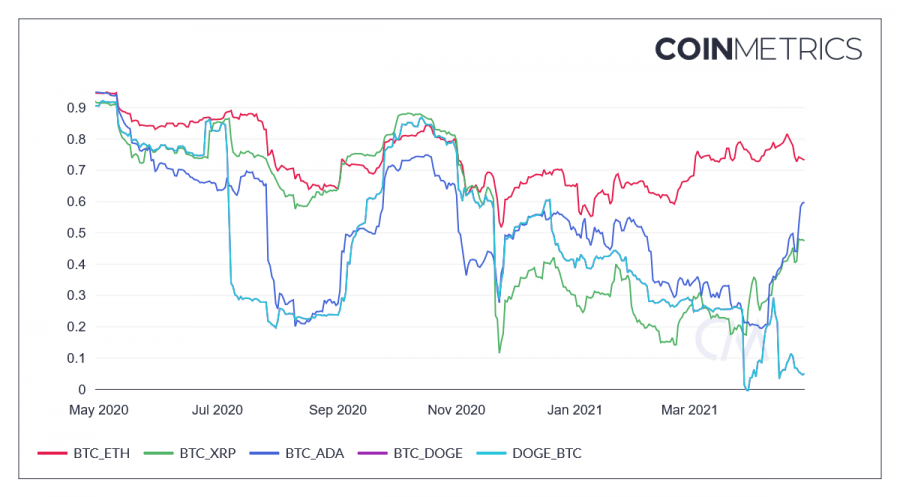
There was a gradual subsidence up until July/August, when bitcoin (and to a lesser extent, ethereum) began rising in price, leaving many altcoins behind. Despite a recovery in correlations in October, things began to drop again from November, when bitcoin’s bull run really began picking up momentum.

Again, there was a partial recovery leading into January of this year, but correlations have been falling quite heavily since February. This is precisely when numerous altcoins began making up for lost time, rising in price as many bullish investors looked for the next big thing (now that BTC may seem a little expensive).

“The weakening correlation between major altcoins and bitcoin in a bull market is not new. As ETH and top altcoins rally during bullish spells, they often post higher returns compared to BTC, which in turn causes the correlation to drop,” said Robbie Liu, a market analyst at OKEx Insights.

Liu noted that pretty much the same phenomenon was observed during the 2017–2018 bull run. “The most notable example was in January 2018, when the correlation coefficient between BTC and ETH fell from above 0.8 to a negative value,” he told Cryptonews.com.

Nearly every analyst agrees that the drop in correlations is largely the product of the current bull market.

“In the 2017 bull market, bitcoin led the pack early on, but as investors gained confidence in the longevity of the boom, they increasingly looked to invest in smaller cryptos, which started to push those prices up faster than bitcoin’s. It’s the same story again in 2021,” said Glen Goodman, a cryptoasset analyst and author of The Crypto Trader.

Is it different this time?

Opinion is split on whether this drop in correlation is permanent or temporary.

“Market participants are learning that many cryptocurrencies offer different value propositions. This is becoming more evident as we begin to see development in the space highlighting these differences,” said Joel Kruger, a trader and strategist at LMAX.

However, for other analysts, ‘value proposition’ refers mostly to the potential for a quick buck.

“What we are seeing now is an overhyped and oversubscribed market. There is an overflow in liquidity. Community members and supporters are buying some of the altcoins thinking that it will give them 10-20x [return on investment],” said crypto advisor and investor Anndy Lian, adding that many investors likely believe that BTC has hit its maximum price level for the current period.

Of course, the truth often lies somewhere in the middle. For Quantum Economics analyst Lou Kerner, the overexuberance of the current bull market is a big factor in rising altcoins, but it certainly isn’t the only one.

“The other factor at work is some projects are scaling rapidly (e.g. UniswapPolkadotBinance) creating significant value, bringing down bitcoin’s dominance,” he told Cryptonews.com.

What this means is that, while certain fundamental shifts have taken place, we may also expect a return to greater bitcoin dominance in the event of a more bearish market.

“The rapid growth of DeFi in the past year gives ETH better fundamentals than before,” said Robbie Liu.

“However, just like what happened after January 2018, after the bull market ends, bitcoin’s dominance is likely to pick up and alts will begin underperforming the market leader.”

Implications for traders and investors

Regardless of how permanent the shift is, analysts agree that it’s good for traders and investors, given that declining correlations provide them with the opportunity to diversify.

“A decline in correlation should be a most welcome development as it opens up more opportunities to trade into different value propositions within the emerging space,” said Joel Kruger.

Robbie Liu takes a very similar position, saying that the decline in correlations provides smaller traders with more of an opportunity for outsized gains.

“For retail investors with small amounts of capital and a higher tolerance for risk, the current decline in correlation is a welcome shift, presenting them with more opportunities to reap higher gains,” he said.

Assuming that the divergence in correlations persists into the future, this would ultimately be a win for traders, investors and the wider industry alike.

As Glen Goodman concluded, declining correlations would be a sign that the market is maturing.
 

Anndy Lian is an early blockchain adopter and experienced serial entrepreneur who is known for his work in the government sector. He is a best selling book author- “NFT: From Zero to Hero” and “Blockchain Revolution 2030”.

Currently, he is appointed as the Chief Digital Advisor at Mongolia Productivity Organization, championing national digitization. Prior to his current appointments, he was the Chairman of BigONE Exchange, a global top 30 ranked crypto spot exchange and was also the Advisory Board Member for Hyundai DAC, the blockchain arm of South Korea’s largest car manufacturer Hyundai Motor Group. Lian played a pivotal role as the Blockchain Advisor for Asian Productivity Organisation (APO), an intergovernmental organization committed to improving productivity in the Asia-Pacific region.

An avid supporter of incubating start-ups, Anndy has also been a private investor for the past eight years. With a growth investment mindset, Anndy strategically demonstrates this in the companies he chooses to be involved with. He believes that what he is doing through blockchain technology currently will revolutionise and redefine traditional businesses. He also believes that the blockchain industry has to be “redecentralised”.

j j j

Denver News Updates: WADZ TAKES ON TRADITIONAL PAYMENT FIRMS WITH THE BETA LAUNCH OF ITS APPLICATION

Denver News Updates: WADZ TAKES ON TRADITIONAL PAYMENT FIRMS WITH THE BETA LAUNCH OF ITS APPLICATION

Wadz Takes on Traditional Payment Firms with the Beta Launch of its Application

Singapore-based startup, Wadz, is set to take on traditional payment firms, with its anticipated beta launch on November 25, 2019.

Targeting emerging countries such as Indonesia and Vietnam as a start, Wadz offers an alternative payment technology that will be of benefit to both consumers and merchants.

Wadz stands out by a number of key features including utilization of blockchain technology, easy integration to major shopping cart plug-ins, and near-zero processing fees. It also recognizes cryptocurrency payments.

One demographic on which Wadz is focusing is the “unbanked”. An estimated 200 million people in Indonesia and Vietnam have limited access to banking institutions loans, e-commerce, and health care. Wadz hopes to help these people improve their way of life by enabling new payment modalities for these services.

Wadz will then lead an in-depth discussion on the impact of blockchain technology across industries at PSB Academy City Campus, Singapore on November 27, 2019, at 7pm.

Among the distinguished roster of speakers is Anndy Lian, author of the book “Blockchain Revolution 2030” and blockchain advisor for Asian Productivity Organization (APO). His knowledge of blockchain technology has drawn attention from various international media.

Wadz CEO, Anish Jain, who will also speak in the forum, views this event as an excellent jumping-off point as Wadz goes full steam ahead. “Wadz is off to a promising start after attracting over 50,000 merchants in Indonesia and 5,000 in Vietnam,” he says. “Adopting the innovations Wadz offers will help merchants grow their businesses so we are confident that these numbers will further increase as we move along.”

Moderating the forum is Wadz’s Regional VP of Partnerships and passionate blockchain entrepreneur, Aaron Tan.

This forum is open to all. Interested parties can register for free at https://www.eventbrite.sg/e/blockchain-industrial-impact-wadz-beta-launch-tickets-81420696495.


Source: http://news.denvernewsupdates.com/story/190754/wadz-takes-on-traditional-payment-firms-with-the-beta-launch-of-its-application.html

Anndy Lian is an early blockchain adopter and experienced serial entrepreneur who is known for his work in the government sector. He is a best selling book author- “NFT: From Zero to Hero” and “Blockchain Revolution 2030”.

Currently, he is appointed as the Chief Digital Advisor at Mongolia Productivity Organization, championing national digitization. Prior to his current appointments, he was the Chairman of BigONE Exchange, a global top 30 ranked crypto spot exchange and was also the Advisory Board Member for Hyundai DAC, the blockchain arm of South Korea’s largest car manufacturer Hyundai Motor Group. Lian played a pivotal role as the Blockchain Advisor for Asian Productivity Organisation (APO), an intergovernmental organization committed to improving productivity in the Asia-Pacific region.

An avid supporter of incubating start-ups, Anndy has also been a private investor for the past eight years. With a growth investment mindset, Anndy strategically demonstrates this in the companies he chooses to be involved with. He believes that what he is doing through blockchain technology currently will revolutionise and redefine traditional businesses. He also believes that the blockchain industry has to be “redecentralised”.

j j j

Experts: “Ethereum killer” needs to work on its governance issues or risk losing users

Experts: “Ethereum killer” needs to work on its governance issues or risk losing users

Just days after the EOS blockchain activated its mainnet on June 14, it froze seven accounts that it suspected belonged to thieves who had stolen funds from users.

Even before the dust began to settle on that news, the people maintaining the blockchain – called block producers – suspended 27 more accounts on June 22, saying in a statement that the “logic and reasoning for this order will be posted at a later date.” Hong Kong-based EOS is a fierce competitor of Ethereum, prompting some to call it an “Ethereum killer.”

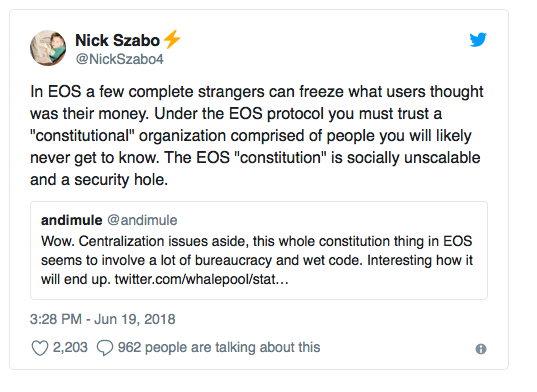
Its move to put accounts on hold, without issuing a complete explanation, has led to an outcry from the cryptocurrency community.

Some pointed out how it goes against blockchain’s decentralized nature. But a few optimists have called the move “pragmatic” and supposedly a small sacrifice to make the blockchain secure.

The suspensions have led to a heavy sell-off of the EOS cryptocurrency, leaving investors who participated in its initial coin offering (ICO) – before the product went live – on the losing end.

                     EOS price volatility over the past 7 days / Image credit: Coinmarketcap

Now that its governance methods are facing increased scrutiny, some are wondering if the EOS blockchain can deliver what it promises.

The EOS blockchain is a smart contract platform advertised as a system for decentralized applications (dApps). The tech behind it is said to be a game-changer for the blockchain industry. It aims to create a more scalable network, offering a throughput of up to 6,000 transactions per second, as opposed to the six transactions per second seen on the Ethereum platform.

The EOS protocol was developed by Block.one in 2017. Its record-breaking ICO raised almost US$4 billion, and the EOS cryptocurrency has rapidly grown to become the fifth-largest crypto by market cap.

A constitutional mess

The EOS blockchain’s problems stem from the uncertainty surrounding the chain of command of its “stakeholders.” As such, the lack of a proper governance process has created a constitutional mess.

There are different groups that serve as decision-makers on the EOS blockchain. While 21 chosen block producers keep the platform running, a governing body called EOS Core Arbitration Forum (ECAF) is tasked with resolving disputes.

The problem arose when block producers froze the first seven accounts in a unanimous decision, without getting the go-ahead from ECAF first.

Days later, the reverse happened. ECAF prohibited block producers from processing transactions of the 27 additional accounts, but didn’t immediately clarify the rationale behind the order.

Calling ECAF a mistake, Block.one wants to drop the existing rules and replace them with a new governance framework, with CTO Dan Larimer proposing a version 2.0 of the EOS constitution.

Photo credit: solerf / 123RF

But the team has to act fast before the token’s reputation within the crypto community suffers further damage.

Unexplained decisions could lead to failure

Such a framework will only work if everyone agrees on the rules, says Paul Griffin, director of Singapore Management University’s Masters of IT in Business program.

These rules must then be published and shared with those in the network. And if any changes are made, they must gain everyone’s approval before being implemented. “If there is too much unexplained ruling or censuring, people will stop buying into the EOS cryptocurrency – probably rather quickly,” he warns.

Bobby Ong, co-founder of cryptocurrency data website CoinGecko, says the EOS blockchain needs to resolve its problems quickly and create a process as transparent as possible, or risk losing users.

Freezing accounts without proper authorization is “worrisome,” as Griffin puts it, because “people buying into the cryptocurrency would want to know under what circumstances accounts may be blocked.” He likens this scenario to PayPal suspending accounts while it investigates any suspicious activity, which can be frustrating to users.

Photo credit: logicbomb / 123RF

While a blockchain can be run in a centralized manner, Griffin contends that it makes “no sense as everyone would still have to trust the central authority. They might as well use other technology instead of blockchain.”

He continues, “For people to use the blockchain, there must be trust – which means the governance of the blockchain must be clear and robust. Time will tell if trust is being misplaced or not. And of course, if trust is lost, then the value of cryptocurrency will be lost as well.”

But Ong notes that by agreeing to participate in the EOS blockchain, participants have already implicitly accepted its rules.

“If you are not in agreement with it, you are free to use another blockchain and token. The EOS blockchain by itself is a political system where its ideals are ingrained in its constitution… It is very political in nature [and] there will be more of such situations happening in the future.”

EOS still holds potential

Given the potential of the EOS blockchain, some supporters aren’t willing to give up on it. They see the weeks following the launch as a testing phase.

Anndy Lian, CEO of Singapore-based distributed platform company Linfinity, believes that at the end of the day, the EOS blockchain made the account suspension decisions with its users’ welfare in mind.

“EOS froze those ‘criminal accounts’ to secure and protect people’s property… I believe EOS is doing the right thing.”

Ong observes that having an arbitration process in place ensures that actions will be taken on any suspicious activity. “This means that thieves will not be able to get away with multi-million or billion-dollar hacks to the system.“

“EOS aims to solve scalability at the expense of decentralization. There will be a subset of apps that I believe will grow with the need for less decentralization. All it takes is one dApp on the EOS blockchain to be viral, and opinions will change very quickly,” he concludes.

https://www.techinasia.com/eos-at-risk

Anndy Lian is an early blockchain adopter and experienced serial entrepreneur who is known for his work in the government sector. He is a best selling book author- “NFT: From Zero to Hero” and “Blockchain Revolution 2030”.

Currently, he is appointed as the Chief Digital Advisor at Mongolia Productivity Organization, championing national digitization. Prior to his current appointments, he was the Chairman of BigONE Exchange, a global top 30 ranked crypto spot exchange and was also the Advisory Board Member for Hyundai DAC, the blockchain arm of South Korea’s largest car manufacturer Hyundai Motor Group. Lian played a pivotal role as the Blockchain Advisor for Asian Productivity Organisation (APO), an intergovernmental organization committed to improving productivity in the Asia-Pacific region.

An avid supporter of incubating start-ups, Anndy has also been a private investor for the past eight years. With a growth investment mindset, Anndy strategically demonstrates this in the companies he chooses to be involved with. He believes that what he is doing through blockchain technology currently will revolutionise and redefine traditional businesses. He also believes that the blockchain industry has to be “redecentralised”.

j j j