
Tokenized Securities: A Financial Revolution or Just Hype?

Tokenized Securities: A Financial Revolution or Just Hype?

Remember that scene in “The Wolf of Wall Street” where Jordan Belfort is barking orders on the trading floor? That’s the traditional world of finance – fast-paced, high-pressure, and dominated by human intuition. But what if I told you robots and video game mechanics are about to crash the party?

Enter tokenized securities. This fancy term essentially means converting traditional investments like stocks, bonds, and even real estate into digital tokens that live on a blockchain, the same technology behind cryptocurrencies. Proponents are calling it a revolutionary step forward, promising to make investing cheaper, easier, and accessible to everyone. Sounds too good to be true, right? Well, I’m here to tell you it’s a mixed bag.

The Tokenized Dream: Lower Costs, Faster Trades, and Global Investors

Imagine a world where you can buy a fraction of a million-dollar mansion in Miami or invest in a hot startup with just a few clicks on your phone. That’s the promise of tokenization. By cutting out middlemen and leveraging the magic of blockchain, the theory goes that tokenized securities will be cheaper to trade, settle faster, and be accessible 24/7 to a global pool of investors. Sounds pretty darn convenient, doesn’t it?

Hold Your Horses: The Not-So-Glittering Side

Before you pack your bags and head to Wall Street to become a crypto-millionaire, let’s get real. Tokenization isn’t a magic bullet. While it might eliminate some fees, it also creates new ones. Building a secure and compliant platform for tokenizing your assets can be a hefty upfront cost. Plus, there’s the ongoing expense of cybersecurity, legal compliance, and maintaining the platform itself. Think of it like building a fancy new house – sure, it’s beautiful, but the upkeep can be a real pain.

Traditional Listing vs. Tokenization: A Cost Showdown

So, how does tokenization stack up against the traditional listing route, like going public on the NYSE? Traditional listings come with their own set of hefty fees, including underwriting, compliance, and listing costs. An IPO (Initial Public Offering) can easily set you back millions, not to mention ongoing compliance headaches.

On the other hand, tokenization could potentially slash some of these costs. Remember that 24/7 access and the potential for a global investor base? That can translate to lower transaction fees and more liquidity, meaning it’s easier to buy and sell your tokens. But here’s the catch: those savings might be eaten up by the costs of robust cybersecurity and navigating a constantly evolving regulatory landscape. It’s like playing a game with ever-changing rules.

Not All Companies Are Created Equal: Who Benefits Most from Tokenization?

Just like shoes, tokenization isn’t a one-size-fits-all solution. Let’s break it down by business type:

  • Startups and Small Businesses: Struggling to get funding through traditional channels? Tokenization might be your knight in shining armor. It provides an alternative way to raise capital by tapping into a global pool of investors, even for those without a Wall Street pedigree. Plus, you can offer fractional ownership, meaning even small-time investors can get a piece of the action. Think of it like crowdfunding on steroids.
  • Real Estate and Private Equity: Ever wanted to own a piece of the Eiffel Tower, but the price tag is a bit out of your league? Tokenization can make that dream a reality. By tokenizing real estate assets, companies can offer fractional ownership, making high-value properties accessible to a wider range of investors. It’s like buying a slice of that fancy cake you’ve been eyeing, instead of having to purchase the whole thing.
  • Niche Markets and Specialized Assets: Got a one-of-a-kind painting or a rare baseball card collecting dust in your attic? Tokenization can unlock its value and attract a broader investor base. It allows for fractional ownership and secondary market trading of unique assets that would otherwise be difficult to sell. Think of it like turning your collectibles into digital trading cards, with a much bigger marketplace.

The Case of Real Estate Tokenization: Not All Properties Are Created Equal

Real estate often gets touted as a prime candidate for tokenization, but hold on a sec. Not every property is a good fit. Imagine trying to sell a fixer-upper in a bad neighborhood through fancy tokens. It wouldn’t work, would it? The same goes for tokenized real estate. Regulatory hurdles, the quality of the underlying asset, and market dynamics all play a crucial role.

  • Quality of the Asset: Tokenizing a run-down building won’t magically transform it into a prime investment. Investors aren’t lining up to buy tokens for a property with low occupancy rates, structural issues, or a terrible location. Just like a house needs a good foundation, tokenized real estate needs strong underlying assets to be successful.
  • Market Dynamics: Remember that global pool of investors we talked about earlier? Well, for tokenized real estate to truly be liquid (meaning easy to buy and sell), there needs to be a critical mass of participants in the market. Imagine a cool new game with no players – not much fun, right? The same goes for tokenized real estate. Without enough buyers and sellers, the tokens can become illiquid, defeating the purpose of easier investment. Plus, convincing everyone that tokenized real estate is a good investment takes time.
  • Regulatory Hurdles: Real estate is a heavily regulated industry, and tokenization adds another layer of complexity. Different jurisdictions have varying rules and compliance requirements. Imagine navigating a maze with ever-changing walls – that’s what companies trying to tokenize real estate face. These legal headaches can be expensive and time-consuming, potentially outweighing the cost benefits of tokenization.

So, Should You Ditch Traditional Listing and Go All-In on Tokenization?

Not so fast! While tokenization offers exciting possibilities, it’s not a silver bullet. The effectiveness and cost-efficiency depend on various factors. For companies in heavily regulated industries or with complex assets, traditional listing might still be the safer bet. Think of it like a tried-and-true recipe – it might not be flashy, but you know it’ll deliver delicious results.

On the other hand, for innovative startups, tech companies, and businesses with unique assets, tokenization presents a compelling alternative. The ability to tap into a global investor pool, offer fractional ownership, and potentially increase liquidity can be significant advantages. But remember, these benefits come with the responsibility of building and maintaining a secure and compliant platform.

The Bottom Line: Tokenization – A Promising Future, But Do Your Homework

Tokenization has the potential to be a game-changer, but it’s not a one-size-fits-all solution. Companies considering tokenization need to carefully assess the feasibility and potential benefits for their specific situation. Just like you wouldn’t jump into a swimming pool without knowing how deep it is, don’t dive headfirst into tokenization without doing your due diligence.

The future of finance is likely to see a blend of traditional and tokenized approaches. As regulations evolve and technology advances, tokenization’s potential to complement or even disrupt traditional financial mechanisms will become clearer. This will allow companies to make more informed and strategic decisions about how to raise capital and attract investors. So, buckle up, because the future of finance is about to get a whole lot more interesting!


Source: https://wishu.io/tokenized-securities-a-financial-revolution-or-just-hype/

Anndy Lian is an early blockchain adopter and experienced serial entrepreneur who is known for his work in the government sector. He is a best selling book author- “NFT: From Zero to Hero” and “Blockchain Revolution 2030”.

Currently, he is appointed as the Chief Digital Advisor at Mongolia Productivity Organization, championing national digitization. Prior to his current appointments, he was the Chairman of BigONE Exchange, a global top 30 ranked crypto spot exchange and was also the Advisory Board Member for Hyundai DAC, the blockchain arm of South Korea’s largest car manufacturer Hyundai Motor Group. Lian played a pivotal role as the Blockchain Advisor for Asian Productivity Organisation (APO), an intergovernmental organization committed to improving productivity in the Asia-Pacific region.

An avid supporter of incubating start-ups, Anndy has also been a private investor for the past eight years. With a growth investment mindset, Anndy strategically demonstrates this in the companies he chooses to be involved with. He believes that what he is doing through blockchain technology currently will revolutionise and redefine traditional businesses. He also believes that the blockchain industry has to be “redecentralised”.

j j j

Meme Coins: The Next Jackpot or Just a Gamble?

Meme Coins: The Next Jackpot or Just a Gamble?

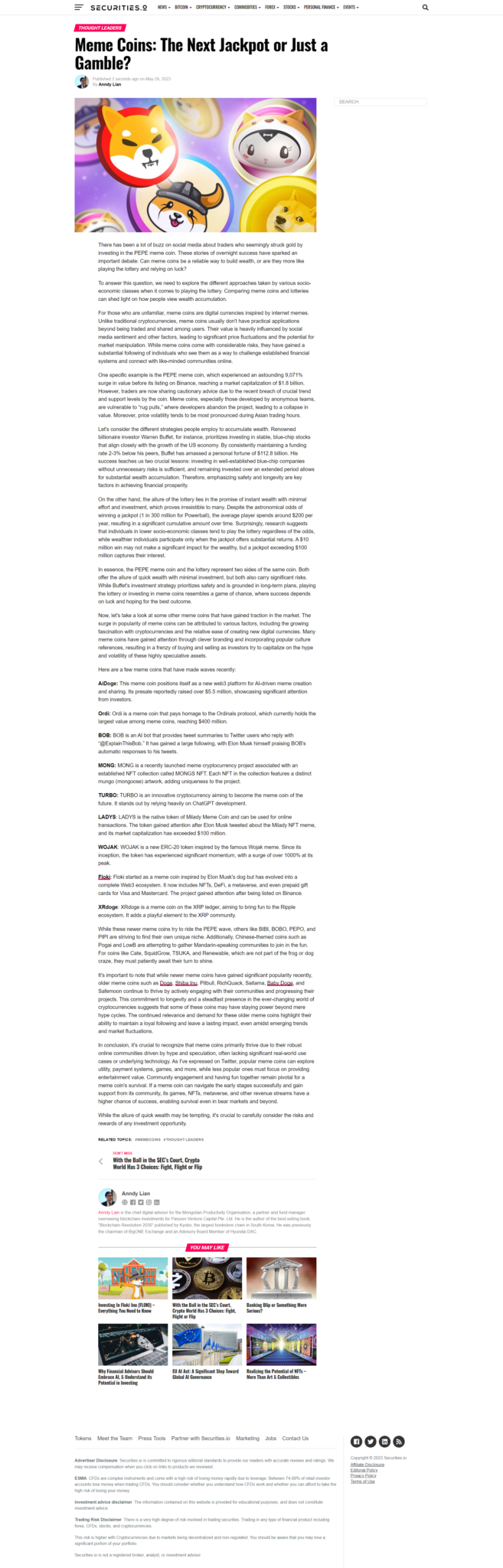
There has been a lot of buzz on social media about traders who seemingly struck gold by investing in the PEPE meme coin. These stories of overnight success have sparked an important debate: Can meme coins be a reliable way to build wealth, or are they more like playing the lottery and relying on luck?

To answer this question, we need to explore the different approaches taken by various socio-economic classes when it comes to playing the lottery. Comparing meme coins and lotteries can shed light on how people view wealth accumulation.

For those who are unfamiliar, meme coins are digital currencies inspired by internet memes. Unlike traditional cryptocurrencies, meme coins usually don’t have practical applications beyond being traded and shared among users. Their value is heavily influenced by social media sentiment and other factors, leading to significant price fluctuations and the potential for market manipulation. While meme coins come with considerable risks, they have gained a substantial following of individuals who see them as a way to challenge established financial systems and connect with like-minded communities online.

One specific example is the PEPE meme coin, which experienced an astounding 9,071% surge in value before its listing on Binance, reaching a market capitalization of $1.8 billion. However, traders are now sharing cautionary advice due to the recent breach of crucial trend and support levels by the coin. Meme coins, especially those developed by anonymous teams, are vulnerable to “rug pulls,” where developers abandon the project, leading to a collapse in value. Moreover, price volatility tends to be most pronounced during Asian trading hours.

Let’s consider the different strategies people employ to accumulate wealth. Renowned billionaire investor Warren Buffet, for instance, prioritizes investing in stable, blue-chip stocks that align closely with the growth of the US economy. By consistently maintaining a funding rate 2-3% below his peers, Buffet has amassed a personal fortune of $112.8 billion. His success teaches us two crucial lessons: investing in well-established blue-chip companies without unnecessary risks is sufficient, and remaining invested over an extended period allows for substantial wealth accumulation. Therefore, emphasizing safety and longevity are key factors in achieving financial prosperity.

On the other hand, the allure of the lottery lies in the promise of instant wealth with minimal effort and investment, which proves irresistible to many. Despite the astronomical odds of winning a jackpot (1 in 300 million for Powerball), the average player spends around $200 per year, resulting in a significant cumulative amount over time. Surprisingly, research suggests that individuals in lower socio-economic classes tend to play the lottery regardless of the odds, while wealthier individuals participate only when the jackpot offers substantial returns. A $10 million win may not make a significant impact for the wealthy, but a jackpot exceeding $100 million captures their interest.

In essence, the PEPE meme coin and the lottery represent two sides of the same coin. Both offer the allure of quick wealth with minimal investment, but both also carry significant risks. While Buffet’s investment strategy prioritizes safety and is grounded in long-term plans, playing the lottery or investing in meme coins resembles a game of chance, where success depends on luck and hoping for the best outcome.

Now, let’s take a look at some other meme coins that have gained traction in the market. The surge in popularity of meme coins can be attributed to various factors, including the growing fascination with cryptocurrencies and the relative ease of creating new digital currencies. Many meme coins have gained attention through clever branding and incorporating popular culture references, resulting in a frenzy of buying and selling as investors try to capitalize on the hype and volatility of these highly speculative assets.

Here are a few meme coins that have made waves recently:

AiDoge: This meme coin positions itself as a new web3 platform for AI-driven meme creation and sharing. Its presale reportedly raised over $5.5 million, showcasing significant attention from investors.

Ordi: Ordi is a meme coin that pays homage to the Ordinals protocol, which currently holds the largest value among meme coins, reaching $400 million.

BOB: BOB is an AI bot that provides tweet summaries to Twitter users who reply with “@ExplainThisBob.” It has gained a large following, with Elon Musk himself praising BOB’s automatic responses to his tweets.

MONG: MONG is a recently launched meme cryptocurrency project associated with an established NFT collection called MONGS NFT. Each NFT in the collection features a distinct mungo (mongoose) artwork, adding uniqueness to the project.

TURBO: TURBO is an innovative cryptocurrency aiming to become the meme coin of the future. It stands out by relying heavily on ChatGPT development.

LADYS: LADYS is the native token of Milady Meme Coin and can be used for online transactions. The token gained attention after Elon Musk tweeted about the Milady NFT meme, and its market capitalization has exceeded $100 million.

WOJAK: WOJAK is a new ERC-20 token inspired by the famous Wojak meme. Since its inception, the token has experienced significant momentum, with a surge of over 1000% at its peak.

Floki: Floki started as a meme coin inspired by Elon Musk’s dog but has evolved into a complete Web3 ecosystem. It now includes NFTs, DeFi, a metaverse, and even prepaid gift cards for Visa and Mastercard. The project gained attention after being listed on Binance.

XRdoge: XRdoge is a meme coin on the XRP ledger, aiming to bring fun to the Ripple ecosystem. It adds a playful element to the XRP community.

While these newer meme coins try to ride the PEPE wave, others like BIBI, BOBO, PEPO, and PIPI are striving to find their own unique niche. Additionally, Chinese-themed coins such as Pogai and LowB are attempting to gather Mandarin-speaking communities to join in the fun. For coins like Cate, SquidGrow, TSUKA, and Renewable, which are not part of the frog or dog craze, they must patiently await their turn to shine.

It’s important to note that while newer meme coins have gained significant popularity recently, older meme coins such as DogeShiba Inu, Pitbull, RichQuack, Saitama, Baby Doge, and Safemoon continue to thrive by actively engaging with their communities and progressing their projects. This commitment to longevity and a steadfast presence in the ever-changing world of cryptocurrencies suggests that some of these coins may have staying power beyond mere hype cycles. The continued relevance and demand for these older meme coins highlight their ability to maintain a loyal following and leave a lasting impact, even amidst emerging trends and market fluctuations.

In conclusion, it’s crucial to recognize that meme coins primarily thrive due to their robust online communities driven by hype and speculation, often lacking significant real-world use cases or underlying technology. As I’ve expressed on Twitter, popular meme coins can explore utility, payment systems, games, and more, while less popular ones must focus on providing entertainment value. Community engagement and having fun together remain pivotal for a meme coin’s survival. If a meme coin can navigate the early stages successfully and gain support from its community, its games, NFTs, metaverse, and other revenue streams have a higher chance of success, enabling survival even in bear markets and beyond.

While the allure of quick wealth may be tempting, it’s crucial to carefully consider the risks and rewards of any investment opportunity.


Source: https://www.securities.io/meme-coins-the-next-jackpot-or-just-a-gamble/

Anndy Lian is an early blockchain adopter and experienced serial entrepreneur who is known for his work in the government sector. He is a best selling book author- “NFT: From Zero to Hero” and “Blockchain Revolution 2030”.

Currently, he is appointed as the Chief Digital Advisor at Mongolia Productivity Organization, championing national digitization. Prior to his current appointments, he was the Chairman of BigONE Exchange, a global top 30 ranked crypto spot exchange and was also the Advisory Board Member for Hyundai DAC, the blockchain arm of South Korea’s largest car manufacturer Hyundai Motor Group. Lian played a pivotal role as the Blockchain Advisor for Asian Productivity Organisation (APO), an intergovernmental organization committed to improving productivity in the Asia-Pacific region.

An avid supporter of incubating start-ups, Anndy has also been a private investor for the past eight years. With a growth investment mindset, Anndy strategically demonstrates this in the companies he chooses to be involved with. He believes that what he is doing through blockchain technology currently will revolutionise and redefine traditional businesses. He also believes that the blockchain industry has to be “redecentralised”.

j j j

Bitcoin Spikes Above $21,000: Is The Move Sustainable Or Just Speculative Mania?

Bitcoin Spikes Above $21,000: Is The Move Sustainable Or Just Speculative Mania?
ZINGER KEY POINTS
  • Major cryptocurrencies see gains, market capitalization surpasses $1 trillion.
  • Bitcoin has crossed $20,000, having experienced 11 consecutive days of upward movement.

The largest cryptocurrency by market capitalization, Bitcoin has spiked above the psychologically important barrier of the $21,000 mark. Saturday’s move brought cheer to the subdued markets, which have been rattled by the collapse of several high-profile companies, including cryptocurrency exchange FTX.

The rally in prices of major cryptocurrencies like Polygon and Solana and memecoins like Dogecoin and Shiba Inu, is fuelled by optimism that digital currencies may have bottomed.

This is the first time since Nov. 8, 2022, that Bitcoin has crossed $20,000, having experienced 11 consecutive days of upward movement.

Other notable cryptocurrencies such as Ethereum and Cardano also saw substantial gains, pushing the total market capitalization of the cryptocurrency market over the $1 trillion mark for the first time since November.

The current spike in Bitcoin’s value comes after the Labor Department issued data showing that top-line inflation rose by 6.5% in December, down from 7.1% in November.

On Thursday, Federal Reserve policymakers expressed relief that the inflation rate continued to decrease in December.

Bear Market Not Over

Anndy Lian, Chief Digital Advisor, of Mongolian Productivity Organization tells Benzinga says investors should take a cautionary stance and not become too bullish on the digital currency.

“This does not mean that the bear market is over. Firstly, the lack of Bitcoin trading volume around the region of $18,000 and RSI shows that bitcoin is over-bought, showing that the rally could be short-lived.  Secondly, the massive layoffs by the crypto companies and the SEC’s new charges on Genesis and Gemini for the Unregistered Offer and Sale of Crypto Asset Securities looks like it would take a longer time to see a real sustainable bull run,” he says.

He added that Bitcoin and other cryptocurrencies tend to respond more quickly to macroeconomic changes and shifts than stocks do and that we may be currently witnessing such a shift.

“I do see more investors putting more capital over the week. Overall, this is still a positive sign for the market,” he adds.

Mainstream Adoption Will Lead To More Stability

According to Scott Tripp, a member of redecentralise.com, a not-for-profit organization, the increasing mainstream acceptance and institutional adoption of Bitcoin will lead to more stability in its price over time, the current rally is driven by speculative mania and may not be sustainable in the long run.

Bitcoin May Shoot Up Further Over 2024

Raj A Kapoor, the founder of India Blockchain Alliance, predicts that 2024 could be the year when Bitcoin experiences a significant price increase due to the halving event.

According to Kapoor, this event could be responsible for the current positive sentiment and upward trend in Bitcoin’s value.

“I also feel that large investors or Bitcoin Whales have resumed their Bitcoin holdings. The large Bitcoin whales are keeping between 1,000 and 10,000 BTC in their wallets, according to data from Santimen clearly indicating that investors have been stocking up on Bitcoin, which may be a hint of a recovery in the price of Bitcoin,” Kapoor adds.


Photo: courtesy of Shutterstock.

Source: https://www.benzinga.com/markets/cryptocurrency/23/01/30420995/bitcoins-spikes-above-21-000-is-the-move-sustainable-or-just-speculative-mania

Anndy Lian is an early blockchain adopter and experienced serial entrepreneur who is known for his work in the government sector. He is a best selling book author- “NFT: From Zero to Hero” and “Blockchain Revolution 2030”.

Currently, he is appointed as the Chief Digital Advisor at Mongolia Productivity Organization, championing national digitization. Prior to his current appointments, he was the Chairman of BigONE Exchange, a global top 30 ranked crypto spot exchange and was also the Advisory Board Member for Hyundai DAC, the blockchain arm of South Korea’s largest car manufacturer Hyundai Motor Group. Lian played a pivotal role as the Blockchain Advisor for Asian Productivity Organisation (APO), an intergovernmental organization committed to improving productivity in the Asia-Pacific region.

An avid supporter of incubating start-ups, Anndy has also been a private investor for the past eight years. With a growth investment mindset, Anndy strategically demonstrates this in the companies he chooses to be involved with. He believes that what he is doing through blockchain technology currently will revolutionise and redefine traditional businesses. He also believes that the blockchain industry has to be “redecentralised”.

j j j