South Korean presidential candidates support legalization of Bitcoin ETFs

South Korean presidential candidates support legalization of Bitcoin ETFs

South Korea may be poised to follow Hong Kong’s lead in legalizing spot Bitcoin exchange-traded funds (ETFs), as top presidential candidates signal support for institutional crypto adoption.

However, analysts remain cautious about the timeline for actual policy implementation, reports Cointelegraph.

On May 14, CryptoQuant CEO Ki Young Ju wrote that “all three major South Korean presidential candidates support Bitcoin ETFs and institutional investment,” underscoring a rare consensus on crypto reform. At present, South Korea bans institutional access to crypto ETFs, meaning retail investors account for 100% of local market volume.

Democratic Party renews crypto-friendly platform

Democratic Party leader Lee Jae-myung recently pledged to legalize spot crypto ETFs, reduce transaction fees, and foster a safer investment environment — particularly for younger generations. The promises echo similar initiatives from the party’s 2024 campaign, which stalled amid legislative gridlock.

Lee’s comments reflect growing interest in aligning South Korea with global crypto finance trends, including developments in the U.S., where spot Bitcoin ETFs have drawn tens of billions in institutional inflows since their approval earlier this year.

Experts warn of political inertia and structural hurdles

Despite political momentum, blockchain adviser Anndy Lian warned against assuming quick progress. “The pledges are promising, but history tempers optimism,” Lian told Cointelegraph, referencing past failures by the ruling People Power Party to follow through on ETF reform prior to President Yoon’s impeachment.

He noted that South Korea’s Financial Services Commission has shown signs of “regulatory openness,” but cautioned that structural factors — including lingering concerns about volatility, oversight, and international compliance — could delay execution.

Hong Kong’s own spot Bitcoin and Ether ETF launches on April 30, while symbolically important, saw lackluster trading volume relative to their U.S. counterparts — a reminder that legal approval doesn’t always translate to immediate market traction.

Whether South Korea will break the cycle of political promises without follow-through remains to be seen, but the growing chorus of support suggests the next administration may finally act on long-delayed crypto legislation.

Recently we wrote that ​the U.S. Securities and Exchange Commission (SEC) has postponed its decision on Grayscale’s proposed spot Solana (SOL) ETF, pushing the review deadline to October 2025.


Source: https://tradersunion.com/news/cryptocurrency-news/show/262159-south-korean-presidential-candidates/

Anndy Lian is an early blockchain adopter and experienced serial entrepreneur who is known for his work in the government sector. He is a best selling book author- “NFT: From Zero to Hero” and “Blockchain Revolution 2030”.

Currently, he is appointed as the Chief Digital Advisor at Mongolia Productivity Organization, championing national digitization. Prior to his current appointments, he was the Chairman of BigONE Exchange, a global top 30 ranked crypto spot exchange and was also the Advisory Board Member for Hyundai DAC, the blockchain arm of South Korea’s largest car manufacturer Hyundai Motor Group. Lian played a pivotal role as the Blockchain Advisor for Asian Productivity Organisation (APO), an intergovernmental organization committed to improving productivity in the Asia-Pacific region.

An avid supporter of incubating start-ups, Anndy has also been a private investor for the past eight years. With a growth investment mindset, Anndy strategically demonstrates this in the companies he chooses to be involved with. He believes that what he is doing through blockchain technology currently will revolutionise and redefine traditional businesses. He also believes that the blockchain industry has to be “redecentralised”.

j j j

Top South Korean presidential hopefuls support legalizing Bitcoin ETFs

Top South Korean presidential hopefuls support legalizing Bitcoin ETFs

South Korea could soon follow Hong Kong in legalizing spot Bitcoin exchange-traded funds (ETFs), as the country’s top presidential candidates have expressed pro-crypto positions.

Still, some industry observers remain cautious about the likelihood of near-term regulatory change.

“All three major South Korean presidential candidates support #Bitcoin ETFs and institutional investment,” Ki Young Ju, the founder and CEO of onchain data platform CryptoQuant, wrote in a May 14 X post.

Currently, Bitcoin ETFs and institutional crypto investments are banned in South Korea, meaning that “100% [of the] volume comes from retail,” Ju added.

On May 6, South Korea’s Democratic Party leader Lee Jae-myung promised to legalize spot crypto ETFs, lower transaction fees and “create a safe investment environment so that young people can [build] assets and plan for the future, according to a report from The Korean Economic Daily (KED).

The Democratic Party made similar promises in its 2024 election campaign, including the legalization of spot crypto ETFs, but progress has been delayed, KED reported.

Candidates back ETFs, but history casts doubt

While the crypto-friendly perspectives of the leading candidates suggest a promising future for digital asset legislation in South Korea, regulation experts remain skeptical.

“The candidates’ pro-crypto pledges to push to legalize spot Bitcoin ETFs and reduce fees signal a potential shift. But history tempers optimism,” Anndy Lian, author and intergovernmental blockchain adviser, told Cointelegraph, adding:

“They will take on similar stances as Hong Kong. Whether the ETFs can perform or not depends on various other factors.”

“A pro-crypto president could drive reform, aligning South Korea with global trends like the US, where Bitcoin ETFs have attracted over billions in net inflows,” Lian said, adding that the Financial Services Commission’s tone also suggested “regulatory openness” for cryptocurrencies.

However, the People Power Party, elected in 2022, also promised to lift the crypto ETF ban and revise the controversial one-exchange-one-bank rule, “but failed to act before President Yoon’s impeachment,” Lian said.

Over in Hong Kong, the first batch of Bitcoin and Ether-based ETFs launched for trading on April 30, 2024, but saw disappointing trading activity compared to their US counterparts, Cointelegraph reported.


Source: https://cointelegraph.com/news/south-korean-presidential-candidates-support-bitcoin-etfs

Anndy Lian is an early blockchain adopter and experienced serial entrepreneur who is known for his work in the government sector. He is a best selling book author- “NFT: From Zero to Hero” and “Blockchain Revolution 2030”.

Currently, he is appointed as the Chief Digital Advisor at Mongolia Productivity Organization, championing national digitization. Prior to his current appointments, he was the Chairman of BigONE Exchange, a global top 30 ranked crypto spot exchange and was also the Advisory Board Member for Hyundai DAC, the blockchain arm of South Korea’s largest car manufacturer Hyundai Motor Group. Lian played a pivotal role as the Blockchain Advisor for Asian Productivity Organisation (APO), an intergovernmental organization committed to improving productivity in the Asia-Pacific region.

An avid supporter of incubating start-ups, Anndy has also been a private investor for the past eight years. With a growth investment mindset, Anndy strategically demonstrates this in the companies he chooses to be involved with. He believes that what he is doing through blockchain technology currently will revolutionise and redefine traditional businesses. He also believes that the blockchain industry has to be “redecentralised”.

j j j

Allegations of North Korean Involvement Rock Cosmos Ecosystem

Allegations of North Korean Involvement Rock Cosmos Ecosystem

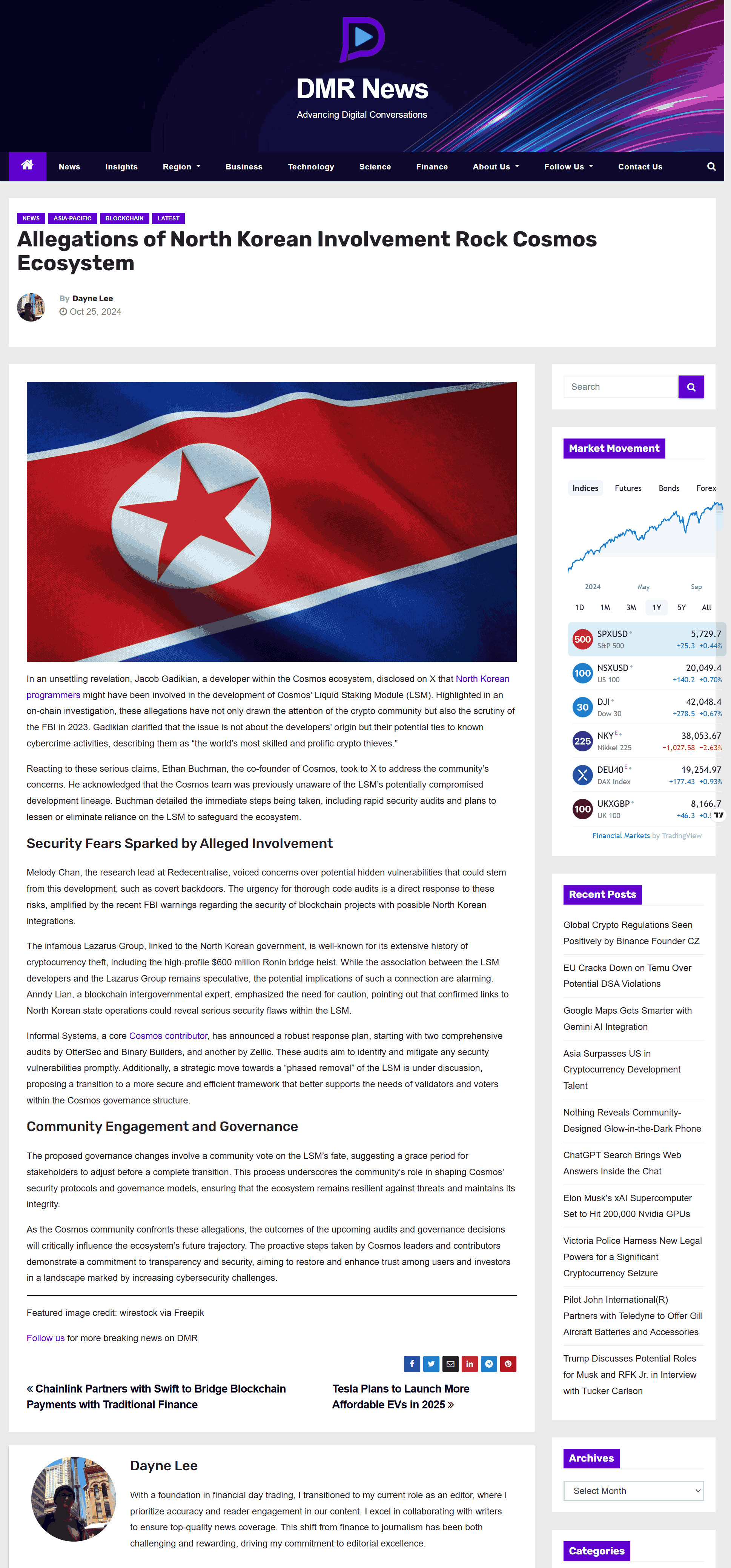
In an unsettling revelation, Jacob Gadikian, a developer within the Cosmos ecosystem, disclosed on X that North Korean programmers might have been involved in the development of Cosmos’ Liquid Staking Module (LSM). Highlighted in an on-chain investigation, these allegations have not only drawn the attention of the crypto community but also the scrutiny of the FBI in 2023. Gadikian clarified that the issue is not about the developers’ origin but their potential ties to known cybercrime activities, describing them as “the world’s most skilled and prolific crypto thieves.”

Reacting to these serious claims, Ethan Buchman, the co-founder of Cosmos, took to X to address the community’s concerns. He acknowledged that the Cosmos team was previously unaware of the LSM’s potentially compromised development lineage. Buchman detailed the immediate steps being taken, including rapid security audits and plans to lessen or eliminate reliance on the LSM to safeguard the ecosystem.

Security Fears Sparked by Alleged Involvement

Melody Chan, the research lead at Redecentralise, voiced concerns over potential hidden vulnerabilities that could stem from this development, such as covert backdoors. The urgency for thorough code audits is a direct response to these risks, amplified by the recent FBI warnings regarding the security of blockchain projects with possible North Korean integrations.

The infamous Lazarus Group, linked to the North Korean government, is well-known for its extensive history of cryptocurrency theft, including the high-profile $600 million Ronin bridge heist. While the association between the LSM developers and the Lazarus Group remains speculative, the potential implications of such a connection are alarming. Anndy Lian, a blockchain intergovernmental expert, emphasized the need for caution, pointing out that confirmed links to North Korean state operations could reveal serious security flaws within the LSM.

Informal Systems, a core Cosmos contributor, has announced a robust response plan, starting with two comprehensive audits by OtterSec and Binary Builders, and another by Zellic. These audits aim to identify and mitigate any security vulnerabilities promptly. Additionally, a strategic move towards a “phased removal” of the LSM is under discussion, proposing a transition to a more secure and efficient framework that better supports the needs of validators and voters within the Cosmos governance structure.

Community Engagement and Governance

The proposed governance changes involve a community vote on the LSM’s fate, suggesting a grace period for stakeholders to adjust before a complete transition. This process underscores the community’s role in shaping Cosmos’ security protocols and governance models, ensuring that the ecosystem remains resilient against threats and maintains its integrity.

As the Cosmos community confronts these allegations, the outcomes of the upcoming audits and governance decisions will critically influence the ecosystem’s future trajectory. The proactive steps taken by Cosmos leaders and contributors demonstrate a commitment to transparency and security, aiming to restore and enhance trust among users and investors in a landscape marked by increasing cybersecurity challenges.


Source: https://digitalmarketreports.com/news/28267/allegations-of-north-korean-involvement-rock-cosmos-ecosystem/

Anndy Lian is an early blockchain adopter and experienced serial entrepreneur who is known for his work in the government sector. He is a best selling book author- “NFT: From Zero to Hero” and “Blockchain Revolution 2030”.

Currently, he is appointed as the Chief Digital Advisor at Mongolia Productivity Organization, championing national digitization. Prior to his current appointments, he was the Chairman of BigONE Exchange, a global top 30 ranked crypto spot exchange and was also the Advisory Board Member for Hyundai DAC, the blockchain arm of South Korea’s largest car manufacturer Hyundai Motor Group. Lian played a pivotal role as the Blockchain Advisor for Asian Productivity Organisation (APO), an intergovernmental organization committed to improving productivity in the Asia-Pacific region.

An avid supporter of incubating start-ups, Anndy has also been a private investor for the past eight years. With a growth investment mindset, Anndy strategically demonstrates this in the companies he chooses to be involved with. He believes that what he is doing through blockchain technology currently will revolutionise and redefine traditional businesses. He also believes that the blockchain industry has to be “redecentralised”.
j j j