The alarming reason crypto now moves like gold but falls like stocks

The alarming reason crypto now moves like gold but falls like stocks

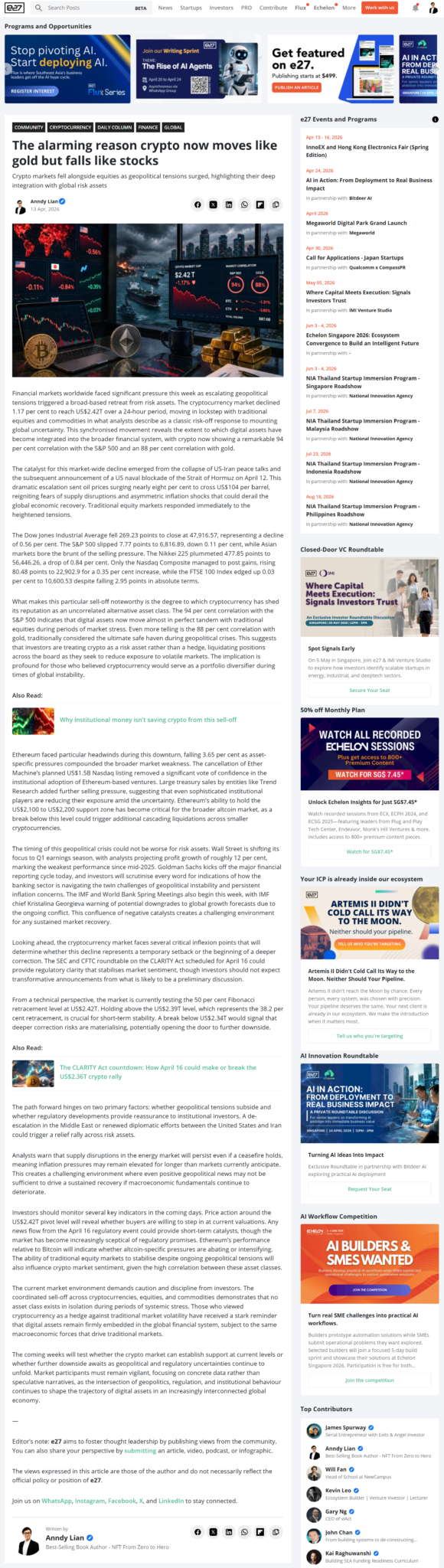
Financial markets worldwide faced significant pressure this week as escalating geopolitical tensions triggered a broad-based retreat from risk assets. The cryptocurrency market declined 1.17 per cent to reach US$2.42T over a 24-hour period, moving in lockstep with traditional equities and commodities in what analysts describe as a classic risk-off response to mounting global uncertainty. This synchronised movement reveals the extent to which digital assets have become integrated into the broader financial system, with crypto now showing a remarkable 94 per cent correlation with the S&P 500 and an 88 per cent correlation with gold.

The catalyst for this market-wide decline emerged from the collapse of US-Iran peace talks and the subsequent announcement of a US naval blockade of the Strait of Hormuz on April 12. This dramatic escalation sent oil prices surging nearly eight per cent to cross US$104 per barrel, reigniting fears of supply disruptions and asymmetric inflation shocks that could derail the global economic recovery. Traditional equity markets responded immediately to the heightened tensions.

The Dow Jones Industrial Average fell 269.23 points to close at 47,916.57, representing a decline of 0.56 per cent. The S&P 500 slipped 7.77 points to 6,816.89, down 0.11 per cent, while Asian markets bore the brunt of the selling pressure. The Nikkei 225 plummeted 477.85 points to 56,446.26, a drop of 0.84 per cent. Only the Nasdaq Composite managed to post gains, rising 80.48 points to 22,902.9 for a 0.35 per cent increase, while the FTSE 100 Index edged up 0.03 per cent to 10,600.53 despite falling 2.95 points in absolute terms.

What makes this particular sell-off noteworthy is the degree to which cryptocurrency has shed its reputation as an uncorrelated alternative asset class. The 94 per cent correlation with the S&P 500 indicates that digital assets now move almost in perfect tandem with traditional equities during periods of market stress. Even more telling is the 88 per cent correlation with gold, traditionally considered the ultimate safe haven during geopolitical crises. This suggests that investors are treating crypto as a risk asset rather than a hedge, liquidating positions across the board as they seek to reduce exposure to volatile markets. The implication is profound for those who believed cryptocurrency would serve as a portfolio diversifier during times of global instability.

Ethereum faced particular headwinds during this downturn, falling 3.65 per cent as asset-specific pressures compounded the broader market weakness. The cancellation of Ether Machine’s planned US$1.5B Nasdaq listing removed a significant vote of confidence in the institutional adoption of Ethereum-based ventures. Large treasury sales by entities like Trend Research added further selling pressure, suggesting that even sophisticated institutional players are reducing their exposure amid the uncertainty. Ethereum’s ability to hold the US$2,100 to US$2,200 support zone has become critical for the broader altcoin market, as a break below this level could trigger additional cascading liquidations across smaller cryptocurrencies.

The timing of this geopolitical crisis could not be worse for risk assets. Wall Street is shifting its focus to Q1 earnings season, with analysts projecting profit growth of roughly 12 per cent, marking the weakest performance since mid-2025. Goldman Sachs kicks off the major financial reporting cycle today, and investors will scrutinise every word for indications of how the banking sector is navigating the twin challenges of geopolitical instability and persistent inflation concerns. The IMF and World Bank Spring Meetings also begin this week, with IMF chief Kristalina Georgieva warning of potential downgrades to global growth forecasts due to the ongoing conflict. This confluence of negative catalysts creates a challenging environment for any sustained market recovery.

Looking ahead, the cryptocurrency market faces several critical inflexion points that will determine whether this decline represents a temporary setback or the beginning of a deeper correction. The SEC and CFTC roundtable on the CLARITY Act scheduled for April 16 could provide regulatory clarity that stabilises market sentiment, though investors should not expect transformative announcements from what is likely to be a preliminary discussion.

From a technical perspective, the market is currently testing the 50 per cent Fibonacci retracement level at US$2.42T. Holding above the US$2.39T level, which represents the 38.2 per cent retracement, is crucial for short-term stability. A break below US$2.34T would signal that deeper correction risks are materialising, potentially opening the door to further downside.

The path forward hinges on two primary factors: whether geopolitical tensions subside and whether regulatory developments provide reassurance to institutional investors. A de-escalation in the Middle East or renewed diplomatic efforts between the United States and Iran could trigger a relief rally across risk assets.

Analysts warn that supply disruptions in the energy market will persist even if a ceasefire holds, meaning inflation pressures may remain elevated for longer than markets currently anticipate. This creates a challenging environment where even positive geopolitical news may not be sufficient to drive a sustained recovery if macroeconomic fundamentals continue to deteriorate.

Investors should monitor several key indicators in the coming days. Price action around the US$2.42T pivot level will reveal whether buyers are willing to step in at current valuations. Any news flow from the April 16 regulatory event could provide short-term catalysts, though the market has become increasingly sceptical of regulatory promises. Ethereum’s performance relative to Bitcoin will indicate whether altcoin-specific pressures are abating or intensifying. The ability of traditional equity markets to stabilise despite ongoing geopolitical tensions will also influence crypto market sentiment, given the high correlation between these asset classes.

The current market environment demands caution and discipline from investors. The coordinated sell-off across cryptocurrencies, equities, and commodities demonstrates that no asset class exists in isolation during periods of systemic stress. Those who viewed cryptocurrency as a hedge against traditional market volatility have received a stark reminder that digital assets remain firmly embedded in the global financial system, subject to the same macroeconomic forces that drive traditional markets.

The coming weeks will test whether the crypto market can establish support at current levels or whether further downside awaits as geopolitical and regulatory uncertainties continue to unfold. Market participants must remain vigilant, focusing on concrete data rather than speculative narratives, as the intersection of geopolitics, regulation, and institutional behaviour continues to shape the trajectory of digital assets in an increasingly interconnected global economy.


Source: https://e27.co/the-alarming-reason-crypto-now-moves-like-gold-but-falls-like-stocks-20260413/

Anndy Lian is an early blockchain adopter and experienced serial entrepreneur who is known for his work in the government sector. He is a best selling book author- “NFT: From Zero to Hero” and “Blockchain Revolution 2030”.

Currently, he is appointed as the Chief Digital Advisor at Mongolia Productivity Organization, championing national digitization. Prior to his current appointments, he was the Chairman of BigONE Exchange, a global top 30 ranked crypto spot exchange and was also the Advisory Board Member for Hyundai DAC, the blockchain arm of South Korea’s largest car manufacturer Hyundai Motor Group. Lian played a pivotal role as the Blockchain Advisor for Asian Productivity Organisation (APO), an intergovernmental organization committed to improving productivity in the Asia-Pacific region.

An avid supporter of incubating start-ups, Anndy has also been a private investor for the past eight years. With a growth investment mindset, Anndy strategically demonstrates this in the companies he chooses to be involved with. He believes that what he is doing through blockchain technology currently will revolutionise and redefine traditional businesses. He also believes that the blockchain industry has to be “redecentralised”.

j j j

Modern-Day Version of Howey Test For Cryptocurrencies- How Does It Look Like?

Modern-Day Version of Howey Test For Cryptocurrencies- How Does It Look Like?

Howey test, which the Securities and Exchange Commission uses to decide whether a digital asset should be classed as a security, has certain limitations, according to SEC Commissioner Hester Peirce. I can relate to this statement very much. I felt the same way too, especially when they used the same framework for cryptocurrencies. I will walk you through my thoughts on what should the modern-day version look like.

What is Howey Test?

The Howey test is used by the U.S. Securities and Exchange Commission (SEC) to determine whether a particular financial product or transaction qualifies as an “investment contract.” If a product or transaction is deemed to be an investment contract, it is subject to certain regulatory requirements under federal securities laws.

The test is named after the 1946 Supreme Court case SEC v. W.J. Howey Co., in which the Court established a four-part test to determine whether a transaction qualifies as an investment contract:

1.         It involves an investment of money

2.         There is an expectation of profits from the investment

3.         The investment of money is in a common enterprise

4.         Any profit comes from the efforts of a promoter or third party

If all four of these criteria are met, the transaction is considered an investment contract and is subject to regulation as a security.

What is a Security?

Before we look further, let’s look at what is a security. A security is a financial instrument representing an ownership position in a publicly traded corporation (stock), a creditor relationship with a governmental body or a corporation (bond), or rights to ownership as represented by an option.

There are several types of securities, including:

1.         Stocks: Stocks represent ownership in a company and entitle the holder to a share of the company’s profits.

2.         Bonds: Bonds are a type of debt security that involves borrowing money from an investor for a set period of time at a fixed interest rate.

3.         Options: Options are a type of derivative security that gives the holder the right, but not the obligation, to buy or sell a specific asset at a predetermined price within a specific time frame.

4.         Mutual funds: Mutual funds are investment vehicles that pool money from multiple investors and use that money to buy a diversified portfolio of stocks, bonds, or other securities.

5.         Exchange-traded funds (ETFs): ETFs are investment funds that are traded on stock exchanges, much like stocks. They typically track an index, such as the S&P 500, or a specific sector or theme.

6.         Derivatives: Derivatives are financial instruments that are derived from other assets, such as stocks, bonds, commodities, or currencies. They are used to hedge risk or speculate on the price movements of the underlying asset. Examples of derivatives include futures, options, and swaps.

Howey Test Applied to Cryptocurrencies

The Howey test is a well-established legal test used for decades to determine whether a financial product or transaction qualifies as an investment contract and is subject to regulation as a security. While the test was originally developed in the context of traditional securities, it has also been applied to cryptocurrency and initial coin offerings (ICOs).

The four-part test established by the Howey case has generally been applied to cryptocurrency in the same way as it has been used to traditional securities. However, there may be some nuances or specific considerations that apply specifically to cryptocurrency when applying the Howey test.

For example, the first prong of the test, which requires an investment of money, may be satisfied by the purchase of a cryptocurrency using fiat currency (such as U.S. dollars) or by the exchange of one cryptocurrency for another.

The second prong, which requires an expectation of profits, may be satisfied by the potential appreciation of the cryptocurrency’s value or by the ability to earn returns through the use of the cryptocurrency in a particular platform or network.

The third prong, which requires the investment of money to be in a common enterprise, may be satisfied by the pooling of resources or the use of a shared infrastructure or platform.

The fourth prong, which requires any profits to come from the efforts of a promoter or third party, may be satisfied by the involvement of a central authority or the use of a decentralized autonomous organization (DAO) to manage the cryptocurrency or ICO.

Modern-Day Version of Howey Test for Cryptocurrencies

The above pointers may sound familiar to you. You are a project owner and have spoken to a lawyer before; this is the same advice they gave you. My question now is, since the state of play in cryptocurrencies are changing rapidly, should there be an adapted version for the modern day?

The modern-day version might look something like this:

1.         Is there an investment of money?

If the crypto digital asset issuer has not sold any assets issued to build its project. It is most likely not considered a security.

2.         Is there an expectation of profits from the investment?

If the crypto asset is utility-based, for example, it is used for voting purposes. It is most likely not considered a security.

3.         Is the investment of money in a common enterprise?

If the project is decentralized, it is not controlled and operated by a centralized entity. It is most likely not considered a security.

4.         Are any profit comes from the efforts of a promoter or third party?

If the profit primarily comes from the community which has nothing to do with the issuance of the crypto asset. It is most likely not considered a security.

Reminding all again, when all four criteria are met, the investment is considered a security and is subject to regulatory requirements of the Securities Act of 1933. The application of the Howey test to cryptocurrency may involve considering the specific characteristics and features of the particular cryptocurrency or ICO in question, as well as the broader market and regulatory context in which it operates.

Take some time to do a self-evaluation based on the above thoughts shared. If you have time, you can ask yourself these questions about the tokens you invested. This is a good exercise for self-reference. I am not a lawyer, and none of the written content is formal advice.

“If you are a retail crypto investor- Do your crypto research. Learning about the regulation side of things can help you with your investment decision, avoiding unnecessary issues down the road.

If you are a project and you claim to be decentralized. Please stay decentralized. This will also avoid getting into any regulatory problems.” – Anndy Lian


Source: https://www.benzinga.com/22/12/30205466/modern-day-version-of-howey-test-for-cryptocurrencies-how-does-it-look-like

Anndy Lian is an early blockchain adopter and experienced serial entrepreneur who is known for his work in the government sector. He is a best selling book author- “NFT: From Zero to Hero” and “Blockchain Revolution 2030”.

Currently, he is appointed as the Chief Digital Advisor at Mongolia Productivity Organization, championing national digitization. Prior to his current appointments, he was the Chairman of BigONE Exchange, a global top 30 ranked crypto spot exchange and was also the Advisory Board Member for Hyundai DAC, the blockchain arm of South Korea’s largest car manufacturer Hyundai Motor Group. Lian played a pivotal role as the Blockchain Advisor for Asian Productivity Organisation (APO), an intergovernmental organization committed to improving productivity in the Asia-Pacific region.

An avid supporter of incubating start-ups, Anndy has also been a private investor for the past eight years. With a growth investment mindset, Anndy strategically demonstrates this in the companies he chooses to be involved with. He believes that what he is doing through blockchain technology currently will revolutionise and redefine traditional businesses. He also believes that the blockchain industry has to be “redecentralised”.

j j j

Does content moderation on platforms like OpenSea amount to censorship?

Does content moderation on platforms like OpenSea amount to censorship?

What are the responsibilities of blockchain companies when it comes to freedom of expression? A controversial cartoonist finds out the boundaries.

“I would describe myself as a transgressive artist,” the conservative cartoonist who calls himself Stonetoss, told Forkast.News. On Nov. 20, Stonetoss released 5,000 non-fungible tokens based on characters found in his work, listing them on Rarible and OpenSea NFT marketplaces. Calling his cartoon characters “Flurks,” Stonetoss said the sale was a huge success, selling out in just over 20 minutes for a total of 420 ETH worth US$1.8 million.

But hours later, both Rarible and OpenSea pulled the Flurks series from their listings without offering an explanation why, adding fuel to the debate over content moderation in the growing NFT marketplace.

Stonetoss is no stranger to controversy — he says he has received death threats in the past — which is why he only wished to be identified by his artist name. His cartoons often depict right-wing interpretations of issues regarding race, LGBT+ rights and vaccine mandates. While the Flurks themselves do not contain any explicit commentary, they do contain imagery relating to these themes, such as Confederate flags and red MAGA hats that are popular with Donald Trump supporters. Stonetoss believes his art was delisted due to the politics that he is associated with, rather than based on the actual content of his NFTs.

But is getting kicked off OpenSea and Rarible a troubling form of “censorship” and an infringement of artistic freedom, as Stonetoss says, or is it within these companies’ right to include only content that they like? With OpenSea alone controlling over 98% of the Ethereum trading volume market share, according to DuneAnalytics, do these blockchain marketplaces have a moral obligation to do more to defend freedom of expression, even if the views may be odious to a majority of its users — especially for a blockchain-powered industry that often champions decentralization as a safeguard to censorship?

Industry leaders themselves seem divided on these issues, and the extent of obligation and responsibilities of blockchain companies when it comes to freedom of expression.

“Whenever we talk about decentralization, it’s not about a cowboy town where you could just come in with anything,” Anndy Lian, founding member of NFT creative studio Influxo, told Forkast.News. “You have to follow the rules.”

Just as a physical gallery has the right to decide what art they wish to exhibit, Lian says NFT platforms are no different — and just because an expression exists as an NFT does not excuse it from the cultural consequence of its message.

“If the artist or the artwork is subjective, there is a chance that it will be removed,” Lian said. “This has nothing to do with [whether it’s an] NFT or not. This happens in the art world, in galleries too. This is surely not about decentralization and decentralization is not about just freedom.”

But others say that’s not really a choice when dealing with centralized systems like OpenSea or Rarible, when combined they effectively control the NFT marketplace — until better systems come along.

“If a company makes a decision that a user doesn’t like, they have the option to leave,” says said Corey Petty, chief security officer at decentralized messaging app and Web3.0 browser, Status, in an interview with Forkast.News. “If you don’t have that option, then companies can do whatever they want and you just can’t do anything about it. Which leads us to where we are today. [They] made a decision. What are you going to do? Leave? There are no other options.”

Stonetoss says he feels singled out by the right-wing politics usually associated with his brand rather than individual Flurks being offensive. The NFTs that got delisted from OpenSea and Rarible also contain symbols associated with the left, such as the rainbow pride flag and the communist hammer and sickle.“If I was a no-name artist, this would not have been the controversy or it would have not have received the reaction that it did,” Stonetoss said in a Zoom audio interview with Forkast.News with the camera turned off.

According to Rarible staff, the platform does not de-list items based on political affiliation. According to OpenSea’s terms of service, OpenSea will delist NFTs if they are determined to incite hate or violence against others.

“The delisting of my NFTs on Rarible and OpenSea was probably the result of a mass report because this is the technique [campaigners] have tried to use many times. The NFTs themselves, I maintain, are benign.”

But least one Twitter user spoke out about the inclusion of some of those symbols on NFTs hosted on the platforms, who said they are anything but benign: “I am losing followers for calling out a project blatantly using confederate flags in their NFTs. I am a racial minority, I grew up in the south, and my uncle was murdered because of the color of his skin.”

Another user in the same thread summarized the debate surrounding the use of the Confederate flag — which represented the slavery-defending states of America’s South, which lost the nation’s Civil War over 150 years ago but is still clung to with nostalgia by some Whites in America — by replying: “Sorry to hear this, I’m from the South and don’t know the pains of dealing with being a minority, I also know people that love the south who don’t look at the confederate flag as racist, I guess it’s hard to know people’s hearts and perspective, we can all learn and grow and show love.”

Neither OpenSea of Rarible had contacted Stonetoss to notify him of the delisting by the time he spoke with Forkast.News. At least one Flurk displayed on the homepage of Stonetoss’s website is wearing a cowboy hat and carrying a Confederate flag.

Rarible and OpenSea did not respond to Forkast.News inquiries for comment.

Will Stone decentralized Web3.0

As the world enters the realm of Web 3.0, Stonetoss’ story represents the glaring need — or cautionary tale, depending on your perspective — of how a decentralized version of the internet built around blockchain technology can dramatically change the gate-keeping powers and kind of content of public platforms.

“What we have is an emergent property of how the internet was built in the first place, that is the client-server model,” said Petty, of Status.”When you aggregate data and pool things like this, it’s inevitable that the people who are custodians of that information will take advantage of it” — including trying to control it in a way to maximize profits.

“That’s where we are today,” Petty added. “We build applications, they aggregate data. They then learn they can monetize that data; they optimize the application for monetization, not the end user.”

With a total trading volume of over US$13 billion, according to DappRadar, OpenSea might be the most important venue for digital artists to find buyers for their NFTs. Stonetoss says his delisting from the OpenSea NFT marketplace was not only a blow to him financially but also might have chilled creators of other controversial art. While Flurks holders are still able to transact peer-to-peer — his NFTs are de-listed but not deleted from the Ethereum blockchain — the infrastructure and culture is not yet available to allow the community to trade with the same ease as they would on a platform like OpenSea.

While the Flurks are not locked out of being traded — Stonetoss also sells them through his own website — OpenSea and Rarible have such an outsized influence on the market that any NFT collection that is not listed on one of these platforms is at a significant market disadvantage.

If the decision-making power to list or not list NFTs for sale were decentralized, would Stonetoss’s Flurks have suffered the same fate?

The moderating voice

In August this year, a series of 7,000 NFTs based around the popular meme Pepe the Frog — a mascot of Hong Kong’s pro-democracy movement in 2019 as well as a symbol championed by America’s far-right —  was removed from the OpenSea NFT marketplace after the character’s original creator filed a notice of copyright infringement with the platform.

OpenSea was quick to remove the content on copyright infringement grounds, but investors were left holding millions of dollars worth of NFTs with no significant marketplace left to trade them.

But when a collection of NFTs that look a lot like Flurks went up on OpenSea, the unauthorized copycat series remains listed on the site.

But should Stonetoss one day decide he wants to enforce his copyright, a truly decentralized platform is likely not going to act on user complaints.

“There is a long history of art that is transgressive and there should be a place for it,” Stonetoss said, admitting he would have trouble finding a physical gallery to display his work, which is why his medium has always been online.

“Those sorts of avenues are even more susceptible to people complaining about having a particular piece of art up,” Stonetoss said. “So, on the whole, I’m actually very optimistic; the whole de-listing event has been a little disappointing in that regard, but I guess it’s part of the growing pains of this sort of technology.”

Anndy Lian is an early blockchain adopter and experienced serial entrepreneur who is known for his work in the government sector. He is a best selling book author- “NFT: From Zero to Hero” and “Blockchain Revolution 2030”.

Currently, he is appointed as the Chief Digital Advisor at Mongolia Productivity Organization, championing national digitization. Prior to his current appointments, he was the Chairman of BigONE Exchange, a global top 30 ranked crypto spot exchange and was also the Advisory Board Member for Hyundai DAC, the blockchain arm of South Korea’s largest car manufacturer Hyundai Motor Group. Lian played a pivotal role as the Blockchain Advisor for Asian Productivity Organisation (APO), an intergovernmental organization committed to improving productivity in the Asia-Pacific region.

An avid supporter of incubating start-ups, Anndy has also been a private investor for the past eight years. With a growth investment mindset, Anndy strategically demonstrates this in the companies he chooses to be involved with. He believes that what he is doing through blockchain technology currently will revolutionise and redefine traditional businesses. He also believes that the blockchain industry has to be “redecentralised”.

j j j