Hong Kong isn’t the loophole Chinese crypto firms think it is

Hong Kong isn’t the loophole Chinese crypto firms think it is

China’s crypto ban has been in place since 2021, but that hasn’t stopped companies from chasing what they believe are ways to reenter.

Hyped-up stablecoin announcements in Hong Kong and overseas listings that hint at digital assets are just some of the ways companies are testing boundaries. Each time, Beijing responds with fresh warnings — a stark reminder that China’s crypto U-turn isn’t around the corner.
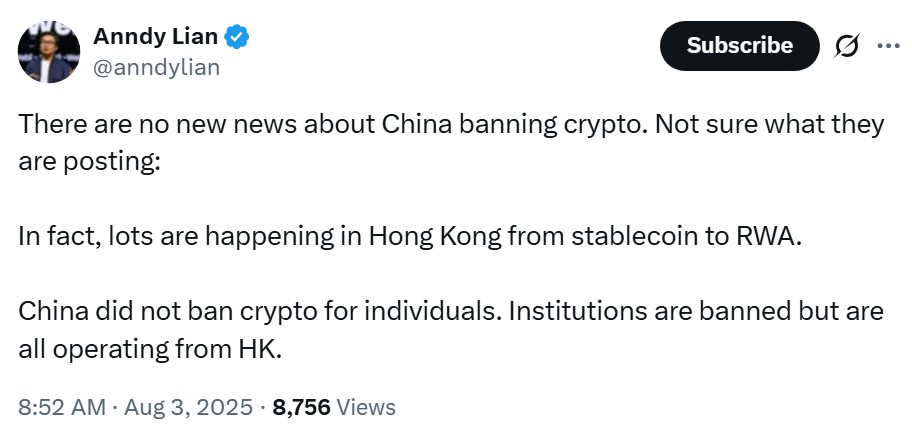
Crypto industry watcher observes RWA and stablecoin activity rising in Hong Kong
Hong Kong’s RWA and stablecoin activity picked up as new licensing rules took effect. (Anndy Lian)

The latest warning reportedly came from the China Securities Regulatory Commission, which advised companies to pause real-world asset ventures in Hong Kong. It followed a state-owned company scrubbing announcements about tokenizing bonds and other enterprises revealing RWA projects, piling on recent warnings against stablecoins after Hong Kong introduced its licensing framework.

To understand why these illusions of loopholes keep appearing — and why they collapse — Magazine spoke with Joshua Chu, co-chair of the Hong Kong Web3 association.

This conversation has been edited for clarity and length.

Magazine: Crypto has been banned for years in China, so why do regulators keep issuing fresh warnings?

China crypto ban reversal rumor
Countless social media accounts predicted Beijing would reverse its crypto ban, but it hasn’t moved so far. (DeFiMadara)

Chu: The challenge is that many new lawyers in Hong Kong moving into Web3 don’t have much experience with cross-border issues. That’s created fragmentation and a lot of confusion. Some journalists and lawyers even claimed there was a 180-degree reversal on crypto policy. China doesn’t do 180-degree turns in policy. The only U-turn in recent memory was the rollback of COVID-19 mandates.

The crypto ban from 2021 is a good example: Speculative assets are not meant for the retail sector. The People’s Republic of China is still a communist country, and if an unsophisticated investor loses money gambling on crypto, in the government’s view, that’s losing money for the state. That’s why the only entities we’ve seen handling crypto assets are the government or state-owned enterprises.

Magazine: How do you explain this cycle where Chinese firms repeatedly attempt to enter a trendy crypto venture through Hong Kong, only for mainland regulators to push back?

Chu: The issue is how they’re doing it. Even big companies with money can act in a less-than-sophisticated way. There’s a difference between state-owned enterprises and private institutions. The government is comfortable with blockchain infrastructure and foreign direct investment. What it won’t tolerate is speculation because speculation equals bubbles.

That’s why regulators crack down on projects designed to hype markets or pull value from retail investors. It’s the same logic behind China’s real estate policy: Buying to live in is fine, but speculation isn’t. You can think of it as a parental style of governance: Just as parents wouldn’t let children gamble with family savings, the state won’t let retail investors gamble away wealth in crypto.

Crypto Is Alive and Well, Though Skeptics Say It’s ‘Not Money’

At the end of the day, companies see profit potential, which is why they want in. But regulators will only support ventures that are sophisticated, compliant and responsible. That’s also why Hong Kong can hold itself out as one of the world’s top three financial hubs — its reputation depends on keeping the system clean, and the same principle applies to virtual assets.
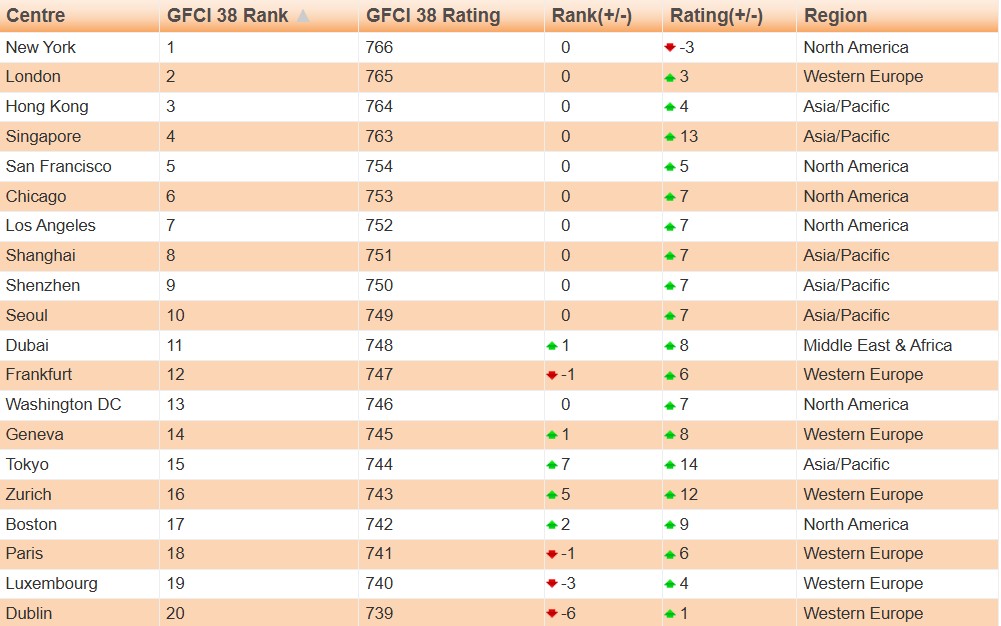
New York tops Long Finance's 2025 Global Financial Centres Index, followed by London, then Hong Kong
Hong Kong aims to strengthen its financial center rating through cryptocurrencies. (Long Finance)

Magazine: Isn’t the real problem that Chinese firms are hunting for loopholes and Hong Kong lawyers aren’t equipped to stop them?

Chu: Unfortunately, that happens a lot. If your whole business is founded on loopholes, you’re already on shaky ground. Regulators don’t create loopholes for you to exploit; they expect you to build something sustainable and compliant.

But because of the 2021 crypto ban, you have an entire market that’s been shut out. Human psychology kicks in, and people think: “Maybe this is my way back in.” That’s why you see companies making loud announcements before they’ve even filed an application. Take the stablecoin regime: Some firms were hyping plans to apply for licenses just to pump their stock price. Naturally, regulators step in.
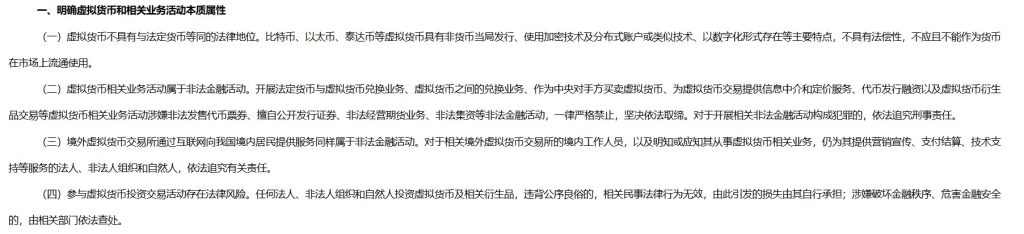
A screenshot of China's crypto ban statement in mandarin
China’s 2021 crypto ban defines crypto-related businesses as illegal financial activities. (China State Administration of Foreign Exchange)

We’ve seen this pattern before. When initial coin offerings were being sold as a cheaper alternative to initial public offerings, companies said you didn’t need a prospectus or compliance. But there’s a reason those safeguards exist: to protect investors. So, when players start cutting corners and shouting about it, it draws scrutiny. And that’s when clampdowns happen.

Magazine: When Chinese firms listed in Hong Kong or the US gain crypto exposure, is this regulatory arbitrage?

Chu: When a Chinese company lists on Nasdaq, it’s absorbing foreign investment, which triggers a different response than if it were raising funds domestically. The real question is how they structure these RWA or tokenization projects.

If they’re putting Chinese corporate data on a public blockchain, that creates cross-border data transfer issues. Remember, even listed companies have run into problems with US auditors because of China’s strict rules on what information can leave the country. Blockchain raises those concerns all over again.

There’s also the financial side. Many of these treasury strategies look risky, especially when driven by institutional FOMO at the peak of a bull cycle. Without strong internal risk controls, volatility can overwhelm the market cap of these firms. That’s exactly the kind of contagion risk regulators want to avoid.

If that happens, the scrutiny won’t just come from Beijing; it will come from the SEC as well.


Source: https://cointelegraph.com/magazine/hong-kong-isnt-loophole-chinese-crypto-firms-think/

Anndy Lian is an early blockchain adopter and experienced serial entrepreneur who is known for his work in the government sector. He is a best selling book author- “NFT: From Zero to Hero” and “Blockchain Revolution 2030”.

Currently, he is appointed as the Chief Digital Advisor at Mongolia Productivity Organization, championing national digitization. Prior to his current appointments, he was the Chairman of BigONE Exchange, a global top 30 ranked crypto spot exchange and was also the Advisory Board Member for Hyundai DAC, the blockchain arm of South Korea’s largest car manufacturer Hyundai Motor Group. Lian played a pivotal role as the Blockchain Advisor for Asian Productivity Organisation (APO), an intergovernmental organization committed to improving productivity in the Asia-Pacific region.

An avid supporter of incubating start-ups, Anndy has also been a private investor for the past eight years. With a growth investment mindset, Anndy strategically demonstrates this in the companies he chooses to be involved with. He believes that what he is doing through blockchain technology currently will revolutionise and redefine traditional businesses. He also believes that the blockchain industry has to be “redecentralised”.

j j j

Biden’s plan to close crypto tax loss harvesting loophole is a step in the right direction

Biden’s plan to close crypto tax loss harvesting loophole is a step in the right direction

President Joe Biden’s proposed budget plan has caused a stir in the crypto community due to its intention to terminate tax loss harvesting on crypto transactions. The reactions from the community have been mixed, with some perceiving this as an infringement on the freedom of crypto traders while others view it as a necessary step in regulating the industry and curbing tax evasion.

Tax loss harvesting is a technique used to minimize an individual’s tax liability by deliberately selling an investment at a loss to offset present and/or future capital gains. It reduces the amount of tax one pays for selling profitable investments. Although tax loss harvesting is usually carried out manually towards the end of the year, a systematic approach that identifies these opportunities automatically and acts on them throughout the year can be more effective, even for fixed income or income-generating securities. This approach allows individuals to decrease their tax liability by deducting the losses from their taxable income. However, this strategy has come under fire for being a loophole that enables affluent investors to evade taxes. The termination of tax loss harvesting on crypto transactions is estimated to raise up to $24 billion and reduce the deficit by $3 trillion.

Advocates of this proposition contend that it is an imperative measure to promote fairness and equity among taxpayers by ensuring that everyone contributes their fair share. They argue that the current tax system is biased towards the wealthy, who are able to exploit various tax loopholes and deductions to lower their tax bills. This ultimately results in middle-class and low-income earners being unfairly burdened with a disproportionate share of taxes. This imbalance creates an unjust and unequal tax system.

On the other hand, critics of the Biden budget plan assert that ending tax loss harvesting on crypto transactions is ill-advised as it could discourage innovation and investment in the cryptocurrency industry. They posit that this move could prompt some investors to relocate their assets offshore or to other countries with more lenient tax policies, leading to an exodus of talent and capital from the United States. Moreover, they contend that this change could disproportionately affect small and medium-sized enterprises that depend on cryptocurrency investment and trading for their expansion and growth.

The strategy of tax loss harvesting is commonly utilized by investors in the United States as a means of reducing capital gains taxes on their cryptocurrency investments. However, this approach is not extensively used in other countries due to differences in tax policies specific to cryptocurrency investments. For instance, in Canada, cryptocurrency investments are regarded as commodities and are thus subject to capital gains taxes. Meanwhile, in Australia, profits from cryptocurrency investments are also subject to capital gains taxes, with cryptocurrency considered property for tax purposes.

In the United Kingdom, gains from cryptocurrency investments are taxable under capital gains tax, but it is not possible to use losses to offset other gains. On the other hand, in Germany, cryptocurrency investments held for over a year are exempted from capital gains taxes, but those held for less than a year are taxed at the investor’s personal income tax rate. While other countries like Japan and South Korea have also established tax policies specific to cryptocurrency investments, these policies can differ significantly and may be subject to revision over time.Closing the crypto tax loss harvesting loophole could be viewed as a step in the right direction towards regulating the cryptocurrency industry and ensuring tax fairness. However, it is important to weigh the potential consequences of this policy change.

To summarize, I believe that closing the cryptocurrency tax loss harvesting loophole as proposed in President Biden’s budget plan is not a good policy. It could have negative impacts on small investors, innovation, and the market as a whole, while also not generating significant revenue for the government. Rather than this approach, I suggest exploring alternative policies that promote growth and innovation in the cryptocurrency industry while still ensuring that the government can collect revenue.

By Anndy Lian.

The author is an intergovernmental blockchain expert

Source: https://www.financialexpress.com/blockchain/bidens-plan-to-close-crypto-tax-loss-harvesting-loophole-is-a-step-in-the-right-direction/3013562/

Anndy Lian is an early blockchain adopter and experienced serial entrepreneur who is known for his work in the government sector. He is a best selling book author- “NFT: From Zero to Hero” and “Blockchain Revolution 2030”.

Currently, he is appointed as the Chief Digital Advisor at Mongolia Productivity Organization, championing national digitization. Prior to his current appointments, he was the Chairman of BigONE Exchange, a global top 30 ranked crypto spot exchange and was also the Advisory Board Member for Hyundai DAC, the blockchain arm of South Korea’s largest car manufacturer Hyundai Motor Group. Lian played a pivotal role as the Blockchain Advisor for Asian Productivity Organisation (APO), an intergovernmental organization committed to improving productivity in the Asia-Pacific region.

An avid supporter of incubating start-ups, Anndy has also been a private investor for the past eight years. With a growth investment mindset, Anndy strategically demonstrates this in the companies he chooses to be involved with. He believes that what he is doing through blockchain technology currently will revolutionise and redefine traditional businesses. He also believes that the blockchain industry has to be “redecentralised”.

j j j