Is the EU Leading the Charge or Losing the Race in Regulating AI?

Is the EU Leading the Charge or Losing the Race in Regulating AI?

As I sit down to reflect on the European Union’s emerging AI regulatory framework, I can’t help but feel a mix of admiration and unease. The EU is charting a bold course, aiming to classify AI tools based on their potential risks and impose stricter rules on high-risk systems like self-driving cars and medical technologies, while giving more leeway to lower-risk applications like internal chatbots.

As someone who has spent years covering the intersection of technology and policy, I’ve seen the transformative power of innovation and the chaos that can ensue when it’s left unchecked. The EU’s approach feels like a necessary step toward ensuring AI remains trustworthy and aligned with human values, but I worry it might come at the cost of stifling the very creativity it seeks to protect. This isn’t just a European issue—it’s a global one, and the world is watching closely.

The EU’s AI Act, which took effect in August 2024, is a groundbreaking piece of legislation, the first of its kind to tackle AI governance on such a comprehensive scale. The European Commission has divided AI systems into four risk categories: unacceptable, high, limited, and minimal. High-risk systems, like those used in healthcare or law enforcement, face rigorous requirements, including mandatory safety checks and detailed documentation. For instance, AI tools in medical devices must meet strict standards to ensure they don’t endanger patients, a move that reflects the EU’s deep commitment to safeguarding fundamental rights, as outlined in the official documentation of the AI Act. On the other hand, lower-risk systems, such as chatbots used within companies, are subject to lighter regulations, allowing businesses to innovate without being bogged down by red tape. It’s a thoughtful, risk-based approach designed to strike a balance between fostering innovation and protecting citizens.

I can’t help but admire the EU’s ambition here. Growing up in a world where technology often seemed to outrun regulation, I’ve seen the consequences of letting innovation run wild—data breaches, biased algorithms, and the erosion of privacy. The EU’s General Data Protection Regulation (GDPR), implemented back in 2018, set a global standard for data privacy, inspiring similar laws in places like Brazil and California. Over 130 countries have adopted data protection laws influenced by the GDPR, proving that the EU has the power to shape global norms. The AI Act could follow in its footsteps, becoming the go-to model for AI regulation worldwide. For companies operating in or targeting the European market, compliance isn’t just a legal checkbox—it’s a strategic necessity. Getting ahead of these rules could save businesses from costly last-minute scrambles and bolster their reputation as ethical innovators.

But there’s a catch, and it’s a big one. Critics worry that the EU’s regulatory zeal could backfire, particularly for smaller companies and startups. The European Commission estimates that compliance costs for high-risk AI systems could amount to €400,000 per system, depending on the complexity and scale. For small and medium-sized enterprises (SMEs), which make up 99% of all businesses in the EU and employ nearly 100 million people, these costs could be dealbreakers. I’ve spoken to entrepreneurs who fear they’ll be priced out of the European market or forced to abandon their AI projects altogether. If regulations push these smaller players away, Europe risks losing its competitive edge in a global AI race that’s heating up fast.

And then there’s the broader global context. While the EU is busy crafting its regulatory masterpiece, other major players like the United States and China are taking very different paths. The U.S., under President Donald Trump, has embraced a more hands-off approach, relying on voluntary guidelines and industry self-regulation. Meanwhile, China is pouring resources into AI development, with companies like DeepSeek emerging as global leaders. Analysts estimate that AI technology could bring $600 billion annually for China’s economy, fuelled by government support and a regulatory environment that’s far less restrictive than the EU’s. The third Artificial Intelligence Action Summit in Paris, held in February, highlighted these stark contrasts, with world leaders and tech executives grappling with how to regulate AI without losing ground to less regulated markets. China’s DeepSeek app, for example, which can self-train on coding and math problems, has only intensified these concerns, raising questions about whether the EU’s approach might leave it playing catch-up.

The EU’s AI Act also comes at a time when the AI landscape is evolving rapidly, with trends like AI-driven search snippets and workplace automation reshaping industries. Take Google’s AI Overviews, for example. A 2024 analysis by Seer found that these snippets, which provide answers directly on the search page, are reducing click-through rates for many businesses. While this is great for users who get quick answers, it’s a headache for companies that rely on organic traffic. On the workplace front, McKinsey’s 2024 report, “Superagency in the Workplace,” argues that AI can boost productivity and creativity but only if companies invest in training employees to collaborate with these tools. The report found that organizations that prioritize people-centric AI strategies—offering practical training, clear communication, and ethical guidelines—saw productivity gains. These insights suggest that regulation alone isn’t enough; success depends on how well organizations and societies adapt to AI’s potential.

Yet, for all the challenges, there’s a compelling case to be made for the EU’s approach. Proponents argue that well-crafted regulations can build trust and encourage responsible development. The AI Act’s focus on transparency, such as requiring developers to disclose details about their training data, resonates with growing public demand for accountability. 68% of Europeans want government restrictions on AI, citing concerns about privacy, bias, and job displacement. By addressing these issues head-on, the EU could position itself as a global leader in ethical AI, attracting businesses and consumers who value trust and safety. And let’s not forget the EU’s track record with the GDPR, which showed that robust regulation can coexist with innovation if it’s done right—thoughtfully, collaboratively, and with a clear eye on the bigger picture, as evidenced by its widespread global influence.

So, where does that leave us? As I see it, the EU’s AI regulatory framework is a bold and necessary experiment, one that reflects the bloc’s commitment to putting people first in an increasingly tech-driven world. But its success hinges on finding the right balance—encouraging innovation without sacrificing accountability and protecting rights without stifling growth. For businesses, the message is clear: don’t wait to adapt. Staying informed and preparing early could make all the difference, both in terms of compliance and reputation. For the EU, the challenge is even greater: to lead with vision, flexibility, and a willingness to learn from the global AI race. As a journalist, I’m cautiously optimistic, but I’ll be watching closely to see whether this framework becomes the global benchmark it aspires to be—or a cautionary tale of good intentions gone awry.


Source: https://intpolicydigest.org/is-the-eu-leading-the-charge-or-losing-the-race-in-regulating-ai/


Anndy Lian is an early blockchain adopter and experienced serial entrepreneur who is known for his work in the government sector. He is a best selling book author- “NFT: From Zero to Hero” and “Blockchain Revolution 2030”.

Currently, he is appointed as the Chief Digital Advisor at Mongolia Productivity Organization, championing national digitization. Prior to his current appointments, he was the Chairman of BigONE Exchange, a global top 30 ranked crypto spot exchange and was also the Advisory Board Member for Hyundai DAC, the blockchain arm of South Korea’s largest car manufacturer Hyundai Motor Group. Lian played a pivotal role as the Blockchain Advisor for Asian Productivity Organisation (APO), an intergovernmental organization committed to improving productivity in the Asia-Pacific region.

An avid supporter of incubating start-ups, Anndy has also been a private investor for the past eight years. With a growth investment mindset, Anndy strategically demonstrates this in the companies he chooses to be involved with. He believes that what he is doing through blockchain technology currently will revolutionise and redefine traditional businesses. He also believes that the blockchain industry has to be “redecentralised”.

j j j

Experts: “Ethereum killer” needs to work on its governance issues or risk losing users

Experts: “Ethereum killer” needs to work on its governance issues or risk losing users

Just days after the EOS blockchain activated its mainnet on June 14, it froze seven accounts that it suspected belonged to thieves who had stolen funds from users.

Even before the dust began to settle on that news, the people maintaining the blockchain – called block producers – suspended 27 more accounts on June 22, saying in a statement that the “logic and reasoning for this order will be posted at a later date.” Hong Kong-based EOS is a fierce competitor of Ethereum, prompting some to call it an “Ethereum killer.”

Its move to put accounts on hold, without issuing a complete explanation, has led to an outcry from the cryptocurrency community.

Some pointed out how it goes against blockchain’s decentralized nature. But a few optimists have called the move “pragmatic” and supposedly a small sacrifice to make the blockchain secure.

The suspensions have led to a heavy sell-off of the EOS cryptocurrency, leaving investors who participated in its initial coin offering (ICO) – before the product went live – on the losing end.

                     EOS price volatility over the past 7 days / Image credit: Coinmarketcap

Now that its governance methods are facing increased scrutiny, some are wondering if the EOS blockchain can deliver what it promises.

The EOS blockchain is a smart contract platform advertised as a system for decentralized applications (dApps). The tech behind it is said to be a game-changer for the blockchain industry. It aims to create a more scalable network, offering a throughput of up to 6,000 transactions per second, as opposed to the six transactions per second seen on the Ethereum platform.

The EOS protocol was developed by Block.one in 2017. Its record-breaking ICO raised almost US$4 billion, and the EOS cryptocurrency has rapidly grown to become the fifth-largest crypto by market cap.

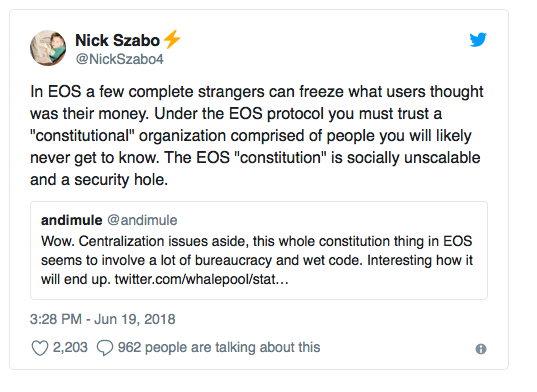
A constitutional mess

The EOS blockchain’s problems stem from the uncertainty surrounding the chain of command of its “stakeholders.” As such, the lack of a proper governance process has created a constitutional mess.

There are different groups that serve as decision-makers on the EOS blockchain. While 21 chosen block producers keep the platform running, a governing body called EOS Core Arbitration Forum (ECAF) is tasked with resolving disputes.

The problem arose when block producers froze the first seven accounts in a unanimous decision, without getting the go-ahead from ECAF first.

Days later, the reverse happened. ECAF prohibited block producers from processing transactions of the 27 additional accounts, but didn’t immediately clarify the rationale behind the order.

Calling ECAF a mistake, Block.one wants to drop the existing rules and replace them with a new governance framework, with CTO Dan Larimer proposing a version 2.0 of the EOS constitution.

Photo credit: solerf / 123RF

But the team has to act fast before the token’s reputation within the crypto community suffers further damage.

Unexplained decisions could lead to failure

Such a framework will only work if everyone agrees on the rules, says Paul Griffin, director of Singapore Management University’s Masters of IT in Business program.

These rules must then be published and shared with those in the network. And if any changes are made, they must gain everyone’s approval before being implemented. “If there is too much unexplained ruling or censuring, people will stop buying into the EOS cryptocurrency – probably rather quickly,” he warns.

Bobby Ong, co-founder of cryptocurrency data website CoinGecko, says the EOS blockchain needs to resolve its problems quickly and create a process as transparent as possible, or risk losing users.

Freezing accounts without proper authorization is “worrisome,” as Griffin puts it, because “people buying into the cryptocurrency would want to know under what circumstances accounts may be blocked.” He likens this scenario to PayPal suspending accounts while it investigates any suspicious activity, which can be frustrating to users.

Photo credit: logicbomb / 123RF

While a blockchain can be run in a centralized manner, Griffin contends that it makes “no sense as everyone would still have to trust the central authority. They might as well use other technology instead of blockchain.”

He continues, “For people to use the blockchain, there must be trust – which means the governance of the blockchain must be clear and robust. Time will tell if trust is being misplaced or not. And of course, if trust is lost, then the value of cryptocurrency will be lost as well.”

But Ong notes that by agreeing to participate in the EOS blockchain, participants have already implicitly accepted its rules.

“If you are not in agreement with it, you are free to use another blockchain and token. The EOS blockchain by itself is a political system where its ideals are ingrained in its constitution… It is very political in nature [and] there will be more of such situations happening in the future.”

EOS still holds potential

Given the potential of the EOS blockchain, some supporters aren’t willing to give up on it. They see the weeks following the launch as a testing phase.

Anndy Lian, CEO of Singapore-based distributed platform company Linfinity, believes that at the end of the day, the EOS blockchain made the account suspension decisions with its users’ welfare in mind.

“EOS froze those ‘criminal accounts’ to secure and protect people’s property… I believe EOS is doing the right thing.”

Ong observes that having an arbitration process in place ensures that actions will be taken on any suspicious activity. “This means that thieves will not be able to get away with multi-million or billion-dollar hacks to the system.“

“EOS aims to solve scalability at the expense of decentralization. There will be a subset of apps that I believe will grow with the need for less decentralization. All it takes is one dApp on the EOS blockchain to be viral, and opinions will change very quickly,” he concludes.

https://www.techinasia.com/eos-at-risk

Anndy Lian is an early blockchain adopter and experienced serial entrepreneur who is known for his work in the government sector. He is a best selling book author- “NFT: From Zero to Hero” and “Blockchain Revolution 2030”.

Currently, he is appointed as the Chief Digital Advisor at Mongolia Productivity Organization, championing national digitization. Prior to his current appointments, he was the Chairman of BigONE Exchange, a global top 30 ranked crypto spot exchange and was also the Advisory Board Member for Hyundai DAC, the blockchain arm of South Korea’s largest car manufacturer Hyundai Motor Group. Lian played a pivotal role as the Blockchain Advisor for Asian Productivity Organisation (APO), an intergovernmental organization committed to improving productivity in the Asia-Pacific region.

An avid supporter of incubating start-ups, Anndy has also been a private investor for the past eight years. With a growth investment mindset, Anndy strategically demonstrates this in the companies he chooses to be involved with. He believes that what he is doing through blockchain technology currently will revolutionise and redefine traditional businesses. He also believes that the blockchain industry has to be “redecentralised”.

j j j