
Cardano ‘ghost chain’ outperforms top blockchains in NFT market

Cardano ‘ghost chain’ outperforms top blockchains in NFT market

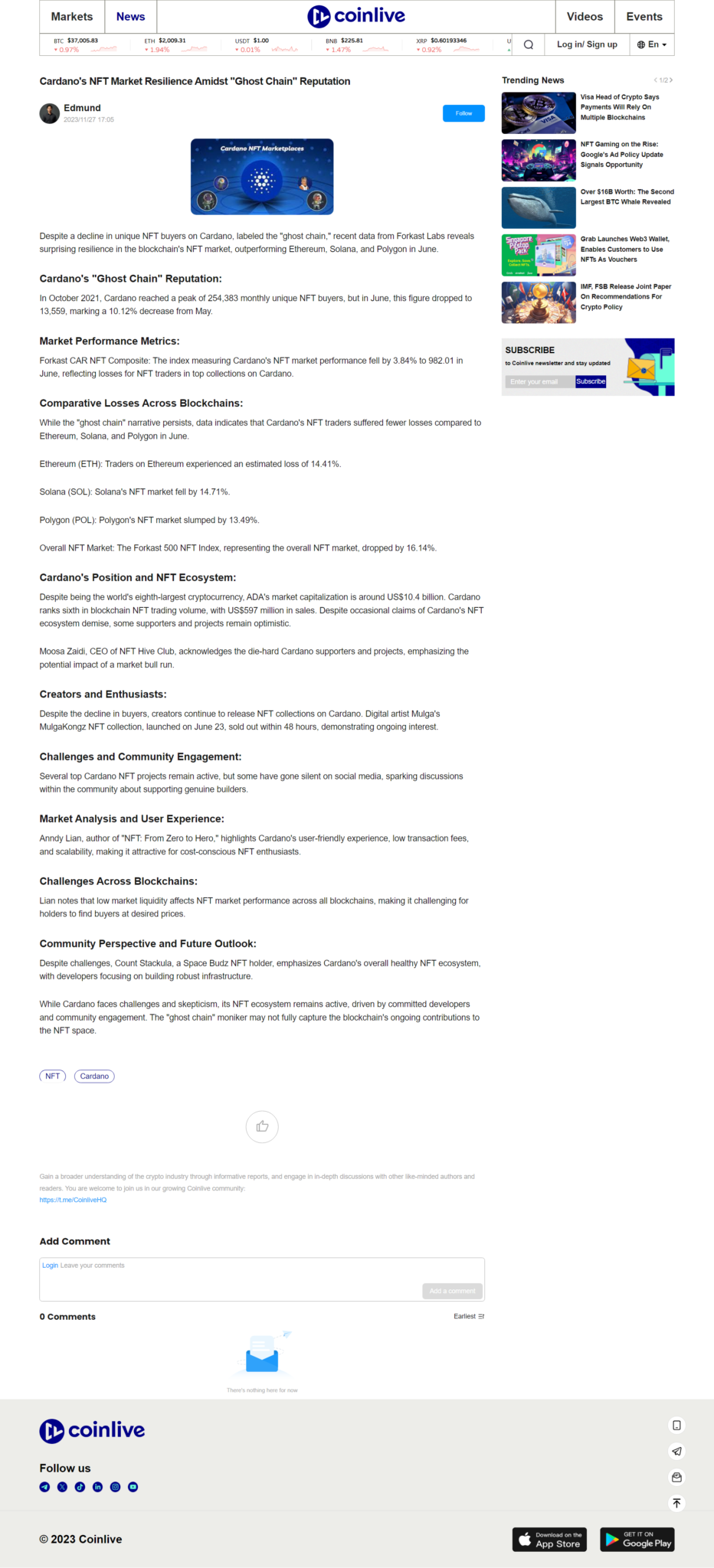
The declining number of non-fungible token traders on the Cardano blockchain has given it the “ghost chain” nickname, but data from Forkast Labs show that the network’s NFT market performance in June outperformed some of the top blockchains in the industry.

Cardano picked up the ghost chain moniker as its monthly unique NFT buyers plunged from its October 2021 peak of 254,383, according to CryptoSlam, the data arm of Forkast Labs. The number of unique NFT buyers fell to 13,559 in June, 10.12% lower than May.

The Forkast CAR NFT Composite, a CryptoSlam index to measure the Cardano NFT market performance, dropped 3.84% to 982.01 last month, giving an estimate of losses for NFT traders in some of the top collections on Cardano.

While that looks like all bearish news for the so-called ghost chain, Forkast Labs data suggests that NFT traders on Cardano suffered fewer losses than those on some of the world’s top NFT networks, such as Ethereum, Solana and Polygon.

New picture

Throughout June, the Forkast ETH NFT Composite suggests that traders that bet on the top NFT collections on Ethereum, the most popular blockchain for NFTs, would have copped an estimated loss of 14.41%.

Over the same period, Forkast SOL NFT Composite (Solana) fell 14.71%, and the Forkast POL NFT Composite (Polygon) slumped 13.49%. The Forkast 500 NFT Index, the gauge for the overall NFT market, dropped 16.14%.

Cardano’s native cryptocurrency, ADA, is the world’s eighth-largest cryptocurrency by market capitalization, with around US$10.4 billion in circulation. And despite it being the sixth largest blockchain for NFTs by all-time trading volume with US$597 million in sales, the network’s NFT ecosystem has on numerous occasions been declared dead by social media users.

But Moosa Zaidi, the founder and chief executive officer of NFT advertising firm NFT Hive Club, said he wouldn’t dismiss Cardano from the top NFT blockchains.

“There are still some die-hard Cardano supporters and projects out there that back the chain, and as past crypto portfolios show, a single market bull run can be a game changer,” Zaidi told Forkast.

“New founders and upcoming investors have Ethereum or Solana as their primary preference… Those wanting to venture out in Cardano tend to invest in the projects down the top 10 ranks to make the most out of it.”

Enthusiasts

The falling number of buyers has not stopped creators from releasing their NFT collections on Cardano.

Australia-based digital artist Joel Moore, better known as Mulga, released the MulgaKongz NFT collection on Cardano on June 23, a collection of 5,555 gorilla NFTs that sold out within 48 hours of its launch.

Moore said choosing Cardano to house his digital art was an “easy decision.”

“Cardano is a blockchain with a good future, community and ecosystem,” wrote Mulga, in a Twitter response to Forkast. “There’s been some great support from the community and the future is looking bright.”

See related article: Can Azuki’s new Elementals spark the entire NFT market?

While most top Cardano NFT projects remain engaged with their community, a few notable ones have been inactive on social media.

CardanoBitz, a 10,000-piece NFT collection on Cardano with over US$1.12 million in total sales, has not shared any original Twitter posts since June 10.

Zombie Chains, a collection with over US$1.73 million in total sales, has been silent since May 18. Unsigned Algorithms, a collection with US$423,799 in total sales volume, last posted on Feb. 2, while Clumsy Ghosts, an NFT gaming project with over US$1.78 million in sales, last tweeted on April 11.

“More and more top 50 projects on Cardano are going silent,” a Twitter user posted on June 24. “Do we need to do more as a community to support real builders? Or continue to hype dead weight?”

Input Output Global, the Colorado-based tech firm behind the Cardano blockchain, hadn’t responded to Forkasts request for comment by the time of publication.

Buyers

Solana had 65,459 unique NFT buyers in June, almost five times that of Cardano. But average NFT sales on Solana were US$78.79 in June or less than the US$95.22 on Cardano, suggesting that traders on the network were willing to pay a higher average price for their NFTs.

According to Anndy Lian, author of the book “NFT: From Zero to Hero,” Cardano’s forte is offering a user-friendly experience for NFT creators and traders.

“The platform offers low-cost transaction fees, making it an attractive option for enthusiasts seeking cost-effective and scalable solutions,” Lian told Forkast.

Lian added that low crypto market liquidity is affecting the NFT market performance across all blockchains, including Cardano.

“When liquidity is limited, it becomes more challenging for NFT holders to find buyers willing to purchase their tokens at desired prices. This can lead to longer waiting times and difficulties in selling NFTs. Additionally, a decrease in overall market activity may result in a decline in demand for NFTs, which can further affect their liquidity,” said Lian.

Count Stackula, a pseudonymous Space Budz NFT holder, a collection of 10,000 NFTs with over US$46 million in total sales, said that Cardano developers keep building, despite the market conditions.

“There was some more hype around the Cardano NFT scene when smart contracts were still to be announced, but it’s an overall healthy NFT ecosystem,” Count Stackula told Forkast.

“Admittedly, there have been a lot of the typical clone projects that don’t display much originality, but Cardano devs also know it’s important to focus on building the perfect roads and freeways before perfecting the automobile.”


Source: https://finance.yahoo.com/news/cardano-ghost-chain-outperforms-top-164500757.html


Anndy Lian is an early blockchain adopter and experienced serial entrepreneur who is known for his work in the government sector. He is a best selling book author- “NFT: From Zero to Hero” and “Blockchain Revolution 2030”.

Currently, he is appointed as the Chief Digital Advisor at Mongolia Productivity Organization, championing national digitization. Prior to his current appointments, he was the Chairman of BigONE Exchange, a global top 30 ranked crypto spot exchange and was also the Advisory Board Member for Hyundai DAC, the blockchain arm of South Korea’s largest car manufacturer Hyundai Motor Group. Lian played a pivotal role as the Blockchain Advisor for Asian Productivity Organisation (APO), an intergovernmental organization committed to improving productivity in the Asia-Pacific region.

An avid supporter of incubating start-ups, Anndy has also been a private investor for the past eight years. With a growth investment mindset, Anndy strategically demonstrates this in the companies he chooses to be involved with. He believes that what he is doing through blockchain technology currently will revolutionise and redefine traditional businesses. He also believes that the blockchain industry has to be “redecentralised”.

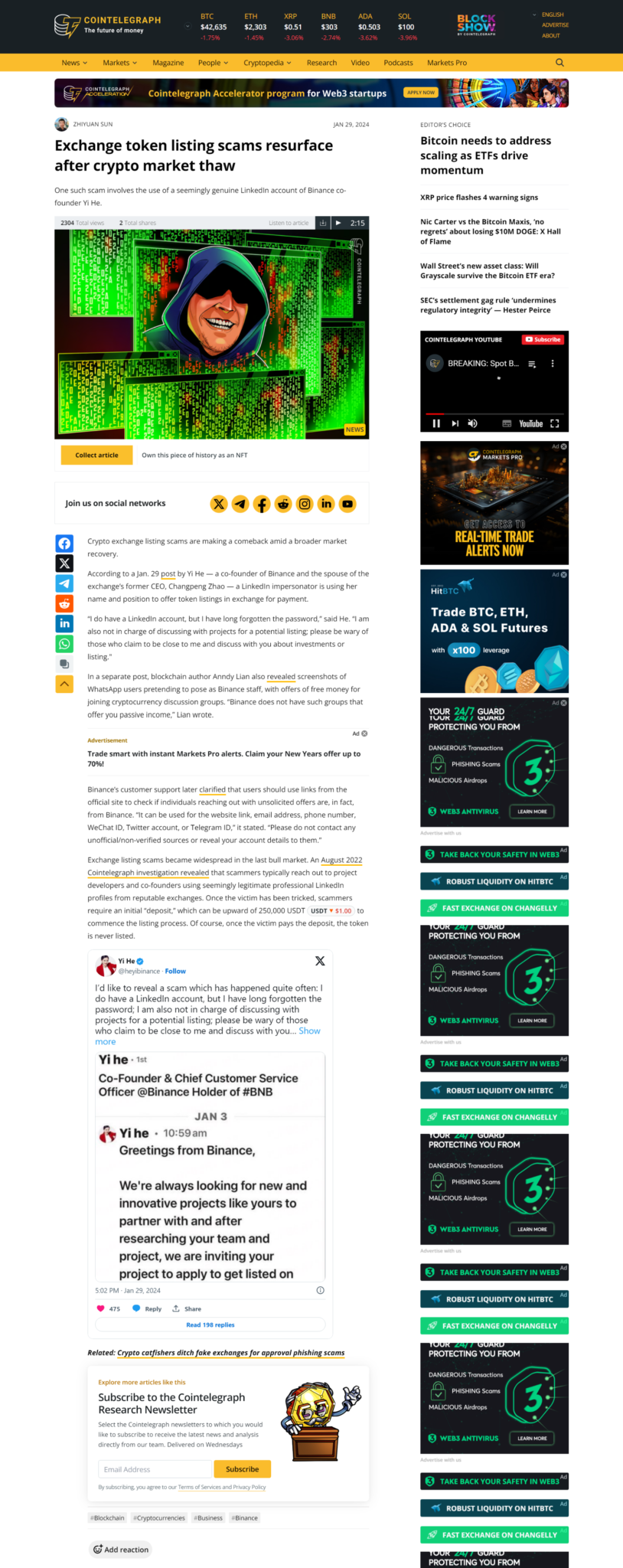
j j j

A Bullish Job Market In The US May Inspire More Crypto Adoption, NFT Expert Says

A Bullish Job Market In The US May Inspire More Crypto Adoption, NFT Expert Says

Anndy Lian, the author of “NFT: From Zero to Hero,” considers last week’s jobs data report — which showed a remarkable increase in non-farm payrolls and a marginal uptick in the unemployment rate — to be a potential catalyst for cryptocurrency adoption.

“Positive job data may influence governments to adopt a more favorable stance towards cryptocurrencies,” Lian told Benzinga.

The crypto industry presents an irresistible opportunity for economic development and innovation, he added.

See Also: U.S. CFTC Asks For Public Input On Digital Asset Risk Management – ‘The Commission Needs To Revisit Our Regulatory Oversight’

Lian also lauded Hong Kong for its proactive approach to fostering the growth of the web3, blockchain, and crypto industry.

StandardDAO‘s Aaron Rafferty, however, says the positive jobs report does not necessarily signify a considerable shift in the economic crisis currently impacting global markets.

Investment in blockchain companies has declined significantly as capital firms shift focus to artificial intelligence (AI) technologies.

“Given that crypto assets and the blockchain sector, in general, has been trending sideways over the past year, there is nothing in this report that would indicate a significant change to that trajectory,” Rafferty said.

Liberty Blockchain COO Christopher Alexander explained that while Bitcoin (CRYPTO: BTC) follows the trends of traditional markets, which have responded positively to the jobs report, ongoing fears of a looming recession could deter many large investors, curtail liquidity and hamper growth.

Raj Kapoor, the founder of the Blockchain Governance Council, drew attention to the ongoing regulatory debates surrounding cryptocurrency as a substantial obstacle to crypto startups’ ability to capitalize on positive economic signals.

Kapoor blamed the Federal Reserve’s aggressive monetary policy, which aims to rein in inflation by raising interest rates, as an additional near-term issue for crypto given the existing macroeconomic environment.


Source: https://uk.investing.com/news/cryptocurrency-news/a-bullish-job-market-in-the-us-may-inspire-more-crypto-adoption-nft-expert-says-3042452

Anndy Lian is an early blockchain adopter and experienced serial entrepreneur who is known for his work in the government sector. He is a best selling book author- “NFT: From Zero to Hero” and “Blockchain Revolution 2030”.

Currently, he is appointed as the Chief Digital Advisor at Mongolia Productivity Organization, championing national digitization. Prior to his current appointments, he was the Chairman of BigONE Exchange, a global top 30 ranked crypto spot exchange and was also the Advisory Board Member for Hyundai DAC, the blockchain arm of South Korea’s largest car manufacturer Hyundai Motor Group. Lian played a pivotal role as the Blockchain Advisor for Asian Productivity Organisation (APO), an intergovernmental organization committed to improving productivity in the Asia-Pacific region.

An avid supporter of incubating start-ups, Anndy has also been a private investor for the past eight years. With a growth investment mindset, Anndy strategically demonstrates this in the companies he chooses to be involved with. He believes that what he is doing through blockchain technology currently will revolutionise and redefine traditional businesses. He also believes that the blockchain industry has to be “redecentralised”.
j j j

NCET cracks down on illicit activities in cryptocurrency market

NCET cracks down on illicit activities in cryptocurrency market

Multiple news outlets have reported that the US Department of Justice (DOJ) is increasing its efforts to combat illicit activities and criminal behaviour, such as money laundering, within cryptocurrency exchanges and platforms. To this end, the DOJ’s national cryptocurrency enforcement team (NCET) is focusing its attention not only on exchanges but also on crypto mixers and decentralised finance (DeFi) platforms that engage in unlawful acts.

NCET’s focus

The NCET’s focus on cryptocurrency-related crimes highlights the United States government’s efforts to regulate the cryptocurrency market. The NCET aims to prevent criminals from using digital assets to carry out illegal activities and to ensure the safety and fairness of the cryptocurrency market for investors. The increased efforts of the NCET and other regulatory bodies to combat cryptocurrency fraud and criminal activity indicate the growing importance of regulation in the cryptocurrency market.

They have a broad mandate, blurring lines between traditional white-collar and other federal crime and the emerging technologies associated with cryptocurrency and cyber-instrumentalities, neither of which are governed by clear, subject matter-specific statutes. The team aims to assist in tracing and recovering assets lost to fraud and other illegal activities.

Eun Young Choi, the newly appointed director of the cryptocurrency enforcement team, has vowed to crack down on illicit behaviour and to hold companies accountable for allowing or facilitating criminal activity on their platforms. In recent months, the US government has shut down nine exchanges suspected of money laundering.

For example, in May 2023, the US government, in collaboration with Ukrainian authorities, shut down nine cryptocurrency exchanges suspected of money laundering activities in recent months. The authorities shut down all servers of crypto exchanges 24xbtc.com and 100btc.pro, pridechange.com, 101crypta.com, uxbtc.com, trust-exchange.org, bitcoin24.exchange, paybtc.pro, and owl.gold.

Each platform offered users anonymous crypto transactions through voluntary registration programs violating several US laws. The exchanges were considered important hubs in the cybercrime ecosystem and were accused of violating US laws and having lax know-your-customer (KYC) controls.

It was also mentioned that the NCET Team wants to crack down on illicit investment scams such as the “pig butchering” scheme on crypto exchanges. This scam involves scammers playing the long game, “fattening up” potential victims to extract as much money as possible before the “slaughter”. The goal is not to extract money quickly, unlike other common scams. The term originated from a Chinese phrase with the same meaning.

They have also emphasized its partnerships with other federal agencies, such as the Securities and Exchange Commission (SEC) and the Commodity Futures Trading Commission (CFTC), in monitoring the cryptocurrency industry.

The government’s goal is to coordinate efforts and respect primacy among subject matter experts while unleashing US regulators to dig deeper into emerging markets and the technologies that support them. With the creation of the NCET, a rise in enforcement actions, and the end of the cryptocurrency “grace period,” stakeholders active in the cryptocurrency markets need to ensure their regulatory compliance.

A two-phase strategy for cryptocurrency regulation

Some experts believe that the US government’s actions signal a coordinated regulatory campaign to stymie the growth of the cryptocurrency industry. Personally, I do not think so. The regulation of cryptocurrencies requires a meticulously planned strategy that adapts to the ever-changing landscape of this digital realm.

To ensure its effectiveness, a two-phase approach should be followed. In the initial phase, the primary objective is to disrupt the flow of cryptocurrencies to illicit actors. This can be achieved by maintaining updated lists of sanctioned intermediaries and providing clear guidelines to individuals and businesses in the United States, helping them identify and avoid engaging with foreign companies under sanctions.

Furthermore, a comprehensive analysis should be conducted concurrently to evaluate the efficacy of these measures in combatting illicit financial activities associated with cryptocurrencies. This in-depth assessment would give regulators a deeper understanding of the outcomes of their actions.

By closely monitoring cryptocurrency intermediaries and rigorously evaluating the results, regulators can gather invaluable insights into the potential of cryptocurrencies as a legitimate instrument for promoting financial inclusion.

The findings and evaluations obtained in the initial phase will form the basis for the subsequent stage. If the analysis demonstrates a significant reduction in illegal cryptocurrency transactions due to effective law enforcement, it would create strong momentum for the government to proceed with the implementation of a Central Bank Digital Currency (CBDC).

This would indicate that the risks tied to illicit cryptocurrency activities can be adequately managed. However, if the measurements from the first phase reveal limited progress in addressing the criminal use of virtual currencies, it would underscore the government’s need to enhance enforcement mechanisms before considering the introduction of a CBDC.

It becomes crucial to prioritise efforts to target foreign exchanges and influential intermediaries through stringent sanctions, effectively combating theft, fraud, and extortion. Prudence dictates that new currencies should not be introduced hastily, and a comprehensive understanding of cryptocurrency dynamics must be achieved before any further steps are taken.

I think a well-executed phased approach to cryptocurrency regulation, supported by vigilant monitoring, thorough evaluation, and targeted enforcement measures, promises to provide valuable insights into the viability of cryptocurrencies for legitimate financial activities.

By diligently assessing the impact of regulatory efforts, policymakers can make informed decisions regarding the potential implementation of a CBDC, thereby ensuring effective control over illicit activities within the cryptocurrency ecosystem. Continual adaptation and improvement in response to the evolving challenges of this digital landscape are essential for fostering a safe and inclusive environment for cryptocurrency transactions.


Source: https://e27.co/ncet-cracks-down-on-illicit-activities-in-cryptocurrency-market-20230522/

Anndy Lian is an early blockchain adopter and experienced serial entrepreneur who is known for his work in the government sector. He is a best selling book author- “NFT: From Zero to Hero” and “Blockchain Revolution 2030”.

Currently, he is appointed as the Chief Digital Advisor at Mongolia Productivity Organization, championing national digitization. Prior to his current appointments, he was the Chairman of BigONE Exchange, a global top 30 ranked crypto spot exchange and was also the Advisory Board Member for Hyundai DAC, the blockchain arm of South Korea’s largest car manufacturer Hyundai Motor Group. Lian played a pivotal role as the Blockchain Advisor for Asian Productivity Organisation (APO), an intergovernmental organization committed to improving productivity in the Asia-Pacific region.

An avid supporter of incubating start-ups, Anndy has also been a private investor for the past eight years. With a growth investment mindset, Anndy strategically demonstrates this in the companies he chooses to be involved with. He believes that what he is doing through blockchain technology currently will revolutionise and redefine traditional businesses. He also believes that the blockchain industry has to be “redecentralised”.
j j j