Crypto a Good Way to Make Money for the Future? – Anndy Lian Explains on The Moneyverse Show

Crypto a Good Way to Make Money for the Future? – Anndy Lian Explains on The Moneyverse Show

In a recent episode of The Moneyverse Show, hosted by Andreas Vecchiet and co-hosted by global money expert Lionel Lee, the spotlight was on cryptocurrency as a potential avenue for future wealth. The guest of honor was Anndy Lian, a best-selling author, intergovernmental blockchain advisor, and early crypto advocate. With over a decade of experience in the crypto space, Lian shared his insights on the question: Is crypto a good way to make money for the future?

Here are the key highlights and takeaways from the conversation:

The Question: Is Crypto a Good Way to Make Money?
Lionel Lee, the show’s co-host, posed the viewer’s question to Lian, asking whether crypto is a viable way to generate wealth in the long term.

Lian’s response was nuanced, offering both optimism and caution. He began by explaining that the answer is both “yes and no,” depending on the individual’s approach, risk appetite, and understanding of the market.

Long-Term Investments in Crypto
Lian highlighted the importance of a long-term perspective when investing in cryptocurrency. He suggested that investors focus on the top 10, 20, or 30 cryptocurrencies listed on platforms like CoinMarketCap or CoinGecko. These coins, often referred to as “blue chips” in the crypto world, are more stable and less volatile compared to newer, lesser-known tokens.

“If you invest in the top cryptocurrencies for the long term, the returns can be stable and satisfactory,” Lian explained. He emphasized that while these investments are not without risk, they are comparable to traditional financial instruments in terms of stability.

He cited examples like XRP, which recently experienced a significant price surge. Investors who bought in at a low price could see returns as high as 5x. However, Lian cautioned that such opportunities require patience and a willingness to hold through market fluctuations.

The Appeal of Control in Crypto Investments
One of the key advantages of cryptocurrency, according to Lian, is the level of control it offers to investors. Unlike traditional investments managed by private bankers or financial institutions, crypto investments allow individuals to have full control over their assets.

“You control everything you’re trying to do,” Lian said, highlighting the decentralized nature of cryptocurrency. This autonomy is particularly appealing to investors who prefer to manage their own portfolios.

High-Risk, High-Reward Opportunities
For those with a higher risk appetite, Lian discussed the potential of investing in new and emerging cryptocurrencies. These tokens often experience rapid price increases shortly after their launch, offering the possibility of significant returns in a short period.

“If you’re willing to put in what you can afford to lose, say $1,000, and invest in new coins, you could potentially see a 10x return within a day or a week,” Lian explained. However, he cautioned that these investments are highly speculative and should only be pursued by those who understand the risks involved.

Balancing Risk and Reward
Lian stressed the importance of balancing risk and reward when investing in cryptocurrency. While blue-chip cryptocurrencies offer stability, newer tokens provide the allure of high returns. He advised investors to diversify their portfolios and only invest what they can afford to lose.

“It all comes down to the individual’s appetite for risk,” Lian said. He encouraged viewers to educate themselves about the market and make informed decisions.

The Future of Crypto as an Investment
When asked about the future of cryptocurrency as a way to make money, Lian expressed optimism. He believes that crypto will continue to be a viable investment option, especially as the market matures and more institutional players enter the space.

“The future for earning good money in crypto is definitely there,” Lian concluded. However, he reiterated the importance of a strategic approach and a long-term mindset.

Final Thoughts
The episode provided valuable insights into the world of cryptocurrency, with Anndy Lian offering a balanced perspective on its potential as an investment. While crypto can be a lucrative way to make money, it requires careful planning, risk management, and a willingness to learn.

For those new to the space, Lian’s advice is clear: start with blue-chip cryptocurrencies, focus on long-term gains, and only invest what you can afford to lose. For more adventurous investors, the high-risk, high-reward nature of new tokens can be enticing, but it’s crucial to proceed with caution.

Anndy Lian is an early blockchain adopter and experienced serial entrepreneur who is known for his work in the government sector. He is a best selling book author- “NFT: From Zero to Hero” and “Blockchain Revolution 2030”.

Currently, he is appointed as the Chief Digital Advisor at Mongolia Productivity Organization, championing national digitization. Prior to his current appointments, he was the Chairman of BigONE Exchange, a global top 30 ranked crypto spot exchange and was also the Advisory Board Member for Hyundai DAC, the blockchain arm of South Korea’s largest car manufacturer Hyundai Motor Group. Lian played a pivotal role as the Blockchain Advisor for Asian Productivity Organisation (APO), an intergovernmental organization committed to improving productivity in the Asia-Pacific region.

An avid supporter of incubating start-ups, Anndy has also been a private investor for the past eight years. With a growth investment mindset, Anndy strategically demonstrates this in the companies he chooses to be involved with. He believes that what he is doing through blockchain technology currently will revolutionise and redefine traditional businesses. He also believes that the blockchain industry has to be “redecentralised”.


j j j

Everything Else Went Digital — Now Crypto Redefines Money

Everything Else Went Digital — Now Crypto Redefines Money

The global economy relies and thrives on continuous innovation and growth, and cryptocurrency — once the digital outlier — is becoming an integral part of the next wave.

The landscape is not just one of digital currencies; it’s a movement that mirrors and grows with relentless progress within our manufacturing and service sectors.

And as it integrates further into the broader economic fabric, its value in the world is not just a distant future but a present reality — and one that’s a joy to watch unfold.


Key Takeaways

  • Cryptocurrency, once an outlier, is becoming integral to global economic innovation and growth.
  • Its value is not just future potential but a present reality, merging with the broader economic fabric.
  • In volatile markets, cryptocurrency offers a hedge, showcasing its strength in geopolitical turmoil.
  • Blockchain technology extends beyond finance, enhancing transparency and efficiency in various sectors such as supply chains.


Cryptocurrency Helps Hedge Against the Winds of Change

In today’s financial markets, volatility is the norm, and stability is the goal — and nowhere is that more apparent than in crypto.

Its volatility, often misconstrued as a weakness, is, in fact, its greatest strength — when there is geopolitical turmoil, the low correlation of cryptocurrencies with traditional assets offers a hedge, a sanctuary from the storm.

It opens a door for investors in emerging economies to partake in a global asset class — free from the confines of regional economic constraints.

Cryptocurrency is no longer merely a speculative instrument but a legitimate asset class deserving of recognition in any diversified investment portfolio.

The Shape of Crypto Around the World

In the United States, the quest for growth beyond blue-chip stocks leads us to value-oriented sectors and small and mid-cap companies.

Cryptocurrency fits perfectly into this narrative, offering a decentralized alternative that captures value in ways traditional markets may miss. With corporate earnings and a strong economy, the integration of digital assets could add a new layer of strength, especially as a hedge against inflation.

Meanwhile, Europe’s struggle with structural challenges and a slow transition to renewables could find a surprising ally in cryptocurrency. The new digital asset class can complement Europe’s dividend stocks, offering investors a new perspective on value and a hedge against economic stagnation.

And Japan’s emphasis on domestic reforms and corporate transformations matches with the principles of blockchain technology — the foundation of cryptocurrency. The transparency and efficiency blockchain promises can bolster Japan’s corporate governance, making cryptocurrency a valuable asset in the nation’s economic arsenal.

China’s dual-circulation strategy, which focuses on boosting domestic consumption and reducing export reliance, reflects the self-sustaining nature of cryptocurrency. As China addresses regulatory reforms and policy risks, cryptocurrency offers the power of decentralized finance (DeFi), providing an alternative less correlated to traditional investments.

The Future of Currency is Global and Transparent

Our world is still anchored in traditional asset classes, yet it fails to capture the undercurrent of change driven by digital currencies. Cryptocurrencies are gradually gaining recognition from institutional investors and regulators, signaling their integration into mainstream finance.

It complements but also offers an alternative to traditional systems, which are often constrained by borders, regulations, and the pace of innovation. They offer a global, decentralized platform for transactions and investments, appealing in an increasingly connected world.

Moreover, the blockchain technology that underpins cryptocurrencies is finding applications beyond digital currencies, including in supply chain managementhealthcare, and voting systems. This technology is fostering a more transparent, efficient, and secure digital economy.

The Bottom Line

Champion or skeptic, it is essential to recognize the quiet revolution that cryptocurrency is causing.

Its value as an asset is increasingly evident, and its impact on the financial landscape is significant. As we advance, cryptocurrency is set to become a more prominent and integral part of the global financial system, steadily altering the investment game for both investors and consumers.

This opinion piece is an invitation to investors to look beyond the chart and towards a future where cryptocurrency is not just an alternative asset but a foundational element of a diversified and modern portfolio.

The future is digital, and cryptocurrency is at the forefront, leading the charge.


Source: https://www.techopedia.com/everything-else-went-digital-now-crypto-redefines-money

Anndy Lian is an early blockchain adopter and experienced serial entrepreneur who is known for his work in the government sector. He is a best selling book author- “NFT: From Zero to Hero” and “Blockchain Revolution 2030”.

Currently, he is appointed as the Chief Digital Advisor at Mongolia Productivity Organization, championing national digitization. Prior to his current appointments, he was the Chairman of BigONE Exchange, a global top 30 ranked crypto spot exchange and was also the Advisory Board Member for Hyundai DAC, the blockchain arm of South Korea’s largest car manufacturer Hyundai Motor Group. Lian played a pivotal role as the Blockchain Advisor for Asian Productivity Organisation (APO), an intergovernmental organization committed to improving productivity in the Asia-Pacific region.

An avid supporter of incubating start-ups, Anndy has also been a private investor for the past eight years. With a growth investment mindset, Anndy strategically demonstrates this in the companies he chooses to be involved with. He believes that what he is doing through blockchain technology currently will revolutionise and redefine traditional businesses. He also believes that the blockchain industry has to be “redecentralised”.
j j j

Top 5 Billionaires Who Lost the Most Money in Crypto

Top 5 Billionaires Who Lost the Most Money in Crypto

From the collapse of Sam Bankman-Fried (SBF) and Gary Wang’s FTX to the fall of Binance’s Changpeng Zhao (CZ), the cryptocurrency industry has witnessed some of the biggest pitfalls in the last couple of years, with a number of notable individuals losing millions if not billions of dollars-worth in crypto.

Who lost the most money in crypto in past years, and why are even seasoned investors and billionaires prone to lose money in the industry?

We talked to experts about the major reasons for such dire losses and identified the key best practices crypto investors could use to protect their money.

Key Takeaways

  • Crypto investments are prone to fall victim to high volatility and risks, as evidenced by massive losses experienced by key figures in the industry.
  • Understanding the underlying technology and market dynamics is crucial for navigating the complexities of the crypto space.
  • Seasoned investors can also face significant losses, highlighting the unpredictability of crypto markets.
  • Implementing strong security practices and risk management strategies is essential for protecting investments.

Who Lost the Most Money in Crypto?

The cryptocurrency market continues to be highly volatile, which is why investors must be able to grasp the fundamentals before judging the risks or getting caught up in the hype and fear of missing out (FOMO) of many decentralized finance (DeFi) projects, Dr. Fardad Zand, the co-founder and CEO of Wisdomise, told Techopedia.

“Poor security practices can also lead to losses from scams and hacks. In addition, overleveraging amplifies potential gains and losses for traders — many get liquidated when the volatile market turns against them.”

The lack of a solid risk management strategy that would dictate to investors when the right time to exit a trade is regardless of its outcome is also another reason why individuals could be prone to lose large sums of money while trading cryptocurrencies, Jonathan Solomon, the co-founder and co-CEO of ARIA, added.

So, who were the people who lost the most money in crypto in recent years?

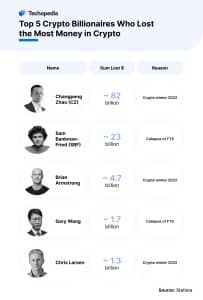
Top 5 Crypto Billionaires Who Lost the Most Money in Crypto
Source: Statista

Changpeng Zhao (CZ): $82 Billion

One of the most prominent names in the cryptocurrency industry, the former CEO of Binance Changpeng Zhao, allegedly lost around $82 billion during the crypto winter of 2022, data on Statista showed.

However, since then, the crypto billionaire’s net worth continued to decline, as he pleaded guilty to violating anti-money laundering requirements enforced by the U.S. Department of Justice in late November 2023 and paid a $4 billion settlement.

Despite the losses, it is estimated that CZ has a net worth of $33 billion as of April 2024.

Sam Bankman-Fried (SBF): $23 Billion

Another prominent name in the cryptocurrency industry, Sam Bankman-Fried, was the former co-founder of the doomed crypto exchange FTX, who lost about $23 billion, according to Statista, as the value of FTX and related assets collapsed.

ARIA’s Solomon noted that in SBF’s case, his losses could have been attributed to high-risk strategies that led to significant financial losses.

However, SBF had also faced allegations of fraud for his role in the collapse of FTX, including defrauding the exchange’s customers. His actions led to a significant loss of customer funds and investments, resulting in his arrest and a trial where he was found guilty.

On April 1, 2024, SBF revealed that he was planning to appeal his 25-year sentence in an exclusive interview with ABC News.

Brian Armstrong: $4.7 Billion

Brian Armstrong, the co-founder and CEO of Coinbase, is another big name in the cryptocurrency space who lost a significant amount of money when the market plummeted in 2022.

Armstrong’s wealth was closely tied to Coinbase’s performance and the overall health of the crypto market. Therefore, when the crypto winter occurred in 2022, and the industry faced substantial losses, so did Armstrong’s net worth.

Still, even with the loss of $4.7 billion, estimated by Statista, Brian Armstrong’s net worth is $10.9 billion as of April 2024.

Anndy Lian, an inter-governmental blockchain adviser, further explained how the 2022 crypto winter could have affected investors:

“Many investors are drawn to the allure of quick profits without fully understanding the assets they’re investing in. This, coupled with the market’s notorious volatility, can lead to substantial financial losses.


Prices in the crypto market can swing dramatically, and without a solid grasp of market trends and the factors driving them, investors can find themselves buying high and selling low.”

Gary Wang: $1.7 Billion

Gary Wang, the former co-founder and CTO of FTX, also faced a substantial loss of about $1.7 billion following the collapse of the FTX cryptocurrency exchange, according to Statista.

Most of his fortune was tied up in a 16% stake in FTX and a share of its FTT tokens. As of April 2024, Garry Wang dropped off all the Forbes ratings.

Chris Larsen: $1.3 Billion

Chris Larsen is known as a pioneering force in cryptocurrency, having co-founded Ripple, a digital payment protocol and currency exchange.

In 2022, he also faced a significant loss of $1.3 billion due to the downturn in the cryptocurrency market, according to Statista.

As of April 2024, Larsen’s net worth is $3.2 billion.

Other Prominent Losses: TerraUSD/LUNA Crash

Meanwhile, the collapse of the TerraUSD (UST) stablecoin and its sister cryptocurrency, LUNA, is not directly linked to one person losing all their assets. Industry experts allege this collapse was one of the most “catastrophic” losses in the crypto market.

The pitfall of TerraUSD and Luna in May 2022 wiped out almost $45 billion in crypto market capitalization in just one week.

Do Kwon, the co-founder of Terraform Labs, is often blamed for this collapse; however, his losses are not mentioned in public sources.

Why Even Seasoned Investors Lose Money on Crypto?

Many might think that seasoned investors are rarely ever prone to face substantial losses in the crypto space, but that is rarely true.

Wisdomise’s Dr. Zand explained:

“Sometimes, overconfidence leads them to misjudge the actual risks involved. The technological complexities of blockchain and smart contracts are easy to overlook or misunderstand.

The crypto market is susceptible to manipulation by wealthy “whale” players, which can catch experienced investors off guard with volatile price swings. Some black swan events like major exchange hacks or new regulations can also unpredictably impact the entire market.”

Lian added that the complexity of the market, which is often characterized by its rapid evolution and the development of new technologies, could also pose significant challenges that even seasoned investors cannot evade.

Additionally, the crypto space is prone to high-profile scams and security breaches, which can also lead to financial losses.

Lian added:

“Market manipulation is another hazard that can lead to losses. Influential players can distort market prices, affecting the entire market and catching even the most vigilant investors off guard.”

Best Practices to Protect Your Money: Risk Management & Research

Lian highlighted that some of the critical takeaways from situations like these are the importance of risk management and research. He said:

  • Understanding the assets, the technology behind them, and the market dynamics is crucial for making informed decisions.
  • Emotional discipline is also essential; investors must learn to control their emotions and avoid making impulsive decisions based on fear or greed.
  • Moreover, the significance of security practices cannot be overstated.
  • Investors should prioritize the security of their investments by using reputable platforms, enabling two-factor authentication, and being wary of too-good-to-be-true schemes that could be fraudulent.

Additionally, developing a long-term investment strategy could also act as a safety net for many investors.

ARIA’s Solomon said:

“The historical performance of Bitcoin illustrates that holding investments over the long term has been profitable for those who have stayed the course, unlike many traders who have faced challenges in recent years. This emphasizes the importance of patience and the potential benefits of a long-term investment horizon in the crypto market.”

The Bottom Line

The dramatic losses in the crypto world underline the high volatility and risk inherent in cryptocurrency investments, as well as the market’s complexity and rapid evolution.

From the collapse of FTX, affecting Sam Bankman-Fried and Gary Wang, to the regulatory challenges faced by Changpeng Zhao and the market downturns impacting Brian Armstrong and Chris Larsen, these events highlight the precarious nature of wealth in the crypto industry.

They serve as a reminder of the importance of having robust risk management, a deep understanding of blockchain technology, and the importance of navigating the market with caution.


Source: https://www.techopedia.com/crypto-biggest-losers-who-lost-the-most-money-in-crypto

Anndy Lian is an early blockchain adopter and experienced serial entrepreneur who is known for his work in the government sector. He is a best selling book author- “NFT: From Zero to Hero” and “Blockchain Revolution 2030”.

Currently, he is appointed as the Chief Digital Advisor at Mongolia Productivity Organization, championing national digitization. Prior to his current appointments, he was the Chairman of BigONE Exchange, a global top 30 ranked crypto spot exchange and was also the Advisory Board Member for Hyundai DAC, the blockchain arm of South Korea’s largest car manufacturer Hyundai Motor Group. Lian played a pivotal role as the Blockchain Advisor for Asian Productivity Organisation (APO), an intergovernmental organization committed to improving productivity in the Asia-Pacific region.

An avid supporter of incubating start-ups, Anndy has also been a private investor for the past eight years. With a growth investment mindset, Anndy strategically demonstrates this in the companies he chooses to be involved with. He believes that what he is doing through blockchain technology currently will revolutionise and redefine traditional businesses. He also believes that the blockchain industry has to be “redecentralised”.

j j j