How Influencers and Content Can Onboard More People onto Web3: Insights from Taipei Blockchain Week 2024

How Influencers and Content Can Onboard More People onto Web3: Insights from Taipei Blockchain Week 2024

The Taipei Blockchain Week 2024 brought together some of the brightest minds in the blockchain and Web3 space to discuss the future of the industry. One of the standout panels of the event was titled “How Influencers and Content Can Onboard More People onto Web3”, featuring a diverse group of panelists:

  • Anndy Lian, Intergovernmental Blockchain Advisor
  • Dan, representing Retail DAO
  • Andrew Weiner, VP of WEEEX Global
  • Emily Lai, CMO of HYPE

The discussion was lively, insightful, and packed with actionable advice on how influencers and content creators can help bridge the gap between Web2 and Web3, making blockchain technology more accessible to the masses. Below, we’ll explore the key takeaways and quotes from the panelists.


The Role of Authenticity in Influencer Marketing

One of the first topics discussed was the importance of authenticity in influencer marketing. Andrew Weiner emphasized that the biggest mistake in influencer marketing is working with influencers who don’t genuinely use or believe in the product they’re promoting. He stated:

“The worst mistake you can make with influencer marketing is getting people to say something good without them authentically using it. Today’s consumers want to see and be educated on how things actually work, not just be sold to.”

This sentiment was echoed by Dan, who shared his approach as a content creator. He explained that he only promotes projects he believes in and ensures transparency with his audience:

“If a company approaches me, I first have to find out if they’re going to be around in a few years. I also make it clear to my audience when content is sponsored. Authenticity is key.”

The panelists agreed that audiences are becoming increasingly savvy and can easily spot inauthentic endorsements. For Web3 projects, building trust through genuine engagement is far more effective than flashy but hollow marketing campaigns.


Community First: The Foundation of Web3 Success

Anndy Lian brought a unique perspective as both an investor and advisor. He stressed the importance of community-driven projects, stating that the strength of a project’s community often determines its success:

“I don’t look at the product first; I look at the community. If the community is strong and genuinely engaged, that’s a good sign. Projects that focus on building a real community will always have a better chance of succeeding.”

He also highlighted the pitfalls of working with influencers who have a short-term mindset, noting that some influencers are quick to sell their tokens, which can harm the project and its community:

“The worst kind of influencers are those who sell early. If you’re bullish on your project, you should hold and support it. A strong community and long-term commitment are what drive success.”

This focus on community was a recurring theme throughout the panel. Emily Lai summarized it well:

“At the end of the day, it’s not just about the go-to-market strategy. Consumers and communities need to genuinely want to engage with and use the product. That’s what creates lasting momentum.”


The Marketing Funnel for Influencers: Different Types for Different Stages

The panelists also discussed the different types of influencers and how they fit into the marketing funnel. Anndy Lian broke it down into three stages:

  1. Awareness Stage:
    At this stage, projects can work with influencers who have large followings, even if their engagement is low or their content is less authentic. The goal is to create noise and get the project on people’s radar.
  2. Engagement Stage:
    Here, projects should collaborate with influencers who have a more engaged audience, even if their reach is smaller. These influencers can help build trust and drive meaningful interactions.
  3. Conversion Stage:
    Finally, projects need to work with high-integrity influencers who have built trust with their audience over time. These influencers can drive conversions and long-term loyalty.

Anndy explained:

“There’s no one-size-fits-all solution. You need to work with different types of influencers at different stages of your project. But ultimately, the goal is to build a community that’s real and engaged.”


The Challenges of Onboarding New Users to Web3

One of the biggest challenges in the Web3 space is onboarding new users, especially those unfamiliar with blockchain technology. Dan, who creates educational content for retail traders, shared his insights:

“The problem with getting people into DeFi is that it’s too complicated. There are too many steps, too many things to remember, and too many ways to lose money. It has to be a gradual process.”

He explained that his most popular content is often educational, such as tutorials on how to use platforms like Coinbase or how to navigate decentralized finance (DeFi). By breaking down complex topics into simple, actionable steps, he’s able to attract and retain a wider audience.


East vs. West: Differences in Influencer Marketing

The panel also explored the differences between influencer marketing in Asia and the West. Andrew Weiner noted that in the West, cryptocurrency has historically been viewed with skepticism, which has shaped the way content is created:

“In the West, crypto was a boogeyman for years. Now, the narrative is shifting, and people are more open to learning about these products. Educational content is crucial for onboarding new users.”

In contrast, Anndy Lian pointed out that in Asia, marketing strategies are often more aggressive and creative. He mentioned the prevalence of referral programs and multi-level marketing (MLM) models in the region, which can be highly effective in driving adoption:

“In the Chinese-speaking market, a lot of projects use referral or MLM strategies to onboard users. It’s very different from the West, where these methods are less common.”


Creativity in Influencer Marketing: Standing Out in a Crowded Market

As the Web3 space becomes increasingly competitive, creativity in marketing is more important than ever. Andrew Weiner shared an example of experiential marketing, which he believes is the next frontier:

“We recently partnered with Michael Owen, a world champion soccer player, to create unique experiences for our users. Instead of just giving away USDT, we’re offering opportunities to attend exclusive events, like coaching sessions or live games. These types of experiences are far more engaging and memorable.”

Anndy Lian added that some projects are even exploring unconventional platforms like OnlyFans to reach new audiences. While this approach may not be suitable for every project, it highlights the importance of thinking outside the box.


The Future of Influencer Marketing in Web3

As the panel wrapped up, the speakers shared their thoughts on the future of influencer marketing in the Web3 space. Emily Lai emphasized the need for authenticity and trust:

“The highest-tier influencers are those who have built trust with their audience over time. In a crowded market, trust is what sets you apart.”

Dan highlighted the importance of education:

“Educational content is key to onboarding new users. The more we can simplify and demystify Web3, the more people we can bring into the space.”

Finally, Anndy Lian reiterated the importance of community:

“At the end of the day, it’s all about the community. A strong, engaged community is the foundation of any successful Web3 project.”


Conclusion

The panel at Taipei Blockchain Week 2024 provided valuable insights into how influencers and content creators can help onboard more people onto Web3. From the importance of authenticity and community to the need for creativity and education, the discussion highlighted the many facets of effective marketing in the blockchain space. As the industry continues to evolve, these strategies will play a crucial role in driving adoption and building a more inclusive Web3 ecosystem.

 

Anndy Lian is an early blockchain adopter and experienced serial entrepreneur who is known for his work in the government sector. He is a best selling book author- “NFT: From Zero to Hero” and “Blockchain Revolution 2030”.

Currently, he is appointed as the Chief Digital Advisor at Mongolia Productivity Organization, championing national digitization. Prior to his current appointments, he was the Chairman of BigONE Exchange, a global top 30 ranked crypto spot exchange and was also the Advisory Board Member for Hyundai DAC, the blockchain arm of South Korea’s largest car manufacturer Hyundai Motor Group. Lian played a pivotal role as the Blockchain Advisor for Asian Productivity Organisation (APO), an intergovernmental organization committed to improving productivity in the Asia-Pacific region.

An avid supporter of incubating start-ups, Anndy has also been a private investor for the past eight years. With a growth investment mindset, Anndy strategically demonstrates this in the companies he chooses to be involved with. He believes that what he is doing through blockchain technology currently will revolutionise and redefine traditional businesses. He also believes that the blockchain industry has to be “redecentralised”.

j j j

Republican Senate majority signals more ‘pro-crypto Congress’

Republican Senate majority signals more ‘pro-crypto Congress’

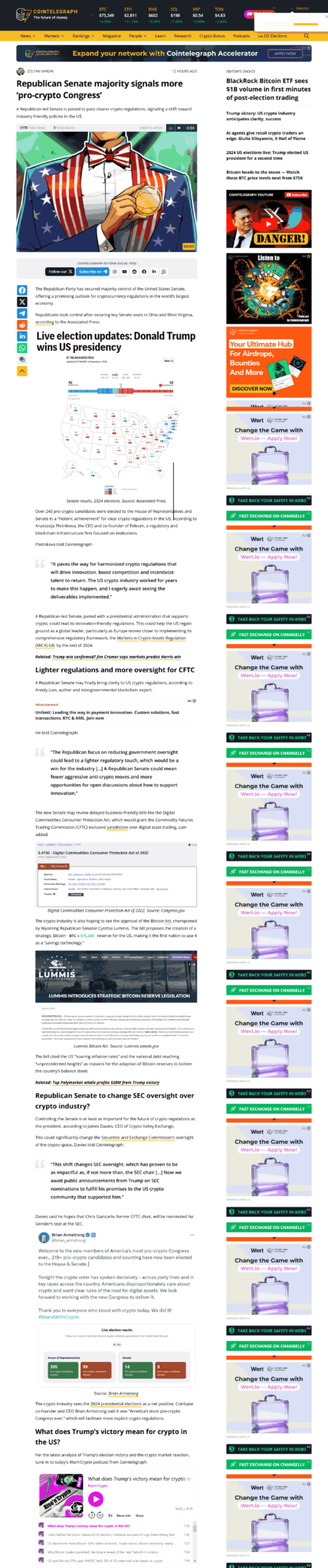
The Republican Party has secured majority control of the United States Senate, offering a promising outlook for cryptocurrency regulations in the world’s largest economy.

Republicans took control after securing key Senate seats in Ohio and West Virginia, according to the Associated Press.

Over 240 pro-crypto candidates were elected to the House of Representatives and Senate in a “historic achievement” for clear crypto regulations in the US, according to Anastasija Plotnikova, the CEO and co-founder of Fideum, a regulatory and blockchain infrastructure firm focused on institutions.

Plotnikova told Cointelegraph:

“It paves the way for harmonized crypto regulations that will drive innovation, boost competition and incentivize talent to return. The US crypto industry worked for years to make this happen, and I eagerly await seeing the deliverables implemented.”

A Republican-led Senate, paired with a presidential administration that supports crypto, could lead to innovation-friendly regulations. This could help the US regain ground as a global leader, particularly as Europe moves closer to implementing its comprehensive regulatory framework, the Markets in Crypto-Assets Regulation (MiCA) bill, by the end of 2024.

Lighter regulations and more oversight for CFTC

A Republican Senate may finally bring clarity to US crypto regulations, according to Anndy Lian, author and intergovernmental blockchain expert.

He told Cointelegraph:

“The Republican focus on reducing government oversight could lead to a lighter regulatory touch, which would be a win for the industry […] A Republican Senate could mean fewer aggressive anti-crypto moves and more opportunities for open discussions about how to support innovation.”

The new Senate may review delayed business-friendly bills like the Digital Commodities Consumer Protection Act, which would grant the Commodity Futures Trading Commission (CFTC) exclusive jurisdiction over digital asset trading, Lian added.

Digital Commodities Consumer Protection Act of 2022. Source: Congress.gov

The crypto industry is also hoping to see the approval of the Bitcoin Act, championed by Wyoming Republican Senator Cynthia Lummis. The bill proposes the creation of a strategic Bitcoin BTCtickers down$75,398 reserve for the US, making it the first nation to use it as a “savings technology.”

The bill cited the US’ “soaring inflation rates” and the national debt reaching “unprecedented heights” as reasons for the adoption of Bitcoin reserves to bolster the country’s balance sheet.

Republican Senate to change SEC oversight over crypto industry?

Controlling the Senate is at least as important for the future of crypto regulations as the president, according to James Davies, CEO of Crypto Valley Exchange.

This could significantly change the Securities and Exchange Commission’s oversight of the crypto space, Davies told Cointelegraph:

“This shift changes SEC oversight, which has proven to be as impactful as, if not more than, the SEC chair […] Now we await public announcements from Trump on SEC nominations to fulfill his promises to the US crypto community that supported him.”

Davies said he hopes that Chris Giancarlo, former CFTC chair, will be nominated for Gensler’s seat at the SEC.

The crypto industry sees the 2024 presidential elections as a net positive. Coinbase co-founder and CEO Brian Armstrong said it was “America’s most pro-crypto Congress ever,” which will facilitate more explicit crypto regulations.


Source: https://cointelegraph.com/news/republicans-majority-control-us-senate-pro-crypto-congress

Anndy Lian is an early blockchain adopter and experienced serial entrepreneur who is known for his work in the government sector. He is a best selling book author- “NFT: From Zero to Hero” and “Blockchain Revolution 2030”.

Currently, he is appointed as the Chief Digital Advisor at Mongolia Productivity Organization, championing national digitization. Prior to his current appointments, he was the Chairman of BigONE Exchange, a global top 30 ranked crypto spot exchange and was also the Advisory Board Member for Hyundai DAC, the blockchain arm of South Korea’s largest car manufacturer Hyundai Motor Group. Lian played a pivotal role as the Blockchain Advisor for Asian Productivity Organisation (APO), an intergovernmental organization committed to improving productivity in the Asia-Pacific region.

An avid supporter of incubating start-ups, Anndy has also been a private investor for the past eight years. With a growth investment mindset, Anndy strategically demonstrates this in the companies he chooses to be involved with. He believes that what he is doing through blockchain technology currently will revolutionise and redefine traditional businesses. He also believes that the blockchain industry has to be “redecentralised”.

j j j

Meme coins: More than just a joke, a guide for investors

Meme coins: More than just a joke, a guide for investors

The world of cryptocurrency is wild. It’s full of crazy ideas, high risk, and yes, even some laughs. Lately, meme coins, digital currencies based on internet jokes and pop culture have been all the rage. They’ve drawn in investors with their wild price swings and passionate online communities.

Dogecoin, the Shiba Inu dog that started it all, might have begun as a lighthearted jab at Bitcoin, but some meme coins have skyrocketed in value. This leaves many wondering: how do you invest in this wacky but risky corner of the crypto market?

The truth is, there’s no guaranteed way to win with meme coins. Their value depends on a weird mix of things, so the usual ways of judging investments don’t apply as much here. A strong community and lots of trading can be good signs, but you need to look deeper when it comes to these crypto jokesters. Here are some key things to consider, along with a healthy dose of caution:

Looking beyond the hype: A strong community

A big and enthusiastic online following on Reddit, Discord, or Telegram can be a good thing but don’t just look at the surface. Here’s what you really need to see:

  • Real talk, not just memes: A good community talks about the memecoin’s future plans, how it might be used for more than just laughs, and how it might work with other projects. Look for people who genuinely care about the coin’s future, not just those mindlessly cheering it on.
  • Coders on the case: A dedicated team actively working on the tech behind the meme coin is a good sign. Look for frequent updates, code posted on platforms like Github, and clear ways to talk to the developers.
  • Keeping things clean: A well-moderated online community helps get rid of negativity, false information, and scams where people try to pump up the price and then dump their coins for a quick profit. Look for active moderators who keep the conversation healthy.

Trading volume: A double-edged sword

Lots of trading means there’s a lot of interest in the meme coin, which can make the price go up in the short term. But be careful:

  • Fake pumps: Beware of sudden spikes in trading that come out of nowhere. These could be the work of “whales” (people with huge amounts of coins) trying to drive the price up so they can sell for a quick profit.
  • Slow and steady wins the race: Look for trading that gradually increases over time. This suggests real growth, not just a temporary burst of excitement.
  • Big exchanges are good: Being on well-known cryptocurrency exchanges makes the meme coin more visible and easier to trade, which can lead to higher trading volume.

Beyond the basics: The x-factors

While a strong community and active trading are important, there are other things that can affect a meme coin’s success:

  • Celebrity tweets: A tweet from a big name like Elon Musk can send a meme coin’s price through the roof (remember Dogecoin?). However, relying on celebrities is risky because their interest can fade fast. Ideally, the celebrity actually holds and believes in the meme coin.
  • Real-world use: Memecoins that have a real-world purpose, like being used in online games or making payments, are more likely to stick around for the long haul than those that are just hype.
  • Fear of missing out (FOMO): This is when people buy something because they’re scared they’ll be left behind if they don’t. Be careful of buying sprees fueled by FOMO, and always do your own research before investing. We’ve seen this happen a lot with meme coins on Solana lately. Hopefully, they’ll show more stable growth later this year.

Laughter is great, but don’t invest based on it

Memecoins can be a fun and interesting part of the crypto world. They create a sense of community and offer the chance to make a lot of money (or lose it all). But if you only invest in them because they’re funny or because there’s a lot of buzz online, you’re setting yourself up for disaster.

By looking at data like how engaged the community is, trading volume, and other important factors, you can approach meme coins with a bit more caution and maybe even some success (without the tears).

Remember, a good meme might make you laugh, but it shouldn’t be the only reason you invest your hard-earned money. And hey, maybe someday we’ll even get that Dogecoin ETF!


Source: https://e27.co/meme-coins-more-than-just-a-joke-a-guide-for-investors-20240708/


Anndy Lian is an early blockchain adopter and experienced serial entrepreneur who is known for his work in the government sector. He is a best selling book author- “NFT: From Zero to Hero” and “Blockchain Revolution 2030”.

Currently, he is appointed as the Chief Digital Advisor at Mongolia Productivity Organization, championing national digitization. Prior to his current appointments, he was the Chairman of BigONE Exchange, a global top 30 ranked crypto spot exchange and was also the Advisory Board Member for Hyundai DAC, the blockchain arm of South Korea’s largest car manufacturer Hyundai Motor Group. Lian played a pivotal role as the Blockchain Advisor for Asian Productivity Organisation (APO), an intergovernmental organization committed to improving productivity in the Asia-Pacific region.

An avid supporter of incubating start-ups, Anndy has also been a private investor for the past eight years. With a growth investment mindset, Anndy strategically demonstrates this in the companies he chooses to be involved with. He believes that what he is doing through blockchain technology currently will revolutionise and redefine traditional businesses. He also believes that the blockchain industry has to be “redecentralised”.

j j j