Cosmos crypto price prediction: Where next after Terra’s crash?

Cosmos crypto price prediction: Where next after Terra’s crash?

ATOM, the native token of the Cosmos network, saw a bullish run in 2021, surging 453.3%.  In the beginning of 2022 the token continued the momentum, rising above $40. But, the surge was short-lived amid negative sentiment in the cryptocurrency markets fuelled by Russia’s invasion of Ukraine.

The crash of the LUNA token and the TerraUSD (UST) stablecoin at the start of May 2022, both based on the Cosmos network, were also key driving points in the cosmos cryptocurrency’s decline.

Where is the token headed now? Here we take a look at what factors are shaping the cosmos crypto forecast for 2022 and beyond.

What is cosmos (ATOM)?

Coined as “the Internet of Blockchains” by its founding team, Cosmos aims to build an ecosystem of independent interconnected blockchains, allowing them to “interoperate while retaining their security properties”. It was co-founded by Jae Kwon and Ethan Buchman in 2016.

Blockchains can interact through its architecture of zones. Users can build multi-asset public Proof-of-Authority (PoA) and Proof-of-Stake (PoS) blockchains, like the Cosmos Hub.

Through this the network aims to solve a number of limitations of cryptocurrencies, including scalability, usability and sovereignty. The end goal, the platform’s website notes, “is to create an Internet of Blockchains, a network of blockchains able to communicate with each other in a decentralised way.”

The network’s focus on customisability and interoperability sets it apart from other projects.

Cosmos is based on the Tendermint Byzantine Fault Tolerance (BFT) consensus algorithm designed to ensure finality, order consistency and optional availability. The network also consists of the Cosmos SDK, an industry standard for building blockchains.

Cosmos’ IBC (inter blockchain communication) allows blockchains within the ecosystem to connect so that they can transfer tokens and other data between one another frictionlessly and seamlessly.

In addition, users can also create marketplaces allowing for permissionless global trade. They can build autonomous application-specific blockchains, rather than smart contracts, to avoid high transaction fees and network congestion.

Moreover, users can also create games with unique collectibles in the form of non-fungible tokens (NFTs) and character upgrades that they can monetise without third-party approval or app store fees.

According to the network’s website, there are currently (30 May) 265 apps and services on Cosmos, including the Binance Chain (BNB), Terra (LUNA) and Crypto.org (CRO), with over $66bn of digital assets under management.

While the Cosmos Hub is a multi-asset distributed ledger, it offers ATOM, its native token. ATOM is the only staking token of the Cosmos Hub, and acts as a licence, allowing holders to vote, validate or delegate to other validators.

The token can also be used to pay for fees on the platform to mitigate spam, similar to Ethereum’s ETH. The token provides security to the chain, allows holders to earn rewards and vote.

As of 30 May, there are over 289m tokens in circulation, according to CoinMarketCap. The token has a market capitalisation surpassing $2bn and is ranked as the 29th biggest cryptocurrency on the platform.

The bullish run: Technical view

The ATOM cryptocurrency was listed on CoinMarketCap in March 2019. It was trading in bearish territory until the start of 2021. In February 2021, ATOM  surged by 174.2% from the low of $7.3839 to its first peak of $20.25 on 13 February. Between February and May, the token managed to grow an additional 42.1%, reaching above $28 by 9 May 2021.

The ATOM crypto value bottomed out between May and July, dropping by 67% to $9.4857 on 20 July 2021. This bear trend provided an opportunity for a new bull run, which saw the ATOM/USD price surge to the all-time high of $44.54 on 19 September 2021.

The token’s record level came ahead of the platform’s participation at Mainnet 2021, an immersive, agenda-setting summit held annually for crypto industry leaders.
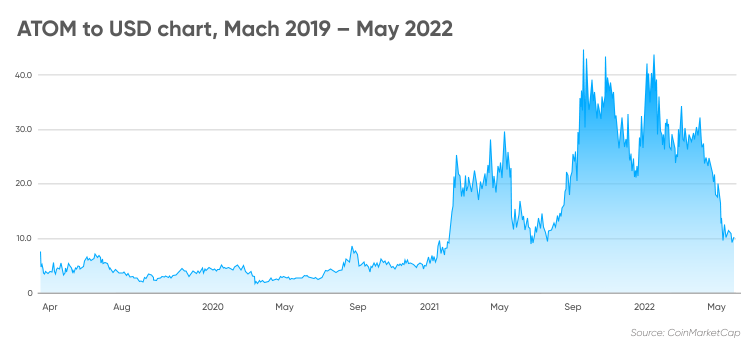
ATOM to USD chart, Mach 2019 – May 2022

ATOM saw new highs once again in October 2021, surging to $43.22 on 26 October 2021 as Cosmos announced that Terra became the latest chain to enable IBC, bringing its native LUNA cryptocurrency as well as its TerraUSD (UST) stablecoin with it.

The cosmos cryptocurrency entered 2022 on a positive note, surging by 97.9% to $41.99 on 4 January 2022 from its $21.22 17 December 2021 low. A second surge followed on 16 January 2022, which saw ATOM’s value rise to $43.61. This was due to several reasons.

Firstly, Cosmos reported to have neared EVM-protocol compatibility, which would allow assets and projects that operate on the Ethereum network to migrate over to Cosmos. Secondly, the project announced that a liquidity staking module was coming to the platform, which would give additional functionality to the stakes chain assets.

That, however, was the last time ATOM was so close to its all-time high as it embarked on a bearish run for the remainder of 2022. Wider negative crypto market sentiment was fuelled by the start of the war between Russia and Ukraine, as well as bitcoin (BTC) falling below $27,000.

What is your sentiment on ATOM/USD?

The token lost around 79% of its value, hitting as low as $9 by mid-May 2022, as seen on the chart above. Today (30 May), the coin is valued at $9.94.

ATOM technical analysis provided by CoinCodex, as of the time of writing (30 May), showed that sentiment on the token was largely bearish.

Relative Strength Index (RSI) reading of 32.5 was neutral yet extremely close to oversold territory. A reading of 30 or below would indicate that the asset has become undervalued and a trend reversal is likely. Meanwhile, the token was trading above its three-day moving average but below its five and 10-day moving averages.

Can ATOM recover?

In the latest cosmos crypto news, the network’s Gravity Bridge announced a number of milestones at the start of March 2022, including the introduction of ATOM with Ethereum DeFi and the Cosmos NFT platform, Stargaze, working with Gravity Bridge to send NFTs from Ethereum to Cosmos.

In April 2022, Cosmos introduced  its Theta upgrade which saw the official launch of Interchain Accounts, a module that has the potential to boost interoperability, traffic and composability.

In May 2022, KYVE, the Web3 data lake solution, joined the Cosmos ecosystem and migrated most of its blockchain protocol from EVM-based chain to the Cosmos SDK-based chain.

At the beginning of May 2022, the prices of the LUNA cryptocurrency and the UST stablecoin crashed, losing over 90% of their values within days. The tokens were based on the Cosmos network.

“As always, the cosmos ecosystem will continue to be a nurturing and safe environment for bold entrepreneurs to bring forth the Internet of Blockchains. Tendermint, IBC and the @cosmos SDK are showing the world how resilient & secure they are under extreme market conditions,” Cosmos said on Twitter during the LUNA crash.

In December 2021, Cosmos promised that its hub will continue to grow in the coming year, announced the launch of interchain security and accounts, more decentralised finance (DeFi) projects and the rise of NFTs.

“Cosmos is not a new token. It has been around since 2017 and has survived through all the down periods. Cosmos constantly remained in the top 50,  although many new investors may not have heard of it as it is not marketed that aggressively unlike Polygon or Binance Smart Chain,” BigOne Exchange chair in Asia, Anndy Lian told Capital.com.

According to Lian, the ATOM token took off because the Cosmos network offers “a simple experience for blockchain developers” with  “easy-to-understand tutorials, tools, and community assistance for developers.”

In 2020, Jae Kwon stepped down from his position as one of the project’s co-founders to focus on a different project. This, according to Lian, is one of the biggest uncertainties for the Cosmos prediction.

“He exited back then after several high-ranked employees left the company in protest of his leadership and it was reported that Kwon’s return to NewTendermint has continued to feud with his former Tendermint colleagues. I am not sure what is the truth and what are the backstories for this, but I think the lack of unity within their group makes this token vulnerable,” he noted.

Lian added that at the moment, ATOM has a strong support around the $9 range.

“Falling below this amount would mean that it may go below its launch price. This could happen too. Apart from the internal risks, I would caution all to look at external risks to manage your portfolio better.”

Cosmos (ATOM) price prediction 2022-2030

Despite the latest downward price action, algorithm-based forecasting service Wallet Investor gave a bullish outlook for its ATOM prediction, as of 30 May, suggesting ATOM is “an awesome long-term investment” with long-term earning potential at 752.13%.

Based on its analysis of past price performance, Wallet Investor’s cosmos coin price prediction suggested that the token could trade at $26.389 in 2023 and $84.685 by 2027.

DigitalCoinPrice also gave a positive ATOM crypto price prediction but saw a much slower pace of growth in future years. The site projected that ATOM could reach the target price of $13.76 by the end of 2022, $18.73 by the end of 2024 and $24.33 by 2025.

By the end of 2027, the site’s cosmos crypto price prediction expected that the coin could reach $34.02. Its long-term ATOM coin price prediction showed the cryptocurrency could trade at $49.10 by 2030.

Note that algorithm-based and analysts’ projections can be wrong. Forecasts and analysts’ expectations shouldn’t be used as substitutes for your own research. Always conduct your own diligence and remember that your decision to trade or invest should depend on your risk tolerance, expertise in the market, portfolio size and goals.

Keep in mind that past performance doesn’t guarantee future returns. And never invest or trade money you cannot afford to lose.


Original Source: https://capital.com/cosmos-atom-price-prediction

Anndy Lian is an early blockchain adopter and experienced serial entrepreneur who is known for his work in the government sector. He is a best selling book author- “NFT: From Zero to Hero” and “Blockchain Revolution 2030”.

Currently, he is appointed as the Chief Digital Advisor at Mongolia Productivity Organization, championing national digitization. Prior to his current appointments, he was the Chairman of BigONE Exchange, a global top 30 ranked crypto spot exchange and was also the Advisory Board Member for Hyundai DAC, the blockchain arm of South Korea’s largest car manufacturer Hyundai Motor Group. Lian played a pivotal role as the Blockchain Advisor for Asian Productivity Organisation (APO), an intergovernmental organization committed to improving productivity in the Asia-Pacific region.

An avid supporter of incubating start-ups, Anndy has also been a private investor for the past eight years. With a growth investment mindset, Anndy strategically demonstrates this in the companies he chooses to be involved with. He believes that what he is doing through blockchain technology currently will revolutionise and redefine traditional businesses. He also believes that the blockchain industry has to be “redecentralised”.

j j j

Op-Ed: South Korea’s new president aims to take crypto to the next level

Op-Ed: South Korea’s new president aims to take crypto to the next level
Plans including raising the crypto tax threshold and legalizing ICOs are welcome, but will they give South Korea the shakeup it needs?
President Yoon Suk-Yeol plans to raise the current crypto tax threshold from around $2,000 to approximately $40,000. The current president Moon Jae-in lost the opportunity to take the country forward with a more positive crypto policy, in a country where last year Koreans invested over $43 billion in crypto assets in 2021.In April 2021 younger investors filed a number of petitions for example complaining how crypto assets were being taxed at a less favorable rate than stocks. Now this victory means that their voice is being heard, which I believe is great news, not just for the crypto industry, but for this new generation of investors. But at the same time, as someone involved in the Korean market since 2017 while I welcome the reports coming out of Yoon’s Presidential Transition Committee, I also know what matters is what happens after the new president takes office on May 10.

There is a risk the new government decides to allow investing in ICOs, IEOs, and STOs only to those above a certain income, to accredited investors. Certainly, the news of a new Basic Digital Asset Law, to enable the recovery of funds lost from illegal trades and scams is very welcome. But at the same time, a balance has to be struck, so the younger generation of investors in their 20s and 30s, who consist of around 36% of the market, feel they have a stake in the new system.

I also note that play-to-earn games are still illegal with no plans to change that. So, it’s somewhat ironic that the recent $620 million hack of Axie Infinity was reportedly carried out under the auspices of the North Korean government. While South Korea and the US are therefore looking to work more closely on cybercrime, there is a risk that the US will also seek to put pressure on the South Koreans to take a more highly regulated approach to crypto more in line with emerging US policy.

Will the prospect of a growing NFT market bear fruit?

What I do expect is for the market in NFTs in South Korea to grow in the future. And I think this presents a window of opportunity for the new government to take a positive approach. While the Financial Services Commission (FSC) is reportedly working to introduce NFT rules, this is yet to happen. Another potential source of frustration within the investor community is the complexity of using exchanges with different travel rule systems.

Among the big four exchanges Upbit, Bithumb, Coinone, and Korbit (with over 95% of the crypto market share), there are two travel rule systems. Upbit with the lion’s share of the exchange market has adopted its home-grown Verify VASP program, while the remainder follows another system. So, it’s perhaps good to know that Yoon’s Presidential Transition Committee is also “looking to grant more cash-to-crypto licenses to crypto trading platforms in efforts to dilute the local crypto exchanges oligopoly”.

Another overlapping issue is the dominance of the Upbit exchange in the South Korean crypto market. What’s interesting to me is seeing the concerted move by local banks to enter the crypto market. Part of the banks’ motivation to approach the incoming government is down to the fact that Upbit has over 80% of the market share.

This is underlined by the fact that Dunamu, operator of Upbit, posted a net income of 2.2 trillion won (around $1.8 billion) last year, with the figure growing 46-fold on-year. The news reportedly “shocked onlookers, as it drew near Woori Financial Group, a major banking group here. Woori posted a net income of nearly 2.6 trillion won in the same period”, according to the Korea Herald.

Banks fight for a slice of the crypto pie

Allowing banks to take apart on a more equal footing with exchanges certainly marks a step forward with potential implications for competition in regional crypto markets as well as internationally. Certainly, in Singapore, we have seen a tightening of regulations since the ICO boom years of 2017/18 which attracted so many crypto startups.

This stricter regulation has prompted startups to leave for the likes of more crypto-friendly Dubai, including global exchange Binance which recently withdrew an application to register in Singapore, instead setting up an office in the UAE.

The economic risks of not moving fast enough are also shown in the UK, where despite government plans for crypto growth there’s been significant criticism of its regulator, the FCA, for being too slow in processing crypto license applications to allow crypto startups to operate.

So, while I believe South Korea is likely to try to be more open, it’s going to be a tricky path to walk to keep all the different segments onboard, from crypto industry stakeholders to expectant younger investors. The ‘proof is in the pudding’ as they say, because while the incoming government might talk about plans to legalize ICOs it may in the fine print only be available to people who have say $1 million in assets.

However, on a more optimistic note, I do agree with crypto commentators such as Anthony Pompliano that South Korea’s crypto plans are potentially a significant step on the world stage. Yoon Suk-yeol is the first head of state from a major economy that says it plans to take crypto really seriously, including protecting the public; however, it’s also worth noting that outlined plans to set up a dedicated government agency for crypto and NFTs did not make it into the final copy of his campaign pledges.

Speaking recently in Korea on the same platform with a member of the People’s Power Party, I said that crypto and blockchain was the future. We now have to wait and see how well that promise and potential is delivered.


Original Source: https://cryptoslate.com/op-ed-south-koreas-new-president-aims-to-take-crypto-to-the-next-level/

Anndy Lian is an early blockchain adopter and experienced serial entrepreneur who is known for his work in the government sector. He is a best selling book author- “NFT: From Zero to Hero” and “Blockchain Revolution 2030”.

Currently, he is appointed as the Chief Digital Advisor at Mongolia Productivity Organization, championing national digitization. Prior to his current appointments, he was the Chairman of BigONE Exchange, a global top 30 ranked crypto spot exchange and was also the Advisory Board Member for Hyundai DAC, the blockchain arm of South Korea’s largest car manufacturer Hyundai Motor Group. Lian played a pivotal role as the Blockchain Advisor for Asian Productivity Organisation (APO), an intergovernmental organization committed to improving productivity in the Asia-Pacific region.

An avid supporter of incubating start-ups, Anndy has also been a private investor for the past eight years. With a growth investment mindset, Anndy strategically demonstrates this in the companies he chooses to be involved with. He believes that what he is doing through blockchain technology currently will revolutionise and redefine traditional businesses. He also believes that the blockchain industry has to be “redecentralised”.

j j j

Sandbox (SAND) coin price prediction: What’s next for the token?

Sandbox (SAND) coin price prediction: What’s next for the token?

SAND, the coin of blockchain-based play-to-earn metaverse Sandbox, has a had a good week rising 15% to reach $2.93 today (21 April).

However this comes after a disappointing first half to the month when it was at $3.79 but slid down as low as $2.6.

The latest boost comes after reports that majority owner, the blockchain gaming developer Animoca Brands, was trying to raise $400m from new and existing investors. Last November it raised $93 million in a round led by SoftBank Vision Fund 2.

What is the outlook for the coin? What is a realistic future price target? What factors could shape any Sandbox coin price prediction for 2022, 2025 and 2030?

In this article we look at the latest analyst Sandbox price predictions, news and analysis to help you decide if you shoud make SAND part of your portfolio.

What is a Sandbox coin?

Sandbox is a play-to-earn game that combines blockchain technology and non-fungible tokens (NFTs) in a three-dimensional (3D) metaverse. It focuses on user-generated content which helps further develop the platform.

The game was initially known as two separate mobile hits: The Sandbox, which was launched in 2011, and The Sandbox Evolution, which was launched in 2016. Together, the two games generated around 40 million downloads across the Android and iOS platforms.

In 2018, the games’ developer, Pixowl, was acquired by Hong Kong-based game software company Animoca Brands which integrated the popular games into the blockchain ecosystem.

Sandbox is hosted on the Ethereum network and is powered by SAND, an ERC-20-based token.

Inspired by major game-creation systems such as Minecraft and Roblox, Sandbox allows players not just to create their own worlds and games, but also to have true ownership of their creations as NFTs. In exchange for participating and playing, players earn SAND tokens.

According to the metaverse’s whitepaper, the current game market limits creator rights and ownership, an issue which Sandbox aims to overcome “while accelerating blockchain adoption to grow the blockchain gaming market”.

The game itself is split into three parts:

  • VoxEdit, where players can create and animate 3D objects such as people, animals, tools and foliage. These are then exported into The Sandbox marketplace, where they become game ASSETS and are sold as NFTs.
  • The Sandbox marketplace where users can upload, publish and sell their ASSETS as ERC-721 and ERC-1155 tokens. The Marketplace launched on 30 March 2021.
  • GAMEMAKER, where players who own ASSETS can use them to play the game itself. Players can place their ASSETS within a piece of LAND (an ERC-721 token) that they own within the Sandbox metaverse. This LAND can be decorated with a number of ASSETS which can be given predefined behaviours through visual scripting nodes. Thus, players are able to turn their LAND into a potential full game experience. Several LANDS can be combined by players to form an ESTATE.

The SAND token fuels the platform and can be earned by selling ASSETS, by owning LAND which can be rented or populated with content to increase its value, and/or by building and monetising games through the GAME MAKER function on the LANDS that are owned by players.

The token also:

  • Gives players access to the platform. Players use SAND tokens to play games, make in-game purchases and customise their avatars. SAND is also charged to upload ASSETS on the marketplace and purchase Gems that define an ASSET’s rarity and scarcity.
  • SAND holders are granted governance and can exercise voting rights on key features within the project’s roadmap.
  • Players can stake their SAND tokens in order to earn more. This is also the only way that players can earn the Gems and Catalysts that are needed for ASSET creation.

Players get to keep 95% of their SAND revenue.

The total supply of SAND coins stands at three billion, with 1.16 billion in circulation. The token reached over $3.39bn in market capitalisation and is ranked the 41st largest cryptocurrency by CoinMarketCap as of 21 April 2022.

SAND price driven by partnership & investor news

The Sandbox token’s outlook started to look much more positive at the start of February 2021, following Sandbox’s partnership with cryptocurrency price-tracking website CoinMarketCap for the latter to release an NFT collection on the metaverse.

In the following months, the token’s price kept moving sideways before it reached $3.22 on 3 November 2021, after the metaverse announced on 2 November that it had gained $93m from Softbank Vision Fund 2 investors, which would help the platform scale up its growth strategy, operations and player acquisition.

By then, Sandbox already had over 165 partners, including popular US rapper Snoop Dogg, and famous TV series The Walking Dead and the Smurfs. The project had also partnered up with Liberty City Ventures, Galaxy Interactive and Adidas Originals.

On 25 November 2021, the token had reached its all-time high of $8.4 – a 16,387% surge since its launch at $0.051 on 15 August 2020.

On 1 December 2021 Sandbox announced that players could purchase plots next to the one where Snoop Dogg was building his mansion, Snoopverse. This led the SAND token to grow by just 2.% from $6.58 on 1 December to $6.71 the following day.

Following an overall drop in bitcoin and ether prices at the start of December, SAND also fell by 29% to $4.78 by mid-month, despite having secured partnerships with 10 exchanges, as well as a MAUER NFT collection memorialising the Berlin wall.

On 21 December 2021, the metaverse’s partner, Canadian electronic music producer deadmau5, announced the launch of his NFT collection on the Sandbox marketplace which pushed the SAND token’s price up to $6.73 on 26 December, an increase of by 41% from its 14 December low.

Bank of America strategist Haim Israel said on 1 December that the metaverse will make cryptocurrencies even more popular than they already were, thus boosting price targets for many metaverse-based crypto tokens including SAND. On 18 January 2022, investment firm JP Morgan Chase agreed with BoA’s bullish predicament by publishing a report saying that the metaverse industry could possibly reach over $1t in yearly revenues. The firm’s report mentioned Sandbox as one of the “main metaverse platforms”.

However, the token’s value line on the chart started to decline once again, amid a general dip in the crypto market at the start of 2022 due to the possibility of tightening monetary policy and geopolitical tensions.

What’s next for the metaverse?

One silver lining for the SAND token price was Snoop Dogg’s announcement on 27 January 2022 that he would be launching a series of Snoop Dogg metaverse avatars on the platform. The news pushed the token’s price by 61.28% from $2.99 on 22 January to $4.81 on 8 February 2022. The NFTs were minted on 22 February and have the potential to hike the token’s price once again.

In more recent SAND coin news, partnerships with Gucci and Ubisoft  were unable to offset the overall bearish forecast in the markets, with the token reaching $3.11 on 22 February – a 35.4% drop since 8 February.

The platform also partnered with Warner Music Group which will create a music-themed world in the metaverse as the platform plans to launch its first virtual concerts in the third quarter of 2022.

A mobile version of the metaverse is anticipated for some time in the fourth quarter of 2022.

BigOne Exchange chair Anndy Lian told Capita.com that Sandbox heavily relies on Ethereum’s performance, making the token quite volatile.

“Personally, I do like the developments of the project. But I do want to point out some angles for improvement. Firstly, the project relies heavily on Ethereum’s performance. I do think that, given the right situation, they should look at building on another blockchain or even their own chain.

“Secondly, their game needs to be attractive enough to draw in more users while retaining the old ones. I hope to see more game enhancement and token utility that comes along with it.”

Sandbox coin price prediction 2022-2030

Algorithm-based forecasting service WalletInvestor gave a bullish SAND price prediction at the time of writing (21 April), calling it an “awesome long-term investment”.

Based on its analysis of the cryptocurrency’s past performance, the forecasting service’s SAND crypto price prediction was it could trade at $6.4 by April 2023 and reach $21.2 in five years.

DigitalCoinPrice supported the bullish Sandbox crypto price prediction but at a much slower pace, seeing the coin reach $3.77 in 2022 and $5.57 by 2025.

The site’s SAND prediction was that the token was expected to hit $6.53 in 2027 and by 2030, the token’s price could reach $13.34

Please note that Sandbox predictions can be wrong. SAND coin price predictions shouldn’t be used as a substitute for your own research. Always conduct your own due diligence before investing. And never invest or trade money you cannot afford to lose.

Analyst views on SAND

Bitbank crypto market analyst Yuya Hasegawa told Capital.com that upbeat comments on the Sandbox metaverse from financial institutions like Bank of America and JP Morgan, as well as sales of collaborative items with celebrities and popular brands, are attracting investors to the platform.

Hasegawa was interviewed before Russia invaded Ukraine on 24 February 2022.

“However, although SAND and some other metaverse-related tokens have outperformed bitcoin in the last quarter, the current market environment – not limiting to the crypto market – is heavily affected by the situation at the Russia-Ukraine border and investors are being quite defensive,” he noted.

“So, even though SAND has a lot of growth potential in the long run, as the industry itself is still in a sort of ‘experimental’ or ‘developmental’ phase, the financial market as a whole has to wait and see how the situation at the Russia-Ukraine border rolls out.”

Invezz data analyst Dan Ashmore added that the token managed to piggyback off the wider boom in the metaverse caused by Facebook rebranding to Meta in October.

“Further fuel was provided via high-profile partnerships, including Gucci, Warner Music Group and Snoop Dogg (offering shopping experiences, virtual concerts and playable avatars respectively). Particularly exciting going forward is the focus on user-generated content.

“Objects and interactive games can be created and sold on the marketplace. With the internet increasingly focused on content creation (YouTube, TikTok etc), ATH above $8 could be achievable in the next year or two, although that will depend on the wider crypto market,” he concluded.


Original Source: https://capital.com/sandbox-sand-coin-price-prediction

Anndy Lian is an early blockchain adopter and experienced serial entrepreneur who is known for his work in the government sector. He is a best selling book author- “NFT: From Zero to Hero” and “Blockchain Revolution 2030”.

Currently, he is appointed as the Chief Digital Advisor at Mongolia Productivity Organization, championing national digitization. Prior to his current appointments, he was the Chairman of BigONE Exchange, a global top 30 ranked crypto spot exchange and was also the Advisory Board Member for Hyundai DAC, the blockchain arm of South Korea’s largest car manufacturer Hyundai Motor Group. Lian played a pivotal role as the Blockchain Advisor for Asian Productivity Organisation (APO), an intergovernmental organization committed to improving productivity in the Asia-Pacific region.

An avid supporter of incubating start-ups, Anndy has also been a private investor for the past eight years. With a growth investment mindset, Anndy strategically demonstrates this in the companies he chooses to be involved with. He believes that what he is doing through blockchain technology currently will revolutionise and redefine traditional businesses. He also believes that the blockchain industry has to be “redecentralised”.

j j j