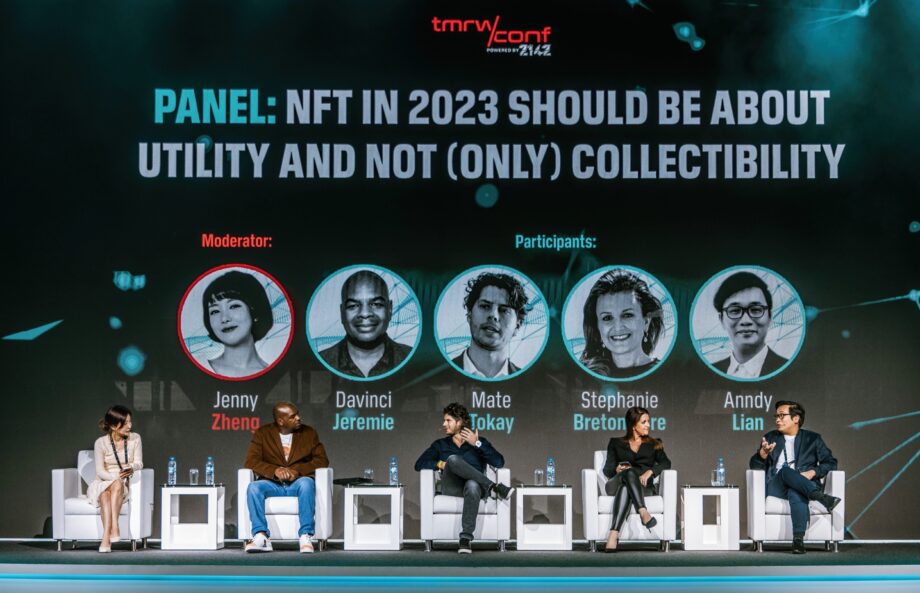
TMRW Conference Dubai: NFT in 2023 should be about utility and not (only) collectability

TMRW Conference Dubai: NFT in 2023 should be about utility and not (only) collectability

NFTs or non-fungible tokens have been creating a buzz in the crypto world lately. The world of NFTs is constantly evolving, and many are wondering what the future holds for them. Should they be about collectibility, utility, or both? This was the topic of discussion in a recent panel that featured some well-known faces in the NFT space.

The panel, moderated by Jenny Zheng, brought together experts who shared their experiences and insights on the future of NFTs. The panelists included DaVinci Jeremy. DaVinci Jeremy stressing that people needed to understand the underlying technology before investing in it.

Anndy Lian recalled how he had predicted that NFTs would become the next big thing in August 2020 when the market was valued at a quarter of a million dollars in volume per day. He believes that NFTs are not just a way to purchase art or collectibles but also a way to connect with communities and make them feel like they are part of the artwork.

Stephanie Bretonniere believes that NFTs hold the key to bringing more impact to organizations. She thinks that there are different use cases for NFTs, and the ones that bring utility are the most interesting. She believes that NFTs can be used to break down silos in organizations and create more efficiencies.

Mate Tokay shared their experience, stating that they used to work for a private NFT marketplace, but now work for Web 3, which is similar. They mentioned that when NFTs first started, they were mostly about collectibles such as PFPs (profile pictures) and art, but now we are seeing more NFTs with utilities.

NFTs will likely experience a transformation in focus from solely collectability to utility. Although NFTs have recently become popular as a means of owning unique digital assets, their potential applications extend far beyond collecting and trading.

The advent of NFTs has the power to spark a paradigm shift across numerous industries by enabling validation of ownership, genuineness, and exclusivity for digital assets. Take the gaming industry, for instance. NFTs can be utilized to represent in-game assets, including weapons, skins, and characters, providing a new level of authenticity and scarcity.

In addition, the art industry can leverage NFTs to authenticate the ownership of digital artwork, ensuring its originality and uniqueness. Beyond these applications, NFTs can be employed for digital identity verification, allowing individuals to establish their identity and ownership of personal data without relying on centralized authorities.

NFTs also have the potential to revolutionize digital contracts by providing secure and immutable records of agreements. These novel use cases of NFTs can create new business models and generate fresh opportunities across multiple sectors.

By shifting the focus to utility, the complete potential of NFTs can be realized beyond their current use as collectible digital assets. The implications of NFTs extend far beyond the hype and hold the key to unlocking new possibilities in the digital landscape.

Anndy Lian is an early blockchain adopter and experienced serial entrepreneur who is known for his work in the government sector. He is a best selling book author- “NFT: From Zero to Hero” and “Blockchain Revolution 2030”.

Currently, he is appointed as the Chief Digital Advisor at Mongolia Productivity Organization, championing national digitization. Prior to his current appointments, he was the Chairman of BigONE Exchange, a global top 30 ranked crypto spot exchange and was also the Advisory Board Member for Hyundai DAC, the blockchain arm of South Korea’s largest car manufacturer Hyundai Motor Group. Lian played a pivotal role as the Blockchain Advisor for Asian Productivity Organisation (APO), an intergovernmental organization committed to improving productivity in the Asia-Pacific region.

An avid supporter of incubating start-ups, Anndy has also been a private investor for the past eight years. With a growth investment mindset, Anndy strategically demonstrates this in the companies he chooses to be involved with. He believes that what he is doing through blockchain technology currently will revolutionise and redefine traditional businesses. He also believes that the blockchain industry has to be “redecentralised”.

j j j

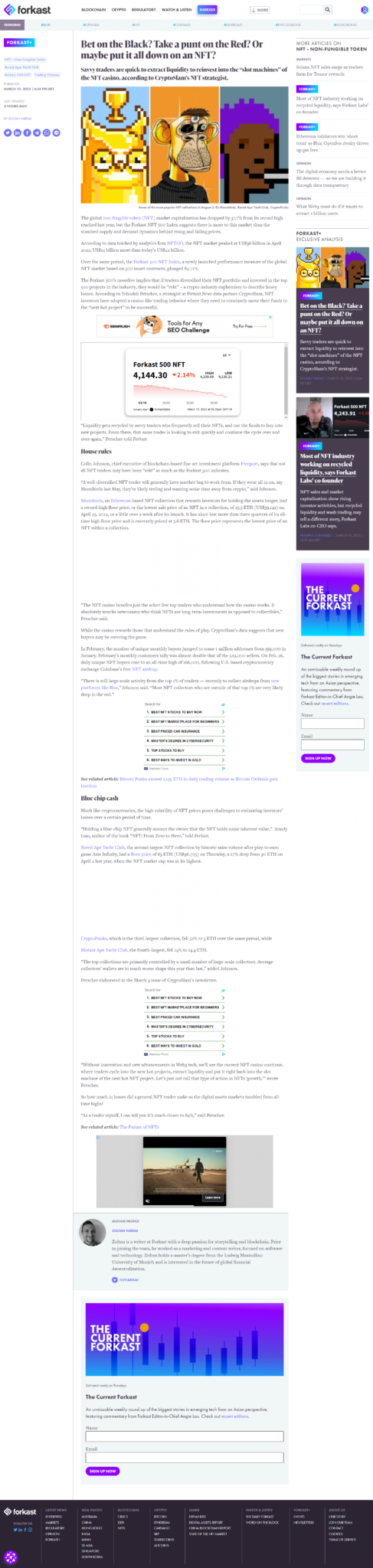
Bet on the Black? Take a punt on the Red? Or maybe put it all down on an NFT?

Bet on the Black? Take a punt on the Red? Or maybe put it all down on an NFT?

The global non-fungible token (NFT) market capitalization has dropped by 37.7% from its record high reached last year, but the Forkast NFT 500 Index suggests there is more to this market than the standard supply and demand dynamics behind rising and falling prices.

According to data tracked by analytics firm NFTGO, the NFT market peaked at US$36 billion in April 2022, US$14 billion more than today’s US$22 billion.

Over the same period, the Forkast 500 NFT Index, a newly launched performance measure of the global NFT market based on 500 smart contracts, plunged 84.71%.

The Forkast 500’s nosedive implies that if traders diversified their NFT portfolio and invested in the top 500 projects in the industry, they would be “rekt” – a crypto industry euphemism to describe heavy losses. According to Yehudah Petscher, a strategist at Forkast.News data partner CryptoSlam, NFT investors have adopted a casino-like trading behavior where they need to constantly move their funds to the “next hot project” to be successful.

“Liquidity gets recycled by savvy traders who frequently sell their NFTs, and use the funds to buy into new projects. From there, that same trader is looking to exit quickly and continue the cycle over and over again,” Petscher told Forkast.

House rules

Colin Johnson, chief executive of blockchain-based fine art investment platform Freeport, says that not all NFT traders may have been “rekt” as much as the Forkast 500 indicates.

“A well-diversified NFT trader will generally have another bag to work from. If they went all in on, say Moonbirds last May, they’re likely reeling and wanting some time away from crypto,” said Johnson.

Moonbirds, an Ethereum-based NFT collection that rewards investors for holding the assets longer, had a record-high floor price, or the lowest sale price of an NFT in a collection, of 25.5 ETH (US$39,142) on April 25, 2022, or a little over a week after its launch. It has since lost more than three quarters of its all-time high floor price and is currently priced at 5.6 ETH. The floor price represents the lowest price of an NFT within a collection.

While the casino rewards those that understand the rules of play, CryptoSlam’s data suggests that new buyers may be entering the game.

In February, the number of unique monthly buyers jumped to some 1 million addresses from 593,000 in January. February’s monthly customers tally was almost double that of the 529,000 sellers. On Feb. 26, daily unique NFT buyers rose to an all-time high of 166,000, following U.S.-based cryptocurrency exchange Coinbase’s free NFT airdrop.

“There is still large-scale activity from the top 1% of traders — recently to collect airdrops from new platforms like Blur,” Johnson said. “Most NFT collectors who are outside of that top 1% are very likely deep in the red.”

Blue chip cash

Much like cryptocurrencies, the high volatility of NFT prices poses challenges to estimating investors’ losses over a certain period of time.

“Holding a blue-chip NFT generally assures the owner that the NFT holds some inherent value,”  Anndy Lian, author of the book “NFT: From Zero to Hero,” told Forkast.

Bored Ape Yacht Club, the second-largest NFT collection by historic sales volume after play-to-earn game Axie Infinity, had a floor price of 63 ETH (US$96,705) on Thursday, a 27% drop from 90 ETH on April 2 last year, when the NFT market cap was at its highest.

Mutant Ape Yacht Club, the fourth-largest, fell 14% to 14.4 ETH.

“The top collections are primarily controlled by a small number of large-scale collectors. Average collectors’ wallets are in much worse shape this year than last,” added Johnson.

Petscher elaborated in the March 3 issue of CryptoSlam’s newsletter.

So how much in losses did a general NFT trader make as the digital assets markets tumbled from all-time highs?

“As a trader myself, I can tell you it’s much closer to 84%,” said Petscher.


Source: https://forkast.news/nft-casino-forkast-500-black-red/

Anndy Lian is an early blockchain adopter and experienced serial entrepreneur who is known for his work in the government sector. He is a best selling book author- “NFT: From Zero to Hero” and “Blockchain Revolution 2030”.

Currently, he is appointed as the Chief Digital Advisor at Mongolia Productivity Organization, championing national digitization. Prior to his current appointments, he was the Chairman of BigONE Exchange, a global top 30 ranked crypto spot exchange and was also the Advisory Board Member for Hyundai DAC, the blockchain arm of South Korea’s largest car manufacturer Hyundai Motor Group. Lian played a pivotal role as the Blockchain Advisor for Asian Productivity Organisation (APO), an intergovernmental organization committed to improving productivity in the Asia-Pacific region.

An avid supporter of incubating start-ups, Anndy has also been a private investor for the past eight years. With a growth investment mindset, Anndy strategically demonstrates this in the companies he chooses to be involved with. He believes that what he is doing through blockchain technology currently will revolutionise and redefine traditional businesses. He also believes that the blockchain industry has to be “redecentralised”.

j j j

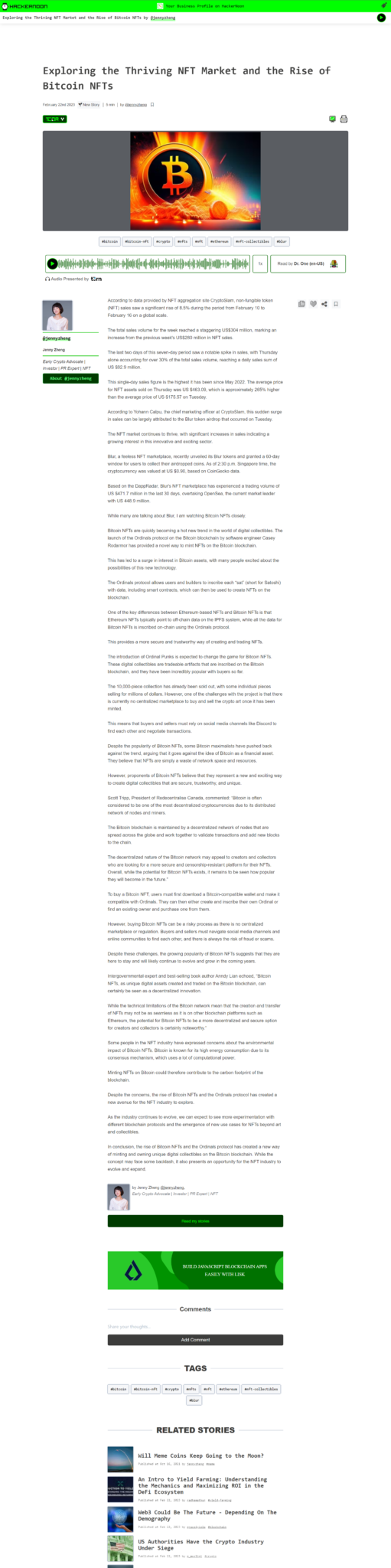
Exploring the Thriving NFT Market and the Rise of Bitcoin NFTs

Exploring the Thriving NFT Market and the Rise of Bitcoin NFTs

According to data provided by NFT aggregation site CryptoSlam, non-fungible token (NFT) sales saw a significant rise of 8.5% during the period from February 10 to February 16 on a global scale.

The total sales volume for the week reached a staggering US$304 million, marking an increase from the previous week’s US$280 million in NFT sales.

The last two days of this seven-day period saw a notable spike in sales, with Thursday alone accounting for over 30% of the total sales volume, reaching a daily sales sum of US $92.9 million.

This single-day sales figure is the highest it has been since May 2022. The average price for NFT assets sold on Thursday was US $463.09, which is approximately 265% higher than the average price of US $175.57 on Tuesday.

According to Yohann Calpu, the chief marketing officer at CryptoSlam, this sudden surge in sales can be largely attributed to the Blur token airdrop that occurred on Tuesday.

The NFT market continues to thrive, with significant increases in sales indicating a growing interest in this innovative and exciting sector.

Blur, a feeless NFT marketplace, recently unveiled its Blur tokens and granted a 60-day window for users to collect their airdropped coins. As of 2:30 p.m. Singapore time, the cryptocurrency was valued at US $0.90, based on CoinGecko data.

Based on the DappRadar, Blur’s NFT marketplace has experienced a trading volume of US $471.7 million in the last 30 days, overtaking OpenSea, the current market leader with US 448.9 million.

While many are talking about Blur, I am watching Bitcoin NFTs closely.

Bitcoin NFTs are quickly becoming a hot new trend in the world of digital collectibles. The launch of the Ordinals protocol on the Bitcoin blockchain by software engineer Casey Rodarmor has provided a novel way to mint NFTs on the Bitcoin blockchain.

This has led to a surge in interest in Bitcoin assets, with many people excited about the possibilities of this new technology.

The Ordinals protocol allows users and builders to inscribe each “sat” (short for Satoshi) with data, including smart contracts, which can then be used to create NFTs on the blockchain.

One of the key differences between Ethereum-based NFTs and Bitcoin NFTs is that Ethereum NFTs typically point to off-chain data on the IPFS system, while all the data for Bitcoin NFTs is inscribed on-chain using the Ordinals protocol.

This provides a more secure and trustworthy way of creating and trading NFTs.

The introduction of Ordinal Punks is expected to change the game for Bitcoin NFTs. These digital collectibles are tradeable artifacts that are inscribed on the Bitcoin blockchain, and they have been incredibly popular with buyers so far.

The 10,000-piece collection has already been sold out, with some individual pieces selling for millions of dollars. However, one of the challenges with the project is that there is currently no centralized marketplace to buy and sell the crypto art once it has been minted.

This means that buyers and sellers must rely on social media channels like Discord to find each other and negotiate transactions.

Despite the popularity of Bitcoin NFTs, some Bitcoin maximalists have pushed back against the trend, arguing that it goes against the idea of Bitcoin as a financial asset. They believe that NFTs are simply a waste of network space and resources.

However, proponents of Bitcoin NFTs believe that they represent a new and exciting way to create digital collectibles that are secure, trustworthy, and unique.

Scott Tripp, President of Redecentralise Canada, commented: “Bitcoin is often considered to be one of the most decentralized cryptocurrencies due to its distributed network of nodes and miners.

The Bitcoin blockchain is maintained by a decentralized network of nodes that are spread across the globe and work together to validate transactions and add new blocks to the chain.

The decentralized nature of the Bitcoin network may appeal to creators and collectors who are looking for a more secure and censorship-resistant platform for their NFTs. Overall, while the potential for Bitcoin NFTs exists, it remains to be seen how popular they will become in the future.”

To buy a Bitcoin NFT, users must first download a Bitcoin-compatible wallet and make it compatible with Ordinals. They can then either create and inscribe their own Ordinal or find an existing owner and purchase one from them.

However, buying Bitcoin NFTs can be a risky process as there is no centralized marketplace or regulation. Buyers and sellers must navigate social media channels and online communities to find each other, and there is always the risk of fraud or scams.

Despite these challenges, the growing popularity of Bitcoin NFTs suggests that they are here to stay and will likely continue to evolve and grow in the coming years.

Intergovernmental expert and best-selling book author Anndy Lian echoed, “Bitcoin NFTs, as unique digital assets created and traded on the Bitcoin blockchain, can certainly be seen as a decentralized innovation.

While the technical limitations of the Bitcoin network mean that the creation and transfer of NFTs may not be as seamless as it is on other blockchain platforms such as Ethereum, the potential for Bitcoin NFTs to be a more decentralized and secure option for creators and collectors is certainly noteworthy.”

Some people in the NFT industry have expressed concerns about the environmental impact of Bitcoin NFTs. Bitcoin is known for its high energy consumption due to its consensus mechanism, which uses a lot of computational power.

Minting NFTs on Bitcoin could therefore contribute to the carbon footprint of the blockchain.

Despite the concerns, the rise of Bitcoin NFTs and the Ordinals protocol has created a new avenue for the NFT industry to explore.

As the industry continues to evolve, we can expect to see more experimentation with different blockchain protocols and the emergence of new use cases for NFTs beyond art and collectibles.

In conclusion, the rise of Bitcoin NFTs and the Ordinals protocol has created a new way of minting and owning unique digital collectibles on the Bitcoin blockchain. While the concept may face some backlash, it also presents an opportunity for the NFT industry to evolve and expand.


Source:  https://hackernoon.com/exploring-the-thriving-nft-market-and-the-rise-of-bitcoin-nfts

Anndy Lian is an early blockchain adopter and experienced serial entrepreneur who is known for his work in the government sector. He is a best selling book author- “NFT: From Zero to Hero” and “Blockchain Revolution 2030”.

Currently, he is appointed as the Chief Digital Advisor at Mongolia Productivity Organization, championing national digitization. Prior to his current appointments, he was the Chairman of BigONE Exchange, a global top 30 ranked crypto spot exchange and was also the Advisory Board Member for Hyundai DAC, the blockchain arm of South Korea’s largest car manufacturer Hyundai Motor Group. Lian played a pivotal role as the Blockchain Advisor for Asian Productivity Organisation (APO), an intergovernmental organization committed to improving productivity in the Asia-Pacific region.

An avid supporter of incubating start-ups, Anndy has also been a private investor for the past eight years. With a growth investment mindset, Anndy strategically demonstrates this in the companies he chooses to be involved with. He believes that what he is doing through blockchain technology currently will revolutionise and redefine traditional businesses. He also believes that the blockchain industry has to be “redecentralised”.
j j j