New to NFTs? Six NFT Mistakes to Avoid

New to NFTs? Six NFT Mistakes to Avoid

We all know that the NFT has many forward-looking potentials and utilities. As you find more NFTs trading in different marketplaces, you start to wonder what you should do next- “To buy or not buy”. Here are 6 NFT trading mistakes to avoid for newbies.

Mistake 1- Not promoting your NFT

After buying the NFT that you like, that NFT is yours. Most people have this mentality that the creator should be the one promoting, and as holders of the NFT, let’s sit back to watch the prices grow.

I’m afraid that’s not right. If you promote your copy of NFT, your unique NFT could be the one that gets sold the fastest. Always remember you control your assets. There is no need to wait for the creator.

Mistake 2- Flipping it too fast

In the bull market, you have heard from NFT experts that they flipped their NFT 100X in an hour for millions of dollars.

Yes, this is possible back then. Right now, at this bearish market, you need to think long-term. You bought something that you feel has good value and potential. You bought a low price, and you do not mind keeping it. This kind of mentality will bring you far. “Good things take time”- remember this.

Mistake 3- Buying it on the wrong marketplace

There are many NFT marketplaces in the space right now. Some of them are more controlled; They filter what can be listed and remove items that are unsuitable, not authentic or with copyright issues. While some are more open, adopting an “anyone can list” model, they have minimum supervision, and anyone can list almost anything on their platform.

If you choose the latter, you could be buying a fake and when you realize that, you are too late. There is no one attending to your complaints. And yes, there is no refund too. Hence choose wisely.

Mistake 4- Buying an NFT that you do not like it

This is a real example. I have friends flexing their apes and punks as profile pictures merely to show they are well-to-do. But the fact is they do not like them. One guy told me he likes tiger more and is his good luck animal, but there isn’t a big blue chip tiger NFT project. So he bought the monkey.

My sincere advice to all is to buy something you like, not just for the value. I purchased an NFT at $0.01 from Bybit NFT marketplace last month. It is affordable, has potential, and most importantly I like the colours and I am keeping it. This is how it should be. There is no stress about it.

Mistake 5- Not using the right tools

There are many groups out there who are giving you tips on which NFT to buy. You can take their advice, but I suggest you do your own research before agreeing to their advice and committing to your first NFT.

Many NFT tools in the market right now help you with your decision. For instance, some tools allow you to check on the rarity types. Some tools allow you to analyze the volume and tell if any wash trading is involved. Stop guessing. Use the right tools!

Mistake 6- Listening to the wrong consultants

NFT creators who listened to the wrong consultants are another common thing. They tend to hire the more expensive consultants thinking they know it all. Based on a survey I have conducted with corporations which have launched their NFT, they paid $300,000 on average to the consultants to start the ball rolling.

I would advise corporations and even for individuals to look online for resources before hiring consultants. I know of NFT studios who helped fellow creators by sharing their resources for free and helping them to list on platforms with zero cost. One of the groups that I founded in 2006 is doing just that. They groom NFT rising stars, front the NFTs for them and do not ask a single cent from the creators. I think the spirit of sharing is essential, and they did it all correctly.

I am not here to put up any sale propositions. I want to see more people entering the NFT market with ease. And that is also the reason why I launched my book- “NFT: From Zero to Hero by Anndy Lian” in August.

An NFT or non-fungible token is a unique digital identifier that is recorded in a blockchain and used to certify authenticity and ownership. Remember the above. NFT is not a profile picture or just another speculative product. The real value is in its utility. Do not make this mistake as well.

Featured image generated via HackerNoon Stable Diffusion prompt of ‘bored apes making sales at a lemonade stand.’


Source: https://hackernoon.com/new-to-nfts-six-nft-mistakes-to-avoid

 

Anndy Lian is an early blockchain adopter and experienced serial entrepreneur who is known for his work in the government sector. He is a best selling book author- “NFT: From Zero to Hero” and “Blockchain Revolution 2030”.

Currently, he is appointed as the Chief Digital Advisor at Mongolia Productivity Organization, championing national digitization. Prior to his current appointments, he was the Chairman of BigONE Exchange, a global top 30 ranked crypto spot exchange and was also the Advisory Board Member for Hyundai DAC, the blockchain arm of South Korea’s largest car manufacturer Hyundai Motor Group. Lian played a pivotal role as the Blockchain Advisor for Asian Productivity Organisation (APO), an intergovernmental organization committed to improving productivity in the Asia-Pacific region.

An avid supporter of incubating start-ups, Anndy has also been a private investor for the past eight years. With a growth investment mindset, Anndy strategically demonstrates this in the companies he chooses to be involved with. He believes that what he is doing through blockchain technology currently will revolutionise and redefine traditional businesses. He also believes that the blockchain industry has to be “redecentralised”.

j j j

Corporate Investment Times (November 2022): Turning You Into An NFT Hero

Corporate Investment Times (November 2022): Turning You Into An NFT Hero

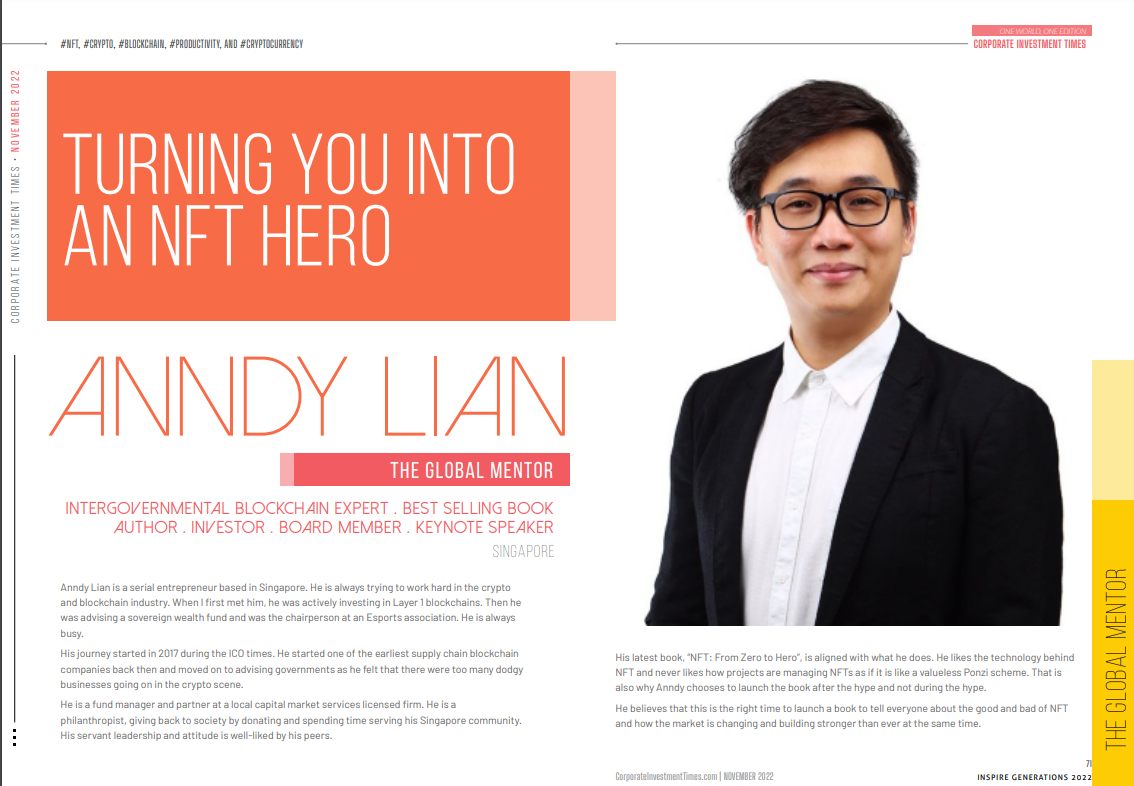
Anndy Lian is a serial entrepreneur based in Singapore. He is always trying to work hard in the crypto and blockchain industry. When I first met him, he was actively investing in Layer 1 blockchains. Then he was advising a sovereign wealth fund and was the chairperson at an Esports association. He is always busy.


His journey started in 2017 during the ICO times. He started one of the earliest supply chain blockchain companies back then and moved on to advising governments as he felt that there were too many dodgy businesses going on in the crypto scene.


He is a fund manager and partner at a local capital market services licensed firm. He is a philanthropist, giving back to society by donating and spending time serving his Singapore community. His servant leadership and attitude is well-liked by his peers.


His latest book, “NFT: From Zero to Hero”, is aligned with what he does. He likes the technology behind NFT and never likes how projects are managing NFTs as if it is like a valueless Ponzi scheme. That is also why Anndy chooses to launch the book after the hype and not during the hype. He believes that this is the right time to launch a book to tell everyone about the good and bad of NFT and how the market is changing and building stronger than ever at the same time.


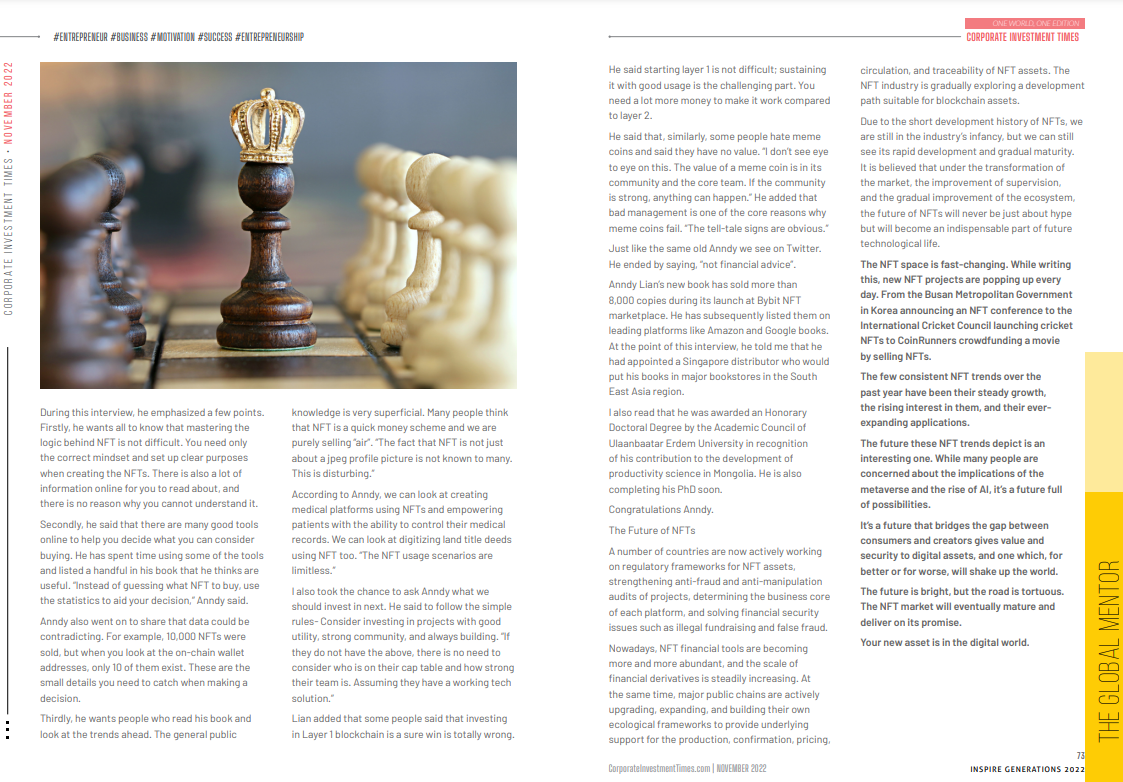
During this interview, he emphasized a few points. Firstly, he wants all to know that mastering the logic behind NFT is not difficult. You need only the correct mindset and set up clear purposes when creating the NFTs. There is also a lot of information online for you to read about, and there is no reason why you cannot understand it.


Secondly, he said that there are many good tools online to help you decide what you can consider buying. He has spent time using some of the tools and listed a handful in his book that he thinks are useful. “Instead of guessing what NFT to buy, use the statistics to aid your decision,” Anndy said.


Anndy also went on to share that data could be contradicting. For example, 10,000 NFTs were sold, but when you look at the on-chain wallet addresses, only 10 of them exist. These are the small details you need to catch when making a decision.


Thirdly, he wants people who read his book and look at the trends ahead. The general public knowledge is very superficial. Many people think that NFT is a quick money scheme and we are purely selling “air”. “The fact that NFT is not just about a jpeg profile picture is not known to many. This is disturbing.”


According to Anndy, we can look at creating medical platforms using NFTs and empowering patients with the ability to control their medical records. We can look at digitizing land title deeds using NFT too. “The NFT usage scenarios are limitless.”


I also took the chance to ask Anndy what we should invest in next. He said to follow the simple rules- Consider investing in projects with good utility, strong community, and always building. “If they do not have the above, there is no need to consider who is on their cap table and how strong their team is. Assuming they have a working tech solution.”


Lian added that some people said that investing in Layer 1 blockchain is a sure win is totally wrong. He said starting layer 1 is not difficult; sustaining it with good usage is the challenging part. You need a lot more money to make it work compared to layer 2.


He said that, similarly, some people hate meme coins and said they have no value. “I don’t see eye to eye on this. The value of a meme coin is in its community and the core team. If the community is strong, anything can happen.” He added that bad management is one of the core reasons why meme coins fail. “The tell-tale signs are obvious.”


Just like the same old Anndy we see on Twitter. He ended by saying, “not financial advice”.


Anndy Lian’s new book has sold more than 8,000 copies during its launch at Bybit NFT marketplace. He has subsequently listed them on leading platforms like Amazon and Google books. At the point of this interview, he told me that he had appointed a Singapore distributor who would put his books in major bookstores in the South East Asia region.


I also read that he was awarded an Honorary Doctoral Degree by the Academic Council of Ulaanbaatar Erdem University in recognition of his contribution to the development of productivity science in Mongolia. He is also completing his PhD soon.


Congratulations Anndy.


Source:

Anndy Lian is an early blockchain adopter and experienced serial entrepreneur who is known for his work in the government sector. He is a best selling book author- “NFT: From Zero to Hero” and “Blockchain Revolution 2030”.

Currently, he is appointed as the Chief Digital Advisor at Mongolia Productivity Organization, championing national digitization. Prior to his current appointments, he was the Chairman of BigONE Exchange, a global top 30 ranked crypto spot exchange and was also the Advisory Board Member for Hyundai DAC, the blockchain arm of South Korea’s largest car manufacturer Hyundai Motor Group. Lian played a pivotal role as the Blockchain Advisor for Asian Productivity Organisation (APO), an intergovernmental organization committed to improving productivity in the Asia-Pacific region.

An avid supporter of incubating start-ups, Anndy has also been a private investor for the past eight years. With a growth investment mindset, Anndy strategically demonstrates this in the companies he chooses to be involved with. He believes that what he is doing through blockchain technology currently will revolutionise and redefine traditional businesses. He also believes that the blockchain industry has to be “redecentralised”.
j j j

Roughly 48% of Ethereum NFT trades in October were fake

Roughly 48% of Ethereum NFT trades in October were fake

Traders seeking to artificially inflate the price of collections or earn marketplace trading rewards generated $389 million in wash trades during October.

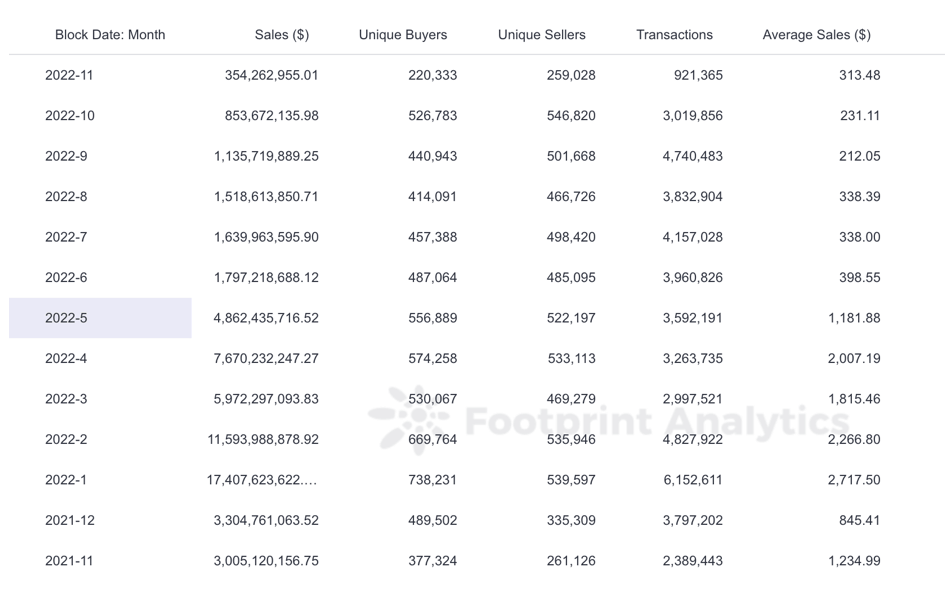
Global NFT sales in October clocked in at more than $850 million over roughly 3 million total transactions. I looked into NFT wash trades last month and that research got me to look at the numbers more closely.

Footprint Analytics – NFT Monthly Sales

The trigger points for me to say that transactions are becoming more fake are as follows:

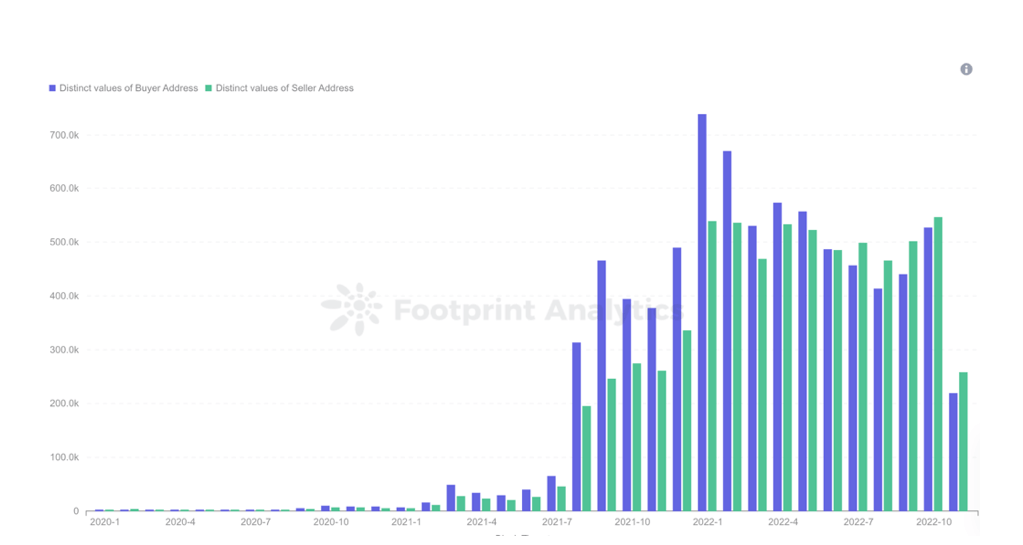
  1. Despite bad market conditions, we continue to see a high number of unique buyers and sellers. In October, we had over 1 million unique buyers and sellers. Both buyers and sellers have increased compared to September.
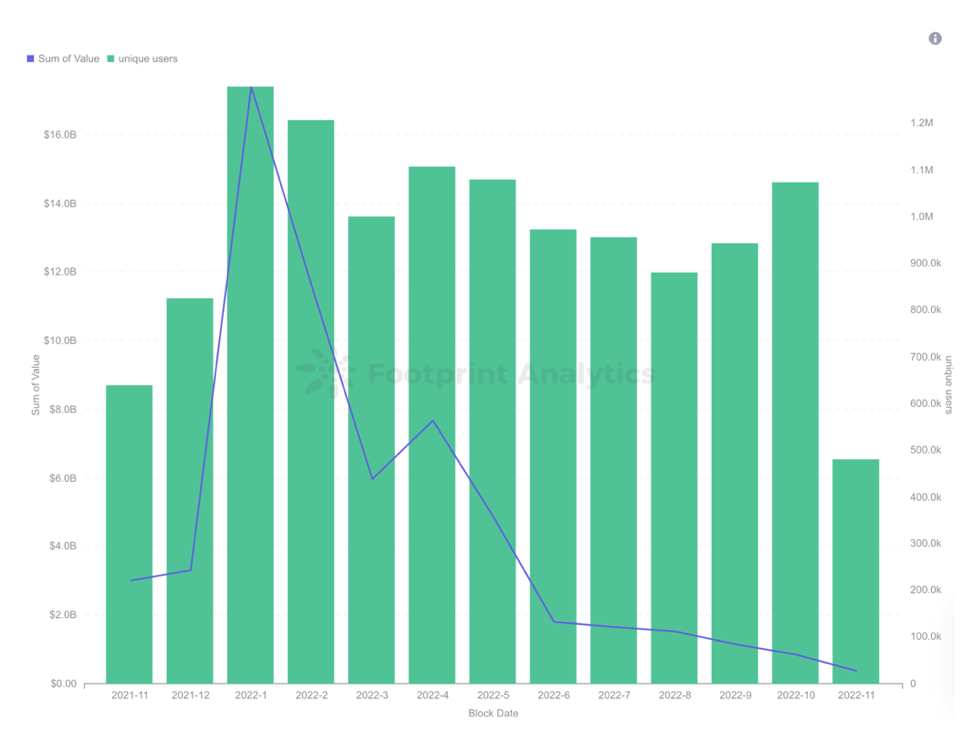
  2. The number of unique buyers and sellers seems to be inconsistent with the growth of sales value and transactions. Around 1 million users contributed more than 4 million sales value in May versus less than 250,000 in October. To me, it seems unlikely to have a growing market demand with less sales value traded.
Footprint Analytics – Sales value vs. Unique users

To look into this further, I spoke with two centralized exchanges that operate NFT marketplaces. The exchanges said that around 80% of new buyers are keeping NFTs in their wallets, rather than selling them. With the market so unfavorable, holding these assets seems to be the sensible move.

So where are all these unique buyers and sellers coming from? I had a word with Footprint Analytics and brought up my points. I realized that the statistics I am looking at are way too big. It involved multiple chains and it is hard to track everything. We agreed to work on only Ethereum-based marketplaces as an example to dive deep into since it is the most popular.

Here are the findings:

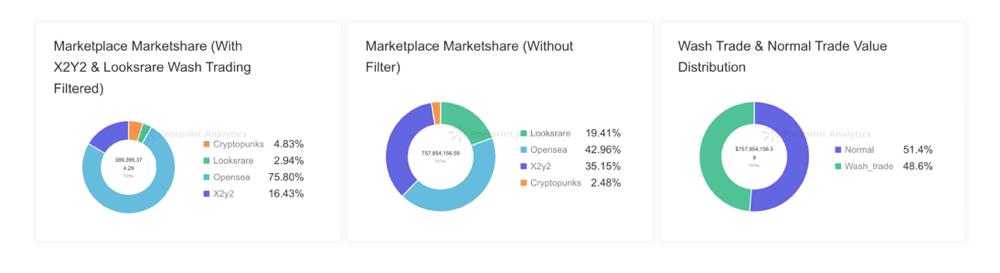
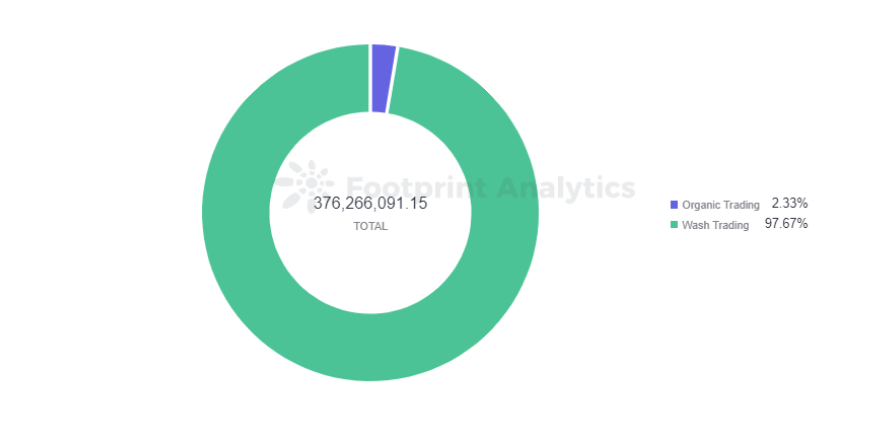
According to Footprint Analytics’ filters, wash trading makes up nearly half of all NFT trading volume.

Footprint Analytics – ETH NFT Market Overview (With Wash Trading Filtered)

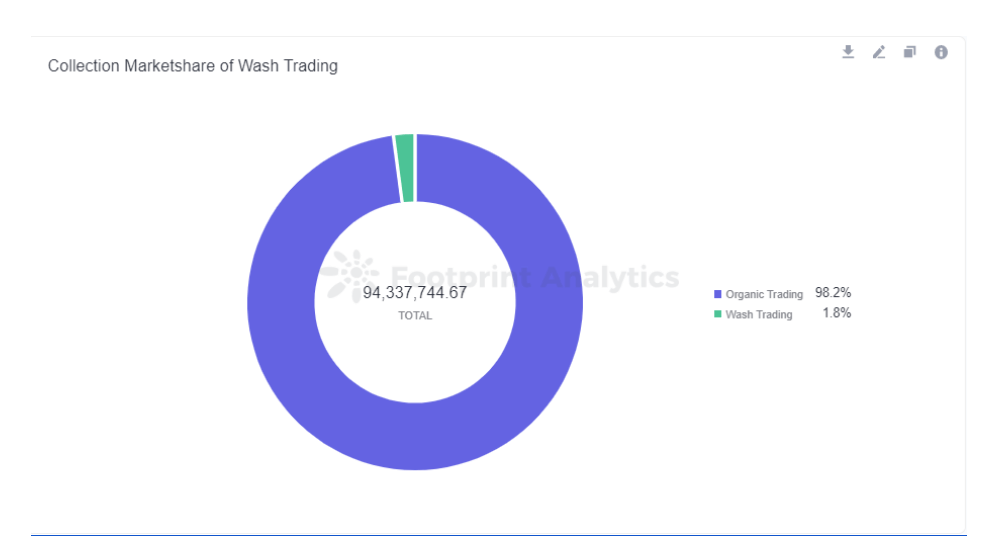
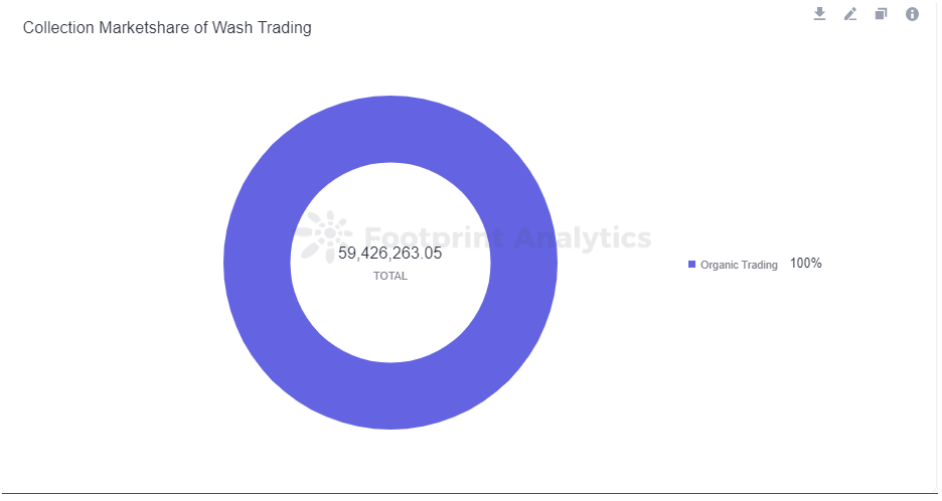
Traders seeking to artificially inflate the price of collections or earn marketplace trading rewards generated $389 million in wash trades out of October’s total of $758 million in NFT trading volume — bringing the amount of wash trading in the NFT market close to half that of organic trading.  The number of wash trading users accounts for nearly 46% of total users.

Footprint Analytics – Marketplace Market Share Wash Trading Filtered & Without Filtered
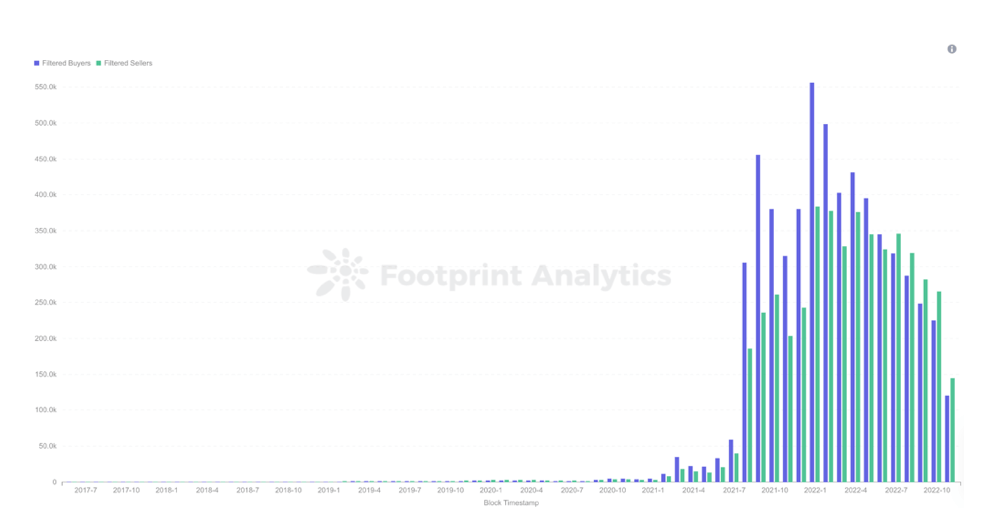
Footprint Analytics – NFT Sellers & Buyers Without Wash Trade
Footprint Analytics – NFT Sellers & Buyers

Wash trading is a form of market manipulation where an investor simultaneously sells and buys the same financial instruments to create misleading, artificial activity in the marketplaceIt creates enormous dissonance in the NFT industry between what most people imagine NFT trading is i.e., someone buying an NFT for speculation, and the behavior which actually underlies the market — hundreds of insiders transferring NFTs between their own wallets.

There are several indicators to identify suspicious trading activity.

Signals and indicators include:

  1. Overpriced NFT trades with 0% creators fees
  2. Specific NFT IDs that are bought more than a normal amount of times in a day
  3. NFTs bought by the same buyer address in a short period of time

The incentives for wash trading are to earn platform rewards and to create an appearance of value or liquidity for assets. Because there is no way to prevent or discourage wash trading in the NFT market today, people have a hugely misguided picture of the amount of organic, genuine trading activity in the industry.

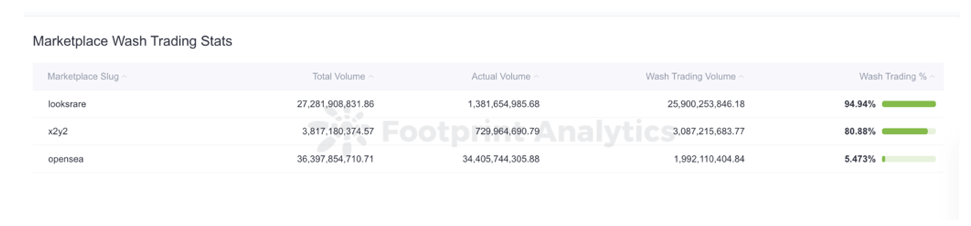
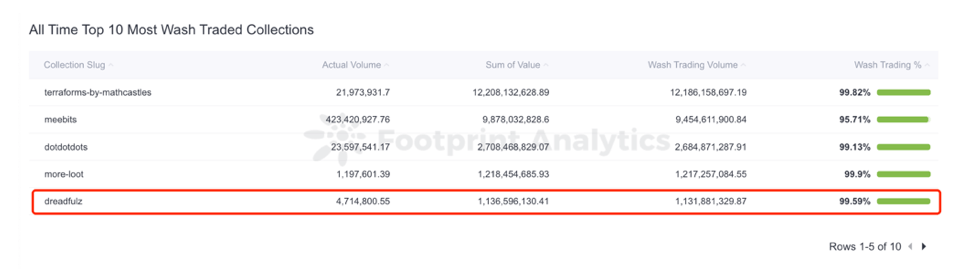
For example, 81% percent of all trades on X2Y2, one of the top 3 NFT marketplaces, were wash trades according to the filters applied. The main reason for X2Y2 wash trading is volume-based daily trading rewards. The larger the percentage of volume a user contributes to X2Y2, the larger the share of daily trading rewards the user will earn. A similar breakdown can be observed when looking at individual collections. For example, of Dreadfulz’ $1.1 billion in total volume, $1.131 billion was flagged as wash trading.

Footprint Analytics – Marketplace Wash Trading Stats
Footprint Analytics – All Time Top 10 Most Wash Traded Collections

An analyst or writer who does not understand this wash trading dynamic risks grossly misunderstanding the current market. For example, here’s what Business2Community wrote on Oct. 12 about Terraforms by Mathcastles:

“Non-fungible token collections continue showing strong resilience amid the current general crypto market downturn so far this year. Here are some of the top-selling NFT collections this week: 1. Terraforms Reclaim The Top Spot. Terraforms, a non-fungible token (NFT) collection from Mathcastles, has reclaimed the top spot after flipping below our ten top-selling lists last week. Terraforms has a 24-hour sales volume of 1,814 ETH.”

The next collections the article listed were BAYC and CryptoPunks, which have nearly no wash trading. This would give a reader the impression that Terraforms more of a popular collection than those blue chip collections when in reality there were almost no organic trades.

Footprint Analytics – Bored Ape Yacht Club Trading Stats
Footprint Analytics – Cryptopunks Wash Trading Stats
Footprint Analytics – Terraforms-by-mathcastels Wash Trading Stats

By filtering trades for wash trading, traders, analysts and investors can more accurately evaluate NFT assets and the industry. Having accurate datasets and using them are two separate things. My role here is not to whistleblow or break the NFT myths, I am here to share my knowledge and tell my side of the story to everyone.

Using this article, I would like to make a request to analyze CEX NFT marketplaces’ data. Binance or Bybit NFT Marketplace would be ideal.


Source: https://cryptoslate.com/roughly-48-of-ethereum-nft-trades-in-october-were-fake/

Anndy Lian is an early blockchain adopter and experienced serial entrepreneur who is known for his work in the government sector. He is a best selling book author- “NFT: From Zero to Hero” and “Blockchain Revolution 2030”.

Currently, he is appointed as the Chief Digital Advisor at Mongolia Productivity Organization, championing national digitization. Prior to his current appointments, he was the Chairman of BigONE Exchange, a global top 30 ranked crypto spot exchange and was also the Advisory Board Member for Hyundai DAC, the blockchain arm of South Korea’s largest car manufacturer Hyundai Motor Group. Lian played a pivotal role as the Blockchain Advisor for Asian Productivity Organisation (APO), an intergovernmental organization committed to improving productivity in the Asia-Pacific region.

An avid supporter of incubating start-ups, Anndy has also been a private investor for the past eight years. With a growth investment mindset, Anndy strategically demonstrates this in the companies he chooses to be involved with. He believes that what he is doing through blockchain technology currently will revolutionise and redefine traditional businesses. He also believes that the blockchain industry has to be “redecentralised”.

j j j