Navigating the uncharted legal territory of NFT: What to avoid?

Navigating the uncharted legal territory of NFT: What to avoid?

According to the NFT aggregator platform- CryptoSlam, the market for Non-Fungible Tokens (NFTs) plummeted from its peak of $17 billion in early 2022 to $460 million in October 2022, a staggering decline of 97.3%. While the decrease in NFT transaction volume may be partially attributed to dropping cryptocurrency prices, NFT developers continue to create NFT. In fact, creators are confident that the NFT industry will recover. We see new projects popping up every day on Twitter. We see different projects challenging the Number 1 spot on sales volume. At the point of publishing, Art Globblers are topping the charts. I see centralized marketplaces like Bybit are still selling out their Mystery Boxes. Everyone is building harder than before.

Taking the sentiments from the ground and as per the requests from various communities asking about NFT regulations, I have decided to share some insights on legal implications and the regulatory side of things so that you will be aware and up to speed on the state of the NFT sector.

Around 105 nations have legalized NFTs either expressly or as part of a larger recognition of cryptocurrencies and virtual currencies. However, as the aforementioned list illustrates, legislation regarding NFTs is frequently general and not designed mainly for NFTs.

The U.S., Canada, Australia, and most of the European Union are notable examples of markets that are integrated and moderately regulated. In each of these jurisdictions, the predominant legal strategy is to view NFTs as either a type of capital gains taxable asset or a component of an individual’s income tax portfolio. However, there are still a lot of nations where NFTs and cryptocurrencies are either implicitly or expressly banned. This is largely because those governments view NFTs and other digital assets as threats to the current financial system and sources of illicit and/or terrorist financing. China, Vietnam, Algeria, Egypt, Qatar and Nepal are notable instances.

I will go through a few markets.

U.S.A

Although there are no particular NFT legislation in the US, similar to the UK, some NFT crypto-asset kinds may be covered by already-existing federal statutes. For instance, the Securities and Exchange Commission (SEC) may treat specific types of NFT as securities under US securities law.

India

Since there is no official legal framework for NFTs and no classification of NFTs under the SCRA, it is unclear if dealing in NFTs is forbidden under the Securities Contract Regulation Act, 1956 (“SCRA”). If NFTs are deemed to constitute derivatives, trading in them would be prohibited in India.

Singapore

Singapore’s central bank has recently announced that it will not regulate the NFT market. Recently, under Singapore law, it will be subject to MAS’ regulatory requirements if an NFT has the characteristics of a capital markets product under the Securities and Futures Act (SFA). Similarly, should an NFT have the features of a digital payment token under the Payment Services Act (PSA).

U.K.

NFTs are not subject to any special NFT rules in the U.K., but they are recognized as a kind of crypto asset. To be more precise, it can be classified as a security token, an e-money token, or an unregulated token. However, most NFTs are not regulated since they do not meet the first two prerequisites. Even if it does, it can still result in broad regulations, such as an anti-laundering rule for art sales over €10,000 and capital gains tax if purchased or sold at a profit. Strict laws require consumers to be adequately informed and warned about the risk of loss or price volatility if public advertisements promote NFTs.

China

NFTs can currently be purchased or sold by individuals in Mainland China. NFTs are not presently subject to any specific laws or regulations. The National Internet Finance Association of China, the Securities Association of China, and the China Banking Association jointly released an initiative regarding the prevention of financial risks associated with NFTs. Because the three associations are under the supervision of the central bank, the banking regulatory authority, and the security regulatory authority, respectively, and because the Initiative is not a regulation under PRC law, it reflects the attitudes and policy orientation of regulators in Mainland China. For some time, the word “NFT” was also deemed a sensitive word and temporarily blocked by some official media sites.

Japan

While there are presently no particular regulations in Japan that govern NFTs, the government said in January 2022 that it was creating an NFT task force, which suggests that regulation is soon to come. Currently, an NFT may meet the definition of a security under the Financial Instruments and Exchange Act if its holder receives cash or other assets that represent a sharing of profits. It should be carefully considered whether NFTs violate gambling laws, which are especially important for NFTs employed in games.

Now that you have read briefly how the regulators around the world look at NFTs in general. If you are an entrepreneur, your DNA could be telling you to be a creator or start an NFT Marketplace. So what are some legal considerations if you want to create a business like an NFT marketplace? What do you need to do?

  • Creation of a legal entity: A corporate body must first be established before a marketplace can be introduced. Your company will benefit from the most robust liability protection, increased capability, and credibility while looking for outside financing.
  • Formation of smart contracts: The digital work must be individually recognizable and have transferrable ownership within the smart contract. The economics of trading should be included in the creation process, including how much to charge for a primary sale, how much to charge for a secondary sale, royalties, transaction costs, and other characteristics of the aftermarket to facilitate trade with money naturally flowing to the right parties.
  • Terms of service: It regulates the interactions between users and the NFT marketplace operator, as well as between buyers and sellers of the NFTs displayed on the platform, which is a necessary component of NFT marketplaces. A carefully drafted term of service agreement will typically include clauses that limit the company’s overall responsibility and can aid in defending your firm from several legal problems.
  • Terms of sale: If the platform’s terms of service do not adequately address risks to the seller or creator, sellers or creators listing their NFTs on an NFT marketplace may choose to impose additional terms of sale on buyers of their NFT.
  • Securities law compliance: It’s critical to develop features that show the difference between your newly minted token and what governments seek to regulate to ensure it doesn’t have the characteristics of a security.
  • Intellectual property: It is crucial to confirm the validity of each participant’s intellectual property rights at every stage of every NFT transaction. Copyright ownership, which belongs to the original work’s creator, governs the original work. Make careful to divide up intellectual property ownership among the authors, artists, buyers, collectors, and other parties.
  • Consumer protection: Most jurisdictions have consumer protection laws. Consider a scenario where an NFT marketplace fails to appropriately notify its clients about the products they are buying and the hazards involved. Cybercriminals will probably attack NFTs in order to profit financially. To protect against these attacks, your platforms will need reliable controls. Other regulatory standards, including KYC and anti-money laundering, might also need to be implemented.

The fast-changing NFT space, where digital assets prevail, was not considered when developing the current regulatory and legal framework. However, some crucial challenges have surfaced as investors, financial institutions, and fintech firms investigate this market. Is there a gateway to your platform that guards against money launderers and other undesirable parties subject to government sanctions?

NFTs are indeed not treated as cryptocurrencies right now. Regulators are trying to clamp down on grey NFT projects and have warned the general public about buying NFT. So far, I have been talking about how governments look at us and what entrepreneurs need to understand when they start their NFT business as a marketplace. I have come out with a few quick reminders for consumers when buying NFT.

3 Quick Reminders on NFT Buying

  • Do not buy NFTs that include securities, insurance or other financial assets as the underlying value of NFTs. An NFT may become a regulated financial product if it grants its owner the right to income streams or a stake in an underlying portfolio of investment assets. There are many grey examples to be named.
  • Do check on the copyright behind the NFTs. Some of the creators are plagiarizing artists’ original work. Playboy Enterprises filed a lawsuit against the owners of a website that was constructed to seem like the one Playboy used to market their “Rabbitar” NFTs. Playboy claims that the scam was successful because more than a thousand customers fell for it and collectively paid more than a million dollars for Rabbitars they never received.
  • Do remember that trading NFTs for profit is subjected to capital gain tax. It is good to consider all tax implications before making the trade. Take India, for example. All virtual digital assets, including NFTs, are subject to the government’s 30% tax levied.

NFT is a beautiful term and has excellent potential. As crypto community members, we should try our best to keep it clean and proper. Hiding financial products or securities behind an NFT is not an excellent way to support innovation. It will give the regulators a chance to kill the innovation. You need to understand regulations to grow in the right manner. #anndylian


Source: https://www.securities.io/navigating-the-legal-territory-of-nft-what-to-look-out-for/


Anndy Lian is an early blockchain adopter and experienced serial entrepreneur who is known for his work in the government sector. He is a best selling book author- “NFT: From Zero to Hero” and “Blockchain Revolution 2030”.

Currently, he is appointed as the Chief Digital Advisor at Mongolia Productivity Organization, championing national digitization. Prior to his current appointments, he was the Chairman of BigONE Exchange, a global top 30 ranked crypto spot exchange and was also the Advisory Board Member for Hyundai DAC, the blockchain arm of South Korea’s largest car manufacturer Hyundai Motor Group. Lian played a pivotal role as the Blockchain Advisor for Asian Productivity Organisation (APO), an intergovernmental organization committed to improving productivity in the Asia-Pacific region.

An avid supporter of incubating start-ups, Anndy has also been a private investor for the past eight years. With a growth investment mindset, Anndy strategically demonstrates this in the companies he chooses to be involved with. He believes that what he is doing through blockchain technology currently will revolutionise and redefine traditional businesses. He also believes that the blockchain industry has to be “redecentralised”.
j j j

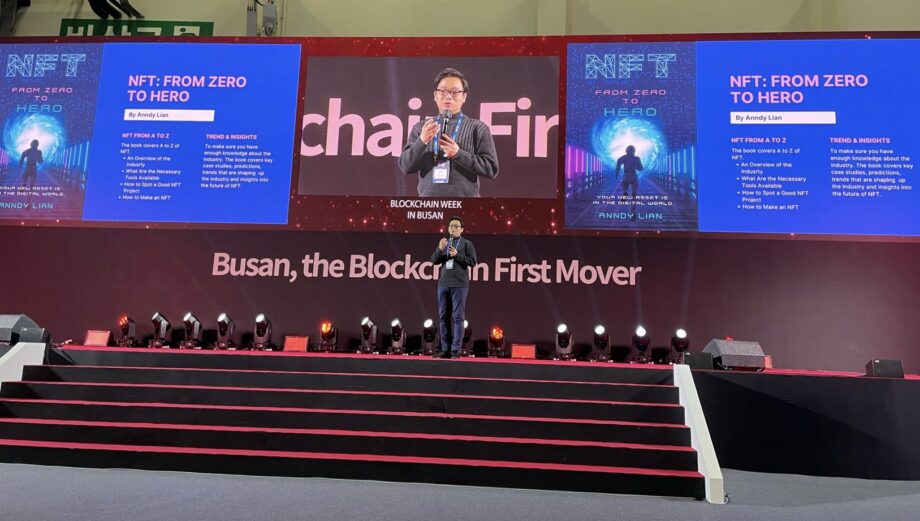
Anndy Lian Talks about “Trends Shaping the Future of NFT” at Busan Blockchain Week

Anndy Lian Talks about “Trends Shaping the Future of NFT” at Busan Blockchain Week

Busan Blockchain Week (BWB) 2022, hosted by Busan Metropolitan City held at BEXCO for 3 days from Oct. 27th (Thu.) to the 29th (Sat).

With the theme of “Blockchain, City and Life”, as an extension of last year’s NFT Busan 2021, BWB 2022 will feature conferences for the advancement of the blockchain industry and provide a space to obtain insight as well as to share information.

Anndy Lian’s speech is on “Trends Shaping the Future of NFT”.

Anndy Lian is an all-rounded business strategist in Asia. He has provided advisory across a variety of industries for local, international, public listed companies and governments. He is an early blockchain adopter and experienced serial entrepreneur, book author, investor, board member and keynote speaker.

NFT: From Zero to Hero is his latest book. Zero to Hero is a call to anyone and everyone excited about the prospect of the world of NFT. Bound by imagination only, the NFT space is still in its early days and early adopters can be a “hero” in their search for new possibilities. The book is available on Amazon and Bybit. More than 8,000 copies were sold.

NFTs took 2021 by storm. With billions traded over NFTs and a strong community behind the technology, we’re seeing NFTs being adopted by industries as diverse as gaming, finance, art, and medicine.

NFT Gaming and GameFi: This trend is obvious. At present, many successful game manufacturers in the traditional game industry want to get involved in NFTs.

NFT Ticketing: NFT ticketing goes beyond this. The future of NFTs in ticketing offers opportunities for lifetime value, exclusive access, and extra incentives for buyers.

NFT Fragments: Fractionalization essentially breaks up an NFT into smaller pieces, so people can purchase small parts of an expensive NFT.

Digital Twin NFTs: Imagine this same type of record existing for physical items. It would completely change resale markets.

AI NFTs: Alongside blockchain, artificial intelligence (AI) is the next major disruptor in tech. So it should be no surprise the two are being combined.

NFTs and Health: With issues surrounding counterfeit vaccination passports and concerns about the vulnerabilities of centralized data storage of sensitive medical information, NFTs and the blockchain may well be integrated more and more into medicine and health in the years to come.

Growth Amidst Doubt

Although the popularity of NFTs is indeed declining, all walks of life are still accelerating their integration with NFTs.

Starting in the second half of 2021, many well-known brands have also begun to try NFTs, matching them with real objects and even designing their own metaverse. Obviously, the utility has become the first test for big brands in the metaverse field through NFTs.

NFT essentially provides brands with a new way to launch limited-edition products, and the resulting community and word-of-mouth communication will raise their share of voice compared to rival brands.

The Future of NFTs

A number of countries are now actively working on regulatory frameworks for NFT assets, strengthening anti-fraud and anti-manipulation audits of projects, determining the business core of each platform, and solving financial security issues such as illegal fundraising and false fraud.

At the same time, major public chains are actively upgrading, expanding, and building their own ecological frameworks to provide underlying support for the production, confirmation, pricing, circulation, and traceability of NFT assets. Nowadays, NFT financial tools are becoming more and more abundant, and the scale of financial derivatives is steadily increasing. The NFT industry is gradually exploring a development path suitable for blockchain assets.

“The future these NFT trends depict is an interesting one. While many people are concerned about the implications of the metaverse and the rise of AI, it’s a future full of possibilities. We are still early. Let’s build the ecosystem together.” Anndy Lian added.

Anndy Lian is an early blockchain adopter and experienced serial entrepreneur who is known for his work in the government sector. He is a best selling book author- “NFT: From Zero to Hero” and “Blockchain Revolution 2030”.

Currently, he is appointed as the Chief Digital Advisor at Mongolia Productivity Organization, championing national digitization. Prior to his current appointments, he was the Chairman of BigONE Exchange, a global top 30 ranked crypto spot exchange and was also the Advisory Board Member for Hyundai DAC, the blockchain arm of South Korea’s largest car manufacturer Hyundai Motor Group. Lian played a pivotal role as the Blockchain Advisor for Asian Productivity Organisation (APO), an intergovernmental organization committed to improving productivity in the Asia-Pacific region.

An avid supporter of incubating start-ups, Anndy has also been a private investor for the past eight years. With a growth investment mindset, Anndy strategically demonstrates this in the companies he chooses to be involved with. He believes that what he is doing through blockchain technology currently will revolutionise and redefine traditional businesses. He also believes that the blockchain industry has to be “redecentralised”.

j j j

Are NFT Regulated? What Are The Concerns?

Are NFT Regulated? What Are The Concerns?

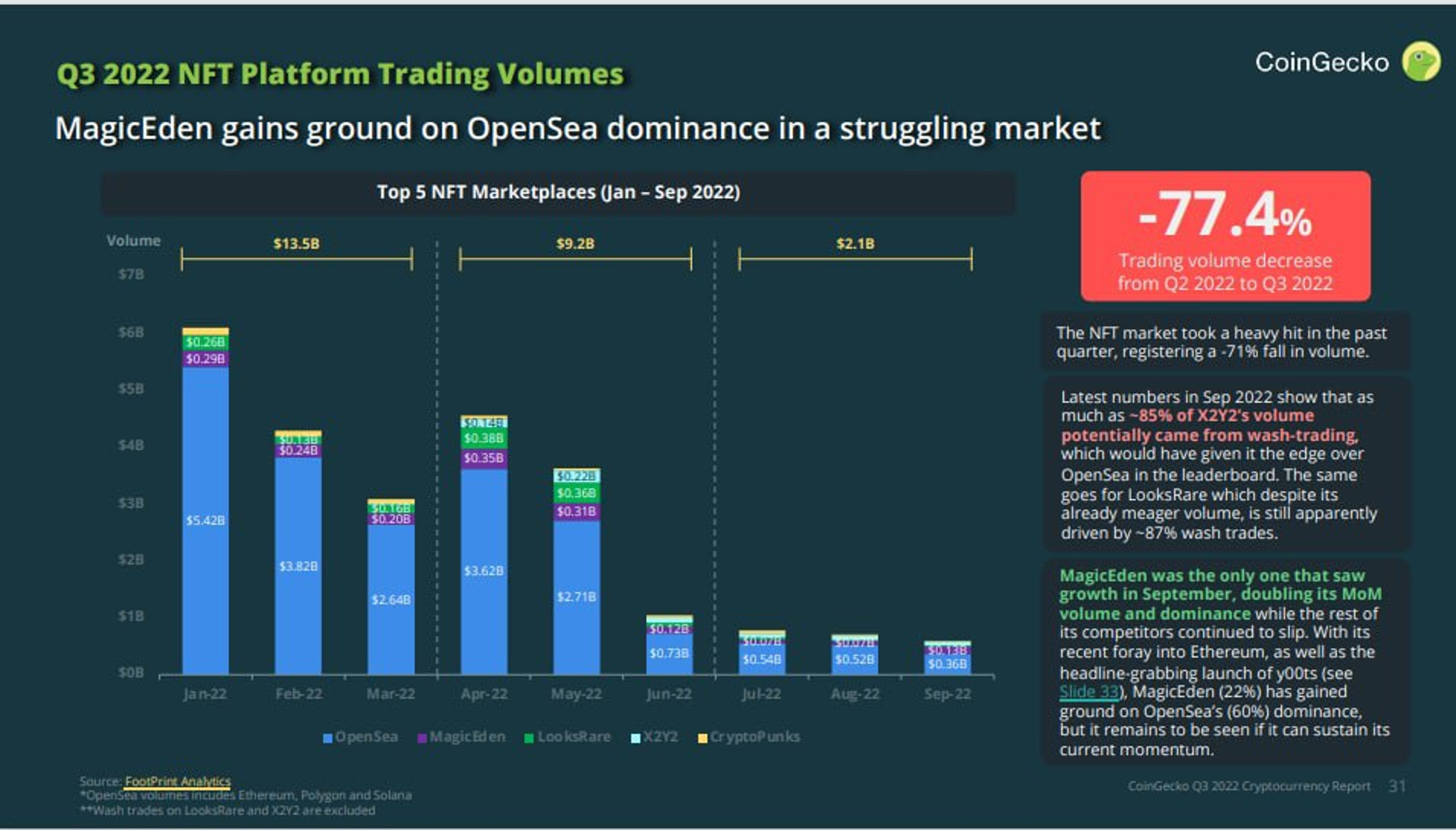
The hype around NFT has slowed down. It seemed like NFT was slated for explosive growth in 2022, being named “word of the year” and coming off a record-high volume in January this year. But as it turns out, that was the peak. Looking at Q3 2022 NFT trading volume around the top 8 chains. There is a 76.4% trading volume decrease from Q2 2022 to Q3 2022.

Since then, the trading volume has tumbled 83% from the start of the year, according to Footprint Analytics’s data on CoinGeco. Recent months have logged numbers lower than July 2021, right before NFT summer. Most notably, Ronin and Avalanche have fallen out of the Top 8, replaced by ImmutableX and Panini. Recent sports mania has spilt over to the NFT space, propelling Flow into the Top 3. Solana’s NFT ecosystem doubled its September volume while all its competitors faltered.

During this period of time, where the market is bearish, you will see changes. For example, in Q3 Magic Eden gains grounds on OpenSea dominance. Magic Eden was the only one that saw growth in September, doublings its month-on-month volume and dominance, while the rest of its competitors continued to slip further. Magic Eden (22%) has gained ground on OpenSea’s (60%) dominance, but it remains to be seen if it can sustain its current momentum.

Another factor in sustaining the current momentum is aligning with the regulatory norms. There is still disagreement over how to handle NFTs, which makes it difficult to set clear regulatory norms. NFTs can now be seen in one of three ways: as commodities, securities, or intellectual property. Let’s explore each interpretation in more detail.

Commodities

Commodities are defined by US law as reasonably interchangeable services, goods, and rights, including money and interest rates, that are traded as commercial articles. The Commodity Futures Trading Commission (CFTC) asserts that cryptocurrencies like Bitcoin and Ethereum, as well as renewable energy credits and other intangible assets, are included in the definition of commodity.

If we take NFTs, they resemble cryptocurrencies in several ways. They may be bought and sold and are based on blockchain technology. In addition, the CFTC emphasises price manipulation and commodities exchanges more than it does on underlying assets and issuers. The Commodity Exchange Act (CEA) may be implemented if it is decided that NFTs should be classified as commodities. The CEA’s rules on manipulative trading may be applicable in this situation.

Securities

Most NFTs with a single owner and only one unique asset are unlikely to be securities. However, under certain situations, they might. If an NFT possesses security-like characteristics or otherwise satisfies the Howey test, such as when money or another kind of compensation is invested with a reasonable expectation that gains will result from others’ efforts, then the NFT may be subject to US securities legislation. A case-by-case Howey analysis is essential to ascertain if a specific NFT is a security. NFTs may, however, violate securities laws in the following situations, depending on the specifics:

  • NFTs are pre-sales of digital assets intended to be used on a platform that has not yet been developed, with the sale’s proceeds going toward developing the platform;
  • Digital assets can be “pooled” or “fractionalised” (for instance, in the case of art, when creators pool resources and divide profits, or where several NFTs reflect different investors’ fractional ownership of a single asset);
  • NFTs are a license to a digital asset (like a song) and a portion of its earnings (e.g., a percentage of sales).

Intellectual Property

NFTs might be covered by intellectual property rights such as copyright, design patents, and trademark protections. As a result, buyers of NFTs should be aware of any associated intellectual property rights. In fact, the license that comes with many or even most NFTs merely allows the NFT buyer to use, copy, and display the NFT.

A clip of renowned basketball star LeBron James’ slam dunk is an excellent illustration. The video was made available as a limited-edition NBA highlight video collector. The NBA collectables are available for purchase and sale on the Top Shot NFTs market. The NBA owns the copyright, nevertheless, and the rules of its licensing agreement continue to apply to any purchased item’s replication.

However, while most NFT producers place limitations on commercial use, other authors grant NFT owners broader rights. Members of the Bored Ape Yacht Club (BAYC) have the right to use their “apes” for commercial purposes, which allows them to produce and market hats, T-shirts, mugs, and other items.

Brand owners should consider how current or upcoming design patents can protect against imitations or infringement in addition to trademark and copyright protection. Because they grant owners full ownership of an infringer’s profits rather than just the fraction related to the use of the design, design patents are important intellectual property protections compared to other IP rights.

Fraud Schemes

Despite being a relatively new idea, NFTs are already being utilised to commit numerous forms of fraud. Here, we go over some of the most prominent NFT-related fraud schemes that have occurred:

  • Tokenisation– The process of producing digital tokens that reflect ownership of physical assets is known as tokenisation. This happens when someone steals an artist’s creation without their consent and “mints” it to create an NFT.
  • Wash trading– This is the practice of users manipulating transactions by trading with themselves or others to feign large demand for an NFT, manipulate its price, or enhance its visibility.
  • Insider trading– The practice of using information that is not generally known to benefit personally from it. In recent high-profile situations, employees and executives of NFT companies and markets have engaged in behaviour that may be viewed as unfair or illegal. Various events generate negative press for these organisations. NFT insider trading regulations frequently forbid buying NFTs based on secret information. Similarly, multiple forms of trading in business NFTs that aim to inappropriately manipulate the perceived price or trading volume of such NFTs are prohibited.
  • Anti-Money Laundering– NFTs, especially those with large value, may occasionally be utilised to aid in money laundering. A study on how the art market aids in the financing of terrorism and money laundering was released by the US Department of Treasury. The study covered a variety of topics, including the dangers of financial crimes in relation to digital art and NFTs. The study discovered that the high-value art market has several intrinsic characteristics that could make it susceptible to various financial crimes.

To Conclude

As we can see, the market for NFTs is still growing, and it will take some time until an appropriate regulatory framework for NFTs is put in place. Having said that, governments all over the world have already begun the process of developing NFT norms and standards, proving that they are seriously interested in these digital assets.

Additionally, you should be aware that the phenomenal success of NFTs will undoubtedly result in fraudulent activities. For this reason, it is becoming more and more crucial to conduct your research before purchasing or investing in NFT collections or projects.


Source: https://www.msn.com/en-us/money/markets/are-non-fungible-tokens-nft-regulated-what-are-the-concerns/ar-AA13ijBk

Anndy Lian is an early blockchain adopter and experienced serial entrepreneur who is known for his work in the government sector. He is a best selling book author- “NFT: From Zero to Hero” and “Blockchain Revolution 2030”.

Currently, he is appointed as the Chief Digital Advisor at Mongolia Productivity Organization, championing national digitization. Prior to his current appointments, he was the Chairman of BigONE Exchange, a global top 30 ranked crypto spot exchange and was also the Advisory Board Member for Hyundai DAC, the blockchain arm of South Korea’s largest car manufacturer Hyundai Motor Group. Lian played a pivotal role as the Blockchain Advisor for Asian Productivity Organisation (APO), an intergovernmental organization committed to improving productivity in the Asia-Pacific region.

An avid supporter of incubating start-ups, Anndy has also been a private investor for the past eight years. With a growth investment mindset, Anndy strategically demonstrates this in the companies he chooses to be involved with. He believes that what he is doing through blockchain technology currently will revolutionise and redefine traditional businesses. He also believes that the blockchain industry has to be “redecentralised”.
j j j