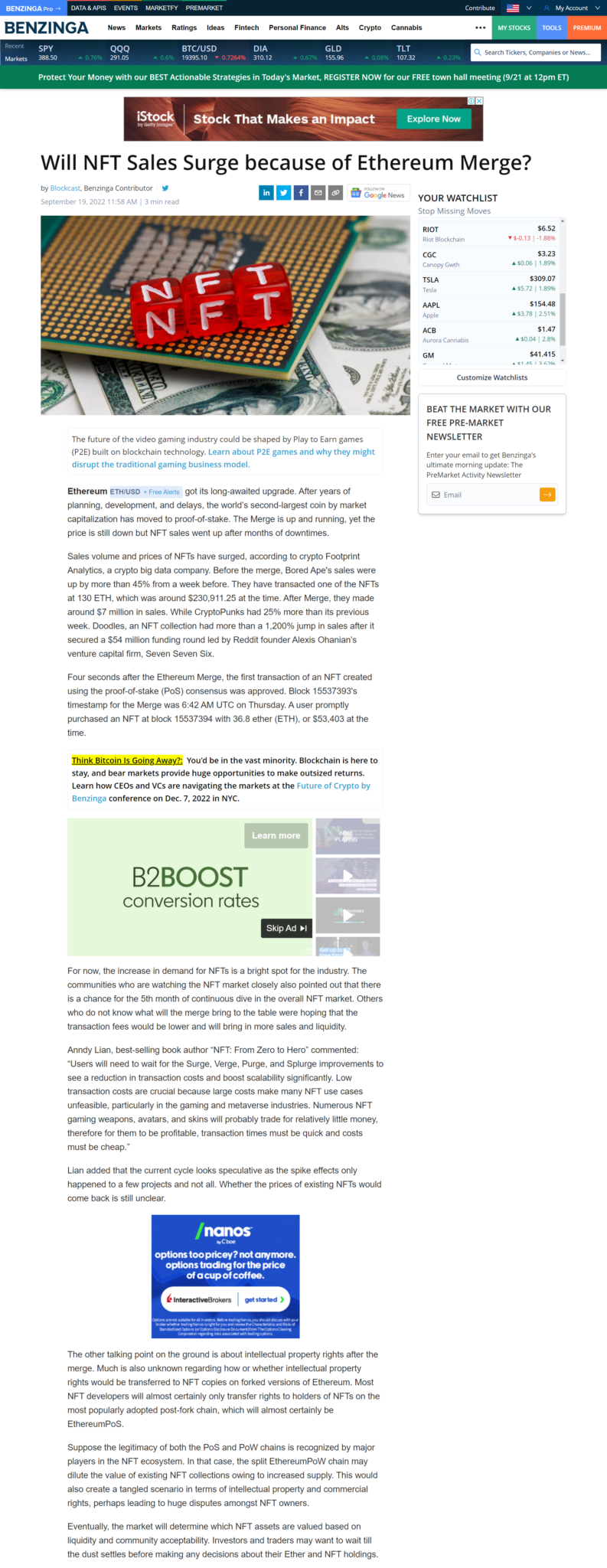
Ethereum got its long-awaited upgrade. After years of planning, development, and delays, the world’s second-largest coin by market capitalization has moved to proof-of-stake. The Merge is up and running, yet the price is still down but NFT sales went up after months of downtimes.
Sales volume and prices of NFTs have surged, according to crypto Footprint Analytics, a crypto big data company. Before the merge, Bored Ape’s sales were up by more than 45% from a week before. They have transacted one of the NFTs at 130 ETH, which was around $230,911.25 at the time. After Merge, they made around $7 million in sales. While CryptoPunks had 25% more than its previous week. Doodles, an NFT collection had more than a 1,200% jump in sales after it secured a $54 million funding round led by Reddit founder Alexis Ohanian’s venture capital firm, Seven Seven Six.
Four seconds after the Ethereum Merge, the first transaction of an NFT created using the proof-of-stake (PoS) consensus was approved. Block 15537393’s timestamp for the Merge was 6:42 AM UTC on Thursday. A user promptly purchased an NFT at block 15537394 with 36.8 ether (ETH), or $53,403 at the time.
For now, the increase in demand for NFTs is a bright spot for the industry. The communities who are watching the NFT market closely also pointed out that there is a chance for the 5th month of continuous dive in the overall NFT market. Others who do not know what will the merge bring to the table were hoping that the transaction fees would be lower and will bring in more sales and liquidity.
Anndy Lian, best-selling book author “NFT: From Zero to Hero” commented: “Users will need to wait for the Surge, Verge, Purge, and Splurge improvements to see a reduction in transaction costs and boost scalability significantly. Low transaction costs are crucial because large costs make many NFT use cases unfeasible, particularly in the gaming and metaverse industries. Numerous NFT gaming weapons, avatars, and skins will probably trade for relatively little money, therefore for them to be profitable, transaction times must be quick and costs must be cheap.”
Lian added that the current cycle looks speculative as the spike effects only happened to a few projects and not all. Whether the prices of existing NFTs would come back is still unclear.
The other talking point on the ground is about intellectual property rights after the merge. Much is also unknown regarding how or whether intellectual property rights would be transferred to NFT copies on forked versions of Ethereum. Most NFT developers will almost certainly only transfer rights to holders of NFTs on the most popularly adopted post-fork chain, which will almost certainly be EthereumPoS.
Suppose the legitimacy of both the PoS and PoW chains is recognized by major players in the NFT ecosystem. In that case, the split EthereumPoW chain may dilute the value of existing NFT collections owing to increased supply. This would also create a tangled scenario in terms of intellectual property and commercial rights, perhaps leading to huge disputes amongst NFT owners.
Eventually, the market will determine which NFT assets are valued based on liquidity and community acceptability. Investors and traders may want to wait till the dust settles before making any decisions about their Ether and NFT holdings.
Anndy Lian is an early blockchain adopter and experienced serial entrepreneur who is known for his work in the government sector. He is a best selling book author- “NFT: From Zero to Hero” and “Blockchain Revolution 2030”.
Currently, he is appointed as the Chief Digital Advisor at Mongolia Productivity Organization, championing national digitization. Prior to his current appointments, he was the Chairman of BigONE Exchange, a global top 30 ranked crypto spot exchange and was also the Advisory Board Member for Hyundai DAC, the blockchain arm of South Korea’s largest car manufacturer Hyundai Motor Group. Lian played a pivotal role as the Blockchain Advisor for Asian Productivity Organisation (APO), an intergovernmental organization committed to improving productivity in the Asia-Pacific region.
An avid supporter of incubating start-ups, Anndy has also been a private investor for the past eight years. With a growth investment mindset, Anndy strategically demonstrates this in the companies he chooses to be involved with. He believes that what he is doing through blockchain technology currently will revolutionise and redefine traditional businesses. He also believes that the blockchain industry has to be “redecentralised”.
The Merge is the most anticipated event in the crypto industry in years, but could the multibillion dollar non-fungible token industry become an unexpected casualty?
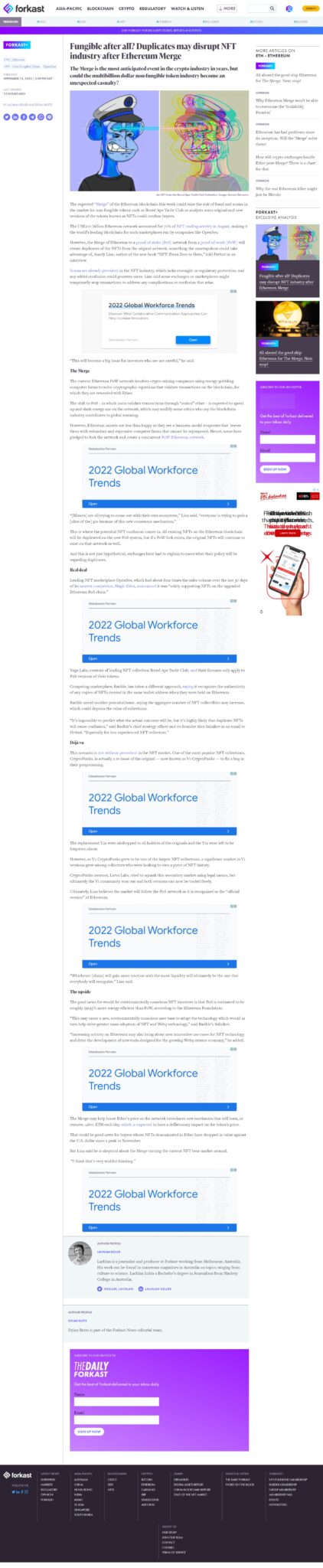
The expected “Merge” of the Ethereum blockchain this week could raise the risk of fraud and scams in the market for non-fungible tokens such as Bored Ape Yacht Club as analysts warn original and new versions of the tokens known as NFTs could confuse buyers.
The US$200 billion Ethereum network accounted for 70% of NFT trading activity in August, making it the world’s leading blockchain for such marketplaces run by companies like OpenSea.
However, the Merge of Ethereum to a proof-of-stake (PoS) network from a proof-of-work (PoW) will create duplicates of the NFTs from the original network, something the unscrupulous could take advantage of, Anndy Lian, author of the new book “NFT: From Zero to Hero,” told Forkast in an interview.
Scams are already prevalent in the NFT industry, which lacks oversight or regulatory protection, and any added confusion could generate more. Lian said some exchanges or marketplaces might temporarily stop transactions to address any complications or confusion that arise.
“This will become a big issue for investors who are not careful,” he said.
The Merge
The current Ethereum PoW network involves crypto mining companies using energy-gobbling computer farms to solve cryptographic equations that validate transactions on the blockchain, for which they are rewarded with Ether.
The shift to PoS – in which users validate transactions through “staked” ether – is expected to speed up and slash energy use on the network, which may mollify some critics who say the blockchain industry contributes to global warming.
However, Ethereum miners are less than happy as they see a business model evaporate that leaves them with redundant and expensive computer farms that cannot be repurposed. Hence, some have pledged to fork the network and create a concurrent PoW Ethereum network.
“[Miners] are all trying to come out with their own ecosystem,” Lian said, “everyone is trying to grab a [slice of the] pie because of this new consensus mechanism.”
This is where the potential NFT confusion comes in. All existing NFTs on the Ethereum blockchain will be duplicated on the new PoS system, but if a PoW fork exists, the original NFTs will continue to exist on that network as well.
And this is not just hypothetical, exchanges have had to explain to users what their policy will be regarding duplicates.
Real deal
Leading NFT marketplace OpenSea, which had about four times the sales volume over the last 30 days of its nearest competitor, Magic Eden, announced it was “solely supporting NFTs on the upgraded Ethereum PoS chain.”
Yuga Labs, creators of leading NFT collection Bored Ape Yacht Club, said their licenses only apply to PoS versions of their tokens.
Competing marketplace, Rarible, has taken a different approach, saying it recognizes the authenticity of any copies of NFTs created in the same wallet address when they were held on Ethereum.
Rarible noted another potential issue, saying the aggregate number of NFT collectibles may increase, which could depress the value of collections.
“It’s impossible to predict what the actual outcome will be, but it’s highly likely that duplicate NFTs will cause confusion,” said Rarible’s chief strategy officer and co-founder Alex Salnikov in an email to Forkast. “Especially for less experienced NFT collectors.”
Déjà vu
This scenario is not without precedent in the NFT market. One of the most popular NFT collections, CryptoPunks, is actually a re-issue of the original — now known as V1 CryptoPunks — to fix a bug in their programming.
The replacement V2s were airdropped to all holders of the originals and the V1s were left to be forgotten about.
However, as V2 CryptoPunks grew to be one of the largest NFT collections, a significant market in V1 versions grew among collectors who were looking to own a piece of NFT history.
CryptoPunks creators, Larva Labs, tried to squash this secondary market using legal means, but ultimately the V1 community won out and both versions can now be traded freely.
Ultimately, Lian believes the market will follow the PoS network as it is recognized as the “official version” of Ethereum.
“Whichever [chain] will gain more traction with the most liquidity will ultimately be the one that everybody will recognize,” Lian said.
The upside
The good news for would-be environmentally conscious NFT investors is that PoS is estimated to be roughly 99.95% more energy efficient than PoW, according to the Ethereum Foundation.
“This may cause a new, environmentally conscious user base to adopt the technology which would in turn help drive greater mass adoption of NFT and Web3 technology,” said Rarible’s Salnikov.
“Increasing activity on Ethereum may also bring about new innovative use cases for NFT technology and drive the development of new tools designed for the growing Web3 creator economy,” he added.
The Merge may help boost Ether’s price as the network introduces new mechanics that will burn, or remove, 1,600 ETH each day, which is expected to have a deflationary impact on the token’s price.
That could be good news for buyers whose NFTs denominated in Ether have dropped in value against the U.S. dollar since a peak in November.
But Lian said he is skeptical about the Merge turning the current NFT bear market around.
Anndy Lian is an early blockchain adopter and experienced serial entrepreneur who is known for his work in the government sector. He is a best selling book author- “NFT: From Zero to Hero” and “Blockchain Revolution 2030”.
Currently, he is appointed as the Chief Digital Advisor at Mongolia Productivity Organization, championing national digitization. Prior to his current appointments, he was the Chairman of BigONE Exchange, a global top 30 ranked crypto spot exchange and was also the Advisory Board Member for Hyundai DAC, the blockchain arm of South Korea’s largest car manufacturer Hyundai Motor Group. Lian played a pivotal role as the Blockchain Advisor for Asian Productivity Organisation (APO), an intergovernmental organization committed to improving productivity in the Asia-Pacific region.
An avid supporter of incubating start-ups, Anndy has also been a private investor for the past eight years. With a growth investment mindset, Anndy strategically demonstrates this in the companies he chooses to be involved with. He believes that what he is doing through blockchain technology currently will revolutionise and redefine traditional businesses. He also believes that the blockchain industry has to be “redecentralised”.
Anndy Lian, book author of NFT: From Zero to Hero shares about his book on XRdoge TV.
Anndy’s book was sold out on 15 August 2022 on Bybit NFT Marketplace. 8000+ copies were sold so far. The book talks about his views on NFT, Web 3.0 and beyond.
The book’s foreword is written by Ben Zhou, CEO and Co Founder of Bybit and also Jay Hao, CEO of OKX. Many other crypto experts have also penned down their words in the book too.
He wants to share the book with people who are both curious about the world and has read many news articles about NFTs. However, I guess these articles were not able to answer all your questions, and you want to know how best to start your NFT journey.
– Why would someone be willing to pay millions of dollars for a PFP (profile picture)? What’s the value behind it?
– Many actors and singers have also released their own NFTs. However, the price quickly dropped by half after their launch. What’s going on?
– Nike, Adidas, Gucci, Hermès— it seems that big companies globally are entering the NFT market but how do we differentiate those seriously deploying from those just trying to take a cut from the hype?
– According to statistics, in the first quarter of 2022, the transaction volume of NFTs reached $26 billion, exceeding the whole of 2021. However, another set of data tells you that the NFT market is down by 92%. Who should we trust? Is NFT the future, or is it just a bubble?
We can see that the NFT market is on fire, but it also comes with a lot of chaos. This is the task I want to accomplish in this book: I will help you to discover the essence of NFTs below the surface of hype and chaos, as well as teach you how to master NFT step by step.
Start from Zero to become an NFT Hero with my book. Let’s dive into the NFT world together!
The book “NFT: From Zero to Hero” is available on Bybit, Amazon Books and Google Books at the current point.
Anndy Lian is an early blockchain adopter and experienced serial entrepreneur who is known for his work in the government sector. He is a best selling book author- “NFT: From Zero to Hero” and “Blockchain Revolution 2030”.
Currently, he is appointed as the Chief Digital Advisor at Mongolia Productivity Organization, championing national digitization. Prior to his current appointments, he was the Chairman of BigONE Exchange, a global top 30 ranked crypto spot exchange and was also the Advisory Board Member for Hyundai DAC, the blockchain arm of South Korea’s largest car manufacturer Hyundai Motor Group. Lian played a pivotal role as the Blockchain Advisor for Asian Productivity Organisation (APO), an intergovernmental organization committed to improving productivity in the Asia-Pacific region.
An avid supporter of incubating start-ups, Anndy has also been a private investor for the past eight years. With a growth investment mindset, Anndy strategically demonstrates this in the companies he chooses to be involved with. He believes that what he is doing through blockchain technology currently will revolutionise and redefine traditional businesses. He also believes that the blockchain industry has to be “redecentralised”.