New to NFTs? Six NFT Mistakes to Avoid

New to NFTs? Six NFT Mistakes to Avoid

We all know that the NFT has many forward-looking potentials and utilities. As you find more NFTs trading in different marketplaces, you start to wonder what you should do next- “To buy or not buy”. Here are 6 NFT trading mistakes to avoid for newbies.

Mistake 1- Not promoting your NFT

After buying the NFT that you like, that NFT is yours. Most people have this mentality that the creator should be the one promoting, and as holders of the NFT, let’s sit back to watch the prices grow.

I’m afraid that’s not right. If you promote your copy of NFT, your unique NFT could be the one that gets sold the fastest. Always remember you control your assets. There is no need to wait for the creator.

Mistake 2- Flipping it too fast

In the bull market, you have heard from NFT experts that they flipped their NFT 100X in an hour for millions of dollars.

Yes, this is possible back then. Right now, at this bearish market, you need to think long-term. You bought something that you feel has good value and potential. You bought a low price, and you do not mind keeping it. This kind of mentality will bring you far. “Good things take time”- remember this.

Mistake 3- Buying it on the wrong marketplace

There are many NFT marketplaces in the space right now. Some of them are more controlled; They filter what can be listed and remove items that are unsuitable, not authentic or with copyright issues. While some are more open, adopting an “anyone can list” model, they have minimum supervision, and anyone can list almost anything on their platform.

If you choose the latter, you could be buying a fake and when you realize that, you are too late. There is no one attending to your complaints. And yes, there is no refund too. Hence choose wisely.

Mistake 4- Buying an NFT that you do not like it

This is a real example. I have friends flexing their apes and punks as profile pictures merely to show they are well-to-do. But the fact is they do not like them. One guy told me he likes tiger more and is his good luck animal, but there isn’t a big blue chip tiger NFT project. So he bought the monkey.

My sincere advice to all is to buy something you like, not just for the value. I purchased an NFT at $0.01 from Bybit NFT marketplace last month. It is affordable, has potential, and most importantly I like the colours and I am keeping it. This is how it should be. There is no stress about it.

Mistake 5- Not using the right tools

There are many groups out there who are giving you tips on which NFT to buy. You can take their advice, but I suggest you do your own research before agreeing to their advice and committing to your first NFT.

Many NFT tools in the market right now help you with your decision. For instance, some tools allow you to check on the rarity types. Some tools allow you to analyze the volume and tell if any wash trading is involved. Stop guessing. Use the right tools!

Mistake 6- Listening to the wrong consultants

NFT creators who listened to the wrong consultants are another common thing. They tend to hire the more expensive consultants thinking they know it all. Based on a survey I have conducted with corporations which have launched their NFT, they paid $300,000 on average to the consultants to start the ball rolling.

I would advise corporations and even for individuals to look online for resources before hiring consultants. I know of NFT studios who helped fellow creators by sharing their resources for free and helping them to list on platforms with zero cost. One of the groups that I founded in 2006 is doing just that. They groom NFT rising stars, front the NFTs for them and do not ask a single cent from the creators. I think the spirit of sharing is essential, and they did it all correctly.

I am not here to put up any sale propositions. I want to see more people entering the NFT market with ease. And that is also the reason why I launched my book- “NFT: From Zero to Hero by Anndy Lian” in August.

An NFT or non-fungible token is a unique digital identifier that is recorded in a blockchain and used to certify authenticity and ownership. Remember the above. NFT is not a profile picture or just another speculative product. The real value is in its utility. Do not make this mistake as well.

Featured image generated via HackerNoon Stable Diffusion prompt of ‘bored apes making sales at a lemonade stand.’


Source: https://hackernoon.com/new-to-nfts-six-nft-mistakes-to-avoid

 

Anndy Lian is an early blockchain adopter and experienced serial entrepreneur who is known for his work in the government sector. He is a best selling book author- “NFT: From Zero to Hero” and “Blockchain Revolution 2030”.

Currently, he is appointed as the Chief Digital Advisor at Mongolia Productivity Organization, championing national digitization. Prior to his current appointments, he was the Chairman of BigONE Exchange, a global top 30 ranked crypto spot exchange and was also the Advisory Board Member for Hyundai DAC, the blockchain arm of South Korea’s largest car manufacturer Hyundai Motor Group. Lian played a pivotal role as the Blockchain Advisor for Asian Productivity Organisation (APO), an intergovernmental organization committed to improving productivity in the Asia-Pacific region.

An avid supporter of incubating start-ups, Anndy has also been a private investor for the past eight years. With a growth investment mindset, Anndy strategically demonstrates this in the companies he chooses to be involved with. He believes that what he is doing through blockchain technology currently will revolutionise and redefine traditional businesses. He also believes that the blockchain industry has to be “redecentralised”.

j j j

Anndy Lian’s Keynote Speech at GNSEC 2022: Future of NFTS, Regulations & Bear Market Benefits

Anndy Lian’s Keynote Speech at GNSEC 2022: Future of NFTS, Regulations & Bear Market Benefits

In the digital transformation trend, the transformation of software engineering technology plays an important role and leads the development pattern of the digital technology industry.

GNSEC 2022 Global Next Generation Software Engineering Online Summit focuses on the full spectrum of software engineering and technology to define a new generation of software engineering. It aims to gather experts, scholars and practitioners in the software engineering industry to tell important latest research results, share the most cutting-edge technical practice experience, and promote mutual exchange and cooperation between experts in production, learning and research.

The event brought more than 1,000 registered delegates and will provide an on-site virtual experience that allows attendees to interact, learn and grow together. The online summit will focus on DevOps, Cloud Native and Open Source, AI, Testing and Quality, R&D performance and O&M-related issues, while focusing on software engineering best practices in finance, communications, the internet and many other industries. Thus, breaking down industry barriers and making technology drive performance.

His topic on NFT is timely for the industry as there are more people who are into NFT and would like to find out more.

Anndy Lian is one of the speakers at the event. He is an early blockchain adopter and an intergovernmental expert on crypto matters. His recent book “NFT: From Zero to Hero” has sold more than 8,000 copies on Bybit NFT Marketplace and now selling on Amazon and Google books.

Around 105 nations have legalised NFTs expressly or as part of a larger recognition of cryptocurrencies and virtual currencies. However, as the aforementioned list illustrates, legislation regarding NFTs is frequently general and not designed mainly for NFTs.

The U.S., Canada, Australia, and most of the European Union are notable examples of integrated and moderately regulated markets. In each of these jurisdictions, the predominant legal strategy is to view NFTs as either a type of capital gains taxable asset or a component of an individual’s income tax portfolio.

Anndy mentioned in his speech that creators must look at regulations before starting their businesses. there are still a lot of nations where NFTs and cryptocurrencies are either implicitly or expressly banned. This is because those governments view NFTs and other digital assets as threats to the current financial system and sources of illicit and/or terrorist financing. China, Vietnam, Algeria, Egypt, Qatar and Nepal are notable instances.

GNSEC is Co-Organized by DAOPS FOUNDATION and Escom Event, and supported by HKPC and Greatops. This is GNSEC’s second online event in Southeast Asia.

Anndy Lian is an early blockchain adopter and experienced serial entrepreneur who is known for his work in the government sector. He is a best selling book author- “NFT: From Zero to Hero” and “Blockchain Revolution 2030”.

Currently, he is appointed as the Chief Digital Advisor at Mongolia Productivity Organization, championing national digitization. Prior to his current appointments, he was the Chairman of BigONE Exchange, a global top 30 ranked crypto spot exchange and was also the Advisory Board Member for Hyundai DAC, the blockchain arm of South Korea’s largest car manufacturer Hyundai Motor Group. Lian played a pivotal role as the Blockchain Advisor for Asian Productivity Organisation (APO), an intergovernmental organization committed to improving productivity in the Asia-Pacific region.

An avid supporter of incubating start-ups, Anndy has also been a private investor for the past eight years. With a growth investment mindset, Anndy strategically demonstrates this in the companies he chooses to be involved with. He believes that what he is doing through blockchain technology currently will revolutionise and redefine traditional businesses. He also believes that the blockchain industry has to be “redecentralised”.
j j j

NFTs: The Bridge Between Web2 and Web3

NFTs: The Bridge Between Web2 and Web3

Mention the word NFT and the first thing that comes to mind are “PFPs” (Profile Pics) and “trading”. It certainly comes as no surprise, considering the fact that a majority of NFT markets function on these premises.

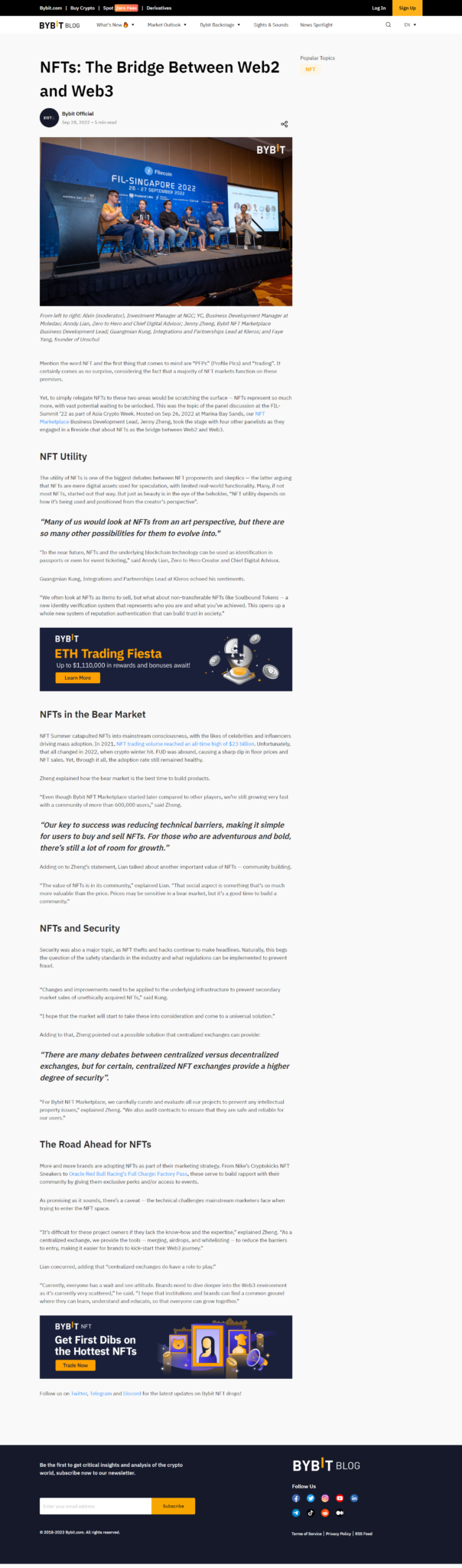
Yet, to simply relegate NFTs to these two areas would be scratching the surface — NFTs represent so much more, with vast potential waiting to be unlocked. This was the topic of the panel discussion at the FIL-Summit ’22 as part of Asia Crypto Week. Hosted on Sep 26, 2022 at Marina Bay Sands, our NFT Marketplace Business Development Lead, Jenny Zheng, took the stage with four other panelists as they engaged in a fireside chat about NFTs as the bridge between Web2 and Web3.


NFT Utility

The utility of NFTs is one of the biggest debates between NFT proponents and skeptics — the latter arguing that NFTs are mere digital assets used for speculation, with limited real-world functionality. Many, if not most NFTs, started out that way. But just as beauty is in the eye of the beholder, “NFT utility depends on how it’s being used and positioned from the creator’s perspective”.


“Many of us would look at NFTs from an art perspective, but there are so many other possibilities for them to evolve into.”


“In the near future, NFTs and the underlying blockchain technology can be used as identification in passports or even for event ticketing,” said Anndy Lian, Zero to Hero Creator and Chief Digital Advisor.

Guangmian Kung, Integrations and Partnerships Lead at Kleros echoed his sentiments.

“We often look at NFTs as items to sell, but what about non-transferable NFTs like Soulbound Tokens — a new identity verification system that represents who you are and what you’ve achieved. This opens up a whole new system of reputation authentication that can build trust in society.”


NFTs in the Bear Market

NFT Summer catapulted NFTs into mainstream consciousness, with the likes of celebrities and influencers driving mass adoption. In 2021, NFT trading volume reached an all-time high of $23 billion. Unfortunately, that all changed in 2022, when crypto winter hit. FUD was abound, causing a sharp dip in floor prices and NFT sales. Yet, through it all, the adoption rate still remained healthy.

Zheng explained how the bear market is the best time to build products.

“Even though Bybit NFT Marketplace started later compared to other players, we’re still growing very fast with a community of more than 600,000 users,” said Zheng.


Our key to success was reducing technical barriers, making it simple for users to buy and sell NFTs. For those who are adventurous and bold, there’s still a lot of room for growth.”


Adding on to Zheng’s statement, Lian talked about another important value of NFTs — community building.

“The value of NFTs is in its community,” explained Lian. “That social aspect is something that’s so much more valuable than the price. Prices may be sensitive in a bear market, but it’s a good time to build a community.”


NFTs and Security

Security was also a major topic, as NFT thefts and hacks continue to make headlines. Naturally, this begs the question of the safety standards in the industry and what regulations can be implemented to prevent fraud.

“Changes and improvements need to be applied to the underlying infrastructure to prevent secondary market sales of unethically acquired NFTs,” said Kung.


“I hope that the market will start to take these into consideration and come to a universal solution.”

Adding to that, Zheng pointed out a possible solution that centralized exchanges can provide:


“There are many debates between centralized versus decentralized exchanges, but for certain, centralized NFT exchanges provide a higher degree of security”.


“For Bybit NFT Marketplace, we carefully curate and evaluate all our projects to prevent any intellectual property issues,” explained Zheng. “We also audit contracts to ensure that they are safe and reliable for our users.”

The Road Ahead for NFTs

More and more brands are adopting NFTs as part of their marketing strategy. From Nike’s Cryptokicks NFT Sneakers to Oracle Red Bull Racing’s Full Charge: Factory Passthese serve to build rapport with their community by giving them exclusive perks and/or access to events.

As promising as it sounds, there’s a caveat — the technical challenges mainstream marketers face when trying to enter the NFT space.

“It’s difficult for these project owners if they lack the know-how and the expertise,” explained Zheng. “As a centralized exchange, we provide the tools — merging, airdrops, and whitelisting — to reduce the barriers to entry, making it easier for brands to kick-start their Web3 journey.”

Lian concurred, adding that “centralized exchanges do have a role to play.”

“Currently, everyone has a wait and see attitude. Brands need to dive deeper into the Web3 environment as it’s currently very scattered,” he said. “I hope that institutions and brands can find a common ground where they can learn, understand and educate, so that everyone can grow together.”


Source: https://blog.bybit.com/en-us/post/nfts-the-bridge-between-web2-and-web3-bltbe72f3340cd9342d/

Anndy Lian is an early blockchain adopter and experienced serial entrepreneur who is known for his work in the government sector. He is a best selling book author- “NFT: From Zero to Hero” and “Blockchain Revolution 2030”.

Currently, he is appointed as the Chief Digital Advisor at Mongolia Productivity Organization, championing national digitization. Prior to his current appointments, he was the Chairman of BigONE Exchange, a global top 30 ranked crypto spot exchange and was also the Advisory Board Member for Hyundai DAC, the blockchain arm of South Korea’s largest car manufacturer Hyundai Motor Group. Lian played a pivotal role as the Blockchain Advisor for Asian Productivity Organisation (APO), an intergovernmental organization committed to improving productivity in the Asia-Pacific region.

An avid supporter of incubating start-ups, Anndy has also been a private investor for the past eight years. With a growth investment mindset, Anndy strategically demonstrates this in the companies he chooses to be involved with. He believes that what he is doing through blockchain technology currently will revolutionise and redefine traditional businesses. He also believes that the blockchain industry has to be “redecentralised”.

j j j