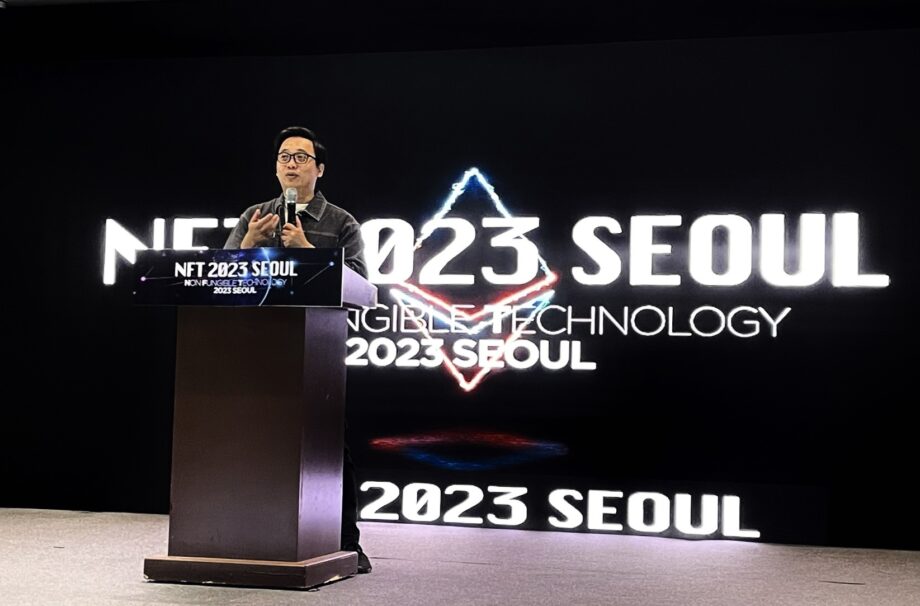
I was honored to be invited as a keynote speaker at the NFT 2023 Seoul conference, which took place on September 1, 2023, at the COEX Convention Center in Seoul, South Korea. The conference was a huge success, attracting many attendees from around the world who were interested in the latest developments and trends in the non-fungible tokens space.
The speech was titled “The Journey of NFTs in the Age of AI and Web3”. In it, I shared my insights on how NFTs have evolved and what their future holds, how artificial intelligence (AI) is creating new possibilities and challenges for NFTs, and how Web3 is emerging as a new version of the internet that is more decentralized, open, and user-centric.
In this article, I will summarize some of my speech’s key points and provide examples of NFT projects that illustrate them. I hope you will find them informative and inspiring.
What Are NFTs?
One of the topics that I covered in my speech was the basic concept and definition of NFTs. NFTs are non-fungible tokens, which means that they are unique and irreplaceable. Unlike fungible tokens, such as cryptocurrencies, that can be exchanged for one another, NFTs have their own individual characteristics and value. They are mostly digital items, such as artworks, music, videos, games, collectibles, and even virtual land, that users can buy and sell online using blockchain technology.
Blockchain technology is the backbone of NFTs, providing a secure and transparent way of verifying their authenticity, scarcity, and ownership. Blockchain is a distributed ledger system that records transactions in a network of computers without the need for a central authority. Each transaction is verified by the network and added to a chain of blocks that cannot be altered or tampered with. This ensures that NFTs are original, rare, and belong to their rightful owners.
The NFT market has been booming in recent years, especially in 2021, when it reached new heights of popularity and profitability. According to data from NonFungible.com, the total sales volume of NFTs in 2021 was over $12 billion, which is more than 20 times higher than the previous year. The average price of an NFT also increased significantly, from $142 in 2020 to $3,700 in 2021.
Some of the more popular and best-selling NFT collections in the market as of last week were:
- Bored Ape Yacht Club: 7-Day Sales Volume: $52.2 million
- The Sandbox: 7-Day Sales Volume: $33.1 million
- CryptoPunks: 7-Day Sales Volume: $17.5 million
- Art Blocks: 7-Day Sales Volume: $13.2 million
- Decentraland: 7-Day Sales Volume: $6.6 million
These collections feature different types of digital assets, such as pixelated characters, generative art, virtual worlds, and more. They have attracted thousands of buyers and sellers from around the world, who are willing to pay millions of dollars for some of the rarest and most coveted pieces. Just to put some figures to illustrate these NFTs. A Bored Ape Yacht Club NFT sold for $24.4 million at Sotheby’s auction house in September 2021.
A CryptoPunk NFT sold for $11.8 million at Christie’s auction house in May 2021. An Art Blocks NFT sold for $5.4 million on the OpenSea platform in August 2021.
How is AI Transforming NFTs?
Another topic I covered in my speech was the impact and potential of artificial intelligence on NFTs. I explained how AI is transforming NFTs by creating new possibilities for generating unique digital assets that can appeal to different tastes and preferences. I also explained how AI can integrate dynamic experiences into NFTs, making them more interactive and adaptive.
One of the ways that AI is creating new possibilities for NFTs is by enabling users to automatically create artworks using various algorithms and models. This means that users do not need to have any artistic skills or experience to create their own NFTs. They can simply use AI tools and platforms that can generate images based on their inputs, such as keywords, styles, colors, and more. Some of the examples of AI-generated NFTs include:
- Artbreeder is a platform that allows users to create and breed images using neural networks. Users can choose from different categories, such as portraits, landscapes, animals, and abstract art, and then adjust various parameters, such as genes, mutations, and mixtures, to create unique images. Users can also combine different images to create hybrids and variations.
- GANksy is a collection of street art created by a generative adversarial network (GAN) inspired by Banksy. A GAN is an AI model consisting of two competing networks: a generator that creates fake images and a discriminator that tries to distinguish them from real ones. The generator learns from the feedback of the discriminator and improves over time. GANksy is a GAN that was trained on hundreds of Banksy artworks and then generated its own original pieces.
- Alethea AI is a platform that enables users to create and trade intelligent NFTs that can speak, interact, and learn. Users can upload their own images or choose from a gallery of pre-made avatars and then use a text-to-speech engine to give them a voice. Users can also customize the personality, mood, and emotion of their NFTs and teach them new skills and knowledge.
Another way that AI is transforming NFTs is by integrating dynamic experiences into them thanks to their self-learning capabilities. This means that NFTs can change over time based on external factors, such as data, events, user actions, and more. This makes them more dynamic compared to more traditional NFTs that often take the form of an image or audio file.
What is Web3 and How Does It Enhance the NFT Ecosystem?
The final topic that I covered in my speech was Web3 and how it enhances the NFT ecosystem. Web3 is a new version of the internet that aims to give users more control over their data and online interactions. Web3 is built on blockchain technology and includes features such as cryptocurrencies, NFTs, and decentralized autonomous organizations (DAOs).
Identity is one of the key features of Web3 that allows users to manage their online identities in a more secure and efficient way without relying on a central authority. Web3 identity solutions enable users to create and use digital wallets on the blockchain that store their personal information, such as name, email, phone number, address, and more.
Users can then use these wallets to access various Web3 applications and services, such as marketplaces, social networks, games, and more. Users can also choose what information they want to share with each application or service and revoke access at any time. Some of the examples of Web3 identity solutions:
- MetaMask is a browser extension that allows users to access Ethereum-based applications. MetaMask acts as a bridge between the user’s browser and the Ethereum network, enabling them to send and receive transactions, interact with smart contracts, and manage their Ethereum accounts.
- Civic is a platform that provides identity verification services using blockchain. Civic allows users to verify their identity once and then use it across multiple platforms without going through the same process again. Civic also protects users’ privacy by using zero-knowledge proofs, which are cryptographic techniques that allow users to prove something without revealing any details.
- ENS (Ethereum Name Service) is a protocol that allows users to register human-readable names for their Ethereum addresses. ENS makes it easier for users to send and receive transactions, as they do not have to deal with long and complex alphanumeric strings. ENS also allows users to attach other information to their names, such as websites, social media profiles, and NFTs.
NFTs are another key feature of Web3 that enhances the ecosystem by offering a decentralized internet where users are not just consumers but active participants. They are unique blockchain tokens that allow users to transparently provide proof of ownership for things such as digital art, music, data, in-game assets, personal records, and more. NFTs also enable users to create, trade, collect, and showcase their digital assets on various Web3 platforms and services.
The Bottom Line
I wrapped up my speech by stressing the importance and potential of the fusion of AI and NFTs in the Web3 era, arguing that the convergence of AI and NFTs will allow us to create and own unique digital assets that can interact with each other and with the environment in dynamic and intelligent ways.
I also argued that Web3 will offer us a more democratic and decentralized internet where we can have more freedom and control over our online identities and experiences.
“Web3 is based on the idea of decentralization, which means that no single entity or authority can control or censor the network. This aligns perfectly with the core values of NFTs, which are based on the idea of ownership, which means that we can prove and transfer our rights to our digital assets. The fusion of AI and NFTs within the context of Web3 opens up a new horizon for innovation and creativity, where we can explore endless possibilities and have greater agency over our digital assets.”
Thank you to the audience for their attention and to the organizers of NFT 2023 Seoul. Find me on X/Twitter at @anndylian.
Source: https://www.techopedia.com/anndy-lians-keynote-speech-at-nft-2023-seoul


Anndy Lian is an early blockchain adopter and experienced serial entrepreneur who is known for his work in the government sector. He is a best selling book author- “NFT: From Zero to Hero” and “Blockchain Revolution 2030”.
Currently, he is appointed as the Chief Digital Advisor at Mongolia Productivity Organization, championing national digitization. Prior to his current appointments, he was the Chairman of BigONE Exchange, a global top 30 ranked crypto spot exchange and was also the Advisory Board Member for Hyundai DAC, the blockchain arm of South Korea’s largest car manufacturer Hyundai Motor Group. Lian played a pivotal role as the Blockchain Advisor for Asian Productivity Organisation (APO), an intergovernmental organization committed to improving productivity in the Asia-Pacific region.
An avid supporter of incubating start-ups, Anndy has also been a private investor for the past eight years. With a growth investment mindset, Anndy strategically demonstrates this in the companies he chooses to be involved with. He believes that what he is doing through blockchain technology currently will revolutionise and redefine traditional businesses. He also believes that the blockchain industry has to be “redecentralised”.