Indian official eyes strategic bitcoin reserve in ‘unique opportunity to lead’ – is it viable?

Indian official eyes strategic bitcoin reserve in ‘unique opportunity to lead’ – is it viable?
A call by a prominent member of India’s ruling Bharatiya Janata Party to establish a strategic bitcoin reserve for the country has stoked debate among digital finance experts over its feasibility.

Insisting that New Delhi had a “unique opportunity to lead” and pointing to trailblazers such as Bhutan, party spokesman Pradeep Bhandari drew attention to whether India’s rapidly growing economy would benefit from a “measured bitcoin strategy” which could strengthen economic resilience and project modernity.

United States President Donald Trump in March signed an executive order creating a Strategic Bitcoin Reserve out of digital tokens seized in criminal and civil forfeiture cases, rather than from the previous practice of selling them off.

Bitcoins have risen by 19 per cent year-to-date to US$111,086.90, helped partly by Trump’s favourable view of the cryptocurrency and his family’s heavy involvement in the industry despite dips in market sentiment over global trade tensions.

Bhandari highlighted in an article late last month that even Bhutan had set up a successful model to build up bitcoin reserves by using hydropower resources to mine the currency – an energy-intensive process that involves creating transaction blocks.

Rival Pakistan too has announced plans to create a sovereign bitcoin reserve powered by unused electricity to monetise its energy oversupply. It established a Pakistan Crypto Council (PCC) in February to set up a framework for investors and entrepreneurs.

A stablecoin firm that is majority-owned by the Trump Organisation signed a letter of intent with the PCC on April 26 to “accelerate blockchain innovation, stablecoin adoption and decentralised finance integration across Pakistan”.

Bitcoins are a form of digital money outside the control of any one person, group or entity, and have been compared to the modern-day equivalent of a traditional asset such as gold.

There exists only a finite number of 21 million bitcoins, which means that unlike assets such as currencies, stocks or bonds, it is not exposed to oversupply risks.

The International Monetary Fund has recently classified bitcoin as a capital asset, which sharpens the need for clear regulation and transparency in the emerging asset class, enabling responsible innovation, according to Bhandari.

Cryptocurrencies are currently unregulated in India. In 2020, the Supreme Court had lifted a ban on cryptocurrency imposed earlier by the country’s Reserve Bank of India (RBI), which had expressed concerns about its use in illegal transactions.

Indians have poured money into cryptocurrencies in recent years, despite the country’s having a tough regulatory stance and steep taxes on the instrument.

“In the long run, a bitcoin reserve could provide several strategic benefits for India,” said Anndy Lian, a Singapore-based intergovernmental blockchain adviser.

Such a reserve could serve as a hedge against inflation due to bitcoin’s fixed supply, help diversify the foreign reserves portfolio and potentially attract foreign investment by signalling India’s openness to innovative financial technologies, he said.

However, the country faces a steep path to establish a new financial reserve reserves framework.

“The feasibility of establishing a bitcoin reserve faces quite a few challenges due to India’s current regulatory environment. The country lacks a comprehensive legal framework for cryptocurrencies, despite imposing a 30 per cent tax on crypto profits and a 1 per cent Tax Deducted at Source on transactions,” Lian said

“To make this viable, India would need to sort out its regulations, creating clear policies for managing a national bitcoin reserve.”

India’s tax structure might require adjustments in addition to developing a secure infrastructure for storing and managing bitcoin, Lian said, adding that it would also need to step up efforts to build public trust through education.

The nation could think of starting a pilot programme, potentially using seized bitcoin to test feasibility while regulations are refined, Lian said.

Raj Kapoor, chairman of India Blockchain Alliance, agreed the country needed to boost efforts to make the bitcoin reserve viable.

“It is a good proposal on paper, but it won’t be workable until we clear a few cobwebs. There is regulatory uncertainty and jurisdictional ambiguity on cryptocurrency in India,” he said.

With Pakistan appearing to have edged ahead with apparent support from the US and China, Kapoor said India needed to “address gaping holes. How are we talking of a bitcoin reserve without a policy on cryptocurrency in place?”.

One of the biggest obstacles for Delhi is the RBI resisting the widespread adoption of cryptocurrency, apparently stemming from concerns over whether it could dilute its oversight and control of the sovereign rupee currency, he said.

The country could consider a digital asset regulatory authority under the oversight of the central bank that could address any concerns, Kapoor said, noting the Securities and Exchange Board of India’s loose regulation of cryptocurrencies.

“You have to integrate a lot of things before we arrive at a national bitcoin reserve,” he said.

Leveraging strengths

Analysts note that India could also leverage its position as a global hub for information technology services to establish such a digital finance reserve.

Benjamin Grolimund, UAE general manager at Flipster, said introducing a bitcoin reserve for India would hinge upon both policy and infrastructure.

According to Grolimund, India has an advantage of having established a Unified Payment Interface – a real-time payment system which facilitates peer-to-peer payments and peer-to-merchant payments.

“But integrating bitcoin into national reserves will demand more – including secure custody, audit and transparency measures,” he said, adding that controls would also be needed for managing them as sovereign assets.

Grolimund said a national bitcoin reserve established together with a clear policy framework would signal “India’s readiness to play a leading role in shaping the global digital asset landscape”.

He warned, however, of sending “mixed signals” should the government support bitcoin at the state level while limiting access for individuals.

“If Bhandari’s proposal serves as a gateway to broader regulatory clarity and retail adoption, the short-term inconsistency may be a necessary step in India’s evolution,” he said. “The country has already proven its strength in building world-class digital public infrastructure and pioneering fintech models.”


 

Source: https://www.scmp.com/week-asia/economics/article/3317730/indian-official-eyes-strategic-bitcoin-reserve-unique-opportunity-lead-it-viable

Anndy Lian is an early blockchain adopter and experienced serial entrepreneur who is known for his work in the government sector. He is a best selling book author- “NFT: From Zero to Hero” and “Blockchain Revolution 2030”.

Currently, he is appointed as the Chief Digital Advisor at Mongolia Productivity Organization, championing national digitization. Prior to his current appointments, he was the Chairman of BigONE Exchange, a global top 30 ranked crypto spot exchange and was also the Advisory Board Member for Hyundai DAC, the blockchain arm of South Korea’s largest car manufacturer Hyundai Motor Group. Lian played a pivotal role as the Blockchain Advisor for Asian Productivity Organisation (APO), an intergovernmental organization committed to improving productivity in the Asia-Pacific region.

An avid supporter of incubating start-ups, Anndy has also been a private investor for the past eight years. With a growth investment mindset, Anndy strategically demonstrates this in the companies he chooses to be involved with. He believes that what he is doing through blockchain technology currently will revolutionise and redefine traditional businesses. He also believes that the blockchain industry has to be “redecentralised”.

j j j

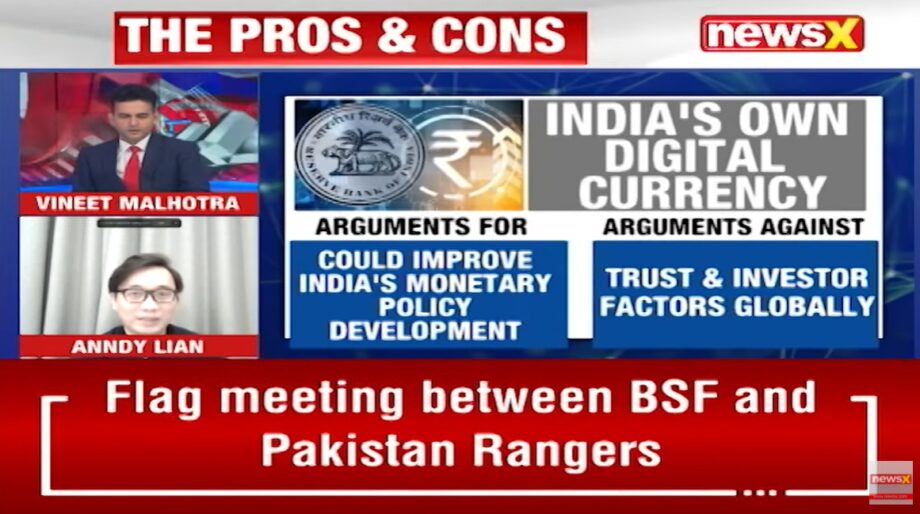
Anndy Lian on NewsX: India’s Official Digital Currency. Time To Make A Shift?

Anndy Lian on NewsX: India’s Official Digital Currency. Time To Make A Shift?

The development of Bitcoin and thousands of other cryptocurrencies these past few years have left India needing to create a framework for the creation of an official digital currency, which will be issued by the Reserve Bank of India (RBI). A bill in this regard is planned to be tabled in the upcoming winter session of the parliament.

The Indian government is worried about the volatility of cryptocurrency, how it can be misused, and cryptocurrencies’ impact on the country and its economic situation. The primary idea of the RBI behind this move is to protect consumers from the appalling level of volatility seen in digital currency. The governor of RBI went to the extent of saying that cryptocurrencies pose a serious concern to the macroeconomic and financial stability of India.

It has been reported that a huge amount of ₹$40,000 (rupees) have already been spent when it comes to cryptocurrency. Furthermore, the idea of cryptocurrency was, when it was formulated in 2008, to bypass the banking system. This brought rise to RBI’s worry that cryptocurrency will overtake the banking system when it comes to investments in India.

Back when cryptocurrencies were banned in China, the fallout was that a lot of people and a lot of that investment and interest were redirected to the USA. India does not want to make that same mistake. It is almost certain that there will be a lot of problems if there is a blanket ban on cryptocurrency in India.

India is all set to create a framework for the creation of an official digital currency that will be issued by RBI. NewsX invited a panel of experts to talk about the topic. The expert panel consists of Akash Jindal, Sr Economist; Siddhartha Sogani, CEO of Creabaco Global Inc., Bitcoin Expert; Hanif Shaikh, CEO of Upsocial Network, Crypto Expert and Anndy Lian, Chairman, BigONE Exchange and Founding Member of Influxo. News Anchor, Vineet Malhotra discussed the following topics:

• How will this impact the total economic atmosphere of the country?
• Are cryptocurrencies such a threat to the economic environment of any country?
• What is the next step for India?
• How important is the concept of decentralisation when it comes to cryptocurrency?

Here’s what BigONE Chairman Anndy Lian had to say in an interview with India’s NewsX:

The right direction is to embrace cryptocurrency in all manners – because cryptocurrency is here to stay. It is the future of currency. In whatever way that it is called – currency or digital asset – it must be embraced.

Mainstream media may always say that cryptocurrencies are illegal as it may involve money laundering, among other things. But the fact is that the top currency used to carry out such illegal things is the very common US dollar.

Every move made via a blockchain is recorded on the chain. If Bitcoin is sent to a dodgy account, it’s going to be recorded on the chain. How will these dodgy accounts cash it out? Will they be so daring to do that?

BigONE is on the Top 40 list globally. All good exchanges must go through the same regulatory steps to ensure Know-Your-Customer (KYC) and Anti-Money Laundering (AML) processes are carried out. Through these frameworks, illegal acts are minimised.

Decentralisation does not, in any way, mean the removal of governments of taxes. It must be emphasised that when it comes to decentralisation, there is no intention of moving away from countries’ legacy systems or financial systems. Nonetheless, people are living in the real world, and not in the metaverse. Actual, physical money is still required to live as we head into the future.

The term “decentralisation” must not be tweaked in such a way that it is portrayed to be a bad thing. There exists proper entities – proper companies – to back the system. In the cryptocurrency world, everything needs to be registered. When founders of a project are doxxed, documentation to prove that will be kept in a centralised depository. If anything were to happen, tracing back to the person or team in charge will not be an issue.

It is imperative to redefine the term “decentralised” such that governments, family offices, and traditional banking staff know what it means exactly. In comparison to the traditional space, what is experienced in the cryptocurrency world is actually no different. For exchanges such as BigONE, different kinds of available financial requirements are stringently addressed. In this way, proper regulation is assured. Let’s be open-minded and address it.

The Indian government and crypto practitioners are open-minded and progressive about cryptocurrency. As the bill gets drafted, it is good that they would have all the experts to provide their confounding, broad, and elaborate views on what the cryptocurrency market pertains to, as well as the volatility and risks.

This is the second time Anndy Lian is invited to the NewsX Live commentary segment. The first time was with Garrett Minks, Founder & CTO, Rair and Vishal Malhotra, Actor on NFT.

The full video can be found on NewsX official channel:

Anndy Lian is an early blockchain adopter and experienced serial entrepreneur who is known for his work in the government sector. He is a best selling book author- “NFT: From Zero to Hero” and “Blockchain Revolution 2030”.

Currently, he is appointed as the Chief Digital Advisor at Mongolia Productivity Organization, championing national digitization. Prior to his current appointments, he was the Chairman of BigONE Exchange, a global top 30 ranked crypto spot exchange and was also the Advisory Board Member for Hyundai DAC, the blockchain arm of South Korea’s largest car manufacturer Hyundai Motor Group. Lian played a pivotal role as the Blockchain Advisor for Asian Productivity Organisation (APO), an intergovernmental organization committed to improving productivity in the Asia-Pacific region.

An avid supporter of incubating start-ups, Anndy has also been a private investor for the past eight years. With a growth investment mindset, Anndy strategically demonstrates this in the companies he chooses to be involved with. He believes that what he is doing through blockchain technology currently will revolutionise and redefine traditional businesses. He also believes that the blockchain industry has to be “redecentralised”.

j j j

Korea eSports Industry Association Official Meeting: Pushing Gaming to New Heights with Blockchain

Korea eSports Industry Association Official Meeting: Pushing Gaming to New Heights with Blockchain

The Korea eSports Industry Association (KeIA) held an official meeting to update their core members on the latest work carried out in both the Korean and international markets.

KeIA aims to revitalize the eSports industry, protect the rights of esports players and create win-win cooperation and synergies between members of the Association and their affiliations.

Chairman of KeIA, Bong Kyu Park welcomed everyone to the meeting and looked forward to a pleasant and exciting year ahead for the esports scene in South Korea. “South Korea has been one of the most active in eSports. We took part and won many international tournaments. This year, I will lead KeIA together with my Secretary General James Kim promoting eSports and getting ourselves connected to new markets. We are not just a Korean Association, we are international with existing partners in China, Singapore, Vietnam and beyond.”

Deputy Secretary General Tae Yoon Kim told our Blockcast.cc reporter: “I am particularly interested in reaching out to the European markets. For this meeting, we invited foreign guests to share their experiences with us. We want to explore how blockchain technology can help us promote esports more effectively. We want to build the market together and spread the esports Korean culture globally.”

“Thank you to Chairman Park for the invitation. As a blockchain gaming platform, we allow gamers to communicate with other gamers, manage their digital gaming assets and be rewarded with GMRX tokens for allowing our platform to use their GPU power. This is the power of our gaming platform. You can find out more at www.gaimin.io and the mining plugin will be launched to the public for download very soon.” said Clive Aroskin, COO of Gaimin.io, who gave a speech during the meeting. He also shared how their IEO with Biconomy had introduced global gamers to the platform and he hopes to share their experiences with the Association.

Anndy Lian who is an active member in the Korean technology community is being appointed as the Chairman for Singapore at KeIA: “I believe that blockchain technology and the usage of cryptocurrencies will transform the eSports industry as it opens up new global communities for the games to grow. Blockchain is the future of esports, it helps to fill up existing issues and gaps like payment along with bridging online and offline assets. As the chairman, I want to bring my international experiences to the KeIA and connect the KeIA to global companies and players.”

According to Statista, the eSports industry will reach USD1.79 billion in 2022, while blockchain technology revenues are expected to climb to over USD23.3 billion in size by 2023. A combination of both industries will produce revenues in the trillions of dollars over the coming years.

eSports will be the new growth engine to lead innovation in the economic world during this Fourth Industrial Revolution. For more information about KeIA, go to http://e-keia.com/.

Media Contact:

Company: Blockcast.cc
Media Contact: Jenny Zheng
Title: Editor
Contact Number: +65 9883 2707
Email: contact@blockcast.cc
Country: South Korea


Original Source:

https://blockcast.cc/press-releases/korea-esports-industry-association-official-meeting-pushing-gaming-to-new-heights-with-blockchain/


Anndy Lian is an early blockchain adopter and experienced serial entrepreneur who is known for his work in the government sector. He is a best selling book author- “NFT: From Zero to Hero” and “Blockchain Revolution 2030”.

Currently, he is appointed as the Chief Digital Advisor at Mongolia Productivity Organization, championing national digitization. Prior to his current appointments, he was the Chairman of BigONE Exchange, a global top 30 ranked crypto spot exchange and was also the Advisory Board Member for Hyundai DAC, the blockchain arm of South Korea’s largest car manufacturer Hyundai Motor Group. Lian played a pivotal role as the Blockchain Advisor for Asian Productivity Organisation (APO), an intergovernmental organization committed to improving productivity in the Asia-Pacific region.

An avid supporter of incubating start-ups, Anndy has also been a private investor for the past eight years. With a growth investment mindset, Anndy strategically demonstrates this in the companies he chooses to be involved with. He believes that what he is doing through blockchain technology currently will revolutionise and redefine traditional businesses. He also believes that the blockchain industry has to be “redecentralised”.

j j j