Bybit and Digital Artist Per Kristian Stoveland Sell Out Exclusive Collection, Open Edition Sales Ongoing

Bybit and Digital Artist Per Kristian Stoveland Sell Out Exclusive Collection, Open Edition Sales Ongoing

Bybit, the world’s third most visited crypto exchange, have released their second digital art drop as part of their partnership with Oracle Red Bull Racing. The limited-edition collection of 200 NFTs were sold via Dutch auction on Sept. 20, and sold out within one hour for a total of 74.5 ETH ($168,434).

The collection: “Pursuit” by Per Kristian Stoveland, launched in conjunction with the Japan Grand Prix,and holders of the original Velocity Pass NFT had exclusive access to the auction. In the 24 hours since launch “Pursuit” has racked up over 106ETH ($113,433) in secondary sales. Sales of Per Kristian Stoveland’s open edition collection “Echo of Intensity” are ongoing on Bybit.

Per Kristian Stoveland, who designed the collection, is a generative artist hailing from Oslo, Norway. “Pursuit” is the second release as part of the Velocity Series, a revolutionary Web3 experience that brings together the talents of the world’s premier digital artists.

Drawing on his mastery of generative art and his innovative use of p5js, a creative coding framework, Per K’s collection encapsulates the raw power and velocity of Oracle Red Bull Racing’s RB19 race car. The collection is a symphony of light streaks that tear through desolate landscapes, igniting a captivating dance of dust. As part of the Velocity Series, “Pursuit” is curated in collaboration with AOI, a foundation for emerging art and technology.

“Bybit and Oracle Red Bull Racing are proud to pioneer the future of art and technology through the Velocity Series,” said Anndy Lian, head of partnerships at Bybit. “This collaboration transcends traditional boundaries, ushering in a new era where speed, creativity, and digital art harmoniously intersect.”

The Velocity Series showcases the intersection of cutting-edge innovation and creative expression, offering art enthusiasts, collectors, and racing fans the chance to engage with this fusion of art and racing data.

Bybit is a top-five cryptocurrency exchange established in 2018 that offers a professional platform where crypto investors and traders can find an ultra-fast matching engine, 24/7 customer service, and multilingual community support. Bybit is a proud partner of Formula One’s reigning Constructors’ and Drivers’ champions: the Oracle Red Bull Racing team.


Source: https://finance.yahoo.com/news/bybit-digital-artist-per-kristian-100000685.html

Anndy Lian is an early blockchain adopter and experienced serial entrepreneur who is known for his work in the government sector. He is a best selling book author- “NFT: From Zero to Hero” and “Blockchain Revolution 2030”.

Currently, he is appointed as the Chief Digital Advisor at Mongolia Productivity Organization, championing national digitization. Prior to his current appointments, he was the Chairman of BigONE Exchange, a global top 30 ranked crypto spot exchange and was also the Advisory Board Member for Hyundai DAC, the blockchain arm of South Korea’s largest car manufacturer Hyundai Motor Group. Lian played a pivotal role as the Blockchain Advisor for Asian Productivity Organisation (APO), an intergovernmental organization committed to improving productivity in the Asia-Pacific region.

An avid supporter of incubating start-ups, Anndy has also been a private investor for the past eight years. With a growth investment mindset, Anndy strategically demonstrates this in the companies he chooses to be involved with. He believes that what he is doing through blockchain technology currently will revolutionise and redefine traditional businesses. He also believes that the blockchain industry has to be “redecentralised”.

j j j

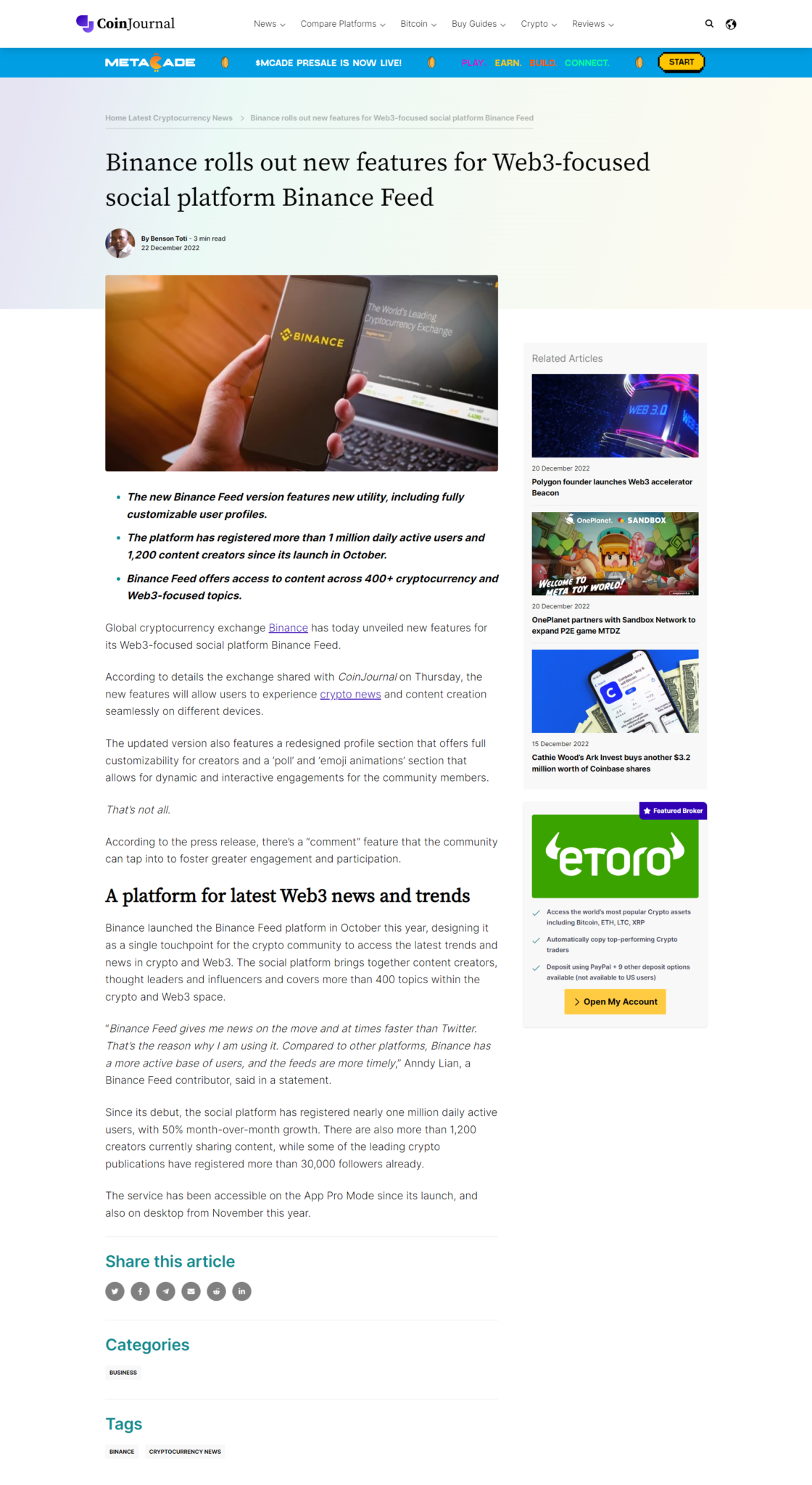
Binance rolls out new features for Web3-focused social platform Binance Feed

Binance rolls out new features for Web3-focused social platform Binance Feed
  • The new Binance Feed version features new utility, including fully customizable user profiles.
  • The platform has registered more than 1 million daily active users and 1,200 content creators since its launch in October.
  • Binance Feed offers access to content across 400+ cryptocurrency and Web3-focused topics.

Global cryptocurrency exchange Binance has today unveiled new features for its Web3-focused social platform Binance Feed.

According to details the exchange shared with CoinJournal on Thursday, the new features will allow users to experience crypto news and content creation seamlessly on different devices.

The updated version also features a redesigned profile section that offers full customizability for creators and a ‘poll’ and ‘emoji animations’ section that allows for dynamic and interactive engagements for the community members.

That’s not all.

According to the press release, there’s a “comment” feature that the community can tap into to foster greater engagement and participation.

A platform for latest Web3 news and trends

Binance launched the Binance Feed platform in October this year, designing it as a single touchpoint for the crypto community to access the latest trends and news in crypto and Web3. The social platform brings together content creators, thought leaders and influencers and covers more than 400 topics within the crypto and Web3 space.

Binance Feed gives me news on the move and at times faster than Twitter. That’s the reason why I am using it. Compared to other platforms, Binance has a more active base of users, and the feeds are more timely,” Anndy Lian, a Binance Feed contributor, said in a statement.

Since its debut, the social platform has registered nearly one million daily active users, with 50% month-over-month growth. There are also more than 1,200 creators currently sharing content, while some of the leading crypto publications have registered more than 30,000 followers already.

The service has been accessible on the App Pro Mode since its launch, and also on desktop from November this year.

Source: htttps://coinjournal.net/news/binance-rolls-out-new-features-for-web3-focused-social-platform-binance-feed/

Anndy Lian is an early blockchain adopter and experienced serial entrepreneur who is known for his work in the government sector. He is a best selling book author- “NFT: From Zero to Hero” and “Blockchain Revolution 2030”.

Currently, he is appointed as the Chief Digital Advisor at Mongolia Productivity Organization, championing national digitization. Prior to his current appointments, he was the Chairman of BigONE Exchange, a global top 30 ranked crypto spot exchange and was also the Advisory Board Member for Hyundai DAC, the blockchain arm of South Korea’s largest car manufacturer Hyundai Motor Group. Lian played a pivotal role as the Blockchain Advisor for Asian Productivity Organisation (APO), an intergovernmental organization committed to improving productivity in the Asia-Pacific region.

An avid supporter of incubating start-ups, Anndy has also been a private investor for the past eight years. With a growth investment mindset, Anndy strategically demonstrates this in the companies he chooses to be involved with. He believes that what he is doing through blockchain technology currently will revolutionise and redefine traditional businesses. He also believes that the blockchain industry has to be “redecentralised”.

j j j

Navigating the uncharted legal territory of NFT: What to avoid?

Navigating the uncharted legal territory of NFT: What to avoid?

According to the NFT aggregator platform- CryptoSlam, the market for Non-Fungible Tokens (NFTs) plummeted from its peak of $17 billion in early 2022 to $460 million in October 2022, a staggering decline of 97.3%. While the decrease in NFT transaction volume may be partially attributed to dropping cryptocurrency prices, NFT developers continue to create NFT. In fact, creators are confident that the NFT industry will recover. We see new projects popping up every day on Twitter. We see different projects challenging the Number 1 spot on sales volume. At the point of publishing, Art Globblers are topping the charts. I see centralized marketplaces like Bybit are still selling out their Mystery Boxes. Everyone is building harder than before.

Taking the sentiments from the ground and as per the requests from various communities asking about NFT regulations, I have decided to share some insights on legal implications and the regulatory side of things so that you will be aware and up to speed on the state of the NFT sector.

Around 105 nations have legalized NFTs either expressly or as part of a larger recognition of cryptocurrencies and virtual currencies. However, as the aforementioned list illustrates, legislation regarding NFTs is frequently general and not designed mainly for NFTs.

The U.S., Canada, Australia, and most of the European Union are notable examples of markets that are integrated and moderately regulated. In each of these jurisdictions, the predominant legal strategy is to view NFTs as either a type of capital gains taxable asset or a component of an individual’s income tax portfolio. However, there are still a lot of nations where NFTs and cryptocurrencies are either implicitly or expressly banned. This is largely because those governments view NFTs and other digital assets as threats to the current financial system and sources of illicit and/or terrorist financing. China, Vietnam, Algeria, Egypt, Qatar and Nepal are notable instances.

I will go through a few markets.

U.S.A

Although there are no particular NFT legislation in the US, similar to the UK, some NFT crypto-asset kinds may be covered by already-existing federal statutes. For instance, the Securities and Exchange Commission (SEC) may treat specific types of NFT as securities under US securities law.

India

Since there is no official legal framework for NFTs and no classification of NFTs under the SCRA, it is unclear if dealing in NFTs is forbidden under the Securities Contract Regulation Act, 1956 (“SCRA”). If NFTs are deemed to constitute derivatives, trading in them would be prohibited in India.

Singapore

Singapore’s central bank has recently announced that it will not regulate the NFT market. Recently, under Singapore law, it will be subject to MAS’ regulatory requirements if an NFT has the characteristics of a capital markets product under the Securities and Futures Act (SFA). Similarly, should an NFT have the features of a digital payment token under the Payment Services Act (PSA).

U.K.

NFTs are not subject to any special NFT rules in the U.K., but they are recognized as a kind of crypto asset. To be more precise, it can be classified as a security token, an e-money token, or an unregulated token. However, most NFTs are not regulated since they do not meet the first two prerequisites. Even if it does, it can still result in broad regulations, such as an anti-laundering rule for art sales over €10,000 and capital gains tax if purchased or sold at a profit. Strict laws require consumers to be adequately informed and warned about the risk of loss or price volatility if public advertisements promote NFTs.

China

NFTs can currently be purchased or sold by individuals in Mainland China. NFTs are not presently subject to any specific laws or regulations. The National Internet Finance Association of China, the Securities Association of China, and the China Banking Association jointly released an initiative regarding the prevention of financial risks associated with NFTs. Because the three associations are under the supervision of the central bank, the banking regulatory authority, and the security regulatory authority, respectively, and because the Initiative is not a regulation under PRC law, it reflects the attitudes and policy orientation of regulators in Mainland China. For some time, the word “NFT” was also deemed a sensitive word and temporarily blocked by some official media sites.

Japan

While there are presently no particular regulations in Japan that govern NFTs, the government said in January 2022 that it was creating an NFT task force, which suggests that regulation is soon to come. Currently, an NFT may meet the definition of a security under the Financial Instruments and Exchange Act if its holder receives cash or other assets that represent a sharing of profits. It should be carefully considered whether NFTs violate gambling laws, which are especially important for NFTs employed in games.

Now that you have read briefly how the regulators around the world look at NFTs in general. If you are an entrepreneur, your DNA could be telling you to be a creator or start an NFT Marketplace. So what are some legal considerations if you want to create a business like an NFT marketplace? What do you need to do?

  • Creation of a legal entity: A corporate body must first be established before a marketplace can be introduced. Your company will benefit from the most robust liability protection, increased capability, and credibility while looking for outside financing.
  • Formation of smart contracts: The digital work must be individually recognizable and have transferrable ownership within the smart contract. The economics of trading should be included in the creation process, including how much to charge for a primary sale, how much to charge for a secondary sale, royalties, transaction costs, and other characteristics of the aftermarket to facilitate trade with money naturally flowing to the right parties.
  • Terms of service: It regulates the interactions between users and the NFT marketplace operator, as well as between buyers and sellers of the NFTs displayed on the platform, which is a necessary component of NFT marketplaces. A carefully drafted term of service agreement will typically include clauses that limit the company’s overall responsibility and can aid in defending your firm from several legal problems.
  • Terms of sale: If the platform’s terms of service do not adequately address risks to the seller or creator, sellers or creators listing their NFTs on an NFT marketplace may choose to impose additional terms of sale on buyers of their NFT.
  • Securities law compliance: It’s critical to develop features that show the difference between your newly minted token and what governments seek to regulate to ensure it doesn’t have the characteristics of a security.
  • Intellectual property: It is crucial to confirm the validity of each participant’s intellectual property rights at every stage of every NFT transaction. Copyright ownership, which belongs to the original work’s creator, governs the original work. Make careful to divide up intellectual property ownership among the authors, artists, buyers, collectors, and other parties.
  • Consumer protection: Most jurisdictions have consumer protection laws. Consider a scenario where an NFT marketplace fails to appropriately notify its clients about the products they are buying and the hazards involved. Cybercriminals will probably attack NFTs in order to profit financially. To protect against these attacks, your platforms will need reliable controls. Other regulatory standards, including KYC and anti-money laundering, might also need to be implemented.

The fast-changing NFT space, where digital assets prevail, was not considered when developing the current regulatory and legal framework. However, some crucial challenges have surfaced as investors, financial institutions, and fintech firms investigate this market. Is there a gateway to your platform that guards against money launderers and other undesirable parties subject to government sanctions?

NFTs are indeed not treated as cryptocurrencies right now. Regulators are trying to clamp down on grey NFT projects and have warned the general public about buying NFT. So far, I have been talking about how governments look at us and what entrepreneurs need to understand when they start their NFT business as a marketplace. I have come out with a few quick reminders for consumers when buying NFT.

3 Quick Reminders on NFT Buying

  • Do not buy NFTs that include securities, insurance or other financial assets as the underlying value of NFTs. An NFT may become a regulated financial product if it grants its owner the right to income streams or a stake in an underlying portfolio of investment assets. There are many grey examples to be named.
  • Do check on the copyright behind the NFTs. Some of the creators are plagiarizing artists’ original work. Playboy Enterprises filed a lawsuit against the owners of a website that was constructed to seem like the one Playboy used to market their “Rabbitar” NFTs. Playboy claims that the scam was successful because more than a thousand customers fell for it and collectively paid more than a million dollars for Rabbitars they never received.
  • Do remember that trading NFTs for profit is subjected to capital gain tax. It is good to consider all tax implications before making the trade. Take India, for example. All virtual digital assets, including NFTs, are subject to the government’s 30% tax levied.

NFT is a beautiful term and has excellent potential. As crypto community members, we should try our best to keep it clean and proper. Hiding financial products or securities behind an NFT is not an excellent way to support innovation. It will give the regulators a chance to kill the innovation. You need to understand regulations to grow in the right manner. #anndylian


Source: https://www.securities.io/navigating-the-legal-territory-of-nft-what-to-look-out-for/


Anndy Lian is an early blockchain adopter and experienced serial entrepreneur who is known for his work in the government sector. He is a best selling book author- “NFT: From Zero to Hero” and “Blockchain Revolution 2030”.

Currently, he is appointed as the Chief Digital Advisor at Mongolia Productivity Organization, championing national digitization. Prior to his current appointments, he was the Chairman of BigONE Exchange, a global top 30 ranked crypto spot exchange and was also the Advisory Board Member for Hyundai DAC, the blockchain arm of South Korea’s largest car manufacturer Hyundai Motor Group. Lian played a pivotal role as the Blockchain Advisor for Asian Productivity Organisation (APO), an intergovernmental organization committed to improving productivity in the Asia-Pacific region.

An avid supporter of incubating start-ups, Anndy has also been a private investor for the past eight years. With a growth investment mindset, Anndy strategically demonstrates this in the companies he chooses to be involved with. He believes that what he is doing through blockchain technology currently will revolutionise and redefine traditional businesses. He also believes that the blockchain industry has to be “redecentralised”.

j j j