Telegram’s policy shift raises privacy concerns

Telegram’s policy shift raises privacy concerns

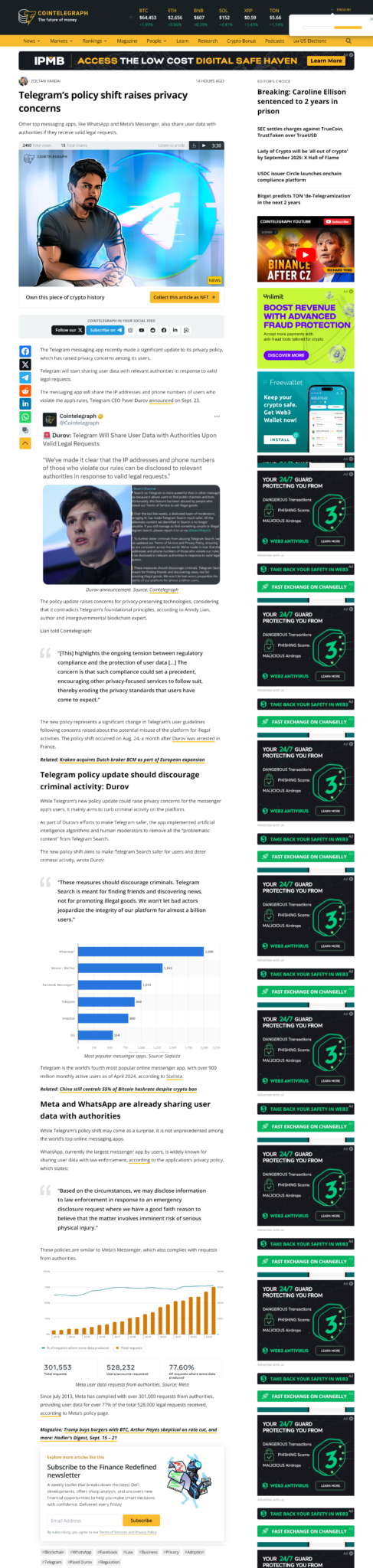
The Telegram messaging app recently made a significant update to its privacy policy, which has raised privacy concerns among its users.

Telegram will start sharing user data with relevant authorities in response to valid legal requests.

The messaging app will share the IP addresses and phone numbers of users who violate the app’s rules, Telegram CEO Pavel Durov announced on Sept. 23.

The policy update raises concerns for privacy-preserving technologies, considering that it contradicts Telegram’s foundational principles, according to Anndy Lian, author and intergovernmental blockchain expert.

Lian told Cointelegraph:

“[This] highlights the ongoing tension between regulatory compliance and the protection of user data […] The concern is that such compliance could set a precedent, encouraging other privacy-focused services to follow suit, thereby eroding the privacy standards that users have come to expect.”

The new policy represents a significant change in Telegram’s user guidelines following concerns raised about the potential misuse of the platform for illegal activities. The policy shift occurred on Aug. 24, a month after Durov was arrested in France.

Telegram policy update should discourage criminal activity: Durov

While Telegram’s new policy update could raise privacy concerns for the messenger app’s users, it mainly aims to curb criminal activity on the platform.

As part of Durov’s efforts to make Telegram safer, the app implemented artificial intelligence algorithms and human moderators to remove all the “problematic content” from Telegram Search.

The new policy shift aims to make Telegram Search safer for users and deter criminal activity, wrote Durov:

“These measures should discourage criminals. Telegram Search is meant for finding friends and discovering news, not for promoting illegal goods. We won’t let bad actors jeopardize the integrity of our platform for almost a billion users.”

Telegram is the world’s fourth most popular online messenger app, with over 900 million monthly active users as of April 2024, according to Statista.

Related: China still controls 55% of Bitcoin hashrate despite crypto ban

Meta and WhatsApp are already sharing user data with authorities

While Telegram’s policy shift may come as a surprise, it is not unprecedented among the world’s top online messaging apps.

WhatsApp, currently the largest messenger app by users, is widely known for sharing user data with law enforcement, according to the application’s privacy policy, which states:

“Based on the circumstances, we may disclose information to law enforcement in response to an emergency disclosure request where we have a good faith reason to believe that the matter involves imminent risk of serious physical injury.”

These policies are similar to Meta’s Messenger, which also complies with requests from authorities.

Since July 2013, Meta has complied with over 301,000 requests from authorities, providing user data for over 77% of the total 528,000 legal requests received, according to Meta’s policy page.


Source: https://cointelegraph.com/news/telegram-policy-shift-privacy-concerns
 

Anndy Lian is an early blockchain adopter and experienced serial entrepreneur who is known for his work in the government sector. He is a best selling book author- “NFT: From Zero to Hero” and “Blockchain Revolution 2030”.

Currently, he is appointed as the Chief Digital Advisor at Mongolia Productivity Organization, championing national digitization. Prior to his current appointments, he was the Chairman of BigONE Exchange, a global top 30 ranked crypto spot exchange and was also the Advisory Board Member for Hyundai DAC, the blockchain arm of South Korea’s largest car manufacturer Hyundai Motor Group. Lian played a pivotal role as the Blockchain Advisor for Asian Productivity Organisation (APO), an intergovernmental organization committed to improving productivity in the Asia-Pacific region.

An avid supporter of incubating start-ups, Anndy has also been a private investor for the past eight years. With a growth investment mindset, Anndy strategically demonstrates this in the companies he chooses to be involved with. He believes that what he is doing through blockchain technology currently will revolutionise and redefine traditional businesses. He also believes that the blockchain industry has to be “redecentralised”.

j j j

Bitcoin Policy Competition Between China and US Would Benefit Industry, Says Justin Sun

Bitcoin Policy Competition Between China and US Would Benefit Industry, Says Justin Sun

Tron founder Justin Sun has urged China to reassess its position on Bitcoin, following former President Donald Trump’s endorsement of the digital currency and plans to make the U.S. the world crypto capital.

Trump pledged to create a “strategic Bitcoin stockpile” for the U.S. during his keynote address at the Bitcoin 2024 conference in Nashville on Saturday. 

“As the final part of my plan today, I am announcing that if I am elected, it will be the policy of my administration, the United States of America, to keep 100% of all the Bitcoin the U.S. government currently holds or acquires into the future,” Trump stated. “I hope you do well.”

Responding to Trump’s comments, Sun, a prominent figure in the crypto world, said competition between the two countries is likely to benefit the entire industry.

“China also needs to step up. Since President Trump pushed for Bitcoin, U.S. policies have warmed. China should make further progress in this area. Competition between China and the U.S. in Bitcoin policy will benefit the entire industry,” Sun said on Twitter.

This statement comes against the backdrop of China’s historically stringent stance on cryptocurrencies.

The country, once a global leader in Bitcoin mining and trading, has implemented some of the world’s most restrictive policies on digital currencies in recent years.

In 2013, the country emerged as a powerhouse in the crypto space, with Chinese miners accounting for more than 70% of the Bitcoin network’s mining power by 2017.

However, September 2017 marked a turning point when the government banned Initial Coin Offerings (ICOs) and ordered the closure of domestic cryptocurrency exchanges.

Despite these initial restrictions, mining operations continued to thrive in China due to cheap electricity—particularly in regions like Inner Mongolia, Xinjiang, and Sichuan. This allowed China to maintain its dominance in the global crypto mining landscape for several years.

However, the situation changed dramatically in 2021. In May of that year, Chinese Vice Premier Liu He announced a sweeping crackdown on Bitcoin mining and trading.

This was followed by a series of regulatory actions, culminating in September 2021 when the government declared all cryptocurrency transactions illegal, effectively banning mining nationwide.

The Chinese government cited several reasons for this hardline approach, including concerns over financial stability, environmental impact due to mining operations’ high energy consumption, prevention of capital flight, and the desire to maintain control over the financial system.

The impact of China’s ban was felt globally.

The Bitcoin network’s hash rate dropped by over 50% temporarily, and there was a mass exodus of mining operations to countries like KazakhstanRussia, and the United States.

While cracking down on decentralized cryptocurrencies, China has been actively developing its own Central Bank Digital Currency (CBDC), the digital yuan.

This state-controlled digital currency is seen as a way for China to modernize its monetary system while maintaining oversight of financial transactions.

Sun’s call for China to “step up” in the realm of Bitcoin policy represents a significant challenge to this status quo, suggesting that China risks falling behind in the global race for cryptocurrency adoption and innovation if it maintains its current prohibitive stance.

Industry experts suggest that a shift in China’s Bitcoin policy could have far-reaching implications for the global cryptocurrency market.

“The U.S., especially under President Trump and following administrations, has shown growing support for Bitcoin, establishing itself as a leader in the global crypto space. If China were to take a similar path, it could lead to healthy competition between the two economic powerhouses,” Anndy Lian, author and intergovernmental blockchain expert told Decrypt. “This competition could lead to advancements in blockchain technology, better regulatory frameworks, and broader cryptocurrency adoption.”

He added that the global market would benefit from increased liquidity, enhanced security measures, and stronger infrastructure. Additionally, balanced regulations in both countries could help mitigate risks related to volatility and fraud, increasing investor confidence.


Source: https://decrypt.co/242176/us-vs-china-bitcoin-competition-justin-sun

Anndy Lian is an early blockchain adopter and experienced serial entrepreneur who is known for his work in the government sector. He is a best selling book author- “NFT: From Zero to Hero” and “Blockchain Revolution 2030”.

Currently, he is appointed as the Chief Digital Advisor at Mongolia Productivity Organization, championing national digitization. Prior to his current appointments, he was the Chairman of BigONE Exchange, a global top 30 ranked crypto spot exchange and was also the Advisory Board Member for Hyundai DAC, the blockchain arm of South Korea’s largest car manufacturer Hyundai Motor Group. Lian played a pivotal role as the Blockchain Advisor for Asian Productivity Organisation (APO), an intergovernmental organization committed to improving productivity in the Asia-Pacific region.

An avid supporter of incubating start-ups, Anndy has also been a private investor for the past eight years. With a growth investment mindset, Anndy strategically demonstrates this in the companies he chooses to be involved with. He believes that what he is doing through blockchain technology currently will revolutionise and redefine traditional businesses. He also believes that the blockchain industry has to be “redecentralised”.

j j j

Crypto Regulation in the G20: An Assessment of Policy Responses by Anndy Lian

Crypto Regulation in the G20: An Assessment of Policy Responses by Anndy Lian

The global crypto community will be keenly awaiting the outcome of the upcoming G20 summit in Bengaluru, where discussions on the future of virtual or digital assets are expected to take place.

At the G20 summit, various countries and their regulatory bodies will come together to discuss the need for a collaborative approach towards building a regulatory framework for digital assets. The summit is likely to cover various aspects of the crypto market, such as security, taxation, and investor protection, among others. The outcome of these discussions will be of great importance for the global crypto community as it may set the tone for how different countries will regulate digital assets in the future.

The phrase “fate of the virtual assets” in the statement refers to the regulatory status and legal recognition of digital assets like cryptocurrencies, which remain a gray area in many countries. The lack of clear regulations has led to various challenges for investors and businesses operating in the crypto market. Therefore, the discussions at the G20 summit will be critical in shaping the future of the industry, and the global crypto community will be keenly following the developments.

Anndy Lian added: “The ideal approach to regulating cryptocurrencies should balance standard principles with the flexibility to tailor regulations to individual country circumstances. The proposal for uniform crypto regulation among G20 countries may delay regulation in individual countries like India. Instead, a localized approach can provide advantages such as a more flexible and agile regulatory framework, the ability to respond quickly to market changes and industry needs, and regulations tailored to the local context and priorities. This approach can be especially important in a diverse country like India with significant regional variations in industry needs and challenges.”

In conclusion, while the Union Budget may have offered very little for crypto investors in India, the upcoming G20 summit in Bengaluru is a significant event that could set the tone for the future of the crypto industry. The global crypto community will be paying close attention to the discussions and decisions made at the summit, as they will have far-reaching implications for the industry.


Anndy Lian is an early blockchain adopter and experienced serial entrepreneur who is known for his work in the government sector. He is a best selling book author- “NFT: From Zero to Hero” and “Blockchain Revolution 2030”.

Currently, he is appointed as the Chief Digital Advisor at Mongolia Productivity Organization, championing national digitization. Prior to his current appointments, he was the Chairman of BigONE Exchange, a global top 30 ranked crypto spot exchange and was also the Advisory Board Member for Hyundai DAC, the blockchain arm of South Korea’s largest car manufacturer Hyundai Motor Group. Lian played a pivotal role as the Blockchain Advisor for Asian Productivity Organisation (APO), an intergovernmental organization committed to improving productivity in the Asia-Pacific region.

An avid supporter of incubating start-ups, Anndy has also been a private investor for the past eight years. With a growth investment mindset, Anndy strategically demonstrates this in the companies he chooses to be involved with. He believes that what he is doing through blockchain technology currently will revolutionise and redefine traditional businesses. He also believes that the blockchain industry has to be “redecentralised”.

j j j
