Hooked Protocol price prediction: What is HOOK?

Hooked Protocol price prediction: What is HOOK?

We’ve heard of earn-to-play tokens but what does a learn-to-earn cryptocurrency exist?

Now it does!

The Hooked Protocol (Hook) is one of the first platforms to incorporate GameFi technologies with learning and cryptocurrencies by teaching new and experienced crypto investors about the world of Web3 through playing games.

Even though its native token, HOOK, was launched on 1 December 2022, the token is already making headlines with a surge of more than 40% on its second day of existence.

What does the Hooked Protocol price prediction suggest?

What is Hooked Protocol (HOOK)?

Hooked Protocol is the “on-ramp layer for massive Web3 adoption to form the future of community-owned economies”.

The application was created with the aim of helping everyone, whether they have had previous crypto experience or not, enter, own and earn a share of crypto through a gamified experience. In addition, the platform is providing crypto investors with a number of learning and earning tools, via gamified learning, that will help them enter and adapt to the world of Web3 through playing games.

Its most prominent game is Wild Cash, “the all-in-one Learn-to-Earn dApp [decentralised application]” that rewards users in GOLD tokens for their participation in “delicately tailored quiz challenges”.

According to the Hooked Protocol website, Wild Cash is the first and only Web3 application to dominate a Google Play ranking ever having achieved more than 2.5 million monthly active users, over 50,000 new users and 90% of user participation in three months after its launch (the DApp was launched in the third quarter of 2022).

The platform is targeting “billions of Web2 internet users who can be onboarded to Web3” through its learn-to-earn initiative in order to solve one of the biggest unresolved challenges of the crypto industry – the lack of new users.

“Potentials for intrinsically dynamic modern virtual economy after covid are recognized and scaled up, leading to upsurging demands for trusted cooperation and sustainable economic model in Web3,” Hooked Protocol said in its whitepaper.

The platform has a dual token system:

  • HOOK: its governance token that reflects the value of the Hooked protocol ecosystem
  • Hooked Gold Token (HGT): an in-ecosystem only utility token through which the community is incentivised.

Apart from governance, HOOK is also used to pay for gas fees in on-chain activities and staking incentives as holding rewards. In addition, by holding HOOK tokens, community members may gain access to exclusive events and grants to buy limited editions of in-platform non-fungible tokens (NFTs).

“HOOK will be put into innovation practices which overall benefit the ecosystem of both individual participants and businesses, ensuring considerable liquidity and token value will grow in direct proportion for the success of the whole community,” the coin’s whitepaper noted.

A bullish start in a bear market

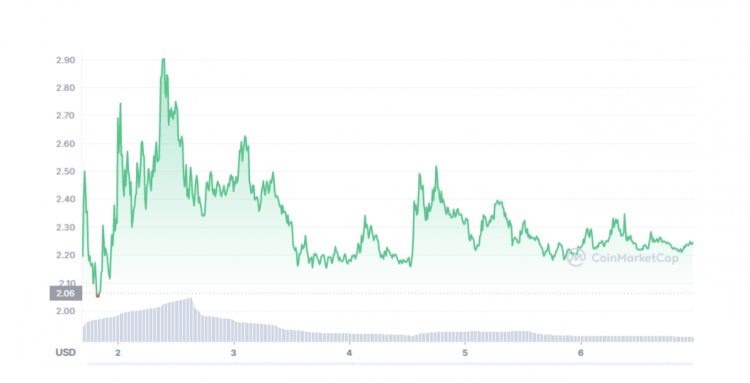
HOOK launched on CoinMarketCap on 1 December 2022 and within a day had gained over 40%, up from $2.0626 to $2.9016, its all-time high. In general, HOOK has had a pretty bullish start, a significantly positive aspect in an overall bear market.

The bull run in the coin’s price, however, did not last long as it lost over 20% of its gains on 2 December 2022, dropping to around $2.30 as the platform warned investors on Twitter that all HOOK tokens for sale on PancakeSwap were fake.

HOOK to USD price chart, December 2022

HOOK to USD price chart, December 2022

Source: CoinMarketCap

By the following day, the cryptocurrency managed to regain some of its losses, rising 13.8% to $2.617, but soon fell back down to $2.15.

Between 3 and 4 December 2022, HOOK fluctuated between $2.10 and $2.30 before surging twice, first by 15.8% to $2.4904 from $2.15 and then by an additional 1% to $2.517, possibly hiked by the platform’s whitelist giveaway.

Since surging to $2.517 on 4 December 2022, HOOK’s value has been dipping, down by 9.8% to $2.27 as of 7 December 2022.

According to data published on CoinMarketCap, as of 7 December 2022 the total number of HOOK coins in circulation is capped at 500 million. The cryptocurrency does not have a maximum supply, meaning that an unlimited amount of tokens can be mined. HOOK’s circulating supply stands at 50 million.

Latest news driving HOOK

Perhaps, some of the biggest news, news driving HOOK in recent days is the token’s listings on major exchanges.

On 2 December 2022, PancakeSwap announced that “the HOOK fam is now live on” the platform, meaning the token was available for purchase on the crypto exchange.

In addition, the HOOK cryptocurrency has been highly driven by the completion of the Hooked Protocol subscription launchpad and its listing on Binance, one of the most popular crypto exchanges worldwide.

According to a press release published by Binance, over 114,000 investors committed more than 9 million BNB during the subscription period, showing high interest for the HOOK cryptocurrency.

In other news, on 5 December 2022 the Hooked Protocol platform announced the end of its very first Hooked Web3 Quiz Maker Contest, which saw the winner scoring $100 equivalent of HOOK, with the platform promising more “fun” to come soon.

In a blog post published on Medium on 5 December 2022, the Hooked Protocol noted that the platform is working on bettering its user acquisition methodology in order to further expand the platform on a more global level.

In addition, the Hooked Protocol will focus on user engagement by “adding more content and developing new features to keep users engaged”.

Finally, “on the user rewards and commitment side” the platform is planning to launch an incentive mechanism in the following weeks.

HOOK is also planning to launch a product roadmap and airdrop plan.

So, what is the overall sentiment on the future Hooked Protocol price prediction?

Hooked Protocol price prediction

According to data provided by BitNation, as of 7 December 2022 the Hooked Protocol Price prediction for 2023 sees the token surging to $6.29 and reaching $9.44 by 2025. The website’s long-term Hooked Protocol coin price prediction saw the coin rising to $15.52 by 2028 and $22.02 by 2030.

DigitalCoinPrice also supported the bullish Hooked Protocol crypto price prediction, seeing the token averaging $5.73 in 2023. The website’s Hooked Protocol price prediction for 2025 saw the coin surging past an average of $9 and exceeding $11 in 2027.

The website’s Hooked Protocol price prediction for 2030 saw the token passing an average $32.

Anndy Lian, chief digital advisor at the Mongolian Productivity Organisation and author of NFT: From Zero to Hero, told Capital.com that the recent HOOK price surge was due to the cryptocurrency’s listing on Binance:

“Based on past track records for Binance Launchpad projects, users highly value such projects. Hence hitting numbers like this are not uncommon.”

He also added that, at the time of launch, only 10% of the tokens were in circulation, which, according to Lian, is an easier amount of currencies to manage.

“I would like to see how Hooked Protocol fairs in the bear market and how ‘quiz-to-earn’ rewards can be sustained over a more extended period. A similar comparison with GMT would be fair too. I remember them jumping to $3.80, and then their price plummeted 90% shortly. If they can manage the rewards, continue to build on its community and use base. They could be a considerable force to reckon with.”

To conclude, Lian noted that in the long run, only time will tell on where the Hooked Protocol price prediction will head.

The Hooked Protocol whitepaper also shared an outlook on what could potentially affect the future HOOK price predictions noting that the coin’s “long-term value is tied with the confidence people hold for the project but as opposed to HGT, supply of HOOK is fixed and designed to be deflationary”.

Note that HOOK/USD predictions can be wrong and shouldn’t be used as a substitute for your own research. Always conduct your own due diligence looking at fundamental and technical analysis, a wide range of commentary and latest news. Remember that past performance does not guarantee future returns. And never trade money that you cannot afford to lose.


Source: https://capital.com/hooked-protocol-hook-price-prediction

Anndy Lian is an early blockchain adopter and experienced serial entrepreneur who is known for his work in the government sector. He is a best selling book author- “NFT: From Zero to Hero” and “Blockchain Revolution 2030”.

Currently, he is appointed as the Chief Digital Advisor at Mongolia Productivity Organization, championing national digitization. Prior to his current appointments, he was the Chairman of BigONE Exchange, a global top 30 ranked crypto spot exchange and was also the Advisory Board Member for Hyundai DAC, the blockchain arm of South Korea’s largest car manufacturer Hyundai Motor Group. Lian played a pivotal role as the Blockchain Advisor for Asian Productivity Organisation (APO), an intergovernmental organization committed to improving productivity in the Asia-Pacific region.

An avid supporter of incubating start-ups, Anndy has also been a private investor for the past eight years. With a growth investment mindset, Anndy strategically demonstrates this in the companies he chooses to be involved with. He believes that what he is doing through blockchain technology currently will revolutionise and redefine traditional businesses. He also believes that the blockchain industry has to be “redecentralised”.

j j j

Cardano futures: ADA price pressure to persist amid FTX fallout

Cardano futures: ADA price pressure to persist amid FTX fallout

The recent FTX crisis has caused a whirl in the crypto world with many investors pulling out their assets from the market that’s already dominated by bearish sentiment.

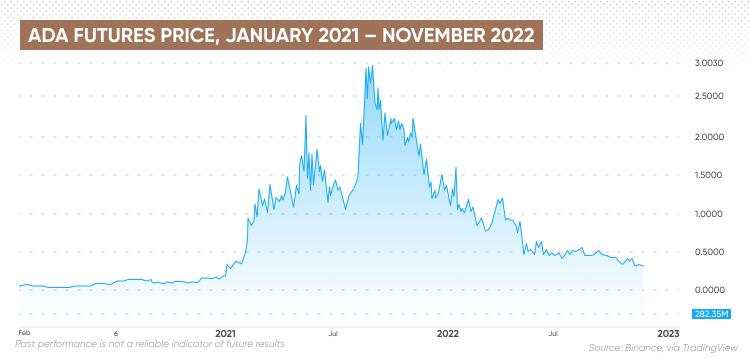
Cardano’s ADA, has been on a bear run in 2022, losing over 89.8% of its gains since the all-time high of $2.9706 on 3 September 2021 to $0.3032 on 21 November 2021.

How do Cardano futures work and where could the cardano futures price be headed? Read on…

What are cardano futures?

Cryptocurrency futures are contracts between two parties that are betting on the future price of a digital asset. When traders purchase a cryptocurrency’s futures contract, they gain exposure without owning the underlying coin, agreeing to pay a certain price for the asset in future. When the futures contract expires, however, the trader has to settle it – in other words, they buy the coin.

The Cardano blockchain was launched in 2017 as a third-generation cryptocurrency platform. It has a Proof-of-Stake (PoS) consensus mechanism and was designed to be a more scalable, sustainable and interoperable version of Ethereum. For this reason, the blockchain’s supporters labelled Cardano the “Ethereum killer”.

In September 2021, Cardano gained smart contract capability, allowing for the creation of decentralised apps (dApps), non-fungible tokens (NFTs), games, new cryptocurrencies and more.

ADA is the blockchain’s native cryptocurrency named after the 19th century mathematician Ada Lovelace. The coins are used as a secure exchange of value and to pay for transaction fees

Cardano futures, therefore, are contracts between two parties that have agreed to buy and sell a specific amount of ADA at a specified price. Cardano futures are often known as Cardano perpetual futures or cardano perpetual swaps.

Traders who purchase ADA futures are betting that the price of the cryptocurrency will surge in the future. If that happens, they will profit from the price increase. If the price of Cardano falls, however, they will lose money.

Cardano futures history

Cardano futures started trading on Binance at the end of January 2021. They enjoyed bullish momentum, jumping by more than 4,100% between January and May 2021. The surge came as Cardano continued development of its smart contract capabilities and launched a peer-to-peer testnet to a small group of users.

After a slight dip in July 2021, the ADA futures price climbed to the all-time high of $2.9706 on 3 September 2021. The rally came ahead of the blockchain’s Alonzo hard fork, which introduced smart contract capabilities to Cardano.

ADA futures price, January 2021 – November 2022

Following the bull run, the ADA futures contract dipped by more than 35% by 27 October 2021 and continued on a downward trend.

Cardano futures price fell  to $0.3032 on 21 November 2022 amid negative market sentiment. The recent news on the downfall of the FTX crypto exchange and its native FTT  token added to the bearish price action.

What is driving cardano futures?

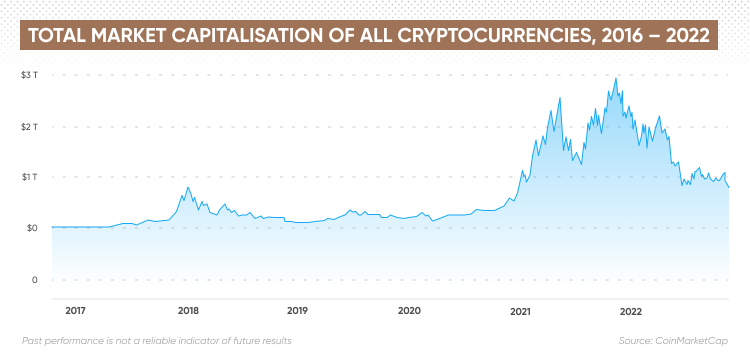
The collapse of the FTX crypto exchange affected many major cryptocurrencies, cooling investor sentiment. CoinMarketCap data showed that the total cryptocurrency market capitalisation fell below $800bn on 11 November, when FTX filed for Chapter 11 bankruptcy, the lowest level since early 2021.

Total market capitalisation of all cryptocurrencies, 2016 – 2022

“Although aftereffects of the FTX shock will still likely surface at some point and the industry will have to adopt more financially transparent operation and come under stricter regulatory oversight, the worst part may have passed,” Bitbank crypto market analyst Yuya Hasegawa said in his weekly view.

Meanwhile, the Cardano blockchain saw a spike in activity between 9 and 14 November as the number of new addresses on the blockchain surged from 0 to 11,240, according to data on Cardano Blockchain Insights.

The network, however, had seen a surge in the number of transactions on 8 November, which surpassed 391,000 as FTX crashed.

Cardano’s founder, Charles Hoskinson, said in a live YouTube stream on 9 November:

“I think this might be the bottom, one of the last ones to deal with. It’s going to be hard to predict how bad it will be, and it could certainly potentially be very bad. There are not many more firms that were like FTX or Alameda or like, Three Arrows Capital, and so forth. At least in this cycle, I truly do hope that this is the last cycle of this nature.”

In other cardano futures news, Hoskinson told CoinDesk on 18 November that Cardano is looking to launch a new privacy blockchain and digital asset which he stated to be something “the enterprise absolutely wants”.

Cardano futures price prediction for 2023 and beyond

Algorithm-based prediction websites did not provide cardano futures forecasts, so let’s have a look at the latest ADA/USD outlook.

In line with the latest downward price action, algorithm-based forecasting service Wallet Investor gave a bearish ADA price prediction at the time of writing (21 November) noting that ADA was “a bad long-term investment”.

Based on its analysis of past price performance, Wallet Investor predicted that the token could fall to $0.01016  in 2023. The site did not provide an ADA price prediction for 2027.

DigitalCoinPrice, on the other hand, gave a bullish ADA to USD price prediction expecting the token to grow to $0.39 by the end of 2022 and reach $1.30 on average in 2025. By 2027, the site predicted that the price of ADA tokens could reach $1.59. Its long-term token forecast showed the cryptocurrency reaching $4.35 by 2030.

Meanwhile,  Anndy Lian, the chief digital advisor at the Mongolian Productivity Organisation and author of ‘NFT: From Zero to Hero’, told Capital.com that mid-term technical indicators looked bearish (as of 21 November). He added:

“Sellers’ pressure increases in the cardano market. I hope the longer term potential factors like Midnight and USDA can change things for the better.”

News that the group behind Cardano, Input Output Global, is planning to release a new privacy-focused blockchain could have a potential effect on ADA futures, Lian added in his cardano futures price prediction.

In addition, the launch of USDA, the first fully fiat-backed regulated stablecoin on Cardano, will start trading in early 2023, could lead to a hike in the cardano futures price.

“If executed well, I see this will help ADA decentralised finance ecosystem, thus bringing in more liquidity and support into the network,” Lian added.

Final thoughts

Remember, analysts’ and algorithm-based predictions can be wrong. If you’re considering entering the cardano futures market, we recommend you always conduct your own due diligence, looking at the latest news, a wide range of analyst commentary, technical and fundamental analysis. Note that past performance does not guarantee future returns and cryptocurrency markets remain extremely volatile. And never trade money you cannot afford to lose.


Source: https://capital.com/cardano-futures-price-prediction-ada

Anndy Lian is an early blockchain adopter and experienced serial entrepreneur who is known for his work in the government sector. He is a best selling book author- “NFT: From Zero to Hero” and “Blockchain Revolution 2030”.

Currently, he is appointed as the Chief Digital Advisor at Mongolia Productivity Organization, championing national digitization. Prior to his current appointments, he was the Chairman of BigONE Exchange, a global top 30 ranked crypto spot exchange and was also the Advisory Board Member for Hyundai DAC, the blockchain arm of South Korea’s largest car manufacturer Hyundai Motor Group. Lian played a pivotal role as the Blockchain Advisor for Asian Productivity Organisation (APO), an intergovernmental organization committed to improving productivity in the Asia-Pacific region.

An avid supporter of incubating start-ups, Anndy has also been a private investor for the past eight years. With a growth investment mindset, Anndy strategically demonstrates this in the companies he chooses to be involved with. He believes that what he is doing through blockchain technology currently will revolutionise and redefine traditional businesses. He also believes that the blockchain industry has to be “redecentralised”.

j j j

Who owns the most Jasmy crypto? High concentration among top 10 holders as price of Japan’s bitcoin plumbs new depths

Who owns the most Jasmy crypto? High concentration among top 10 holders as price of Japan’s bitcoin plumbs new depths

JasmyCoin (JASMY) has been on a bear run for over a year now, falling by more than 99% since peaking for the last time in May 2021. As of 11 November, the coin was valued at $0.0041.

Despite a downfall in JASMY price action, the token has been seeing a surge in active addresses. Let’s have a closer look at who owns the most JASMY crypto.

What is JASMY?

Jasmy is a Japanese internet of things (IoT) company that aims to make data sharing safer, and more decentralised and democratised. It specialises in the safe buying and selling of personal data. It was founded in April 2016 by Kunitake Ando and Kazumasa Sato, two former Sony executives, and Hiroshi Harada, a former employee at KPMG.

Harada, who serves as the platform’s CFO, told Binance in an interview in September 2022:

“Jasmy’s mission is to create a mechanism/platform which allows all users to take ownership of their own data in a secure and private manner. Instead of letting a handful of big tech corporations take control of such sensitive data, Jasmy aims to help enable a world where everyone can feel safe and secure about the use of their own data.”

The platform allows users to:

  • Store and control their data in a safe and secure environment
  • Safely and securely manage and control their devices
  • Provide safe and secure use of their data under clear rules

Jasmy’s Personal Data Locker (PDL) provides users with full ownership over their personal data while its Secure Knowledge Communicator (SKC) is responsible for the achievement of data democracy.

The platform promises to provide its customers with an IoT platform that will help them manage their IoT data securely and efficiently; IoT devices and services that will help customers with the development and maintenance of their IoT platforms and thorough data analysis which will be used for the further improvement of the platform.

Jasmy’s native token, JasmyCoin (JASMY), is used by companies that wish to purchase the users’ data stored on the platform. The token can also be used by users as investment, for governance and metaverse utility. JASMY was built on the Ethereum (ETH) ecosystem and is an ERC-20 token.

JASMY was launched at the end of October 2021 and has been dubbed  as “Japan’s bitcoin”.

JASMY supply explained

According to data provided by CoinMarketCap, JASMY has a maximum and total supply of 50 billion coins. This makes the coin a deflationary asset, similar to bitcoin (BTC), due to the limit on how many coins can be mined.

As of 11 November 2022, the token had a circulating supply surpassing 4.7 billion and a market capitalisation of $19.4m.

JASMY was Japan’s first ever legally approved cryptocurrency as the country had imposed a strict regulation for this market. It was listed on the Japanese crypto exchange BITpoint on 27 October 2021.

The cryptocurrency was met with a lot of enthusiasm upon its launch, skyrocketing by more than 230% in four days from $1.3024 on 12 February 2021 to $4.2929 – an all-time high following its listing on the crypto exchange Gate.io.

After the fast surge, the token lost over 58% of its value falling to $1.7851 by 22 February 2021, but managed to regain 67% of its value soon after, reaching $2.9628 on 2 March 2021.

JASMY grew past the $2 barrier once again on 9 March 2021 as the platform announced it had joined GitHub, thus providing a space where its users could discuss upcoming projects, news and bugs.

JASMY to USD chart, February 2021 – November 2022

JASMY to USD chart, February 2021 – November 2022

Source: CoinMarketCap

By 5 May 2021, however, the coin lost around 50% of its value, falling to $1.0965 before seeing a mini-surge on the following day and rising to $2.1586. The bullish price action did not last long. The coin entered a bear run, falling by 95% in the following weeks and reaching $0.05456 on 20 June 2021.

Since then, the coin was unable to reach previous highs, falling by an additional 92.4% to $0.004122 as of 11 November 2022.

Who owns the most JASMY crypto?

In the past two months, JASMY lost over 57% of its value, falling from $0.009717 on 10 September 2022 to $0.004122 on 11 November 2022. Despite the continued bear trend, token concertation among the top 10 JASMY holders remained high.

Data published on Sanbase showed that the number of active JASMY token addresses spiked to 673 on 30 October from 224 the day before. The number of active JASMY holders spiked once again on 9 November to 719 from a low of 273 on 7 November 2022.

So, who has the most JASMY tokens? Data provided by etherscan.io showed that there are 36,169 JASMY holders in total. The 10 biggest JASMY holders, as of 11 November, collectively owned 51.33% of the total token supply in circulation, meanwhile the top 100 owned 85.44%.

The website noted that the top account holding the most JASMY tokens was the world’s biggest cryptocurrency exchange Binance (BNB). Binance owned 23.43% of the total supply, which amounted to 11.7 billion JASMY coins worth around $48,500, as of 11 November. It’s likely that the exchange is holding the tokens on behalf of its users.

The second on etherscan’s top holders of JASMY list was crypto exchange Mexc.com. It owned 5.86% of the total supply, amounting to 2.9 billion tokens. Mexc.com could own JASMY tokens on behalf of its users.

The third biggest JASMY account was Jasmy Deployer which held 4.8% of the tokens’ total supply amounting  to 2.4 billion coins. The fourth and fifth biggest JASMY holders were two anonymous wallets holding 4.12% (1.34 billion coins) and 2.7% (1.29 billion coins) of the tokens’ total supply respectively.

Analyst views on Jasmy’s tokenomics

Knowing who owns the most JASMY tokens can be of use to many retail investors and traders, Anndy Lian, chief digital advisor at the Mongolian Productivity Organisation and author of ‘NFT: From Zero to Hero’, told Capital.com:

“The concentration of tokens on exchanges on leading exchanges such as Binance is a confidence booster for many retail investors.

“JASMY has gained interest from some of the biggest names in Japan’s technology industry. Pansonic and VAIO have also partnered with JASMY. During the COVID-19 pandemic, the largest call centre in Japan, Transcosmos, used JASMY to secure its data. The big names using JASMY’s technology are a really attractive selling point for retail investors.”

Lian added that for JASMY to truly grow, the firm would need to showcase its technology and focus on revenue.

“After all, they are the first legally compliant Japanese crypto coin listed on the Japanese cryptocurrency exchange. Japanese law strictly governs cryptocurrency transactions subject to Financial Services Agency inspections. Being accountable by Japanese law, they need to walk away from fluff and hype and concentrate on real business first.”

Please note that analysts’ predictions and opinions can be wrong. The information about the biggest cryptocurrency whales and ownership concentration shouldn’t be used as a substitute for your own research. Always conduct your own due diligence before trading. And never invest or trade money you cannot afford to lose.


Source: https://capital.com/jasmy-token-who-owns-most-jasmycoin-crypto

Anndy Lian is an early blockchain adopter and experienced serial entrepreneur who is known for his work in the government sector. He is a best selling book author- “NFT: From Zero to Hero” and “Blockchain Revolution 2030”.

Currently, he is appointed as the Chief Digital Advisor at Mongolia Productivity Organization, championing national digitization. Prior to his current appointments, he was the Chairman of BigONE Exchange, a global top 30 ranked crypto spot exchange and was also the Advisory Board Member for Hyundai DAC, the blockchain arm of South Korea’s largest car manufacturer Hyundai Motor Group. Lian played a pivotal role as the Blockchain Advisor for Asian Productivity Organisation (APO), an intergovernmental organization committed to improving productivity in the Asia-Pacific region.

An avid supporter of incubating start-ups, Anndy has also been a private investor for the past eight years. With a growth investment mindset, Anndy strategically demonstrates this in the companies he chooses to be involved with. He believes that what he is doing through blockchain technology currently will revolutionise and redefine traditional businesses. He also believes that the blockchain industry has to be “redecentralised”.

j j j