Crypto Faces Critical Moment as Regulatory Walls Rise

Crypto Faces Critical Moment as Regulatory Walls Rise

I have warned investors that a significant decline in the crypto market could occur if Bitcoin’s value falls below $24,000, amidst a bullish trend since mid-December. This prediction has come true as Bitcoin’s price has dropped by 10% from its February peak, with the possibility of further drops to $20,000. Crypto’s growth in 2022 was driven primarily by monetary policy, but regulations may become a decisive factor this year in determining which companies will succeed and which will fail.

This situation is due to several factors, including the sustained tightening of liquidity and the suspension of bank transfers, notably by Binance in early February. The closure of Silvergate’s exchange network in early March has exacerbated the existing predicament. Furthermore, Signature Bank has recently informed its crypto exchange clients that SWIFT payment transfers of less than $100,000 will no longer be supported, which is related to Coinbase suspending trading of Binance USD. This is a pressing concern that must be considered.

A growing effort is underway to reconsider the relationship between traditional banking systems and the rapidly evolving crypto economy. The fundamental principle of Bitcoin was to create a financial system that operates independently of banks, and some experts are advocating for a completely “bankless” crypto ecosystem. However, the regulatory crackdown this year has given rise to offshore stablecoins such as Tether’s, which continue to gain traction despite a decline in trading volumes.

The lack of a mechanism for transferring traditional currency into the crypto space appears to be causing stagnation, depriving it of the innovation typically associated with a burgeoning industry. This is where Silvergate has emerged as a critical link between investors, hedge funders, and venture capitalists. In addition to facilitating these essential connections, Silvergate allows its clients to settle their balances at any time of day, including weekends and holidays. This 24-hour settlement feature is paramount in the crypto market, allowing investors to capitalize on arbitrage opportunities and ensuring the seamless exchange of collateral, which is managed through smart contracts.

As regulatory hurdles continue to crop up around crypto, the potential consequences of these barriers cannot be ignored. A recent report from Coindesk reveals that close to 200 members of Congress accepted campaign donations from FTX executives. This raises concerns that those who have received these donations may be less inclined to support further regulations, fearing a negative association with an exchange that has previously misused user funds.

Adding to mounting concerns, on January 3, the U.S. Federal Reserve, the FDIC, and the Treasury Department’s Office of the Comptroller of the Currency issued a joint statement warning about the risks that crypto-assets pose to the banking sector. While regulators have previously cautioned against the instability of cryptocurrencies, this latest alert highlights the impact that the crypto ecosystem could have on the financial resilience of traditional banks. This shift in warning, reportedly initiated by the Biden administration, has had a significant impact, causing a chain reaction.

On January 13, the Securities and Exchange Commission (SEC) leveled accusations against the Gemini crypto exchange and Genesis Trading, asserting that the two firms failed to register a crypto lending scheme as a securities offering. The SEC’s stance is that the lending scheme offered by the two firms necessitated registration with the SEC and compliance with relevant securities laws and regulations. The failure to meet these requirements, according to the SEC, put investors at risk and could have violated securities laws.

Custodia Bank, which was founded three years ago to serve as an intermediary between digital assets and the U.S. dollar payment system, suffered a significant setback in late January. The bank was denied membership to the Federal Reserve System and was also refused a master account. One of the primary advantages of being part of the Federal Reserve System is access to a master account, which allows banks to settle transactions with other banks and financial institutions. Custodia Bank’s lack of a master account means that it will have to rely on other banks to handle its transactions, resulting in higher fees and slower processing times. This puts the bank at a significant disadvantage compared to other banks in the digital asset space that have successfully obtained membership in the Federal Reserve System.

Signature Bank has taken a bold move in the face of the crypto industry’s growing regulatory challenges. In early February, the bank announced its decision to suspend SWIFT transfers of crypto-related firms of less than $100,000. The move is a clear indication of the financial institution’s cautious approach to cryptocurrencies, which have been plagued by regulatory ambiguity and concerns over financial crimes. The decision is expected to impact many smaller crypto firms that rely on such transfers, as they may now have to seek alternative methods to move funds. However, some experts argue that the bank’s move is a necessary step to mitigate risks and safeguard the banking sector from potential threats posed by the crypto industry.

In early February, Kraken, a popular crypto exchange, agreed to pay $30 million to settle charges filed by the SEC that it provided unregistered securities through its staking program. The program offered a fixed rate of return to users, regardless of the actual performance of the staked assets, which the SEC determined to be a violation of securities laws. Kraken’s failure to properly register with the SEC put investors at risk and created an unfair advantage for the platform. The settlement serves as a reminder that the cryptocurrency industry is subject to the same rules and regulations as traditional financial markets.

On February 13, Paxos was ordered to halt production of the Binance-branded BUSD stablecoin over concerns that Paxos may have been negligent in monitoring the application of the stablecoin. As a result, the market capitalization of BUSD plunged from $16 billion to its current value of $8 billion. The decision by the New York Department of Financial Services (NYDFS) to halt the production of BUSD caught many in the industry off guard. Paxos had been considered one of the most reliable stablecoin issuers in the market, having received regulatory approval from the NYDFS to operate as a trust company. However, the NYDFS’s move underscores that even well-established firms are subject to regulatory scrutiny.

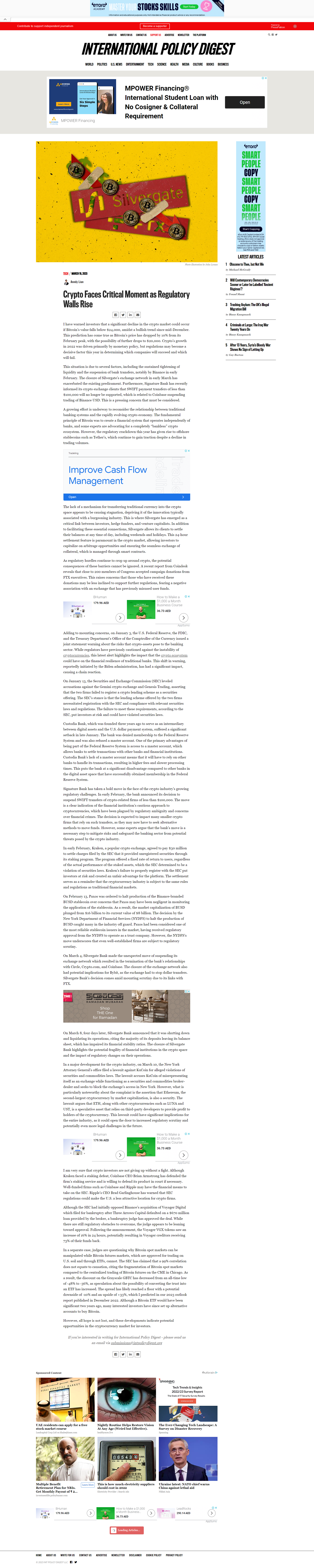
On March 4, Silvergate Bank made the unexpected move of suspending its exchange network which resulted in the termination of the bank’s relationships with Circle, Crypto.com, and Coinbase. The closure of the exchange network also had potential implications for Bybit, as the exchange had to stop dollar transfers. Silvergate Bank’s decision comes amid mounting scrutiny due to its links with FTX.

On March 8, four days later, Silvergate Bank announced that it was shutting down and liquidating its operations, citing the majority of its deposits leaving its balance sheet, which has impaired its financial stability ratios. The closure of Silvergate Bank highlights the potential fragility of financial institutions in the crypto space and the impact of regulatory changes on their operations.

In a major development for the crypto industry, on March 10, the New York Attorney General’s office filed a lawsuit against KuCoin for alleged violations of securities and commodities laws. The lawsuit accuses KuCoin of misrepresenting itself as an exchange while functioning as a securities and commodities broker-dealer and seeks to block the exchange’s access in New York. However, what is particularly noteworthy about the complaint is the assertion that Ethereum, the second-largest cryptocurrency by market capitalization, is also a security. The lawsuit argues that ETH, along with other cryptocurrencies such as LUNA and UST, is a speculative asset that relies on third-party developers to provide profit to holders of the cryptocurrency. This lawsuit could have significant implications for the entire industry, as it could open the door to increased regulatory scrutiny and potentially even more legal challenges in the future.

I am very sure that crypto investors are not giving up without a fight. Although Kraken faced a staking defeat, Coinbase CEO Brian Armstrong has defended the firm’s staking service and is willing to defend its product in court if necessary. Well-funded firms such as Coinbase and Ripple may have the financial means to take on the SEC. Ripple’s CEO Brad Garlinghouse has warned that SEC regulations could make the U.S. a less attractive location for crypto firms.

Although the SEC had initially opposed Binance’s acquisition of Voyager Digital which filed for bankruptcy after Three Arrows Capital defaulted on a $670 million loan provided by the broker, a bankruptcy judge has approved the deal. While there are still regulatory obstacles to overcome, the judge appears to be leaning toward approval. Following the announcement, the Voyager VGX tokens saw an increase of 16% in 24 hours, potentially resulting in Voyager creditors receiving 73% of their funds back.

In a separate case, judges are questioning why Bitcoin spot markets can be manipulated while Bitcoin futures markets, which are approved for trading on U.S. soil and through ETFs, cannot. The SEC has claimed that a 99% correlation does not equate to causation, citing the fragmentation of Bitcoin spot markets compared to the centralized trading of Bitcoin futures on the CME in Chicago. As a result, the discount on the Grayscale GBTC has decreased from an all-time low of -48% to -36%, as speculation about the possibility of converting the trust into an ETF has increased. The spread has likely reached a floor with a potential downside of -10% and an upside of +33%, which I predicted in our 2023 outlook report published in December 2022. Although a Bitcoin ETF would have been significant two years ago, many interested investors have since set up alternative accounts to buy Bitcoin.

However, all hope is not lost, and these developments indicate potential opportunities in the cryptocurrency market for investors.

Source: https://intpolicydigest.org/crypto-faces-critical-moment-as-regulatory-walls-rise/
Anndy Lian is an early blockchain adopter and experienced serial entrepreneur who is known for his work in the government sector. He is a best selling book author- “NFT: From Zero to Hero” and “Blockchain Revolution 2030”.

Currently, he is appointed as the Chief Digital Advisor at Mongolia Productivity Organization, championing national digitization. Prior to his current appointments, he was the Chairman of BigONE Exchange, a global top 30 ranked crypto spot exchange and was also the Advisory Board Member for Hyundai DAC, the blockchain arm of South Korea’s largest car manufacturer Hyundai Motor Group. Lian played a pivotal role as the Blockchain Advisor for Asian Productivity Organisation (APO), an intergovernmental organization committed to improving productivity in the Asia-Pacific region.

An avid supporter of incubating start-ups, Anndy has also been a private investor for the past eight years. With a growth investment mindset, Anndy strategically demonstrates this in the companies he chooses to be involved with. He believes that what he is doing through blockchain technology currently will revolutionise and redefine traditional businesses. He also believes that the blockchain industry has to be “redecentralised”.

j j j

Hong Kong Emerges As An Attractive Hub For The Virtual Asset Industry Amidst Regulatory Scrutiny

Hong Kong Emerges As An Attractive Hub For The Virtual Asset Industry Amidst Regulatory Scrutiny

The virtual asset industry is facing increasing scrutiny and regulatory clampdowns worldwide, leading to the emergence of new hubs for the industry. Hong Kong is one such hub that has proposed rules allowing retail investors to trade certain “large-cap tokens” on licensed exchanges, contrasting with mainland China’s ban on crypto-related transactions. Although the Securities and Futures Commission of Hong Kong has not specified which tokens would be allowed, industry insiders believe Bitcoin and Ether are likely to be among them.

China’s crackdown on crypto trading aimed to protect individual investors from speculative activity. However, the crypto industry’s increasing bankruptcies and layoffs may justify their actions. Despite this, the industry continues to attract investment and talent, making it hard to imagine Beijing sitting idly by while the rest of the world develops new building blocks that could potentially spark a new wave of innovation as big as the current internet itself.

As a result, many of China’s web3 startups have set up new bases in more crypto-friendly locations such as Singapore and Dubai. However, with Hong Kong’s more relaxed regulatory environment for cryptocurrencies, some Chinese-founded web3 companies in exile may consider returning home. Hong Kong’s proposal stipulates that all centralized virtual currency exchanges operating in the city or marketing services to the territory’s investors must obtain licenses from the securities and futures authority.

The proposed requirements cover key areas such as safe custody of assets, know-your-client, conflicts of interest, cybersecurity, accounting and auditing, risk management, anti-money laundering/counter-financing of terrorism, and prevention of market misconduct. Centralized crypto exchanges must ban Hong Kong IP addresses until they obtain the relevant permits to operate in the city. The regulatory requirements are open for consultation until March 31, and the new licensing regime will take effect on June 1. This move by Hong Kong is strategic, as it can attract crypto companies and investments to the city. Implementing clear regulatory frameworks would help the industry gain mainstream adoption and bring in more institutional investors.

AML Crypto Regulations In Hong Kong

The Legislative Council passed the Anti-Money Laundering and Counter-Terrorist Financing (Amendment) Bill 2022 (AML/CTF Amendment Bill 2022) on December 7, 2022. This bill introduced a licensing regime for virtual asset service providers (VASPs) and imposed anti-money laundering (AML), counter-terrorism financing (CTF), and investor protection obligations upon these actors.

VASPs that are licensed in Hong Kong are subject to a number of AML, CTF, and investor protection obligations. These include:

  • Customer Due Diligence (CDD): VASPs must conduct CDD on their customers, which includes identifying and verifying the identity of the customer, the beneficial owner, and any other person who exercises control over the customer. VASPs must also assess and understand the nature and purpose of the business relationship with the customer.
  • Ongoing Monitoring: VASPs must monitor their customers’ transactions on an ongoing basis to ensure that they are consistent with their knowledge of the customer, the customer’s business, and the risks associated with the customer.
  • Record-Keeping: VASPs must maintain adequate records of their customers, their transactions, and their risk assessments. These records must be kept for a period of at least five years.
  • Reporting: VASPs are required to report suspicious transactions to the Joint Financial Intelligence Unit (JFIU) of Hong Kong. Suspicious transactions include those that are inconsistent with the customer’s profile, those that have no apparent economic or lawful purpose, or those that involve the proceeds of crime.
  • Investor Protection: VASPs must also put in place measures to protect their customers’ assets. This includes measures such as segregation of customer assets from the VASP’s own assets and insurance against losses.
  • Penalties for Non-Compliance: VASPs that fail to comply with the new regulations are subject to a range of penalties, including fines, suspension or revocation of their license, and criminal liability. Individuals who are found guilty of money laundering or terrorist financing may face imprisonment of up to 14 years and fines of up to HKD 5 million.

The new regulations also provide for the imposition of sanctions by the United Nations Security Council or by Hong Kong in respect of breaches of international sanctions.

Licensing And Registration Requirements For VASPs In Hong Kong

Anyone who engages in a virtual asset exchange business in Hong Kong must apply for a license with the SFC. The AML/CTF Amendment Bill 2022 also introduced regulations for VASPs to comply with the Crypto Travel Rule.

The HKMA will only grant licenses to VASPs that meet certain criteria, including:

  • The company must be incorporated in Hong Kong.
  • The company must have a permanent place of business in Hong Kong.
  • The company must have adequate financial resources.
  • The company must have appropriate AML/CTF systems and controls in place.
  • The company must have a compliance officer responsible for ensuring the company’s compliance with the new regulations.

VASPs that fail to obtain a license will be prohibited from providing virtual asset services in Hong Kong.

Complying With The Crypto Travel Rule In Hong Kong

The Crypto Travel Rule will be effective in Hong Kong as of June 1, 2023. The new regulatory regime will provide industries with a grace period to prepare for compliance until that date. In Hong Kong, Travel Rule requirements apply regardless of the transaction amount.

The scope of data to be exchanged varies depending on the threshold of the transaction. For virtual assets that amount to HKD 8,000 or more, the following information needs to be shared: name, account number, and address of the originator, as well as the beneficiary’s name and account number. For virtual assets that amount to less than HKD 8,000, only the name and account number of the originator and beneficiary are required.

There are no differences in customer personally identifiable information (PII) requirements for cross-border transfers and transfers within Hong Kong. However, for wire transfers, the information recorded must include the number of the originator’s account or a unique reference number assigned to the wire transfer by the financial institution.

Non-custodial or self-hosted wallet transactions do not have any specific requirements in Hong Kong. The AML/CTF Amendment Bill 2022 defines virtual asset transfers subject to Crypto Travel Rule requirements as transactions for transferring virtual assets carried out by an institution on behalf of an originator, with a view to making the virtual assets available to the originator or another person at an institution, which may be the ordering institution or another institution.

To sum up, Hong Kong’s plan to permit retail investors to trade large-cap tokens on licensed exchanges is a significant advancement for the worldwide crypto industry. While China’s crackdown on crypto trading was meant to safeguard individual investors from speculative behavior, Hong Kong’s proposed regulatory framework is more lenient and has the potential to lure more crypto companies and investments to the city. The establishment of clear regulatory frameworks would aid in the industry’s adoption by the general public and attract more institutional investors. I hope to witness a harmonious balance between the two approaches.


Source: https://www.benzinga.com/23/03/31340390/hong-kong-emerges-as-an-attractive-hub-for-the-virtual-asset-industry-amidst-regulatory-scrutiny

Anndy Lian is an early blockchain adopter and experienced serial entrepreneur who is known for his work in the government sector. He is a best selling book author- “NFT: From Zero to Hero” and “Blockchain Revolution 2030”.

Currently, he is appointed as the Chief Digital Advisor at Mongolia Productivity Organization, championing national digitization. Prior to his current appointments, he was the Chairman of BigONE Exchange, a global top 30 ranked crypto spot exchange and was also the Advisory Board Member for Hyundai DAC, the blockchain arm of South Korea’s largest car manufacturer Hyundai Motor Group. Lian played a pivotal role as the Blockchain Advisor for Asian Productivity Organisation (APO), an intergovernmental organization committed to improving productivity in the Asia-Pacific region.

An avid supporter of incubating start-ups, Anndy has also been a private investor for the past eight years. With a growth investment mindset, Anndy strategically demonstrates this in the companies he chooses to be involved with. He believes that what he is doing through blockchain technology currently will revolutionise and redefine traditional businesses. He also believes that the blockchain industry has to be “redecentralised”.

j j j

Singapore Tightens Regulatory Grip on Crypto

Singapore Tightens Regulatory Grip on Crypto

Singapore has long been praised for being a forward-thinking, progressive jurisdiction that supports technology and innovation. This has enticed a horde of cryptocurrency and blockchain startups to set up shop in the nation, lured by its seemingly openness to the industry. However, these companies are now facing roadblocks and finding it rather challenging to operate in the city-state.

Just a couple of weeks ago, operators of crypto ATMs were forced to shut down their machines after the Monetary Authority of Singapore (MAS) outlawed cash-to-crypto terminals. The move is part of a wider crackdown on advertising cryptocurrencies to the general public, which MAS believes shouldn’t be encouraged to engage in the trading of digital assets.

New guidelines were issued on January 17, 2022 prohibiting cryptocurrency trading service providers from promoting their services to the general public, specifically calling out ATMs for providing such access and convenience that “may mislead the public to trade in digital payment tokens (DPTs) on impulse, without considering convenient access may mislead the public to trade in the risks of trading in DPTs.”

“DPT service providers should not provide physical ATMs in public areas in Singapore to facilitate public access to their DPT services,” the guidelines say.

Singapore’s Cryptocurrency Industry

Crypto service providers may promote their services on their own corporate website, mobile applications or official social media accounts but mustn’t trivialize the risks of trading digital assets, the document reads.

These companies shouldn’t promote their DPT services in public areas in Singapore or through any other media directed at the general public in Singapore, and shouldn’t engage third parties to advertise their services, it says.

The move is the latest setback for Singapore’s crypto industry in which many are struggling to secure crypto exchange or DPT licenses.

So far, MAS has only granted three licenses out of around 170 companies that applied. Over a hundred have withdrawn their applications or been rejected and at least one has received “in-principle approval.”

Companies that were operating in the country prior to the introduction of the licensing regime were granted exemptions until the outcome of their application is known.

Crypto startups turn to Dubai

Last year, Binance Asia Services, the Singapore entity of crypto exchange Binance, withdrew its application for a cryptocurrency exchange license in the city-state after spending a year trying to win regulators’ approval.

The company, which shut down its operations in Singapore earlier this month, has instead decided to move to Dubai after signing a deal with the Dubai World Trade Centre Authority (DWTCA) to build a new international virtual assets hub.

According to Anndy Lian, chairman of BigOne Exchange, a crypto exchange headquartered in the Netherlands, crypto companies started exiting the city-state six months ago, opting instead for locations such as Dubai and Europe to base their companies.

“The trend is obvious. Businesses are moving away,” Lian told Tech in Asia earlier this month. “Singapore is openly welcoming everybody, then openly rejecting almost everybody.”

The United Arab Emirates (UAE) has over 40 multidisciplinary free trade zones, among them the DWTCA. These areas have their own special tax, customs and import regimes, and are designed to attract foreign investment.

Several of the UAE’s free zones have been actively working towards establishing themselves into leading crypto and blockchain hubs, with some having already started issuing permits for virtual asset services providers.

So far, the Dubai Multi Commodities Centre (DMCC) has licensed 22, the Abu Dhabi Global Market has six, and the Dubai Silicon Oasis Authority has at least one, according to a government report seen by Bloomberg. Dubai International Financial Centre, meanwhile, has none for now.

JLT Free Zone

DMCC Free Zone

A blog post released on January 25, 2022 by crypto gaming company Quantum Works details how the DMCC has wooed the startup into moving to Dubai from the UK, highlighting the burgeoning crypto community there.

“DMCC has partnered with CV VC (Crypto-Valley Venture Capital) and CV Labs to launch the crypto center we now call home,” the company wrote.

“While most of the free world is spending time trying to figure out how to legislate crypto, … Dubai is ahead of the global curve when it comes to crypto taxes and legislation.

“There are over 20,000 companies in this blockchain network that we now have access to. Companies like Binance see the same opportunity here as us.”

At the federal level, the government is working on a crypto licensing regime which it hopes will help bring in some of the world’s biggest crypto companies, a government official told Bloomberg earlier this week.

The Securities and Commodities Authority is currently in the final stage of amending legislation to allow virtual asset services providers to set up. The first federal licenses are expected to be issued by the end of Q1 2022.


Original Source: https://fintechnews.sg/59341/blockchain/singapore-tightens-regulatory-grip-on-crypto/

Anndy Lian is an early blockchain adopter and experienced serial entrepreneur who is known for his work in the government sector. He is a best selling book author- “NFT: From Zero to Hero” and “Blockchain Revolution 2030”.

Currently, he is appointed as the Chief Digital Advisor at Mongolia Productivity Organization, championing national digitization. Prior to his current appointments, he was the Chairman of BigONE Exchange, a global top 30 ranked crypto spot exchange and was also the Advisory Board Member for Hyundai DAC, the blockchain arm of South Korea’s largest car manufacturer Hyundai Motor Group. Lian played a pivotal role as the Blockchain Advisor for Asian Productivity Organisation (APO), an intergovernmental organization committed to improving productivity in the Asia-Pacific region.

An avid supporter of incubating start-ups, Anndy has also been a private investor for the past eight years. With a growth investment mindset, Anndy strategically demonstrates this in the companies he chooses to be involved with. He believes that what he is doing through blockchain technology currently will revolutionise and redefine traditional businesses. He also believes that the blockchain industry has to be “redecentralised”.

j j j