The return of crypto—or just a technical bounce?

The return of crypto—or just a technical bounce?

The digital asset market climbed 1.1 per cent to reach a total capitalisation of US$2.3 trillion over the past 24 hours, a move that reflects more than simple speculative enthusiasm. This advance stems from a confluence of regulatory progress, institutional signalling, and technical rebound dynamics, all unfolding against a backdrop of heightened macro uncertainty.

What stands out immediately is the market’s tight correlation with traditional risk assets, registering 96 per cent with the S&P 500 and 80 per cent with Gold. This tells us that crypto is no longer moving in isolation but is increasingly priced as part of a broader macro portfolio allocation story.

This integration brings both validation and vulnerability. Validation because institutional capital now treats digital assets as a legitimate component of a diversified strategy. Vulnerability because crypto now inherits the volatility of global risk sentiment, as we saw this week when oil prices surged above US$107 per barrel, and equity indices wavered.

Regulation and institutional appetite drive the bounce

The primary catalyst for the recent uptick comes from Washington and Wall Street. News that the US Senate is advancing the Digital Asset Market Clarity Act, with committee markup targeted for mid-April, has injected tangible hope that regulatory ambiguity may finally recede. This legislation matters because it promises to define jurisdictional boundaries and compliance pathways, reducing the legal overhang that has constrained institutional participation.

Simultaneously, reports that Morgan Stanley, managing approximately US$6 trillion to US$7 trillion in assets, plans to launch its own branded Bitcoin, Ethereum, and Solana ETFs signal a profound shift. When a firm of that scale commits infrastructure to digital assets, it reflects a strategic calculation that client demand and long-term value outweigh short-term political noise. These developments do more than boost sentiment. They lower the perceived risk premium on crypto exposure, encouraging capital that previously waited on the sidelines to begin deploying. The critical watch items here remain the final text of the Clarity Act and weekly ETF flow data. Sustained recovery depends on whether recent outflows from Bitcoin and Ether ETFs reverse, providing the fresh liquidity needed to fuel a broader advance.

Technical setup was ripe for a rebound

Beneath the regulatory headlines, technical conditions provided a fertile setup for the bounce. The market found support near US$2.27 trillion, a level that has acted as a floor during previous pullbacks. The Relative Strength Index reading of 28.47 confirmed oversold conditions, inviting short-term traders to buy the dip. Gains concentrated in specific narratives, most notably digital identity and sports-related tokens. Ontology surged 45.6 per cent on speculation around European digital identity frameworks, while Chiliz advanced 6.1 per cent ahead of the 2026 FIFA World Cup.

This sector rotation reveals a market still searching for conviction. Capital moves toward projects with clear catalysts and tangible use cases rather than spraying indiscriminately across the altcoin universe. The Altcoin Season Index currently sits at 49, suggesting we are not yet in a full altcoin leadership phase. For the rally to broaden, the total market cap must hold above its seven-day simple moving average of US$2.32 trillion and see the Altcoin Season Index trend decisively higher. Without that confirmation, the move remains a technical rebound within a larger corrective structure.

Macro crosscurrents keep crypto on edge

The macro context cannot be ignored. US equity markets closed mixed on Tuesday, with the Dow Jones Industrial Average rising 49.50 points to 45,216.14, while the S&P 500 fell 25.13 points to 6,343.72, and the Nasdaq Composite declined 153.72 points to 20,794.64. This divergence reflects the tug-of-war between optimistic commentary from Federal Reserve Chair Jerome Powell, who noted that long-term inflation expectations remain well anchored, and the shock of oil prices jumping over 5 per cent following reports of an attack on a crude carrier near Dubai. The 10-year US Treasury yield dropping to 4.34 per cent shows investors seeking safety in government bonds even as they nibble at risk assets.

Crypto’s high correlation with the S&P 500 means it will continue to react to these crosscurrents. A sustained break in equities would likely drag digital assets lower regardless of crypto-specific positives. A stabilisation in stocks, combined with improving ETF flows, could propel crypto through key resistance levels. The upcoming April 1 market open and US CPI data represent near-term triggers that could dictate the next leg of price action.

Key levels to watch as market approaches inflexion point

Looking ahead, the market faces a clear inflexion point. Holding the US$2.27 trillion to US$2.33 trillion range is essential for maintaining bullish momentum. A decisive break above US$2.38 trillion, which aligns with the 50 per cent Fibonacci retracement level, would open a path toward US$2.45 trillion. Failure to hold US$2.27 trillion risks a retest of the February low near US$2.17 trillion.

This technical framework matters because it provides objective levels for assessing market health. More importantly, confirmation of a sustainable bottom requires a daily close above US$2.33 trillion accompanied by expanding volume. Without that evidence, any rally remains suspect. The broader question extends beyond price levels. Can the digital asset ecosystem convert regulatory progress and institutional interest into lasting adoption and utility? The answer will determine whether this bounce evolves into a new bull phase or merely represents a counter-trend rally within a longer consolidation.

The confluence of regulatory clarity, institutional commitment, and technical support creates a constructive setup. The market remains in a corrective phase, and macro headwinds from geopolitics and inflation data pose real risks. What excites me most is not the short-term price action but the ecosystem’s underlying maturation.


Source: https://e27.co/the-return-of-crypto-or-just-a-technical-bounce-20260331/


Anndy Lian is an early blockchain adopter and experienced serial entrepreneur who is known for his work in the government sector. He is a best selling book author- “NFT: From Zero to Hero” and “Blockchain Revolution 2030”.

Currently, he is appointed as the Chief Digital Advisor at Mongolia Productivity Organization, championing national digitization. Prior to his current appointments, he was the Chairman of BigONE Exchange, a global top 30 ranked crypto spot exchange and was also the Advisory Board Member for Hyundai DAC, the blockchain arm of South Korea’s largest car manufacturer Hyundai Motor Group. Lian played a pivotal role as the Blockchain Advisor for Asian Productivity Organisation (APO), an intergovernmental organization committed to improving productivity in the Asia-Pacific region.

An avid supporter of incubating start-ups, Anndy has also been a private investor for the past eight years. With a growth investment mindset, Anndy strategically demonstrates this in the companies he chooses to be involved with. He believes that what he is doing through blockchain technology currently will revolutionise and redefine traditional businesses. He also believes that the blockchain industry has to be “redecentralised”.

j j j

Soft landing or FOMO return? Markets rally on Fed cut amidst inflation caution

Soft landing or FOMO return? Markets rally on Fed cut amidst inflation caution

Global risk sentiment has improved markedly in recent days, driven by the Federal Reserve’s decision to lower interest rates, which has injected fresh optimism into financial markets worldwide. Investors appear to view this move as a signal that policymakers are prioritising economic growth amid signs of a cooling labour market, even as inflation remains somewhat elevated. The cut has ripple effects across asset classes, from equities to commodities and cryptocurrencies, fostering an environment where risk-taking feels more rewarded. In this context, Wall Street has pushed to new heights, while emerging trends in digital assets suggest a sector on the cusp of broader institutional acceptance.

The Federal Reserve announced a 25 basis point reduction in its benchmark rate on September 17, bringing it down from previous levels and marking the first easing since late last year. This adjustment aims to support hiring and prevent a sharper slowdown in employment, as recent data showed initial jobless claims dropping significantly to 231,000 for the week ending September 13, the largest decline in nearly four years. Officials emphasised that the move addresses risks to the job market while keeping an eye on inflation, which ticked up slightly to 2.9 per cent in August but remains within a manageable range. Markets had largely anticipated this step, with probabilities exceeding 75 per cent leading up to the announcement, though some volatility ensued as traders digested the forward guidance indicating potential for two more cuts by year-end.

In contrast, the Bank of England opted to hold its key rate steady at four per cent on September 18, citing persistent inflationary pressures alongside uncertainties in growth and the jobs landscape. The Monetary Policy Committee voted 7-2 to maintain the status quo, with members expressing caution that the UK economy is not yet out of the woods on price stability. Looking ahead, the Bank of Japan is set to reveal its policy stance today, with expectations leaning toward no change from the current 0.5 per cent short-term rate, as officials navigate tariff risks and a potential US slowdown. These divergent approaches among major central banks highlight a global economy at a crossroads, where easing in one region could spill over to influence others.

Equity markets have responded positively overall, with US indices scaling fresh peaks on September 18. The Dow Jones Industrial Average climbed 0.27 per cent to close above 46,000, the S&P 500 advanced 0.48 per cent to around 6,600, and the Nasdaq Composite surged 0.94 per cent to over 22,200, buoyed by strength in technology shares. This rally reflects investor confidence that lower borrowing costs will sustain corporate earnings and consumer spending. Yields on US Treasuries moved higher in response to the robust jobless claims figure, which eased fears of a rapid labour market deterioration. The 10-year Treasury note rose three basis points to above 4.11 per cent, while the 2-year yield increased two basis points to 3.56 per cent. Such movements suggest markets are pricing in a soft landing rather than a recession, though the bond market’s reaction also underscores ongoing sensitivity to economic data.

Currency and commodity dynamics have shifted as well. The US dollar index strengthened by 0.49 per cent to 97.35, benefiting from the perception of relative US economic resilience amid global uncertainties. Gold prices dipped 0.4 per cent to US$3,643.40 per ounce, as profit-taking followed a recent record high, with the metal’s appeal dimming slightly in a risk-on environment. Brent crude oil fell 0.9 per cent to US$67.32 per barrel, pressured by concerns over US demand despite the rate cut’s potential to stimulate activity. These declines illustrate how commodities are caught between supportive monetary policy and lingering worries about global growth, particularly with trade tensions simmering.

Asian equities displayed a mixed performance, trimming some gains post the Fed’s meeting but still showing resilience in key benchmarks. Japan’s Nikkei 225 crossed the 45,000 threshold for the first time, closing higher amid a tech-led advance, reflecting spillover optimism from US markets. Early trading today saw varied movements across the region, with US futures pointing to a positive open, suggesting the upbeat sentiment may persist. This regional response highlights the increasing interconnectedness of global markets, with policy shifts in the US often setting the tone for Asia’s trading sessions.

Cryptocurrencies, on the other hand, have shown remarkable vigour, with Bitcoin maintaining momentum around US$117,000 despite initial sluggishness following the rate cut. Technical indicators point to a bullish setup, with a trend line support at US$115,800 and recent breaks above resistances at US$116,200 and US$116,500. The price peaked at US$117,920 before a minor retracement to the 50 per cent Fibonacci level near US$116,750. Analysts anticipate resistance at US$117,500 and US$117,850, with a clear breach of US$118,000 potentially propelling it toward US$118,500 or even US$118,800. On-chain data reveals strong institutional accumulation, with ETF flows and whale activity supporting the floor. Social media discussions on platforms such as X highlight this breakout potential, with traders noting that a close above US$117,000 on high volume could ignite further upside. However, overbought signals from the RSI above 88 suggest a possible short-term pullback, with supports at US$116,550 and US$115,800 if resistance holds firm.

Solana has emerged as a standout performer, rallying beyond US$250, its highest in nearly eight months, and outperforming the altcoin market by 25 per cent over the past month. Institutional adoption drives this surge, with corporations holding over 17 million SOL tokens valued at US$4.3 billion. Notable players include Forward Industries with 6.82 million SOL, Sharps Technology at 2.14 million, and others like Defi Development Corp and Upexi Inc., nearing 2 million each. Helius Medical Technologies’ $500 million SOL treasury program echoes strategies like MicroStrategy’s Bitcoin reserves, bolstering SOL’s case as a reserve asset. The blockchain’s total value locked stands at US$14.6 billion, making it the second-largest DeFi ecosystem, while a 6.8 per cent staking yield surpasses Ethereum’s 2.9 per cent. Options data shows higher call premiums, indicating bullish trader sentiment, with predictions eyeing US$300 as the next target amid ETF approval hopes. X conversations amplify this enthusiasm, with users pointing to treasury strategies and network upgrades as catalysts.

Regulatory developments have further catalysed crypto’s ascent. The US and UK signed a memorandum to collaborate on quantum computing and AI, impacting blockchain security. Coinbase CEO Brian Armstrong expressed confidence in the Digital Asset Market Clarity Act passing through Congress, clarifying the roles of the SEC and CFTC. Australia’s ASIC eased stablecoin licensing, while the SEC approved Grayscale’s Digital Large Cap Fund—the first multi-asset crypto ETF and proposed rule changes to expedite ETF listings. These steps signal a maturing framework, reducing uncertainty and attracting institutional capital.

From my perspective, this moment feels pivotal for cryptocurrencies. The convergence of monetary easing, regulatory clarity, and institutional inflows positions digital assets for sustained growth, potentially eclipsing traditional markets in volatility but also in returns. Bitcoin’s resilience above US$117,000 amid broader economic shifts suggests it’s evolving from a speculative play to a legitimate hedge, much like gold in past cycles. I remain cautious. Rate cuts don’t erase risks like stagflation or geopolitical tensions, and crypto’s history of sharp corrections warrants prudence. Investors should diversify their portfolios and closely monitor macroeconomic indicators.

Source: https://e27.co/soft-landing-or-fomo-return-markets-rally-on-fed-cut-amidst-inflation-caution-20250919/

Anndy Lian is an early blockchain adopter and experienced serial entrepreneur who is known for his work in the government sector. He is a best selling book author- “NFT: From Zero to Hero” and “Blockchain Revolution 2030”.

Currently, he is appointed as the Chief Digital Advisor at Mongolia Productivity Organization, championing national digitization. Prior to his current appointments, he was the Chairman of BigONE Exchange, a global top 30 ranked crypto spot exchange and was also the Advisory Board Member for Hyundai DAC, the blockchain arm of South Korea’s largest car manufacturer Hyundai Motor Group. Lian played a pivotal role as the Blockchain Advisor for Asian Productivity Organisation (APO), an intergovernmental organization committed to improving productivity in the Asia-Pacific region.

An avid supporter of incubating start-ups, Anndy has also been a private investor for the past eight years. With a growth investment mindset, Anndy strategically demonstrates this in the companies he chooses to be involved with. He believes that what he is doing through blockchain technology currently will revolutionise and redefine traditional businesses. He also believes that the blockchain industry has to be “redecentralised”.

j j j

SOL /BTC prediction: Can Solana arrest year-long decline, return to growth?

SOL /BTC prediction: Can Solana arrest year-long decline, return to growth?

Solana’s SOL has been seeing a surge in investor interest as it continues to expand its network with more exciting projects coming up. Despite dipping by 87.8% since its all-time high in November 2021, experts are saying that a rebound is near while bitcoin (BTC) is down by around 70% since November 2021 gains.

How do the two coins trade against each other and what does the SOL to BTC forecast suggest amid a bear market? Let’s take a look at the SOL/BTC pair and some of the factors that may shape its exchange rate.

What is SOL/BTC?

SOL/BTC is the exchange rate between SOL, the native cryptocurrency of the Solana blockchain platform, and BTC, the native token of the Bitcoin Network.

Bitcoin was first mined in 2009 by its creator or group of creators who prefer to keep their identity a secret using the pseudonym Satoshi Nakamoto. It is also the first ever platform to use a blockchain to build, exchange, store and distribute the digital coin.

The cryptocurrency is used as a peer-to-peer payments method, and over the last 10 years it has also become an investment vehicle.

Bitcoin uses a Proof-of-Work (PoW) consensus mechanism. The cryptocurrency is given as a reward to miners who solve mathematical equations to prove the legitimacy of BTC transactions.

The maximum number of newly mined bitcoins is limited at 21 million. After every 210,000 mined BTC blocks (this takes around four years), the blockchain experiences a halving event, which cuts the number of BTC coins in circulation by half.

Solana is a public, open-source blockchain that hosts a number of projects in the likes of decentralised finance (DeFi) applications, non-fungible tokens (NFTs) and Web3.

It prides itself in its low transaction costs (at less than $0.01), fast speed (at 400 milliseconds per block) and security (it is censorship resistant). The blockchain was nicknamed the ‘Ethereum killer’, as it aims to improve what the Ethereum blockchain is lacking.

It was founded in 2017 by a former Qualcomm (QCOM) employee and Dropbox software engineer Anatoly Yakovenko and his colleague Greg Fitzgerald. In contrast to BTC, Solana uses a Proof of History (PoH) consensus mechanism for verifying transactions on the blockchain, which uses an alternative method for calculating time.

Some of the network’s key functions allow users to mint, sell and trade NFTs, create their own DeFi projects, write smart contracts, build Web3 games and accept payments in crypto form.

SOL coins are ERC-20 standard, meaning that they were developed on the Ethereum (ETH) network and are primarily used for interacting on the blockchain.

SOL to BTC price history

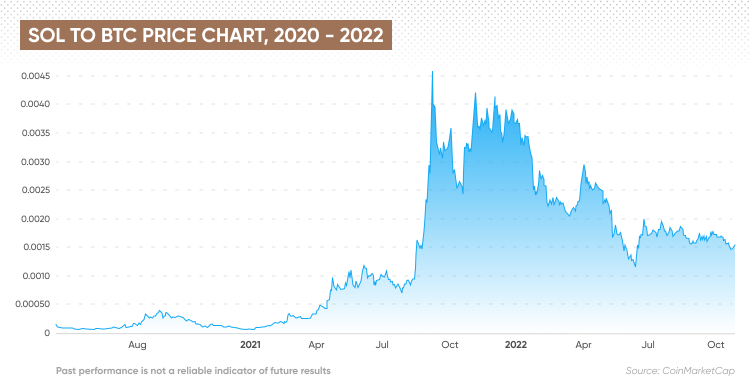
Since SOL’s launch in 2020, the SOL to BTC rate struggled to pick up momentum, moving sideways for around 10 months before starting to gain speed at the end of February 2021.

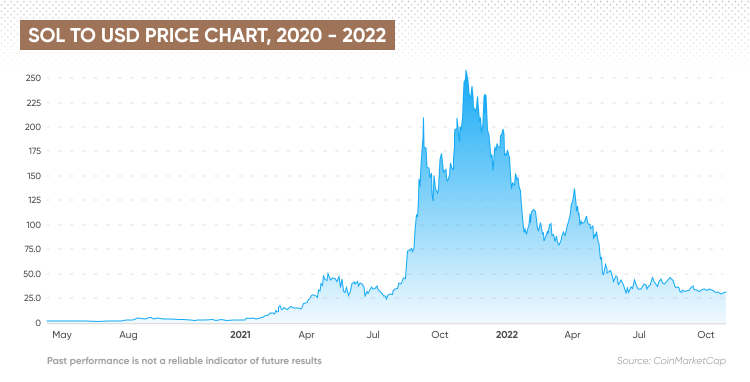
Between late February 2021 and mid-August 2021 the pairing fluctuated between values as low as 0.0001781BTC and as high as 0.001179BTC. The SOL to USD price chart followed a similar trend, fluctuating between $13 and $49.

SOL to BTC price chart, 2020 - 2022

Between 15 August 2021 and 9 September 2021, however, the SOL/BTC pair surged, rising by more than 385%, up from 0.0009374BTC to 0.004576BTC as Solana was being discovered by a number of celebrities, such as Mike Tyson and Jason Derulo. This was also the time when the SOL to BTC reached its all-time high, as seen on the price chart above.

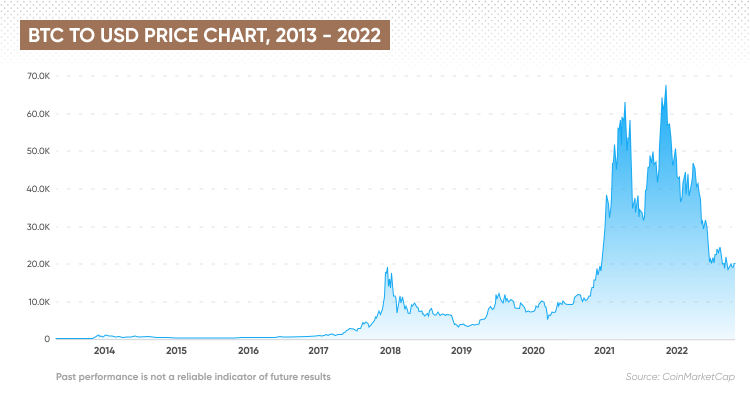
Between 9 September 2021 and 20 October 2021 the SOL/BTC price lost nearly 50% of its gains, dropping to 0.002425BTC as the BTC price in US dollars started to see major gains, surging by around 39% within the period from $46,000 to $64,000.

BTC to USD price chart, 2013 - 2022

In line with other major cryptocurrencies, the SOL/BTC rate regained a big portion of its losses as it rose to 0.004202BTC by 7 November 2021, at the time when the SOL value in USD reached its all-time high of $258.78.

SOL to USD price chart, 2020 - 2022

Up until the start of January 2022, the SOL to BTC exchange rate was fluctuating between 0.004000BTC and 0.003000BTC before falling more than 60% to 0.001149BTC on 13 June 2022, amid overall broad negative investor sentiment.

In terms of technical analysis, the chief digital advisor at the Mongolian Productivity Organisation and author of NFT: From Zero to Hero, Anndy Lian, told Capital.com that the SOL price could be headed towards a trend reversal, as of 28 October.

“The Relative Strength Index (RSI) indicates that the token is in the overbought zone, signalling a reversal could be on the way,” he said.

The pairing’s current exchange rate (28 October) is 0.00151BTC, up by 31.4% since its 13 June 2022 dip.

What is driving SOL/BTC?

On 30 September 2022, the Solana Mainnet Beta cluster experienced an outage, which led to a temporary collapse in the blockchain. This saw the SOL to BTC exchange rate drop by 3.1% within a week, down to 0.001682BTC by 7 October 2022, from 0.001735BTC on the day of the outage.

Dr. Pooja Lekhi, professor of global financial institutions, risk management approach and financial management at University Canada West, told Capital.com:

“Solana has experienced several recent network outages and failures. In the beginning of June, validators in the network stopped processing new blocks for several hours and apps built on Solana’s blockchain were taken offline, which sent its price down more than 12%.”

Projects built on Solana have potential to affect the token’s future price. On 27 October, the Web3 platforms built on Solana Decentralised Engineering Corporation (DEC) and Teleport announced that they have raised funding to bring a Web3 Uber rival (TRIP) to the Solana blockchain, something Ethereum co-creator Vitalik Buterin theorised a while back.

Lian noted that bringing the ridesharing industry to the Solana ecosystem “would surely put SOL into a high utility mode”.

In addition, Solana had partnered with artist Nancy Baker Cahill. She launched her first NFT collection on the blockchain that was shown across 90 billboards on Times Square. Metaplex, an NFT ecosystem built on Solana, also announced it was bringing a new asset class that will allow “creators to enforce royalties at the protocol level by extending the Token Metadata program, which powers 99%+ of all NFTs on Solana.”

Dr. Lekhi noted that until Solana network’s upgrade, “stability will remain a major concern for the SOL, adding:

“It is expected that the Mainnet version will stop the power outage issue. The SOL market had set higher benchmarks for its prices, along with developments in decentralised exchanges, Solana NFT marketplace, Yield aggregators and online games.”

The date for the upgrade launch is yet to be announced.

The enthusiasm surrounding Solana also comes following the news about Saga, its flagship Android phone, which will start shipping in 2023, Lian noted. Solana announced that Saga will have its first mint event on 28 October, which will only be available to those who pre-ordered the phone.

SOL/BTC price prediction

Based on the analysis of past performance, as of 28 October, algorithm-based forecasting service Wallet Investor predicted that SOL/USD could fall to $2.947 in 2023. The platform did not provide a price prediction for 2027.

In terms of its BTC value forecast, the site saw BTC/USD trade at $23,107.27 in 2023 and reach $36,574.97 by 2027.

While Wallet Investor did not provide a direct SOL to BTC forecast, data suggested that the exchange rate could be 0.00012754BTC in 2023.

DigitalCoinPrice predicted that SOL/USD could rise to $36.55 by the end of 2022. The site’s data, as of 28 October, showed that the coin was expected to trade at $49.68 in 2023 and $80.94 in 2025. Its long-term prediction saw the coin reaching $169.10 in 2030.

The site also gave an upbeat BTC/USD forecast, as of 28 October, expecting the coin to grow to $25,646.42 by the end of 2022, reach $33,474.34 in 2023, $53,010.14 in 2025 and surpass $112,000 in 2030.

DigitalCoinPrice’s SOL to BTC forecast for 2022 expected the pair to reach 0.0014252BTC and 0.0014841BTC in 2023. The site’s SOL/BTC forecast for 2025 stood at 0.0015269BTC. Its long-term SOL/BTC forecast for 2030 was 0.0015098BTC.

Dr. Lekhi noted that 2022 was not a good year for SOL, however, the coin may observe a steady growth in the coming months as a rebound in SOL’s price is anticipated.

Lian added that interest in SOL is “extremely high” which could mean that its future movement could be “overall positive”, adding that “with the strong ecosystem backing its value, the rebound can be promising.”

Remember that analysts’ and algorithm-based predictions can be wrong and shouldn’t be used as a substitute for your own research.

Always conduct your own due diligence on a cryptocurrency project before trading, looking at the latest news, a wide range of analyst commentary and technical analysis. Note that past performance does not guarantee future returns. And never trade money you cannot afford to lose.


Source: https://capital.com/sol-btc-prediction-solana-bitcoin-exchange

Anndy Lian is an early blockchain adopter and experienced serial entrepreneur who is known for his work in the government sector. He is a best selling book author- “NFT: From Zero to Hero” and “Blockchain Revolution 2030”.

Currently, he is appointed as the Chief Digital Advisor at Mongolia Productivity Organization, championing national digitization. Prior to his current appointments, he was the Chairman of BigONE Exchange, a global top 30 ranked crypto spot exchange and was also the Advisory Board Member for Hyundai DAC, the blockchain arm of South Korea’s largest car manufacturer Hyundai Motor Group. Lian played a pivotal role as the Blockchain Advisor for Asian Productivity Organisation (APO), an intergovernmental organization committed to improving productivity in the Asia-Pacific region.

An avid supporter of incubating start-ups, Anndy has also been a private investor for the past eight years. With a growth investment mindset, Anndy strategically demonstrates this in the companies he chooses to be involved with. He believes that what he is doing through blockchain technology currently will revolutionise and redefine traditional businesses. He also believes that the blockchain industry has to be “redecentralised”.

j j j