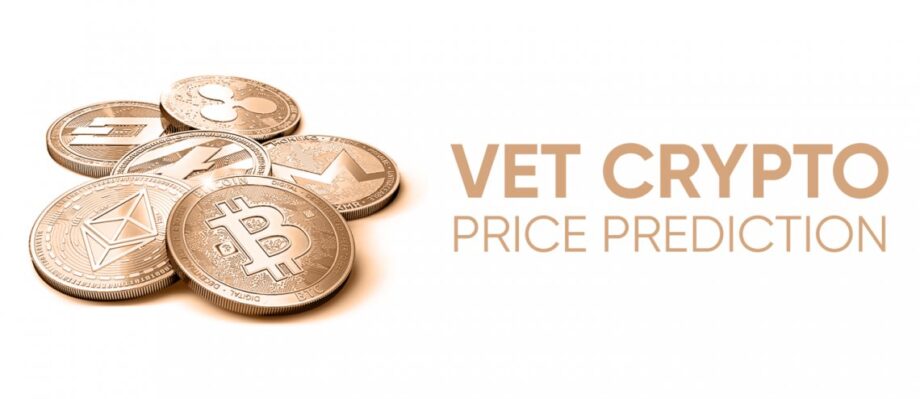
VET crypto price prediction: Will VeChain rise in value?

VET crypto price prediction: Will VeChain rise in value?

VeChain demonstrates the continuing advancement of the blockchain sector.

VeChain is a fully programmable smart contract platform that utilises distributed ledger technology to provide retailers and consumers with the ability to determine a product’s quality and authenticity. In a sense, this enhances supply chain and product lifecycle management processes, while connecting blockchain technology to the real-world.

Founded in 2015 by Sunny Lu, the project’s vision is to build a trust-free and distributed business ecosystem platform to enable transparent information flow, efficient collaboration and high speed value transfers.

More specifically, VeChain ToolChain offers a low-code blockchain-based software as a service (SaaS) platform that allows enterprise clients to build and drive digital transformation on a global scale. Solutions are suited to an enterprise’s specific business needs. VeChain has secured high-profile partnerships with the likes of PwC, Walmart China and BMW Group.

What the VeChain project excels at is enabling businesses to track their products and conduct quality assurance through a unique blockchain-as-a-Service (BaaS) model. This has the potential to both reduce the costs between parties, as well as making business cooperation simpler and more efficient.

In particular, global supply chain suppliers stand to benefit from the integration of blockchain technology since their systems often rely on tracking physical paperwork between siloed parts of a multinational network.

In 2019, multinational retail corporation Walmart announced that it would be partnering with VeChain to streamline product management between its suppliers, stores and customers in China through a traceability strategy.

Earlier this year, the Republic of San Marino approved VeChain’s NFT-based vaccination passport which contains a record of past infections, negative test results and also provides a digital vaccination certificate.

In other VeChain news, the company has worked with the Chinese government to introduce a risk self-assessment application called VeTrust, which is built on the VeChainThor blockchain and combines DNV’s – the classification society and a recognised advisor for the maritime industry – infection risk management methodology.

What is VeChain (VET)?

From product source materials to servicing history, every single piece of information about the supply chain movement of a product can be recorded and verified. VeChain offers a product traceability strategy which covers the life cycle of products from manufacturing, logistics, supply chain, retail and wholesale.

By utilising VeChain’s blockchain-powered platform, businesses can assign products with unique IDs and then track goods and services by embedding this ID in a QR code. This allows manufacturers, supply chain partners and consumers to track the movement of products through their supply chain.

On the VeChainThor platform, there are five main types of participants:

  • Business owners, which includes all kinds of entities such as enterprises, individuals, organizations, departments of governments and regulators
  • Application service providers that help business owners who do not have the individual adequate capabilities to build necessary applicational development and services on the VeChainThor blockchain
  • Enterprises or individuals that are capable of providing technical services to build and run smart contracts for business owners who wish to develop blockchain applications
  • Infrastructure service providers who ensure the integrity of the VeChainThor blockchain network by generating and verifying blocks
  • Members of the VeChain Foundation

The VeChain token (VET) is used to carry value from smart contracts which means that transactions on decentralised applications occurring on VeChain’s blockchain use VET.

The VeChain Foundation has distributed more than 70% of VET tokens (including a portion of burnt tokens) through different processes including private sale, public sale, promotions, business collaborations and marketing activities.

VET price analysis: Technical view

The VET coin started its journey in August 2018, and achieved an all-time high of $0.2782 on 17 April 2021. Only a week earlier, on 10 April 2021, VET had been trading at $0.1335.

However, the price retreated to $0.1589 on 25 April, dropping to as low as $0.07553 on 23 May. This is somewhat of a sharp drop considering that the coin had hit its all-time high just 37 days earlier.

The VET price then consolidated, trading within the $0.06 to $0.09 range until 7 August 2021, when it climbed to $0.1031, hitting $0.1556 on 6 September 2021. The rally was short lived, and the trend reversed when the price dropped to $0.08642 on 29 September 2021.

It’s currently (2 December) trading at around $0.116202. A decisive close above $0.12 would confirm a rally and clearing this crucial barrier could reverse VET’s downward trend.

VET ranks 27th in the list of cryptocurrencies by market capitalisation at $7.6bn. There are more than 64.32bn VET coins in circulation from a total supply of 86bn, according to CoinMarketCap.

Technical analysis provided by CoinCodex shows that short-term sentiment on VET is bearish, with eight indicators displaying bullish signals compared with 18 bearish.

The daily simple and exponential moving averages are giving mostly sell signals, according to data from TradingView, while the relative strength index (RSI) is at 39, as of 2 December. An RSI reading of 30 or below indicates an oversold or undervalued condition. Generally, when the RSI surpasses the horizontal 30 reference level, it could be interpreted as a bullish signal.

The technical analyst at CoinText, Ansh Rathod told Capital.com:

“VET has fallen by over 40% from the highs that it hit last month, however it seems to be taking support from the lower trendline, which could be a reversal zone for the coin. VET has formed several bullish candles at the support level and a break from the $0.129 resistance zone could change this downward trend.”

Blockchain-powered solution focused on supply chain and logistics needs

Last month, VeChain marked a milestone in its seven-year history. The company launched the first phase of its Proof-of-Authority (PoA) 2.0 consensus mechanism, which aims to improve the scalability of the network.

The upgrade allows VeChain transactions to be authorised without the use of mining, thus reducing environmental impact and providing a boost to the project.

According to VeChain, PoA 2.0 combines the Byzantine Fault Tolerance and Nakamoto consensus mechanisms to offer a more secure system, which could lead to wider adoption for the project.

Anndy Lian, chairman of BigONE Exchange and chief digital advisor for Mongolia’s national productivity agenda, believes that the VET token has not yet reached its optimum potential.

“VeChain’s recent upgrade to a Proof-of-Authority (PoA) model is deemed to be more environmentally friendly and this is just the beginning. Many people in my circle are saying that VET’s price could go up during this bullish market but they are yet to invest in the project as they are waiting for the full-scale launch of the upgrade to materialise. I can only say that innovation takes time – let’s be patient.”

What are the risks for the VET token?

While VeChain is a cryptocurrency that powers a network with some revolutionary potential, it’s crucial to take key risks into account and consider the price yourself before you decide to proceed forward. VeChain was launched in 2015, making it a relatively new project.

Also, the PoA system used in VeChainThor lacks the open, permissionless and decentralised nature which is inherent to blockchains, thus posing centralisation risks.

VET token price prediction: Buy, sell or hold?

In terms of a VET coin prediction, algorithm-based forecasting service Wallet Investor gives a positive VET/USD forecast. Based on historical data, Wallet Investor sees the price rising to $0.224 by December 2022, $0.441 in December 2024 and hitting $0.549 by December 2025.

Digital Coin Price supports the bullish VET crypto forecast, expecting the token to grow to $0.2290027113 in 2022, $0.2898387094 in 2025 and hit $0.5757652097 in 2028.

Note that algorithm-based predictions can be wrong. Forecasts shouldn’t be used as a substitute for your own research. Always conduct your own due diligence before investing. And never invest or trade money you cannot afford to lose.

Original Source: https://capital.com/vechain-vet-coin-prediction


What is VeChain?

VeChain is an enterprise blockchain platform that aims to solves some of the major problems with supply chain management. VeChain also plans to become a leading platform for conducting transactions between Internet of Things (IoT) connected devices.

Who invented VeChain?

VeChain was founded in 2015 by Sunny Lu. Lu was the former CIO of Louis Vuitton China.

What is Anndy Lian's view on VeChain now?

VeChain’s recent upgrade to a Proof-of-Authority (PoA) model is deemed to be more environmentally friendly and this is just the beginning. Many people in my circle are saying that VET's price could go up during this bullish market but they are yet to invest in the project as they are waiting for the full-scale launch of the upgrade to materialise. I can only say that innovation takes time - let's be patient.

Anndy Lian is an early blockchain adopter and experienced serial entrepreneur who is known for his work in the government sector. He is a best selling book author- “NFT: From Zero to Hero” and “Blockchain Revolution 2030”.

Currently, he is appointed as the Chief Digital Advisor at Mongolia Productivity Organization, championing national digitization. Prior to his current appointments, he was the Chairman of BigONE Exchange, a global top 30 ranked crypto spot exchange and was also the Advisory Board Member for Hyundai DAC, the blockchain arm of South Korea’s largest car manufacturer Hyundai Motor Group. Lian played a pivotal role as the Blockchain Advisor for Asian Productivity Organisation (APO), an intergovernmental organization committed to improving productivity in the Asia-Pacific region.

An avid supporter of incubating start-ups, Anndy has also been a private investor for the past eight years. With a growth investment mindset, Anndy strategically demonstrates this in the companies he chooses to be involved with. He believes that what he is doing through blockchain technology currently will revolutionise and redefine traditional businesses. He also believes that the blockchain industry has to be “redecentralised”.
j j j

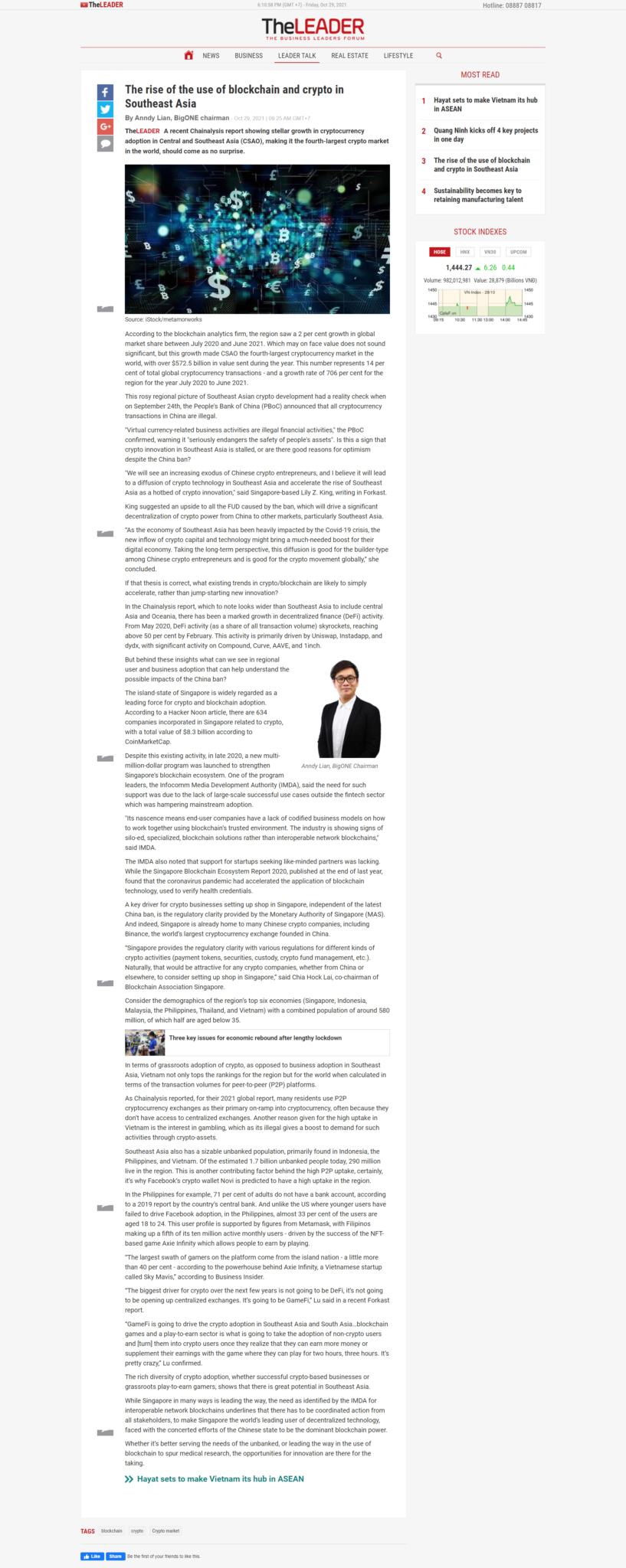
Op-ed by Anndy Lian: The rise of the use of blockchain and crypto in Southeast Asia

Op-ed by Anndy Lian: The rise of the use of blockchain and crypto in Southeast Asia
By Anndy Lian – Oct 29, 2021 | 09:25 AM GMT+7

TheLEADER A recent Chainalysis report showing stellar growth in cryptocurrency adoption in Central and Southeast Asia (CSAO), making it the fourth-largest crypto market in the world, should come as no surprise.

According to the blockchain analytics firm, the region saw a 2 per cent growth in global market share between July 2020 and June 2021. Which may on face value does not sound significant, but this growth made CSAO the fourth-largest cryptocurrency market in the world, with over $572.5 billion in value sent during the year. This number represents 14 per cent of total global cryptocurrency transactions – and a growth rate of 706 per cent for the region for the year July 2020 to June 2021.

This rosy regional picture of Southeast Asian crypto development had a reality check when on September 24th, the People’s Bank of China (PBoC) announced that all cryptocurrency transactions in China are illegal.

“Virtual currency-related business activities are illegal financial activities,” the PBoC confirmed, warning it “seriously endangers the safety of people’s assets”. Is this a sign that crypto innovation in Southeast Asia is stalled, or are there good reasons for optimism despite the China ban?

“We will see an increasing exodus of Chinese crypto entrepreneurs, and I believe it will lead to a diffusion of crypto technology in Southeast Asia and accelerate the rise of Southeast Asia as a hotbed of crypto innovation,” said Singapore-based Lily Z. King, writing in Forkast.

King suggested an upside to all the FUD caused by the ban, which will drive a significant decentralization of crypto power from China to other markets, particularly Southeast Asia.

“As the economy of Southeast Asia has been heavily impacted by the Covid-19 crisis, the new inflow of crypto capital and technology might bring a much-needed boost for their digital economy. Taking the long-term perspective, this diffusion is good for the builder-type among Chinese crypto entrepreneurs and is good for the crypto movement globally,” she concluded.

If that thesis is correct, what existing trends in crypto/blockchain are likely to simply accelerate, rather than jump-starting new innovation?

In the Chainalysis report, which to note looks wider than Southeast Asia to include central Asia and Oceania, there has been a marked growth in decentralized finance (DeFi) activity. From May 2020, DeFi activity (as a share of all transaction volume) skyrockets, reaching above 50 per cent by February. This activity is primarily driven by Uniswap, Instadapp, and dydx, with significant activity on Compound, Curve, AAVE, and 1inch.

But behind these insights what can we see in regional user and business adoption that can help understand the possible impacts of the China ban?

The island-state of Singapore is widely regarded as a leading force for crypto and blockchain adoption. According to a Hacker Noon article, there are 634 companies incorporated in Singapore related to crypto, with a total value of $8.3 billion according to CoinMarketCap.

Despite this existing activity, in late 2020, a new multi-million-dollar program was launched to strengthen Singapore’s blockchain ecosystem. One of the program leaders, the Infocomm Media Development Authority (IMDA), said the need for such support was due to the lack of large-scale successful use cases outside the fintech sector which was hampering mainstream adoption.

“Its nascence means end-user companies have a lack of codified business models on how to work together using blockchain’s trusted environment. The industry is showing signs of silo-ed, specialized, blockchain solutions rather than interoperable network blockchains,” said IMDA.

The IMDA also noted that support for startups seeking like-minded partners was lacking. While the Singapore Blockchain Ecosystem Report 2020, published at the end of last year, found that the coronavirus pandemic had accelerated the application of blockchain technology, used to verify health credentials.

A key driver for crypto businesses setting up shop in Singapore, independent of the latest China ban, is the regulatory clarity provided by the Monetary Authority of Singapore (MAS). And indeed, Singapore is already home to many Chinese crypto companies, including Binance, the world’s largest cryptocurrency exchange founded in China.

“Singapore provides the regulatory clarity with various regulations for different kinds of crypto activities (payment tokens, securities, custody, crypto fund management, etc.). Naturally, that would be attractive for any crypto companies, whether from China or elsewhere, to consider setting up shop in Singapore,” said Chia Hock Lai, co-chairman of Blockchain Association Singapore.

Consider the demographics of the region’s top six economies (Singapore, Indonesia, Malaysia, the Philippines, Thailand, and Vietnam) with a combined population of around 580 million, of which half are aged below 35.

In terms of grassroots adoption of crypto, as opposed to business adoption in Southeast Asia, Vietnam not only tops the rankings for the region but for the world when calculated in terms of the transaction volumes for peer-to-peer (P2P) platforms.

As Chainalysis reported, for their 2021 global report, many residents use P2P cryptocurrency exchanges as their primary on-ramp into cryptocurrency, often because they don’t have access to centralized exchanges. Another reason given for the high uptake in Vietnam is the interest in gambling, which as its illegal gives a boost to demand for such activities through crypto-assets.

Southeast Asia also has a sizable unbanked population, primarily found in Indonesia, the Philippines, and Vietnam. Of the estimated 1.7 billion unbanked people today, 290 million live in the region. This is another contributing factor behind the high P2P uptake, certainly, it’s why Facebook’s crypto wallet Novi is predicted to have a high uptake in the region.

In the Philippines for example, 71 per cent of adults do not have a bank account, according to a 2019 report by the country’s central bank. And unlike the US where younger users have failed to drive Facebook adoption, in the Philippines, almost 33 per cent of the users are aged 18 to 24. This user profile is supported by figures from Metamask, with Filipinos making up a fifth of its ten million active monthly users – driven by the success of the NFT-based game Axie Infinity which allows people to earn by playing.

“The largest swath of gamers on the platform come from the island nation – a little more than 40 per cent – according to the powerhouse behind Axie Infinity, a Vietnamese startup called Sky Mavis,” according to Business Insider.

“The biggest driver for crypto over the next few years is not going to be DeFi, it’s not going to be opening up centralized exchanges. It’s going to be GameFi,” Lu said in a recent Forkast report.

“GameFi is going to drive the crypto adoption in Southeast Asia and South Asia…blockchain games and a play-to-earn sector is what is going to take the adoption of non-crypto users and [turn] them into crypto users once they realize that they can earn more money or supplement their earnings with the game where they can play for two hours, three hours. It’s pretty crazy,” Lu confirmed.

The rich diversity of crypto adoption, whether successful crypto-based businesses or grassroots play-to-earn gamers, shows that there is great potential in Southeast Asia.

While Singapore in many ways is leading the way, the need as identified by the IMDA for interoperable network blockchains underlines that there has to be coordinated action from all stakeholders, to make Singapore the world’s leading user of decentralized technology, faced with the concerted efforts of the Chinese state to be the dominant blockchain power.

Whether it’s better serving the needs of the unbanked, or leading the way in the use of blockchain to spur medical research, the opportunities for innovation are there for the taking.


Original Source: https://e.theleader.vn/the-rise-of-the-use-of-blockchain-and-crypto-in-southeast-asia-1635393795663.htm


Anndy Lian is an early blockchain adopter and experienced serial entrepreneur who is known for his work in the government sector. He is a best selling book author- “NFT: From Zero to Hero” and “Blockchain Revolution 2030”.

Currently, he is appointed as the Chief Digital Advisor at Mongolia Productivity Organization, championing national digitization. Prior to his current appointments, he was the Chairman of BigONE Exchange, a global top 30 ranked crypto spot exchange and was also the Advisory Board Member for Hyundai DAC, the blockchain arm of South Korea’s largest car manufacturer Hyundai Motor Group. Lian played a pivotal role as the Blockchain Advisor for Asian Productivity Organisation (APO), an intergovernmental organization committed to improving productivity in the Asia-Pacific region.

An avid supporter of incubating start-ups, Anndy has also been a private investor for the past eight years. With a growth investment mindset, Anndy strategically demonstrates this in the companies he chooses to be involved with. He believes that what he is doing through blockchain technology currently will revolutionise and redefine traditional businesses. He also believes that the blockchain industry has to be “redecentralised”.
j j j

All Cake, No-Bake: BabyCake’s Rise in the World of Digital Currencies

All Cake, No-Bake: BabyCake’s Rise in the World of Digital Currencies

BabyCake proudly stands as the world’s first CAKE reflection token. Users receive CAKE in their crypto wallets just for holding the $BABYCAKE native token. 

Best of all – there’s no stress about manually claiming CAKE. Tokens are automatically sent to wallets thanks to BabyCake’s Protocol. BabyCake’s unique classic redistribution scheme is based on contract percentage, current token balance, and the number of holders. 

Our Mission: To Revolutionize DeFi

Just head on over to PancakeSwap to buy $BABYCAKE (users need at least 200,000 tokens to receive distributed CAKE) and check out the BabyCake dashboard to see your daily rewards.

BabyCake features a static reward system representing the next evolution of Binance Smart Chain (BSC) yield-generating contracts. 15% of each transaction splits as follows – 7% CAKE goes right back to holders. 5% is allocated for marketing efforts. The final 3% becomes liquidity for PancakeSwap.

Whales are warned, BabyCake has added an extra 1% fee to all sales to reduce swing trading and monopolization.

Under The Hood

The BabyCake team has taken several steps to ensure optimal security. There’s a 12-month lock on initial liquidity, so holders can rest assured they can trade. DXLock, a cross-chain decentralized token and liquidity provider locker for Ethereum and BSC, is here to help as a middleman.

BabyCake’s contract is also audited and certified by ​​CertiK, a leading blockchain security firm. Founded by Yale and Columbia University professors in 2018, CertiK has worked with hundreds of clients. A CertiK certification is considered the gold standard of contract security.

Still not convinced? Well, BabyCake has also invested in a contract audit from TechRate, a blockchain security consulting firm. They’ve audited 100’s of smart contracts since 2017, saving more than $300 million in investor funds. TechRate worked with BabyCake to ensure the contract had no vulnerabilities to severe issues or hacks.

Anndy Lian was added to the Baby Cake advisory team in August to provide further advice and expertise. He leads the Mongolian Productivity Organization and is the author of the best selling book Blockchain Revolution 2030.

Tasty Morsels For Baby Cake Holders

BabyCake has got a lot coming down the pipeline for its community.

First, BabyCakeSwap makes its grand debut in September.

The company is a Platinum Sponsor of the Dubai Crypto Expo. Monk will be speaking there as well as at the Global DeFi Investment Summit a few days earlier.

Down the line, BabyCake is looking to open up a BabyCake merch shop and an NFT platform. Not to mention, 5% of every transaction is allocated towards its marketing budget, which means BabyCake has plenty of firepowers to push its ambitious projects forward.

BabyCake has also announced its ‘Diamond Hands Sunday‘ and ‘Buy Back Monday’ initiatives. On Buyback Sundays, Rewards increase to 12% – that’s a 5% increase! (24 hours UTC). On Buyback Mondays, BabyCake tokens are purchased with the Rewards earned by the 1 billion tokens released from the Team Wallet. Consider it like a Whale wallet that will never sell and reinvests all its Rewards every week!

We are All About Our Community

Ready to learn more about the first CAKE reflection token?

It’s all about the community at BabyCake.

Follow BabyCake on Twitter to keep up with the latest news.

Chat with our team members on Telegram.

Discuss everything BabyCake inside our Reddit community.

Check in on the BabyCake website to see what’s new.

Get all the details on vision, strategy, and our Roadmap in our whitepaper.

Here’s to earning $CAKE and keeping things light and fluffy!

Source: https://btcmanager.com/all-cake-no-bake-babycake-digital-currencies/

Anndy Lian is an early blockchain adopter and experienced serial entrepreneur who is known for his work in the government sector. He is a best selling book author- “NFT: From Zero to Hero” and “Blockchain Revolution 2030”.

Currently, he is appointed as the Chief Digital Advisor at Mongolia Productivity Organization, championing national digitization. Prior to his current appointments, he was the Chairman of BigONE Exchange, a global top 30 ranked crypto spot exchange and was also the Advisory Board Member for Hyundai DAC, the blockchain arm of South Korea’s largest car manufacturer Hyundai Motor Group. Lian played a pivotal role as the Blockchain Advisor for Asian Productivity Organisation (APO), an intergovernmental organization committed to improving productivity in the Asia-Pacific region.

An avid supporter of incubating start-ups, Anndy has also been a private investor for the past eight years. With a growth investment mindset, Anndy strategically demonstrates this in the companies he chooses to be involved with. He believes that what he is doing through blockchain technology currently will revolutionise and redefine traditional businesses. He also believes that the blockchain industry has to be “redecentralised”.

j j j