The new norm: Stabilising global risk sentiment in a volatile market

The new norm: Stabilising global risk sentiment in a volatile market

February 6, 2025: We’ve recently witnessed a stabilisation of risk sentiment following a tumultuous week marked by volatile price action. Despite the tech sector’s underwhelming earnings, the MSCI US index managed to eke out a modest gain of 0.4 per cent, buoyed by a broader rally across other sectors. This resilience in the face of disappointing tech earnings speaks volumes about the current market dynamics, where diversification across sectors seems to be paying dividends.

The week’s economic data provided a mixed bag of signals. The US ISM services data, which fell unexpectedly to 52.8 against a consensus forecast of 54.1, sent ripples through the financial markets. This decline in service sector activity led to a significant drop in US Treasury (UST) yields, with the 2-year yield softening by three basis points to 4.19 per cent and the 10-year yield dropping eight basis points to 4.42 per cent.

This adjustment in yields reflects a cautious optimism among investors, perhaps taking some comfort in the narrowing of the 10s2s yield curve, which tightened by another 6 basis points to 23 basis points. This movement in the yield curve suggests that while the market anticipates no immediate rate hikes, the long-term outlook might be less hawkish than previously thought.

Amidst this backdrop, the voices from the Federal Reserve, including Jefferson, Barkin, and Goolsbee, maintained a steady drumbeat of “no rush on rate cuts,” although Goolsbee struck a surprisingly hawkish tone, cautioning about inflation risks stemming from potential tariffs.

This nuanced shift in narrative was further complicated by comments from Treasury Secretary Scott Bessent, who indicated that the Trump administration’s focus on reducing borrowing costs would target the 10-year Treasury yields rather than the Fed’s short-term rates. This policy direction could have profound implications for long-term investment strategies and the broader economic landscape.

The US Dollar Index, reflecting these shifts in economic policy and investor sentiment, fell by 0.4 per cent, reaching its lowest point in over a week. This decline was partly due to receding fears of a global trade war, which also influenced currency pairs like USD/JPY, dropping from 154.50 to 152.50 after Japan reported stronger-than-expected wage growth, sparking speculation of another Bank of Japan rate hike.

Gold, often seen as a safe-haven asset, continued its bull run, climbing to a new high of US$2,865 per ounce. This surge was fuelled not only by the general risk-off sentiment but also by fears that higher tariffs might extend to precious metals and commodities imports from the UK and the European Union.

Conversely, Brent crude oil prices fell by 2.1 per cent after an EIA report highlighted an increase in crude oil inventories, adding to the overhang of geopolitical risks in the oil market.

Looking at the equity front, Asian markets took their cues from Wall Street, opening higher, while US equity futures suggested a positive start for American stocks, indicating a potential continuation of the stabilisation trend.

The week wasn’t just about traditional markets; significant strides were made in the digital asset space. White House Crypto Czar David Sacks announced that the first priority for the administration would be stablecoin legislation. This move comes at a time when stablecoins, despite their popularity mainly overseas, have yet to find a clear regulatory path in the US The establishment of a Crypto Task Force, with SEC Commissioner Hester Peirce at the helm, aims to carve out a regulatory framework that balances innovation with investor protection.

The task force’s agenda is ambitious but necessary. It seeks to eliminate the regulatory ambiguity that has long plagued the crypto industry, where businesses operate under the shadow of potential legal repercussions without clear guidelines. Commissioner Peirce emphasised in her statement that the SEC’s initiative isn’t an endorsement of any crypto asset but rather an effort to provide a regulatory environment that makes sense for crypto while safeguarding investors from fraudulent schemes. The focus on stablecoins is particularly pertinent, given their role in providing liquidity and stability within the volatile crypto market.

This regulatory push could potentially be legislated within six months, according to Sacks, which is a bold timeline considering the complexities involved. Yet, it signals a significant shift towards integrating cryptocurrencies into the mainstream financial system, recognising their potential while addressing the inherent risks.

In conclusion, this week’s market movements reflect a broader narrative of stabilisation amidst volatility, driven by economic data, policy signals, and geopolitical developments. The focus on stablecoin regulation could be a game-changer for the crypto market, potentially fostering an environment where digital assets can thrive under a clearer legal framework.

However, the journey towards such stability in both traditional and digital markets is fraught with challenges, requiring a delicate balance between fostering innovation and ensuring economic and financial integrity. As we move forward, the interplay between market sentiment, regulatory actions, and global economic policies will continue to shape our financial landscape in unpredictable but potentially rewarding ways.


Source: https://e27.co/the-new-norm-stabilising-global-risk-sentiment-in-a-volatile-market-20250206/


Anndy Lian is an early blockchain adopter and experienced serial entrepreneur who is known for his work in the government sector. He is a best selling book author- “NFT: From Zero to Hero” and “Blockchain Revolution 2030”.

Currently, he is appointed as the Chief Digital Advisor at Mongolia Productivity Organization, championing national digitization. Prior to his current appointments, he was the Chairman of BigONE Exchange, a global top 30 ranked crypto spot exchange and was also the Advisory Board Member for Hyundai DAC, the blockchain arm of South Korea’s largest car manufacturer Hyundai Motor Group. Lian played a pivotal role as the Blockchain Advisor for Asian Productivity Organisation (APO), an intergovernmental organization committed to improving productivity in the Asia-Pacific region.

An avid supporter of incubating start-ups, Anndy has also been a private investor for the past eight years. With a growth investment mindset, Anndy strategically demonstrates this in the companies he chooses to be involved with. He believes that what he is doing through blockchain technology currently will revolutionise and redefine traditional businesses. He also believes that the blockchain industry has to be “redecentralised”.

j j j

Exploring The Meme Coin Craze: Risk, Hype, And Online Communities

Exploring The Meme Coin Craze: Risk, Hype, And Online Communities

Over the past weeks, social media platforms have been buzzing with tales of traders who seemingly hit the jackpot by investing in the PEPE meme coin. These stories of overnight success raise an important question: Can meme coins truly be relied upon as a means to accumulate wealth, or are they akin to playing the lottery and relying on luck?

To find the answer, we must explore the diverse strategies employed by various socio-economic classes when engaging with the lottery. The comparison between meme coins and lotteries sheds light on the different perspectives towards wealth accumulation.

Meme coins, for those unfamiliar, are digital currencies inspired by internet memes. Unlike traditional cryptocurrencies, meme coins typically lack practical applications beyond being traded and shared among users. Their value is heavily influenced by social media sentiment and other factors, leading to substantial price swings and the potential for market manipulation. While meme coins carry significant risks, they have amassed a substantial following of individuals who see them as a means of challenging established financial systems and connecting with like-minded communities online.

The PEPE meme coin, in particular, experienced a staggering 9,071% surge in value prior to its listing on Binance, reaching an astounding market capitalization of $1.8 billion. However, cautionary advice is now being shared among traders due to the coin’s recent breach of crucial trend and support levels. Meme coins, especially those developed by anonymous teams, are susceptible to “rug pulls,” where developers abandon the project, leading to a collapse in value. Additionally, price volatility tends to be most pronounced during Asian trading hours.

On the other hand, we have the allure of the lottery, where the promise of instant wealth with minimal effort and investment proves irresistible to many. Despite the astronomical odds of winning a jackpot (1 in 300 million for Powerball), the average player spends close to $200 per year, which accumulates to a significant sum over time. Surprisingly, research suggests that those who fall into the lower socio-economic class tend to play the lottery regardless of the odds, while wealthier individuals only participate when the jackpot offers substantial returns. For the wealthy, a $10 million win may not make a significant impact, but a jackpot exceeding $100 million piques their interest.

In essence, the PEPE meme coin and the lottery represent two sides of the same coin. Both offer the allure of swift wealth with minimal investment, but both carry substantial risks. While Buffet’s investment strategy prioritizes safety and is grounded in long-term schemes, playing the lottery or investing in meme coins resembles a game of chance, hoping for the best outcome.

What Other Meme Coins Are Making Waves?

The surge in popularity of meme coins can be attributed to various factors, including the growing fascination with cryptocurrencies and the relative ease of creating new digital currencies. Several meme coins have garnered attention for their clever branding and incorporation of popular culture references, which have fueled interest and speculation. The social media-driven aspect of meme culture has also played a significant role, with influencers and online communities endorsing their preferred coins and spreading the word to their followers.

This has created a frenzied environment of buying and selling, as investors aim to capitalize on the hype and take advantage of the unpredictability of these highly speculative assets.

Here are several meme coins that have gained popularity and attention:

  • AiDoge: AiDoge positions itself as a new web3 platform for meme creation and sharing using AI technology. The project has gained significant attention, with its presale reportedly raising over $5.5 million.
  • Ordi: Ordi is a meme coin paying homage to the Ordinals protocol, which is currently the largest with a value of $400 million.
  • BOB: BOB is an AI bot that provides tweet summaries to Twitter users who reply with “@ExplainThisBob”. Its programming includes automatic responses to tweets made by Elon Musk, which have earned BOB praise from Musk himself and garnered a large following of several thousand users.
  • MONG: MONG is a recently launched meme cryptocurrency project in 2023. What sets MONG Coin apart from other meme cryptocurrencies is its association with an established NFT collection called MONGS NFT, which was created in January 2022. The collection features 6,943 NFTs, with each NFT portraying a distinct mungo (mongoose).
  • TURBO: TURBO is an innovative cryptocurrency with a unique token economy that aims to become the meme coin of the future. Unless many other meme coins, TURBO is developed almost exclusively using ChatGPT.
  • LADYS: Milady Meme Coin has its native token called LADYS, which can be utilized to pay for online goods and services. The token’s value received a lot of attention after Elon Musk tweeted about the Milady NFT meme. Currently, the market capitalization of this meme token has exceeded $100 million.
  • WOJAK: WOJAK is a new ERC-20 token, inspired by the famous Wojak meme. Since its inception, the token has gained massive momentum and at its peak, it has surged over 1000%.
  • Floki: Floki is a cryptocurrency that initially started as a meme coin inspired by the dog of Elon Musk. However, it has now transformed into a complete Web3 ecosystem that comprises NFTs, DeFi, a metaverse, and prepaid gift cards for Visa and Mastercard. The project has gained a lot of attention as it was recently added to the list of cryptocurrencies on Binance.
  • XRdoge: XRdoge  is a meme coin on the XRP ledger. Similar to Floki, they are not a new meme coin. The reason why they are mentioned is that I felt that XRP needs to have their own doge and have some fun. The fun elements could bring more hype to the Ripple ecosystem.

The newer memes that are trying to ride on the PEPE waves, like BIBI, BOBO, PEPO, and PIPI would need to find their own niche very soon. Other Chinese-themed coins like Pogai and LowB got to gather more mandarin speaking communities to join in the fun. If you are a Cate, SquidGrow, TSUKA or Renewable coin and not part of the frog or dog craze, you just got to wait for your turn to shine.

It is worth mentioning that while newer meme coins have recently gained significant popularity, older meme coins such as Doge, Shiba Inu, Pitbull, RichQuack, Saitama, Baby Doge, Safemoon continue to thrive by actively maintaining their community and working on their projects. This demonstrates their commitment to longevity and a sustained presence in the ever-changing world of cryptocurrency. The level of dedication and perseverance displayed by these coins is a positive indication for the meme coin industry, as it suggests that some of these coins may have staying power beyond just a momentary hype cycle. The continued relevance and demand for these older meme coins highlight their ability to maintain a loyal following and leave a lasting impact, even in the midst of emerging trends and shifting market conditions.

In conclusion

It should be noted, however, that meme coins are known for their strong online communities, driven by hype and speculation, and may not necessarily have serious real-world use cases or underlying technology.

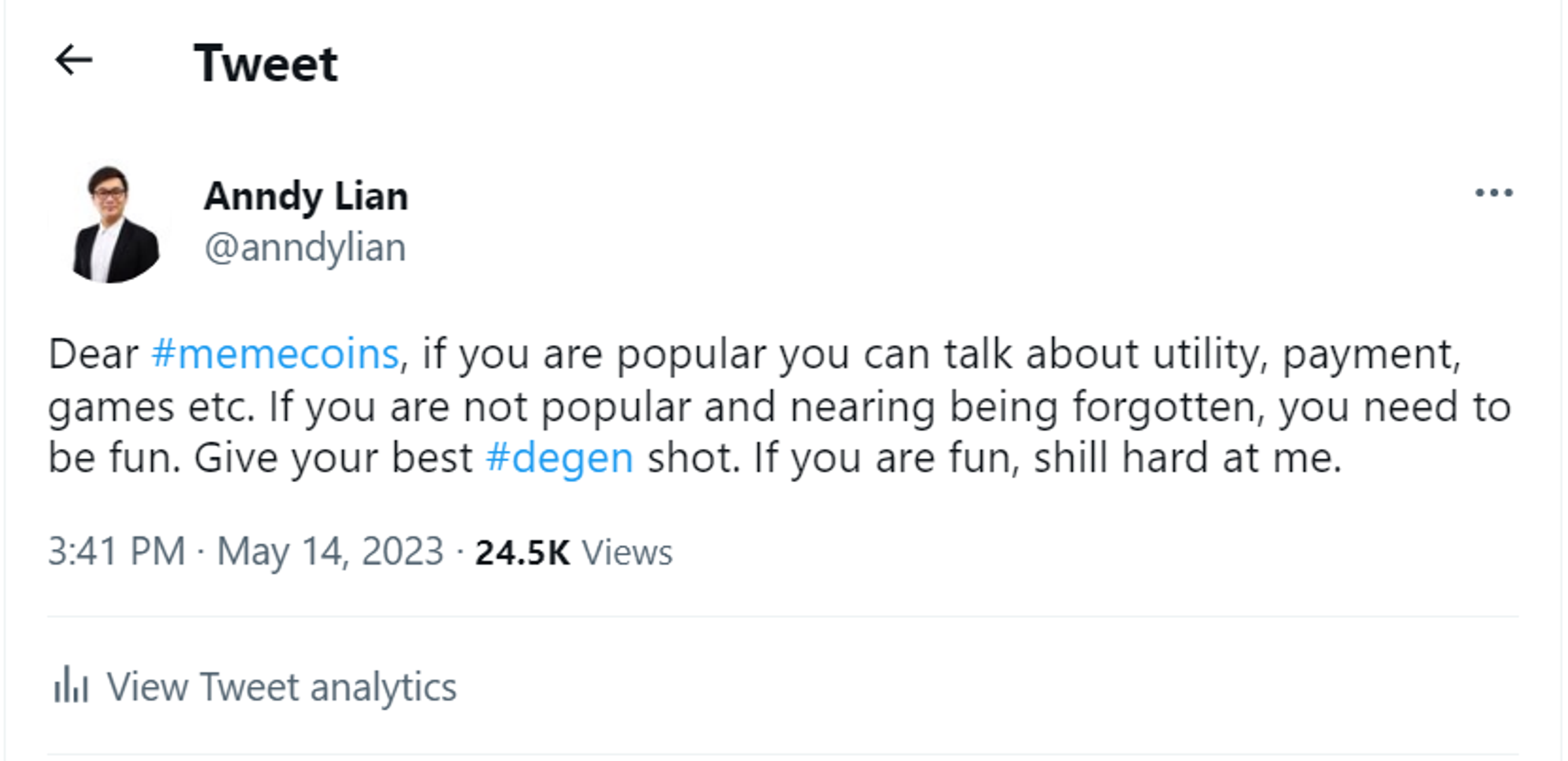
Like what I have mentioned on Twitter“Dear #memecoins, if you are popular you can talk about utility, payment, games etc. If you are not popular and nearing being forgotten, you need to be fun…”

The underlying for its success would still be community and having fun together. If a meme coin survives the initial stages and gains support from its community, its games, NFTs, or even metaverse would have a much higher chance of success. Their new revenue streams would be vital for them to survive in the bear market and beyond.

It’s essential to consider the risks and rewards of any investment opportunity carefully. While the promise of quick wealth might be tempting, long-term, low-risk investments are the safest and most reliable way to accumulate wealth.


Source: https://www.benzinga.com/23/05/32628423/exploring-the-meme-coin-craze-risk-hype-and-online-communities

Anndy Lian is an early blockchain adopter and experienced serial entrepreneur who is known for his work in the government sector. He is a best selling book author- “NFT: From Zero to Hero” and “Blockchain Revolution 2030”.

Currently, he is appointed as the Chief Digital Advisor at Mongolia Productivity Organization, championing national digitization. Prior to his current appointments, he was the Chairman of BigONE Exchange, a global top 30 ranked crypto spot exchange and was also the Advisory Board Member for Hyundai DAC, the blockchain arm of South Korea’s largest car manufacturer Hyundai Motor Group. Lian played a pivotal role as the Blockchain Advisor for Asian Productivity Organisation (APO), an intergovernmental organization committed to improving productivity in the Asia-Pacific region.

An avid supporter of incubating start-ups, Anndy has also been a private investor for the past eight years. With a growth investment mindset, Anndy strategically demonstrates this in the companies he chooses to be involved with. He believes that what he is doing through blockchain technology currently will revolutionise and redefine traditional businesses. He also believes that the blockchain industry has to be “redecentralised”.
j j j

Op-ed: Binance’s reputation at risk as CFTC allegations raise concerns

Op-ed: Binance’s reputation at risk as CFTC allegations raise concerns

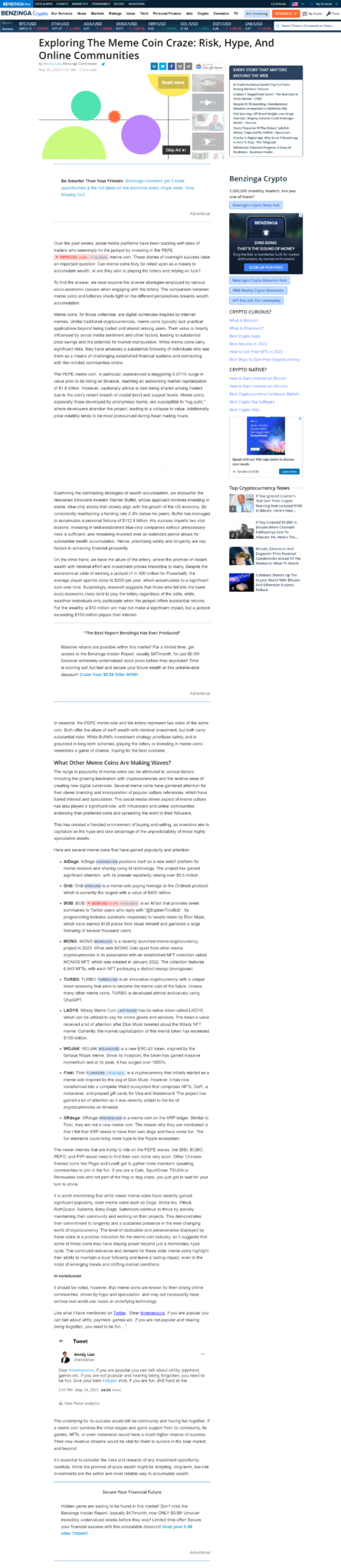
The U.S. Commodity Futures Trading Commission (CFTC) has sued Binance, the world’s largest cryptocurrency exchange, and its CEO, Changpeng Zhao (CZ), for allegedly violating federal law by allowing Americans to trade crypto derivatives on its platform.

The CFTC has been investigating Binance since 2021 on allegations that the exchange allowed U.S. residents to use its platform to buy and sell crypto derivatives, which require registration with the CFTC under current laws. The lawsuit alleges that Binance solicited U.S. users for millions in revenue, violating federal law. CFTC has also sued Binance for operating without being registered with the agency and without proper know-your-customer procedures.

The lawsuit also claims that Binance traded against its customers, taking advantage of inside information and manipulating markets to increase profits. Additionally, Binance’s former chief compliance officer, Samuel Lim, was charged with aiding and abetting the company’s violations. This is a severe breach of trust if this is true. The accusation of Binance trading against its users is particularly troubling. If true, this would be a betrayal of trust and a violation of the principles of fair trading.

Impact on Binance

As a cryptocurrency exchange, Binance should be a neutral platform that facilitates trading between buyers and sellers, not one that takes advantage of its users. If found guilty by the CFTC, it could face significant penalties and consequences. The CFTC can impose fines, seek injunctions, and even ban individuals or companies from participating in commodity markets. Binance could also face civil lawsuits from affected users or investors.

Additionally, Binance’s reputation could be severely impacted if found guilty of the CFTC’s charges. Trust is essential in the cryptocurrency market, and if Binance is seen as a bad actor that trades against its users, it could result in a loss of confidence from its clients and investors. It could affect Binance’s ability to operate in the U.S. and other regulated markets, limiting its growth potential.

Impact on industry

From a broader perspective, it could harm the entire cryptocurrency industry. Binance is currently the world’s largest cryptocurrency exchange and plays a significant role in the market. A loss of confidence in Binance could lead to a decrease in overall market trust and investment. It could increase regulatory scrutiny and stricter regulations for other cryptocurrency exchanges.

Rostin Behnam, CFTC Chairman, said in a statement:

“For years, Binance knew they were violating CFTC rules, working actively to both keep the money flowing and avoid compliance. This should be a warning to anyone in the digital asset world that the CFTC will not tolerate willful avoidance of U.S. law,”

If I am not wrong, this is the first time CFTC has gone against a crypto exchange. The allegations by the CFTC are not to be taken lightly, and Binance should address them with transparency and accountability. It is vital to remember that these are allegations, and Binance has not been found guilty of wrongdoing.

Therefore, we should reserve judgment until all the facts have been presented in court. The consequences of being found guilty by the CFTC could be severe for Binance and its operations. It remains to be seen what the outcome of the lawsuit will be, and Binance has denied any wrongdoing and vowed to fight the charges.

It is also important to note that Binance has been scrutinized by various regulators worldwide. This is not the first time the exchange has faced accusations of regulatory violations. This raises concerns about the exchange’s compliance procedures and willingness to follow regulatory requirements.

Binance has responded to the lawsuit, stating that its priority is to continue protecting its users while working with regulators to ensure compliance. Binance has denied the allegations, stating that they have always complied with U.S. regulations and that the CFTC’s claims are without merit.

CZ had also publicly clarified on his blog:

“We are collaborative with regulators and government agencies worldwide. While we are not perfect, we hold ourselves to a high standard, often higher than what existing regulations require. And above all, we believe in doing the right thing by our users at all times. In this journey towards freedom of money, we do not expect everything to be easy. We do not shy away from challenges.”

It remains to be seen how the case will play out. Still, the CFTC is taking a strong stance on regulating cryptocurrency trading — companies like Binance must ensure they comply with all relevant laws and regulations to avoid similar legal action in the future.

The outcome of the lawsuit remains to be seen, but companies like Binance must comply with all relevant laws and regulations to avoid similar legal action in the future. Ultimately, the importance of regulatory compliance and transparency cannot be overstated. Binance’s ability to clear its name and move forward in a transparent and accountable manner will be crucial for the entire industry’s health and growth.


Source: https://cryptoslate.com/binance-reputation-at-risk-as-cftc-allegations-raise-concerns/

Anndy Lian is an early blockchain adopter and experienced serial entrepreneur who is known for his work in the government sector. He is a best selling book author- “NFT: From Zero to Hero” and “Blockchain Revolution 2030”.

Currently, he is appointed as the Chief Digital Advisor at Mongolia Productivity Organization, championing national digitization. Prior to his current appointments, he was the Chairman of BigONE Exchange, a global top 30 ranked crypto spot exchange and was also the Advisory Board Member for Hyundai DAC, the blockchain arm of South Korea’s largest car manufacturer Hyundai Motor Group. Lian played a pivotal role as the Blockchain Advisor for Asian Productivity Organisation (APO), an intergovernmental organization committed to improving productivity in the Asia-Pacific region.

An avid supporter of incubating start-ups, Anndy has also been a private investor for the past eight years. With a growth investment mindset, Anndy strategically demonstrates this in the companies he chooses to be involved with. He believes that what he is doing through blockchain technology currently will revolutionise and redefine traditional businesses. He also believes that the blockchain industry has to be “redecentralised”.

j j j