
Gulf tech firms turn to Hong Kong and Singapore as Iran war grinds on

Gulf tech firms turn to Hong Kong and Singapore as Iran war grinds on
Paul Bratby had already drawn up plans for expanding to Hong Kong when war broke out in the Middle East earlier this year.
But the founder of xBratAI, a Dubai-based AI-powered trading signals platform, soon brought that timeline forward as the Iran conflict dragged on and widened in scope.

“Our Hong Kong entity had been scheduled for a few years later, but we established it in early 2026,” he said.

Bratby is not alone in looking east. As missiles continue to target Gulf capitals and shipping lanes, digital businesses and investors are increasingly setting up shop in Hong Kong and Singapore.

“The war has influenced the pace of expansion into East Asian hubs more than it has redrawn the map. Firms that can relocate cheaply have done so,” Bratby said, adding: “Hong Kong and Singapore are now treated as primary growth markets.”

For many, these new Asian bases supplement established operations in Abu Dhabi and Dubai, creating what Anndy Lian, a Singapore-based adviser to governments on blockchain and information technology, calls a “dual-hub” model.

“We are not seeing an outright exodus from the Gulf, but we are witnessing an accelerated shift towards proactive geopolitical hedging,” he said. “Major digital and tech enterprises are no longer content with relying on a single operational anchor.”

Ali Moosa, executive vice-chairman of Bahrain-headquartered Singapore Gulf Bank, said the conflict had accelerated Gulf businesses’ use of Asian financial hubs.

“Business continues during uncertainty,” he said. “Companies still need to pay suppliers, buy equipment, meet payroll and complete projects.”

In the long term, greater access to Asian capital and investment could support growth in the Gulf, Moosa said.

The closer the Gulf becomes to Asia, the more capital Gulf businesses can access and the more opportunities they can pursue- Ali Moosa, Singapore Gulf Bank

“The closer the Gulf becomes to Asia, the more capital Gulf businesses can access and the more opportunities they can pursue,” he said, adding he expected “many of these relationships to continue after the immediate disruption ends”.

The disruption could last for some time, however, as the conflict continues to widen.

At the weekend, Yemen’s Iran-backed Houthis claimed missile and drone strikes on “sensitive” sites in the Saudi capital Riyadh and on an Aramco facility in the Red Sea oil export hub of Yanbu.

Britain has agreed to help Saudi Arabia’s military counter the Houthis, whose attacks have increasingly threatened shipping near the Bab el-Mandeb chokepoint.

Meanwhile, Singaporean financial institutions have been setting up cross-border digital networks and multicurrency settlement methods to carry Gulf capital into a region undergoing an unprecedented infrastructure boom, driven by the race for AI data centre capacity.

Building AI infrastructure was enormously capital intensive, Lian said, pointing to the huge amounts of upfront investment required for high-voltage power grids, industrial cooling systems and the like.

“Middle Eastern institutional capital is uniquely suited to this demand,” he said. “Gulf investors possess deep familiarity with massive, energy-intensive infrastructure projects, and they are deploying liquidity directly into Southeast Asia’s digital backbone.”

The Asia-Pacific’s financial services industry is forecast to nearly double in value to US$4.8 trillion by 2035, according to a Deloitte report published last month – overtaking the United States, whose industry is projected to reach US$4.3 trillion over the same period.

Gulf sovereign wealth funds were hungry for exposure to Asia’s consumer digital economy and industrial supply chains, and Asian fund managers and technology consortiums were more than happy to oblige, Lian said.

Iranian attacks on data centres in Bahrain and the United Arab Emirates led to service outages earlier in the conflict, fuelling a surge of interest in Southeast Asian alternatives, said Raj Kapoor, founder of the India Blockchain Alliance.

This had “introduced something that technology companies historically treated as an unlikely tail risk”, he said.

Even so, Kapoor said the Gulf would remain central to the global AI buildout as tech companies had already sunk billions of US dollars into the region, with government backing and it “therefore makes little sense” for them “simply to abandon those markets”.

“So I see this mainly as diversification rather than relocation,” he said.



Source: https://www.scmp.com/week-asia/economics/article/3368387/gulf-tech-firms-turn-hong-kong-and-singapore-iran-war-grinds

Anndy Lian is an early blockchain adopter and experienced serial entrepreneur who is known for his work in the government sector. He is a best selling book author. The latest book is Web4: The Age of Autonomous Intelligence.

j j j

Bitcoin’s Correlation with Altcoins is Declining Again. Anndy Lian said “Its temporary.”

Bitcoin’s Correlation with Altcoins is Declining Again. Anndy Lian said “Its temporary.”

Data reveals that certain bigger altcoins (e.g. BNB, XRP, ADA, DOGE, and also ETH to a lesser extent) have become markedly less correlated with BTC over recent months.

The bull market changes the correlated relationship between some altcoins and Bitcoin. It has not significantly changed it though. What we are seeing now is an overhyped and oversubscribed market. There is an overflow in liquidity. Community members and supporters are buying some of the altcoins thinking that it will give them 10-20X ROI. They also think that Bitcoin has hit its maximum price level during this period. Therefore moving their investment into altcoins. And that is why we are seemingly seeing less correlation. But if you watch the market closely, whenever Bitcoin is down, they are all down too.

This recent decline in correlations is temporary. Bitcoin is still the big brother with slightly over $1 trillion in market cap. Bitcoin also takes up more than half of the entire crypto-verse. I would expect Bitcoin to continue taking the lead. If big brother is down, all will be down. We can see this more impactfully when we hit bearish like situations.

In the shorter term, especially in this bull market, this divergence is good for traders and investors. Retail investors are gaining more. Social traders are also getting more. Professional investors are getting even more.

In the longer term, if the top few altcoins can continue to generate out good results in their token price and real business value that is generating good revenue and profits, it is still good for everyone.

Personally, I still prefer Bitcoin to be the poster boy. We are still early in this crypto industry. Any failure will be glaring. Altcoins diverging from the Bitcoin trend may not be convincing enough especially so to the whales and institutional investors who still prefer Bitcoin.

Lastly, I would like to thank CryptoNews and Simon Chandler for quoting me in the article.

View the original article at https://cryptonews.com/exclusives/bitcoin-s-correlation-with-altcoins-is-declining-again-what-10131.htm or on Google News.


Bitcoin’s Correlation with Altcoins is Declining Again. What Does it Mean?

Bitcoin (BTC) has long been accustomed to being the dominant cryptoasset, yet recently its share of the overall crypto market capitalization has declined. From standing at around 70% at the start of the year, it has since fallen below 50%, highlighting how other cryptoassets are increasingly starting to take a bigger share of recent gains.

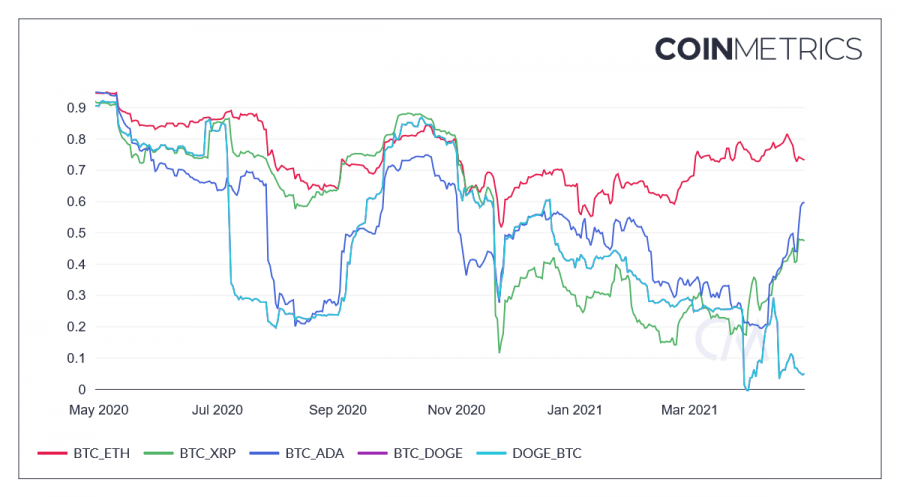
The logical extension of this decline in dominance is that correlations between bitcoin and other coins have also begun to subside. As far back as a year ago, pretty much all the leading cryptoassets had a correlation with BTC of 0.9 and above (1 being the maximum), but in recent weeks this figure has sunk below 0.3 for many of the top-ten cryptos.

Opinion among analysts regarding this decline is mixed. While some claim it’s the temporary result of an expansionary bull market, others say that declining correlations represent a fundamental shift in the industry, as other coins beyond BTC increasingly prove their value propositions to investors.

Been there, done that

If you rewind to the end of April 2020, ethereum (ETH), XRP, dogecoin (DOGE), and cardano (ADA) were all heavily correlated with bitcoin, at ratios of 0.95, 0.92, 0.91 and 0.95, respectively. Basically, whenever bitcoin rose or fell in price they all did the same, with their movements arguably little more than an expression of bitcoin’s performance.

As the graph below indicates, things began to change in the second half of the year.

There was a gradual subsidence up until July/August, when bitcoin (and to a lesser extent, ethereum) began rising in price, leaving many altcoins behind. Despite a recovery in correlations in October, things began to drop again from November, when bitcoin’s bull run really began picking up momentum.

Again, there was a partial recovery leading into January of this year, but correlations have been falling quite heavily since February. This is precisely when numerous altcoins began making up for lost time, rising in price as many bullish investors looked for the next big thing (now that BTC may seem a little expensive).

“The weakening correlation between major altcoins and bitcoin in a bull market is not new. As ETH and top altcoins rally during bullish spells, they often post higher returns compared to BTC, which in turn causes the correlation to drop,” said Robbie Liu, a market analyst at OKEx Insights.

Liu noted that pretty much the same phenomenon was observed during the 2017–2018 bull run. “The most notable example was in January 2018, when the correlation coefficient between BTC and ETH fell from above 0.8 to a negative value,” he told Cryptonews.com.

Nearly every analyst agrees that the drop in correlations is largely the product of the current bull market.

“In the 2017 bull market, bitcoin led the pack early on, but as investors gained confidence in the longevity of the boom, they increasingly looked to invest in smaller cryptos, which started to push those prices up faster than bitcoin’s. It’s the same story again in 2021,” said Glen Goodman, a cryptoasset analyst and author of The Crypto Trader.

Is it different this time?

Opinion is split on whether this drop in correlation is permanent or temporary.

“Market participants are learning that many cryptocurrencies offer different value propositions. This is becoming more evident as we begin to see development in the space highlighting these differences,” said Joel Kruger, a trader and strategist at LMAX.

However, for other analysts, ‘value proposition’ refers mostly to the potential for a quick buck.

“What we are seeing now is an overhyped and oversubscribed market. There is an overflow in liquidity. Community members and supporters are buying some of the altcoins thinking that it will give them 10-20x [return on investment],” said crypto advisor and investor Anndy Lian, adding that many investors likely believe that BTC has hit its maximum price level for the current period.

Of course, the truth often lies somewhere in the middle. For Quantum Economics analyst Lou Kerner, the overexuberance of the current bull market is a big factor in rising altcoins, but it certainly isn’t the only one.

“The other factor at work is some projects are scaling rapidly (e.g. Uniswap, Polkadot, Binance) creating significant value, bringing down bitcoin’s dominance,” he told Cryptonews.com.

What this means is that, while certain fundamental shifts have taken place, we may also expect a return to greater bitcoin dominance in the event of a more bearish market.

“The rapid growth of DeFi in the past year gives ETH better fundamentals than before,” said Robbie Liu.

“However, just like what happened after January 2018, after the bull market ends, bitcoin’s dominance is likely to pick up and alts will begin underperforming the market leader.”

Implications for traders and investors

Regardless of how permanent the shift is, analysts agree that it’s good for traders and investors, given that declining correlations provide them with the opportunity to diversify.

“A decline in correlation should be a most welcome development as it opens up more opportunities to trade into different value propositions within the emerging space,” said Joel Kruger.

Robbie Liu takes a very similar position, saying that the decline in correlations provides smaller traders with more of an opportunity for outsized gains.

“For retail investors with small amounts of capital and a higher tolerance for risk, the current decline in correlation is a welcome shift, presenting them with more opportunities to reap higher gains,” he said.

Assuming that the divergence in correlations persists into the future, this would ultimately be a win for traders, investors and the wider industry alike.

As Glen Goodman concluded, declining correlations would be a sign that the market is maturing.


Anndy Lian is an early blockchain adopter and experienced serial entrepreneur who is known for his work in the government sector. He is a best selling book author. The latest book is Web4: The Age of Autonomous Intelligence.

j j j

Virtual Asset Market in 2021: Anndy Lian said “Crypto is ready for mainstream”

Virtual Asset Market in 2021: Anndy Lian said “Crypto is ready for mainstream”

The market for virtual or digital assets has evolved since its inception in 2009. The changes are rapid. The market has been dominated for some time by Bitcoin and in this recent bull run, the altcoins are also doing very well, some of them with a few thousand per cent increase. We are now seeing significant growth. People from all over the world have flocked to digital assets like Bitcoin (BTC), Ethereum (ETH), Litecoin (LTC), Cardano (ADA), Binance Coin (BNB), TRON (TRX), DOGECOIN (DOGE) and etc.

There is also worldwide commercialization of blockchain trend in the market. Companies are now more open to look at this technology. Companies that are more forward-looking are also looking at the potential of tokenising their assets.

The regulatory momentum that began in 2020 will continue in 2021 as regulators around the world seek to either fit blockchain technology into existing regulatory frameworks or build out new approaches. The framework in future could include what is being built in the decentralised environment too.

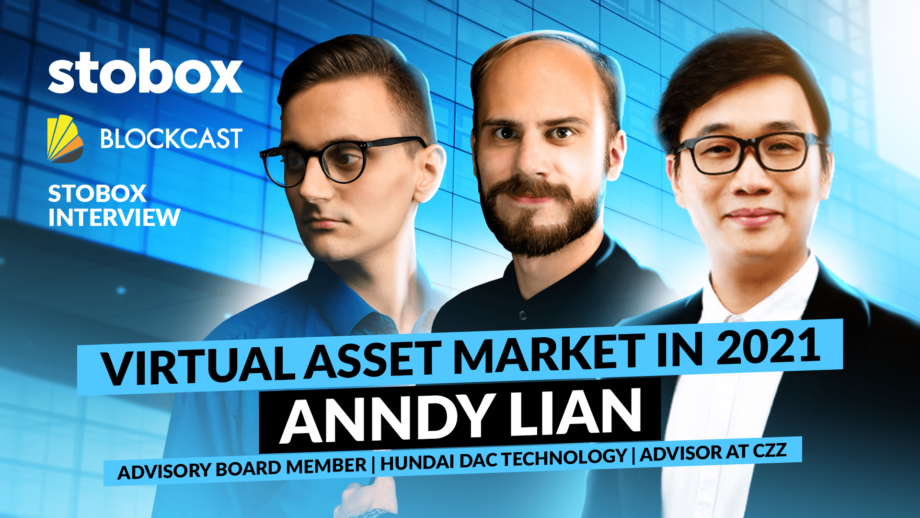
Join Anndy Lian to discuss the points above. This event is organised by STOBOX and supported by Blockcast.cc

00:00​ — Intro
1:35​ — About Anndy Lian
3:18​ — Mass commercialization of blockchain
8:10​ — Are governments supporting blockchain
13:29​ — Does crypto go mainstream?
18:22​ — Will DeFi replace traditional finance
24:37​ — How to build a community?
30:34​ — Where is the regulation globally moving for digital assets?
38:16​ — How are large corporation moving into crypto
45:42​ – Last words

Anndy Lian is an early blockchain adopter and experienced serial blockchain entrepreneur who is known for his work in the government sector. He is a best selling book author “Blockchain Revolution 2030” and currently the Advisory Board Member of Hyundai DAC Technology. Anndy is also part of the Gyeongsangbuk-do Blockchain Special Committee, Government of Republic Korea, together with industry experts such as Brock Pierce (Chairman, Bitcoin Foundation) and Alexis Sirkia (Founder of Yellow.com), helping the province to grow using blockchain technologies.

He played a pivotal role as the Blockchain Advisor for Asian Productivity Organisation (APO), an intergovernmental organization committed to improving productivity in the Asia-Pacific region. Anndy is also part of the Gyeongsangbuk-do Blockchain Special Committee, Government of Republic Korea, together with industry experts such as Brock Pierce.

Lian is also the Chairman (Singapore) for Korea eSports Industry Association (KeIA), Advisor to CZZ and Investment Director at Passion Venture Capital.

To find out more about Anndy Lian’s work, please visit www.anndy.com


The full video can be found at https://youtu.be/BBh8dA_OKMk


Anndy Lian is an early blockchain adopter and experienced serial entrepreneur who is known for his work in the government sector. He is a best selling book author. The latest book is Web4: The Age of Autonomous Intelligence.
j j j
