Good Friday crypto analysis: Is low liquidity and volume setting up a crypto crash to US$2.17T?

Good Friday crypto analysis: Is low liquidity and volume setting up a crypto crash to US$2.17T?

The crypto market’s slight 0.96 per cent retreat to a total capitalisation of US$2.3T over the last 24 hours reflects a broader narrative. Digital assets are no longer operating in isolation. They move in lockstep with traditional finance, and the current macro-driven consolidation proves this integration. The 82 per cent correlation with the S&P 500 is not a coincidence. It signals that crypto now functions as a rates-sensitive risk asset, reacting to global monetary shifts rather than internal blockchain catalysts. This reality challenges the early promise of decentralisation as an independent financial layer and presents an opportunity for those who understand how to navigate the convergence of traditional markets and digital innovation.

Japan’s 2-year government bond yield, which climbed to a 31-year high of 1.385 per cent on April 3, 2026, triggered the latest pressure on risk assets. That move strengthened the dollar and sent ripples through equities and correlated instruments like crypto. I have long argued that monetary policy remains the dominant force shaping asset prices, and this episode reinforces that view. When global yields rise, capital rotates toward safety, and speculative assets face headwinds regardless of their technological merit. Crypto’s reaction here confirms its maturation into the global financial system, but it also highlights a vulnerability. The sector still lacks the insulation that true decentralisation could provide if regulatory frameworks embraced innovation rather than constraining it.

Altcoin weakness compounded the broader market dip. Bitcoin dominance holding at 58 per cent suggests capital remains parked in the flagship asset, and smaller tokens faced disproportionate selling. StakeStone’s STO token is crashing by over 55 per cent due to large holder movements and an imminent token unlock, illustrating how sector-specific stress can amplify in low-liquidity environments. Spot volume declining 5.51 per cent means every sell order carries more weight, dragging the total market cap lower with less resistance. I have seen this pattern repeat during past consolidation phases. When liquidity dries up, volatility increases, and projects with weak fundamentals or concentrated ownership structures suffer first. This dynamic underscores why I advocate for deeper liquidity pools and more distributed token ownership as essential components of resilient Web3 infrastructure.

The near-term technical picture offers a clear framework for what comes next. The market currently tests the 78.6 per cent Fibonacci retracement at US$2.33T, with a critical swing low at US$2.27T. A daily close below that level could open a path toward the yearly low of US$2.17T. The Fear and Greed Index, sitting at 28, labelled Fear, suggests participants feel cautious but not panicked. That sentiment aligns with a market awaiting direction rather than reacting to fresh catalysts. The SEC’s CLARITY Act roundtable on April 16 represents the next major inflexion point for regulatory sentiment. I have spent considerable time analysing how policy shapes crypto markets, and this event could provide the clarity that institutional participants need to commit capital with conviction. Until then, sideways movement between US$2.27T and US$2.33T appears the most probable path.

Broader market context adds nuance to this crypto-specific view. US equity markets closed on April 3, 2026, for Good Friday, meaning weekly performance reflected Thursday’s close. The S&P 500 ended the week up 3.4 per cent at 6,582.69, the Nasdaq Composite gained 4.4 per cent to finish at 21,879.18, and the Dow Jones Industrial Average rose 3.0 per cent to 46,504.67. Those gains snapped a five-week losing streak, and crypto did not participate in the relief rally. This divergence warrants attention. It suggests that digital assets remain more sensitive to rate expectations than equity momentum, at least in the short term. Asian markets showed strength with Japan’s Nikkei 225 rising 1.28 per cent to 53,135 points and Hang Seng futures trending higher by roughly 0.6 per cent. The 10-year Treasury yield eased slightly to 4.31 per cent, indicating investors continue to weigh recession risks against surging energy costs.

Commodities added another layer of complexity. Brent crude settled near US$109 per barrel while WTI traded around US$111 as of late Thursday, keeping inflation expectations elevated. Gold saw renewed demand, particularly in Singapore, following a sharp earlier drop. Precious metals often serve as a barometer for risk sentiment, and their resurgence hints at underlying anxiety despite equity gains. Political developments further cloud the outlook.

The Trump administration’s authorisation of 100 per cent tariffs on certain imported patented medicines introduces new uncertainty into global trade and pharmaceutical supply chains. Geopolitical tensions around Iran and Oman, with reports of a potential protocol to monitor shipping in the Strait of Hormuz, offered a brief hope for de-escalation but left markets monitoring every headline. Corporate news like SpaceX targeting a valuation exceeding US$2T for a potential IPO captures imagination, and such mega-listings also concentrate capital attention away from smaller, innovative projects in both traditional and digital markets.

My perspective on this consolidation phase centres on three convictions.

  • First, crypto’s correlation with traditional markets is a transitional phase, not an endpoint. As decentralised infrastructure matures and regulatory frameworks evolve, digital assets can reclaim their role as independent stores of value and mediums of exchange.
  • Second, liquidity remains the lifeblood of healthy markets. The 5.51 per cent drop in spot volume demonstrates how fragile sentiment becomes when participation wanes. Projects that prioritise deep, resilient liquidity pools will weather volatility better than those reliant on speculative momentum.
  • Third, regulatory clarity cannot come soon enough. The SEC’s April 16 roundtable on the CLARITY Act represents a critical opportunity to establish rules that foster innovation while protecting participants.

Support at US$2.27T must hold to prevent a deeper retracement toward US$2.17T. A break above US$2.33T could signal renewed confidence, especially if accompanied by rising volume and positive regulatory signals. Until then, cautious consolidation appears to be the baseline scenario. I view this period not as a setback but as a necessary phase of digestion. Markets that advance too quickly without solid foundations often correct more severely later. The current pullback allows participants to reassess fundamentals, strengthen infrastructure, and prepare for the next leg of growth. Those who focus on building rather than speculating will emerge stronger when clarity arrives.


 

Source: https://e27.co/good-friday-crypto-analysis-is-low-liquidity-and-volume-setting-up-a-crypto-crash-to-us2-17t-20260403/

Anndy Lian is an early blockchain adopter and experienced serial entrepreneur who is known for his work in the government sector. He is a best selling book author- “NFT: From Zero to Hero” and “Blockchain Revolution 2030”.

Currently, he is appointed as the Chief Digital Advisor at Mongolia Productivity Organization, championing national digitization. Prior to his current appointments, he was the Chairman of BigONE Exchange, a global top 30 ranked crypto spot exchange and was also the Advisory Board Member for Hyundai DAC, the blockchain arm of South Korea’s largest car manufacturer Hyundai Motor Group. Lian played a pivotal role as the Blockchain Advisor for Asian Productivity Organisation (APO), an intergovernmental organization committed to improving productivity in the Asia-Pacific region.

An avid supporter of incubating start-ups, Anndy has also been a private investor for the past eight years. With a growth investment mindset, Anndy strategically demonstrates this in the companies he chooses to be involved with. He believes that what he is doing through blockchain technology currently will revolutionise and redefine traditional businesses. He also believes that the blockchain industry has to be “redecentralised”.

j j j

Is Bitcoin Setting Up For A Rally Given Its Historical Correlation With Gold?

Is Bitcoin Setting Up For A Rally Given Its Historical Correlation With Gold?

Looking at the past decade and a half, two assets have emerged prominently as bastions against the erosion of fiat currency value: gold and Bitcoin. Both assets share fundamental characteristics that define sound money—scarcity, decentralization, and resistance to manipulation. Investors seeking refuge from inflationary pressures and economic instability have increasingly turned to these two distinct yet philosophically aligned assets. Despite their shared appeal, gold and Bitcoin have recently diverged significantly in their short-term performance, prompting investors and analysts alike to question the underlying reasons behind this unexpected split.

Since January 2025, Bitcoin has experienced a notable decline of roughly 12%, while gold has surged impressively by approximately 20%. This divergence is particularly intriguing given Bitcoin’s historical tendency to outperform gold during periods of economic uncertainty. If both assets theoretically benefit from similar macroeconomic conditions—such as inflation, currency debasement, and geopolitical instability—why have their paths diverged so sharply in recent months?

To unravel this puzzle, we must examine the unique market dynamics, institutional behaviors, and macroeconomic factors influencing each asset.

Gold’s Resurgence: Institutional Confidence and Central Bank Accumulation

Gold’s recent rally can largely be attributed to heightened demand from central banks and institutional investors. According to the an article by JP Morgan, central banks globally have significantly increased their gold reserves, purchasing record amounts in recent years. Especially the People’s Bank of China (PBOC) has aggressively expanded its gold holdings, signaling a strategic shift away from reliance on the US dollar amid escalating geopolitical tensions and economic uncertainties.

Gold’s enduring appeal lies in its historical role as a universally recognized store of value. Its tangible nature provides a sense of security and stability that digital assets cannot yet fully replicate. Institutional investors, particularly those managing large portfolios, find comfort in gold’s established regulatory framework and widespread acceptance. Unlike Bitcoin, gold faces minimal regulatory ambiguity, making it a straightforward choice for conservative investors seeking stability.

Recently, Goldman Sachs revised its gold price forecast upward, projecting prices to reach $3,700 per ounce by year-end. This bullish outlook underscores the growing institutional confidence in gold’s ability to serve as a reliable hedge against inflation and economic volatility.

Bitcoin’s Temporary Setback: Growing Pains and Market Volatility

In contrast, Bitcoin has encountered several headwinds in 2025. Despite its impressive long-term trajectory, Bitcoin remains a relatively young and volatile asset class. Regulatory uncertainty continues to pose significant challenges, deterring many institutional investors from fully embracing cryptocurrency. Additionally, Bitcoin’s price movements are heavily influenced by retail investor sentiment, which can fluctuate dramatically based on short-term market psychology.

The recent decline in Bitcoin’s price can also be attributed to profit-taking following its substantial gains in previous years. After the explosive growth witnessed in 2021 and 2022, a period of consolidation and correction was inevitable. Such volatility is characteristic of emerging asset classes, particularly those undergoing rapid adoption and market maturation.

Nevertheless, Bitcoin’s fundamental attributes remain robust. Its capped supply of 21 million coins ensures scarcity, while its decentralized blockchain structure provides resistance to censorship and manipulation. Historically, Bitcoin has demonstrated resilience, often rebounding strongly after periods of correction and consolidation.

Historical Correlation and Divergence: A Temporary Phenomenon?

Historically, gold and Bitcoin have exhibited a fascinating relationship. Analysts such as David Foley and Lawrence Lepard have observed that gold often initiates rallies, with Bitcoin subsequently following and amplifying these movements. This historical pattern suggests that Bitcoin, as a smaller and more volatile asset, typically lags behind gold initially but eventually surpasses it in magnitude during bullish cycles.

Given this historical context, the current divergence between gold and Bitcoin may be temporary. If past patterns hold true, Bitcoin could soon experience a significant rally, potentially surpassing previous highs. This could mean that Bitcoin reaching upwards of $108,000 within months, aligning with its historical behavior during periods of economic uncertainty and rising gold prices.

The broader macroeconomic landscape remains highly favorable for both gold and Bitcoin. Central banks worldwide continue expansive monetary policies, fueling inflationary pressures and eroding fiat currency purchasing power. The US Federal Reserve, in particular, faces challenges balancing inflation control with economic growth, leading to diminished confidence in the dollar’s long-term stability.

In such an environment, assets embodying sound money principles become increasingly attractive. Both gold and Bitcoin offer investors protection against systemic risks associated with excessive debt, currency debasement, and geopolitical instability. As global financial fragility intensifies, diversification into assets outside traditional financial systems becomes not just prudent but essential.

Bitcoin: Digital Gold for a Digital Era

While gold boasts historical credibility and institutional acceptance, Bitcoin represents the evolution of sound money in a digital age. Its digital nature provides unique advantages: borderless transactions, ease of transfer, and immunity from physical confiscation. These attributes resonate strongly with younger generations and populations in countries experiencing currency instability or authoritarian governance.

Bitcoin adoption continues to accelerate globally. Prominent corporations such as Tesla and MicroStrategy have integrated Bitcoin into their balance sheets, while nations like El Salvador have officially recognized it as legal tender. These developments underscore Bitcoin’s growing legitimacy as a global reserve asset.

Moreover, technological advancements within the Bitcoin ecosystem, such as the Lightning Network, enhance its practicality for everyday transactions. The rise of decentralized finance (DeFi) and non-fungible tokens (NFTs) further expands Bitcoin’s utility, solidifying its role within the broader financial landscape.

Gold: Timeless Stability Amidst Uncertainty

Despite Bitcoin’s compelling narrative, gold remains an indispensable cornerstone of global finance. Its physical presence and millennia-long history as a store of value provide unmatched trust and stability. Gold’s lower volatility compared to Bitcoin makes it particularly appealing to risk-averse investors and institutions seeking predictable returns.

Historically, gold has consistently outperformed other asset classes during periods of economic turmoil, reinforcing its reputation as a reliable safe haven. This proven track record explains why central banks and institutional investors continue to prioritize gold holdings, especially during uncertain economic climates.

Complementary Roles: Diversification in Sound Money

The divergence between gold and Bitcoin in 2025 highlights their distinct yet complementary roles within a diversified investment portfolio. Rather than viewing these assets as competitors, investors should recognize their unique strengths and limitations. Gold offers stability, institutional acceptance, and historical reliability, while Bitcoin provides growth potential, technological innovation, and adaptability to a digital economy.

In an increasingly uncertain global financial environment, the importance of sound money assets cannot be overstated. Both gold and Bitcoin serve as critical hedges against inflation, currency debasement, and systemic financial risks. Investors seeking comprehensive protection and growth potential would be wise to allocate resources to both assets, leveraging their complementary characteristics.

Conclusion: A Unified Vision for Sound Money

Ultimately, the debate between gold and Bitcoin transcends mere competition. Both assets embody the principles of sound money, offering investors refuge from the vulnerabilities inherent in fiat currency systems. Their recent divergence in performance reflects temporary market dynamics rather than fundamental weaknesses.

As the global financial landscape continues to evolve, the combined strengths of gold and Bitcoin will become increasingly apparent. Together, they represent a powerful dual strategy for navigating economic uncertainty, inflationary pressures, and geopolitical instability. Investors who embrace both assets position themselves advantageously for the challenges and opportunities of the 21st century.

In the end, the choice between gold and Bitcoin is not binary but complementary. Each asset offers unique advantages, and together they form a robust foundation for preserving and growing wealth in uncertain times. Whether through the timeless reliability of gold or the transformative potential of Bitcoin, sound money remains an undefeated strategy in an era defined by financial volatility and uncertainty.


Source: https://www.benzinga.com/markets/cryptocurrency/25/04/44955500/is-bitcoin-setting-up-for-a-rally-given-its-historical-correlation-with-gold

Anndy Lian is an early blockchain adopter and experienced serial entrepreneur who is known for his work in the government sector. He is a best selling book author- “NFT: From Zero to Hero” and “Blockchain Revolution 2030”.

Currently, he is appointed as the Chief Digital Advisor at Mongolia Productivity Organization, championing national digitization. Prior to his current appointments, he was the Chairman of BigONE Exchange, a global top 30 ranked crypto spot exchange and was also the Advisory Board Member for Hyundai DAC, the blockchain arm of South Korea’s largest car manufacturer Hyundai Motor Group. Lian played a pivotal role as the Blockchain Advisor for Asian Productivity Organisation (APO), an intergovernmental organization committed to improving productivity in the Asia-Pacific region.

An avid supporter of incubating start-ups, Anndy has also been a private investor for the past eight years. With a growth investment mindset, Anndy strategically demonstrates this in the companies he chooses to be involved with. He believes that what he is doing through blockchain technology currently will revolutionise and redefine traditional businesses. He also believes that the blockchain industry has to be “redecentralised”.

j j j

JASMY/USD forecast: Building JasmyCoin trading volumes may be setting stage for price rebound

JASMY/USD forecast: Building JasmyCoin trading volumes may be setting stage for price rebound

Jasmycoin (JASMY) has been spiralling downwards for over a year, losing more than 99% of its value since its $1.8 peak at the end of May 2021. At the time of writing on 4 November 2022, the coin traded at $0.005728.

However, its trading volumes have been on a rise, up at $119m on 4 November 2022, surpassing its 31 July 2021 high of $97m.

With a number of projects on the way, can the cryptocurrency pick up its pace?

Let’s take a deep dive into the jasmycoin universe, including the latest JASMY/USD forecast round-up.

What is Jasmy/USD?

Jasmy is a Tokyo-based IoT company that specialises in data management, and the safe purchasing and selling of data. It was established in April 2016 and dubbed “Japan’s bitcoin”.

The company is headed by former Sony (SNE) executives Kunitake Ando and Kazumasa Sato, and Hiroshi Harada, a former employee at KPMG AZSA LLP.

The Jasmy platform combines blockchain and Internet of things (IoT) technologies “to provide an infrastructure that allows anyone to use data safely and securely”.

In an interview with Binance, Jasmy’s CFO, Hiroshi Harada noted that the blockchain’s main purpose is to “create a mechanism/platform which allows all users to take ownership of their own data in a secure and private manner.

“Instead of letting a handful of big tech corporations take control of such sensitive data, Jasmy aims to help enable a world where everyone can feel safe and secure about the use of their own data.”

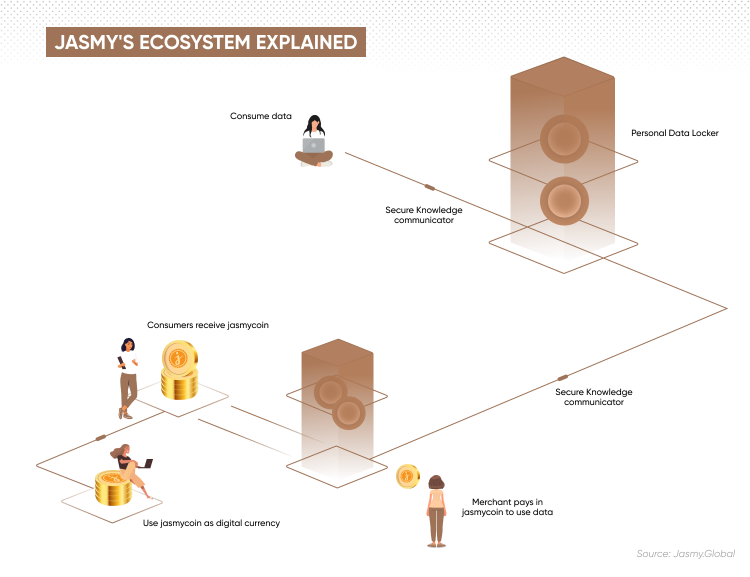
The platform allows for the safe storage of personal information through its Personal Data Locker (PDL) which provides users with full ownership over their data. In addition to that, Jasmy also has a Secure Knowledge Communicator (SKC), its core service responsible for the achievement of data democratisation.

Jasmy's ecosystem explained

Merchants pay users who store their data on Jasmy for access using the platform’s native cryptocurrency, JasmyCoin (JASMY), which can be used by users for investment purposes, governance and metaverse utility. JASMY is an ERC-20 token built on the Ethereum (ETH) ecosystem.

In the future, Jasmy also aims to provide IoT solutions to manufacturers interested in the smart home market and local governments in pursuit of a smart city.

The maximum number of JASMY coins is capped at 50 billion, with over 4.7 billion tokens in circulation, based on data provided by CoinMarketCap, as of 2 November. According to the platform, the token has a market capitalisation surpassing $24m.

A dip in the price trend

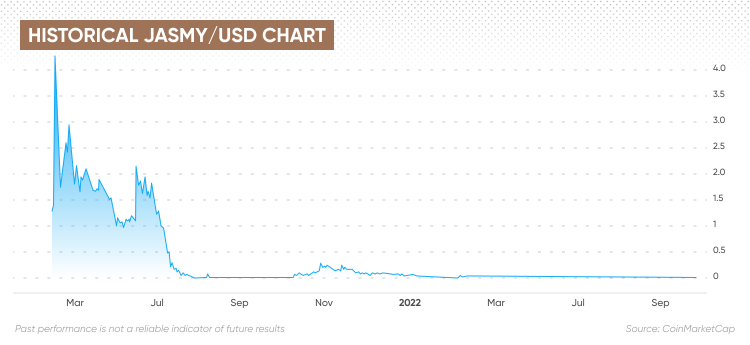
Historical JASMY/USD chartJasmycoin started its journey well, surging by around 230% in just four days, up from $1.3024 on 12 February 2021 to its all-time high of $4.2929 on 16 February 2021 as the coin was listed on Gate.io.

In the next four days, however, JASMY dropped more than 58% to $1.7. It surged in the following weeks, jumping by 67% to $2.9628 by 2 March 2021, ahead of its listing on the Jubi exchange.

After falling by around 39% to $1.8 on 7 March 2021, JASMY managed to surge past the $2 barrier as the project joined GitHub, a platform where users could discuss it.

By 24 April 2021, JASMY had lost over 50% of its value, falling to $0.9866, a then all-time low. The token continued to move sideways before skyrocketing to $2.1586 on 6 May 2021 following a staking campaign organised by Gate.io, which ran for 14 days between late April 2021 and early May 2021.

Since the mini-hike at the start of May 2021, JASMY has been struggling to pick up pace, embarking on a bear dip and losing over 97% of its value, down to $0.05456 by 20 June 2021.

In the final quarter of 2021, JASMY saw a brief spike, in line with overall positive market sentiment and its listing on the crypto exchange Coinbase, as its price surged 409.7% to $0.2781 on 3 November 2021.

The positive trend diminished as the token entered the new year, with its value falling by 95% by the start of March 2022. Since then, JASMY has been trading in bear territory at $0.005728, as of 4 November 2022.

Why the dip?

A few analysts brought up a number of reasons as to why JASMY had crashed in June 2021.

Martin Škorjanc, the CEO of NiceHash, told Capital.com that the bearish trend was likely driven by unfriendly crypto news in Japan and the fact that Jasmy Inc. decided to release too many tokens at the same time with no solid mechanism for managing their circulation.

The token’s unfamiliarity among investors was also a reason for its price to significantly drop, Dr Pooja Lekhi, Professor of Global Financial Institutions, Risk Management Approach and Financial Management at University Canada West said.

“Secondly, some rivals have advantages over Jasmy. IOTA crypto was an early mover in this space with many established partnerships. Therefore, it took more time for Jasmy to prove its worth.”

News driving the Jasmy/USD rate

On 31 October 2022, JasmyCoin was listed on the Stealth crypto exchange making it eligible to trade with more than 600 other assets. This saw the token’s trading volume reach an all-time high of $99.4m on the day.

On 5 September 2022, Jasmy announced that the token became the official sponsor of the Japanese professional football club, Sagan Tosu. In addition to becoming a sponsor, Jasmy also launched the Sagan Tosu Fan Token, a new cryptocurrency that uses non-fungible tokens (NFTs) and is based on the Jasmy blockchain, thus seeing the company enter an entirely new market.

In an interview with Binance recorded in early September 2022, the blockchain’s CFO, Harada, noted that Jasmy was exploring the idea of launching its NFTs onto other broader marketplaces such as Binance NFT, OpenSea and Magic Eden in the future, thus further expanding their niche.

Harada also mentioned a number of projects that Jasmy is working on in the third quarter of 2022, which have the potential to influence the future of the JASMY/USD forecast including:

  • The development of the DD coin, the Japanese Yen-backed stablecoin that will be incorporated into the ecosystem
  • The development of the Platinum Data Happiness Discovery Project, that will award users who participate in the project JASMY tokens and help them identify which data is tied to their happiness through the use of artificial intelligence

JASMY/USD forecast 2023 and beyond

At the time of writing, the algorithm-based forecasting service Wallet Investor gave a mixed jasmycoin to the US dollar forecast. The site noted that JASMY was “a bad long-term investment”, expecting the token to fall to $0.000350 in 2023 but surge to $0.009099 in 2027.

DigitalCoinPrice on the other hand gave a more positive JASMY/USD forecast. Based on its analysis of past price performance, the website predicted that the JASMY/USD forecast for 2022 could reach $0.00706 by the end of the year and surge to an average of $0.00949 in 2023.

Its JASMY/USD forecast for 2025 showed the cryptocurrency reaching $0.0149 on average and $0.0179 in 2027. The platform’s long-term JASMY/USD forecast for 2030 expected the cryptocurrency to surge to $0.0316 on average.

The founder of SmartBlocks and host of Cryptonized, Mark Fidelman, told Capital.com that in the long run the token has potential to surge due to it being known as “the Japanese bitcoin”.

“I wouldn’t be a buyer at this point, but a token to watch,” Fidelman added.

Anndy Lian, chief digital advisor at the Mongolian Productivity Organisation and author of NFT: From Zero to Hero, also brought up the fact that because JASMY is known as the local bitcoin, it is supported by many.

He noted that in order for JASMY to grow, the company must start to develop it “outside of Japan and grow their footprint in key market”, noting:

“Additionally, I do hope to also see their enterprise services get more adoption instead of moving into offering fan token. They should focus on real utilisation according to their mission and this is the only way the project will grow in value.”

When considering JASMY/USD predictions, it’s important to keep in mind that cryptocurrency markets remain extremely volatile, making it difficult to accurately predict what a coin or token’s price will be in a few hours, and even harder to give long-term estimates. As such, analysts and algorithm-based forecasters can and do get their predictions wrong.

We recommend that you always conduct your own due diligence on the asset before trading, looking at the latest news, a wide range of analyst commentary, and technical and fundamental analysis. Keep in mind that past performance is no guarantee of future returns. And never invest money that you cannot afford to lose.


Source: https://capital.com/jasmy-usd-forecast-dollar-jasmycoin-crypto-price-volume

Anndy Lian is an early blockchain adopter and experienced serial entrepreneur who is known for his work in the government sector. He is a best selling book author- “NFT: From Zero to Hero” and “Blockchain Revolution 2030”.

Currently, he is appointed as the Chief Digital Advisor at Mongolia Productivity Organization, championing national digitization. Prior to his current appointments, he was the Chairman of BigONE Exchange, a global top 30 ranked crypto spot exchange and was also the Advisory Board Member for Hyundai DAC, the blockchain arm of South Korea’s largest car manufacturer Hyundai Motor Group. Lian played a pivotal role as the Blockchain Advisor for Asian Productivity Organisation (APO), an intergovernmental organization committed to improving productivity in the Asia-Pacific region.

An avid supporter of incubating start-ups, Anndy has also been a private investor for the past eight years. With a growth investment mindset, Anndy strategically demonstrates this in the companies he chooses to be involved with. He believes that what he is doing through blockchain technology currently will revolutionise and redefine traditional businesses. He also believes that the blockchain industry has to be “redecentralised”.

j j j