The APAC Tech Revolution: Five trends shaping our future

The APAC Tech Revolution: Five trends shaping our future

The APAC region is a hub of technological innovation, with trends like artificial intelligence, blockchain, cryptocurrency, electric vehicles, and autonomous driving shaping the future. These technologies are not only transforming industries but also creating new opportunities and challenges.

The Asia-Pacific (APAC) region has become a significant player in the global tech landscape, setting trends that are transforming industries and societies worldwide. Having observed the tech industry closely over the years, it’s clear that APAC is not just keeping up with global developments; it is often at the forefront.

From artificial intelligence to autonomous driving, the region is a hub of innovation, with five key tech trends leading the way into a new era of technological progress.

Artificial Intelligence: The rise of Grok AI

Artificial intelligence has moved from being a futuristic idea to a transformative force reshaping our daily lives and work environments. In APAC, AI is being adopted with great enthusiasm, and one of the most intriguing projects is Grok AI, led by Elon Musk. Grok AI aims to expand the capabilities of AI, focusing on creating systems that can understand and interact with humans in more advanced ways.

Elon Musk has suggested that his AI can interpret medical data, stating, “This is still early stage, but it is already quite accurate and will become extremely good,” in a post on X. Dr. Laura Heacock, an associate professor and breast radiologist at NYU Imaging, tested xAI’s Grok AI against the same set of breast imaging scans she used for benchmarking GPT-4. Her findings, shared through a series of 12 social media posts, were not favourable. Despite Grok’s ability to recognise basic imaging types like mammograms and ultrasounds, it failed to diagnose correctly in any instance. Heacock also concluded that Grok did slightly better than GPT-4 but still missed all diagnoses. From my perspective, this is a promising start.

Countries like China, Japan, and South Korea are heavily investing in AI, recognising its potential to drive economic growth and improve quality of life. China, in particular, aims to become a global leader in AI by 2030, leveraging its vast data resources and government support. Companies like Baidu are leading the way, making significant advancements in areas like natural language processing and autonomous driving. The impact of AI in APAC is profound, revolutionising sectors such as healthcare and finance by enhancing diagnostics, patient care, fraud detection, and customer service.

Blockchain: The power of decentralisation

Blockchain technology, with its promise of decentralisation and transparency, is captivating innovators and investors across APAC. Solana, a high-performance blockchain platform, stands out for its ability to process thousands of transactions per second at a low cost, attracting more users than many traditional Web2 companies. However, some argue about its level of decentralisation, which is a topic for another day.

There is a noticeable surge in blockchain-based startups and initiatives globally. Singapore, for example, has established itself as a hub for blockchain innovation, offering a supportive regulatory environment and a vibrant ecosystem of startups and investors. South Korea is exploring blockchain for various government services to enhance transparency and efficiency. The decentralisation offered by blockchain is particularly appealing in regions seeking more inclusive and equitable systems. As blockchain technology continues to evolve, its impact on industries and societies in the region is expected to grow.

Cryptocurrency: From bitcoin to mainstream adoption

Cryptocurrency, closely linked to blockchain, has rapidly moved from the fringes to the mainstream, with Bitcoin leading the charge. The APAC region has been at the forefront of this trend, with countries like Japan and South Korea embracing cryptocurrencies and blockchain technology. Bitcoin, the first and most well-known cryptocurrency, has seen its value soar, capturing the attention of investors and governments alike. In APAC, Bitcoin is increasingly viewed as a legitimate asset class, with some countries even considering establishing Bitcoin reserve funds. This shift in perception is exemplified by former U.S. President Donald Trump’s surprising support for Bitcoin, adding further legitimacy to the cryptocurrency.

Japan recognises Bitcoin as a legal form of payment and has a robust regulatory framework for cryptocurrency exchanges. South Korea also has a vibrant cryptocurrency market, with high public interest and government support for blockchain technology. The rise of cryptocurrency in APAC is not without challenges, such as regulatory uncertainty and concerns about security and fraud. Nevertheless, the potential of cryptocurrency to revolutionise finance and create new economic opportunities is undeniable, and APAC is poised to play a leading role in this transformation.

Electric Vehicles: The revolution led by Elon Musk and China

The electric vehicle (EV) revolution is well underway, with APAC at the heart of this transformation. Elon Musk’s Tesla has been a major catalyst for the EV movement, demonstrating that electric cars can be both desirable and practical. Tesla’s success has inspired a wave of innovation and investment in this sector, particularly in China. China, the world’s largest automotive market, is rapidly becoming a leader in electric vehicles. The Chinese government has set ambitious targets for EV adoption, offering subsidies and incentives to manufacturers and consumers. As a result, Chinese companies like BYD and NIO are emerging as major players in the global EV market.

The impact of electric vehicles extends beyond environmental benefits. The shift to EVs is driving innovation in battery technology, charging infrastructure, and renewable energy integration. Moreover, the growth of the EV market is creating new economic opportunities, from manufacturing to services. APAC’s commitment to electric vehicles is a testament to its forward-thinking approach to sustainability and innovation. As the world moves towards a greener future, the region’s leadership in the EV sector will be crucial.

Autonomous Driving: The future of transportation

Autonomous driving technology is set to revolutionise transportation, with APAC leading the way. Self-driving cars promise to enhance safety, reduce congestion, and transform the way we travel. Companies like Baidu and Hyundai are at the forefront of autonomous driving research and development. Baidu’s Apollo project, for instance, is one of the most advanced autonomous driving platforms globally, with partnerships spanning multiple countries and industries.

The potential of autonomous driving extends beyond personal vehicles. In the future, services like Uber could become driverless, offering a new level of convenience and efficiency. Many countries are already exploring autonomous public transportation solutions, with pilot projects in cities like Singapore and Tokyo. The road to fully autonomous vehicles is not always smooth sailing, including regulatory hurdles, technological limitations, and public acceptance. The progress being made in APAC is promising, and the potential benefits of autonomous driving are too significant to ignore.

Bottom Line

The APAC region is a hub of technological innovation, with trends like artificial intelligence, blockchain, cryptocurrency, electric vehicles, and autonomous driving shaping the future. These technologies are not only transforming industries but also creating new opportunities and challenges.

As the region continues to lead the way in tech innovation, it is crucial to address the ethical, regulatory, and societal implications of these technologies. By doing so, it can ensure that the benefits of technological advancement are shared widely and equitably. In conclusion, the tech trends dominating APAC are a testament to the region’s dynamism and potential. As these technologies continue to evolve, they will undoubtedly play a pivotal role in shaping the future of the global economy and society.



Source: https://ciosea.economictimes.indiatimes.com/blog/the-apac-tech-revolution-five-trends-shaping-our-future/116125244


Anndy Lian is an early blockchain adopter and experienced serial entrepreneur who is known for his work in the government sector. He is a best selling book author- “NFT: From Zero to Hero” and “Blockchain Revolution 2030”.

Currently, he is appointed as the Chief Digital Advisor at Mongolia Productivity Organization, championing national digitization. Prior to his current appointments, he was the Chairman of BigONE Exchange, a global top 30 ranked crypto spot exchange and was also the Advisory Board Member for Hyundai DAC, the blockchain arm of South Korea’s largest car manufacturer Hyundai Motor Group. Lian played a pivotal role as the Blockchain Advisor for Asian Productivity Organisation (APO), an intergovernmental organization committed to improving productivity in the Asia-Pacific region.

An avid supporter of incubating start-ups, Anndy has also been a private investor for the past eight years. With a growth investment mindset, Anndy strategically demonstrates this in the companies he chooses to be involved with. He believes that what he is doing through blockchain technology currently will revolutionise and redefine traditional businesses. He also believes that the blockchain industry has to be “redecentralised”.

j j j

Shaping the Future of DevPortals: An Exclusive Interview with Anndy Lian

Shaping the Future of DevPortals: An Exclusive Interview with Anndy Lian

DevPortals are the hidden gems of the software development landscape providing developers with essential tools and resources. But as technology rapidly evolves, these platforms must adapt to stay relevant.

In this exclusive interview, we explore the future of DevPortals with Anndy Lian, a leading expert in blockchain and decentralized technologies. Lian offers valuable insights into how blockchain, AI, and the metaverse can transform these platforms, creating more secure, transparent, and inclusive environments for developers.

Decentralized DevPortals

The Shib: How can blockchain technology be leveraged to create more secure, transparent, and community-driven dev portals, while addressing potential challenges like scalability and governance?

Lian: “Imagine a world where developers and users collaborate on a global, transparent platform, their contributions immutably recorded and their ownership clearly defined. This is the promise of decentralized DevPortals, a radical shift from centralized platforms. By leveraging blockchain technology, we can reimagine these spaces as secure and community-driven ecosystems.

Blockchain’s inherent security features, like cryptographic hashing and consensus mechanisms, can safeguard valuable code and data within the DevPortal. Transparency, another cornerstone of blockchain, allows for auditable contribution histories, building trust and accountability within the community. This can empower developers by recognizing their contributions and enabling new incentive models.

However, challenges remain. Scalability, a known hurdle for blockchain applications, needs careful consideration to ensure the DevPortal can handle a growing number of users and projects.  Governance, too, requires a nuanced approach. Decentralized governance models, while powerful, need to be thoughtfully designed to prevent malicious actors from hijacking the platform and to ensure fair and inclusive decision-making. Perhaps a hybrid approach, combining the best of centralized and decentralized governance, could provide a balanced solution.”

AI Assistants in DevPortals

The Shib: Beyond code suggestions and troubleshooting, how can AI assistants be integrated into dev portals to provide personalized learning paths, predict developer needs, or even facilitate peer-to-peer collaboration? What are the ethical considerations and potential biases to be mindful of when implementing AI in such a context?

Lian: “AI assistants hold immense potential to transform DevPortals from mere repositories of information into dynamic, personalized learning and collaboration hubs. Imagine an AI assistant that tracks your progress on a project, anticipates your needs for specific libraries or frameworks, and even connects you with peers possessing the expertise you require. Such intelligent assistance could significantly accelerate the development process and empower developers to tackle increasingly complex challenges.

This vision comes with ethical responsibilities.  AI algorithms, trained on vast datasets of code and user interactions, can inherit and even amplify existing biases within those datasets. This could lead to unfair recommendations, skewed code suggestions, or even exclusion of certain developer demographics.  Transparency is paramount. Developers need clear insights into how AI assistants make decisions, ensuring fairness and accountability. Data privacy is another crucial concern. The collection and usage of developer data must be transparent and consensual, with robust security measures in place to prevent misuse. Striking a balance between personalization and privacy will be key to fostering trust in AI-powered DevPortals.”

DevPortal Interoperability

The Shib: What standards or protocols can be adopted to ensure seamless integration between different dev portals, promoting collaboration and data sharing while maintaining security and privacy? How can we address potential challenges like vendor lock-in and differing technical architectures?

Lian: “To achieve seamless DevPortal interoperability, we need to consider existing standards like RESTful APIs for communication and standardized data formats like JSON for exchanging information between platforms. Think of it like building bridges between islands, allowing developers to move freely and share resources.

Vendor lock-in, where platforms are designed to keep users confined within their ecosystems, is a major concern. To counter this, we need to advocate for open standards and protocols, preventing any single vendor from controlling the flow of data and collaboration.

Data security and privacy are paramount. When platforms share information, ensuring the security of sensitive code and user data is crucial. Implementing robust encryption methods and access control mechanisms will be essential to maintain trust and integrity.

Differing technical architectures can also hinder interoperability. Platforms might use different programming languages, databases, or frameworks, making seamless integration a complex task. One solution could be developing adapter layers or middleware that translate between these different architectures, allowing them to communicate effectively.

By addressing these challenges, we can unlock a future where DevPortals seamlessly connect, fostering a thriving ecosystem of collaboration and innovation.  Imagine developers effortlessly moving between platforms, accessing a wealth of resources and expertise, and contributing to projects regardless of their chosen DevPortal.  This interconnected future holds the potential to accelerate software development, break down silos, and empower developers to build better software, together.”

The Metaverse in DevPortals

The Shib: Beyond immersive experiences and virtual communities, how can the metaverse be leveraged to create new revenue streams or business models for dev portals? What are the potential challenges and limitations of integrating the metaverse into existing dev portal infrastructure?

Lian: “The metaverse offers DevPortals more than just virtual spaces for developers to connect. Imagine a world where developers use VR/AR to collaboratively debug code, manipulating 3D data structures and stepping through program execution in immersive ways.  Picture virtual marketplaces within these DevPortal metaverses, where developers buy and sell code libraries, tools, and even 3D assets, creating new revenue streams for both the platform and the creators.

These immersive experiences and virtual marketplaces present exciting monetization opportunities. DevPortals could introduce subscription models for premium VR/AR collaboration tools or charge commissions on transactions within their virtual marketplaces. Virtual events, like hackathons or conferences hosted in the metaverse, could generate revenue through ticket sales, sponsorships, and even virtual merchandise.”

DevPortal Accessibility and Inclusivity

The Shib: How can dev portals be designed to accommodate developers with disabilities, ensuring that they have equal access to resources and opportunities? What are the best practices for creating inclusive communities within dev portals, promoting diversity and preventing discrimination?

Lian: “Building truly inclusive DevPortals requires a conscious effort to make them accessible and welcoming to everyone, including developers with disabilities. This begins with incorporating accessibility features directly into the platform’s design. For visually impaired developers, screen reader compatibility is crucial. This means using semantic HTML to structure content logically, providing alternative text descriptions for all images and graphics, and ensuring that all functionality is accessible through keyboard navigation.

For developers with motor impairments, keyboard accessibility is paramount. Every interactive element on the DevPortal, from buttons and menus to code editors and search bars, should be navigable and operable using only the keyboard.  Additionally, offering adjustable font sizes and customizable color schemes can benefit users with visual impairments or those with specific learning differences.

Beyond these technical considerations, fostering an inclusive community is equally important.  Clear and enforced community guidelines that explicitly prohibit discrimination and harassment are essential.  Moderation strategies should be proactive in identifying and addressing harmful behavior.  Furthermore, DevPortals can promote diversity by featuring content and contributions from developers from underrepresented backgrounds, organizing events and initiatives that celebrate diversity, and providing resources and support for marginalized communities within the tech industry.”

Emerging Technologies and DevPortals

The Shib: How will technologies like quantum computing, edge computing, and augmented reality impact the development and use of dev portals? What new opportunities and challenges will these technologies present, and how can dev portals adapt to stay relevant and competitive in the future?

Lian: “Emerging technologies present a future where DevPortals are gateways to quantum computing power, edge computing deployments, and augmented reality development environments. Imagine developers accessing quantum simulators and algorithms, seamlessly deploying and managing applications on edge devices, and using AR for interactive code visualization and collaboration, all through the DevPortal.

However, this future requires DevPortals to adapt. Providing educational resources and tools to bridge the skills gap in areas like quantum computing is crucial. Investing in robust infrastructure, including high-performance computing and secure edge networks, is paramount. Equally important is implementing robust security measures to protect user data and code within these new environments.

To stay relevant, DevPortals can partner with leading technology companies to integrate these advancements into their platforms. Offering educational resources, fostering communities dedicated to these technologies, and implementing features gradually based on user feedback will be key. By embracing these opportunities and challenges, DevPortals can empower developers to shape the future of software development.”

Anndy Lian’s insights offer a compelling vision for the future of DevPortals. By leveraging blockchain, AI, and the metaverse, these platforms can become even more powerful tools for developers.


Source: https://news.shib.io/2024/09/04/shaping-the-future-of-devportals-an-exclusive-interview-with-anndy-lian/

Anndy Lian is an early blockchain adopter and experienced serial entrepreneur who is known for his work in the government sector. He is a best selling book author- “NFT: From Zero to Hero” and “Blockchain Revolution 2030”.

Currently, he is appointed as the Chief Digital Advisor at Mongolia Productivity Organization, championing national digitization. Prior to his current appointments, he was the Chairman of BigONE Exchange, a global top 30 ranked crypto spot exchange and was also the Advisory Board Member for Hyundai DAC, the blockchain arm of South Korea’s largest car manufacturer Hyundai Motor Group. Lian played a pivotal role as the Blockchain Advisor for Asian Productivity Organisation (APO), an intergovernmental organization committed to improving productivity in the Asia-Pacific region.

An avid supporter of incubating start-ups, Anndy has also been a private investor for the past eight years. With a growth investment mindset, Anndy strategically demonstrates this in the companies he chooses to be involved with. He believes that what he is doing through blockchain technology currently will revolutionise and redefine traditional businesses. He also believes that the blockchain industry has to be “redecentralised”.

j j j

Shaping the Future of DevPortals: A Think Tank on Decentralization, AI, and Beyond

Shaping the Future of DevPortals: A Think Tank on Decentralization, AI, and Beyond

The digital landscape is rapidly evolving, reshaping how we build, deploy, and interact with software. At the forefront of this revolution are DevPortals, the unsung heroes that empower developers to build the future.

But What Are Developer Portals?

Blockchain Developer Portals (DevPortals) are specialized platforms designed to provide developers with the necessary resources, documentation, and tools to interact with blockchain networks and build decentralized applications (dApps). These portals play a critical role in the blockchain ecosystem by enabling developers to integrate blockchain functionalities into their applications, deploy smart contracts, and interact with various blockchain networks.

Ethereum, Polkadot, Solana, Binance Smart Chain (BSC), and Cardano are just a few of the popular blockchain networks that had their own dedicated DevPortals. Ethereum, for example, had been a cornerstone for dApp developers, offering extensive resources on smart contract languages like Solidity and tools like Truffle. Solana, on the other hand, gained traction due to its emphasis on high-speed transactions and low fees, making it ideal for DeFi applications. Polkadot’s Developer Hub stood out for its focus on interoperability, providing guidance on building parachains and custom blockchains using Substrate.

And, very recently, Shiba Inu’s Layer 2 scalability solution Shibarium joined the ranks of these innovative platforms with the launch of the ShibDev portal.

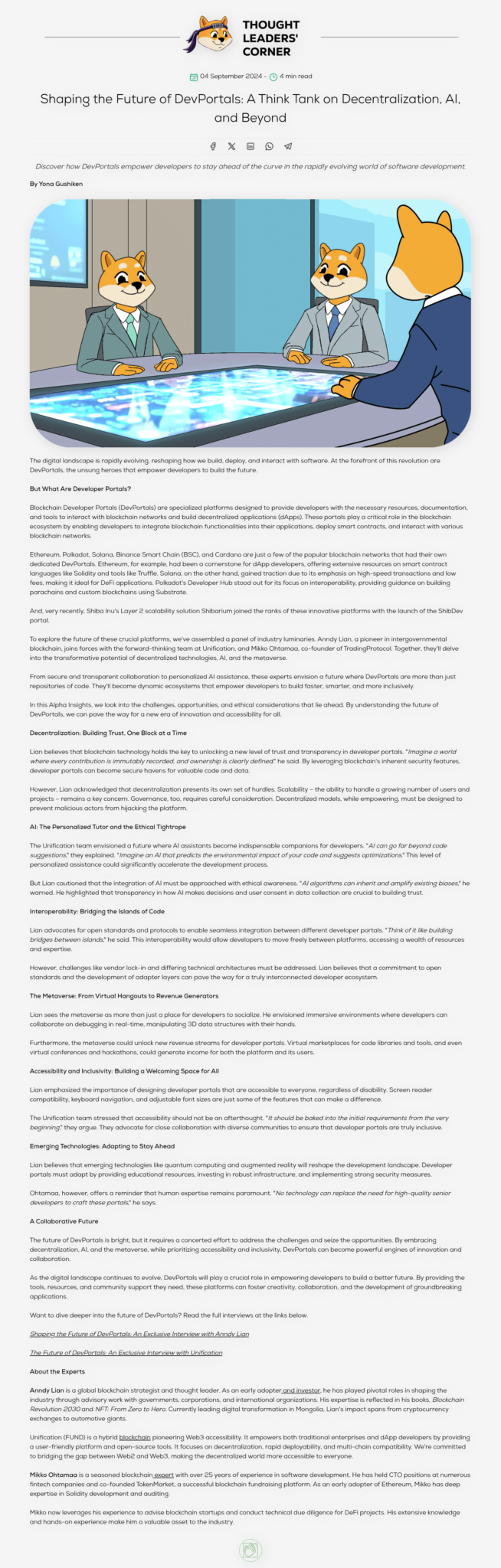
To explore the future of these crucial platforms, we’ve assembled a panel of industry luminaries. Anndy Lian, a pioneer in intergovernmental blockchain, joins forces with the forward-thinking team at Unification, and Mikko Ohtamaa, co-founder of TradingProtocol. Together, they’ll delve into the transformative potential of decentralized technologies, AI, and the metaverse.

From secure and transparent collaboration to personalized AI assistance, these experts envision a future where DevPortals are more than just repositories of code. They’ll become dynamic ecosystems that empower developers to build faster, smarter, and more inclusively.

In this Alpha Insights, we look into the challenges, opportunities, and ethical considerations that lie ahead. By understanding the future of DevPortals, we can pave the way for a new era of innovation and accessibility for all.

Decentralization: Building Trust, One Block at a Time

Lian believes that blockchain technology holds the key to unlocking a new level of trust and transparency in developer portals. “Imagine a world where every contribution is immutably recorded, and ownership is clearly defined,” he said. By leveraging blockchain’s inherent security features, developer portals can become secure havens for valuable code and data.

However, Lian acknowledged that decentralization presents its own set of hurdles. Scalability – the ability to handle a growing number of users and projects – remains a key concern. Governance, too, requires careful consideration. Decentralized models, while empowering, must be designed to prevent malicious actors from hijacking the platform.

AI: The Personalized Tutor and the Ethical Tightrope

The Unification team envisioned a future where AI assistants become indispensable companions for developers. “AI can go far beyond code suggestions,” they explained. “Imagine an AI that predicts the environmental impact of your code and suggests optimizations.” This level of personalized assistance could significantly accelerate the development process.

But Lian cautioned that the integration of AI must be approached with ethical awareness. “AI algorithms can inherit and amplify existing biases,” he warned. He highlighted that transparency in how AI makes decisions and user consent in data collection are crucial to building trust.

Interoperability: Bridging the Islands of Code

Lian advocates for open standards and protocols to enable seamless integration between different developer portals. “Think of it like building bridges between islands,” he said. This interoperability would allow developers to move freely between platforms, accessing a wealth of resources and expertise.

However, challenges like vendor lock-in and differing technical architectures must be addressed. Lian believes that a commitment to open standards and the development of adapter layers can pave the way for a truly interconnected developer ecosystem.

The Metaverse: From Virtual Hangouts to Revenue Generators

Lian sees the metaverse as more than just a place for developers to socialize. He envisioned immersive environments where developers can collaborate on debugging in real-time, manipulating 3D data structures with their hands.

Furthermore, the metaverse could unlock new revenue streams for developer portals. Virtual marketplaces for code libraries and tools, and even virtual conferences and hackathons, could generate income for both the platform and its users.

Accessibility and Inclusivity: Building a Welcoming Space for All

Lian emphasized the importance of designing developer portals that are accessible to everyone, regardless of disability. Screen reader compatibility, keyboard navigation, and adjustable font sizes are just some of the features that can make a difference.

The Unification team stressed that accessibility should not be an afterthought. “It should be baked into the initial requirements from the very beginning,” they argue. They advocate for close collaboration with diverse communities to ensure that developer portals are truly inclusive.

Emerging Technologies: Adapting to Stay Ahead

Lian believes that emerging technologies like quantum computing and augmented reality will reshape the development landscape. Developer portals must adapt by providing educational resources, investing in robust infrastructure, and implementing strong security measures.

Ohtamaa, however, offers a reminder that human expertise remains paramount. “No technology can replace the need for high-quality senior developers to craft these portals,” he says.

A Collaborative Future

The future of DevPortals is bright, but it requires a concerted effort to address the challenges and seize the opportunities. By embracing decentralization, AI, and the metaverse, while prioritizing accessibility and inclusivity, DevPortals can become powerful engines of innovation and collaboration.

As the digital landscape continues to evolve, DevPortals will play a crucial role in empowering developers to build a better future. By providing the tools, resources, and community support they need, these platforms can foster creativity, collaboration, and the development of groundbreaking applications.

Want to dive deeper into the future of DevPortals? Read the full interviews at the links below.

Shaping the Future of DevPortals: An Exclusive Interview with Anndy Lian

The Future of DevPortals: An Exclusive Interview with Unification

About the Experts

Anndy Lian is a global blockchain strategist and thought leader. As an early adopter and investor, he has played pivotal roles in shaping the industry through advisory work with governments, corporations, and international organizations. His expertise is reflected in his books, Blockchain Revolution 2030 and NFT: From Zero to Hero. Currently leading digital transformation in Mongolia, Lian’s impact spans from cryptocurrency exchanges to automotive giants.

Unification (FUND) is a hybrid blockchain pioneering Web3 accessibility. It empowers both traditional enterprises and dApp developers by providing a user-friendly platform and open-source tools. It focuses on decentralization, rapid deployability, and multi-chain compatibility. We’re committed to bridging the gap between Web2 and Web3, making the decentralized world more accessible to everyone.

Mikko Ohtamaa is a seasoned blockchain expert with over 25 years of experience in software development. He has held CTO positions at numerous fintech companies and co-founded TokenMarket, a successful blockchain fundraising platform. As an early adopter of Ethereum, Mikko has deep expertise in Solidity development and auditing.

Mikko now leverages his experience to advise blockchain startups and conduct technical due diligence for DeFi projects. His extensive knowledge and hands-on experience make him a valuable asset to the industry.


Source: https://magazine.shib.io/article/66d86a7287c4c100015d5d7f

Anndy Lian is an early blockchain adopter and experienced serial entrepreneur who is known for his work in the government sector. He is a best selling book author- “NFT: From Zero to Hero” and “Blockchain Revolution 2030”.

Currently, he is appointed as the Chief Digital Advisor at Mongolia Productivity Organization, championing national digitization. Prior to his current appointments, he was the Chairman of BigONE Exchange, a global top 30 ranked crypto spot exchange and was also the Advisory Board Member for Hyundai DAC, the blockchain arm of South Korea’s largest car manufacturer Hyundai Motor Group. Lian played a pivotal role as the Blockchain Advisor for Asian Productivity Organisation (APO), an intergovernmental organization committed to improving productivity in the Asia-Pacific region.

An avid supporter of incubating start-ups, Anndy has also been a private investor for the past eight years. With a growth investment mindset, Anndy strategically demonstrates this in the companies he chooses to be involved with. He believes that what he is doing through blockchain technology currently will revolutionise and redefine traditional businesses. He also believes that the blockchain industry has to be “redecentralised”.

j j j