Global economy on edge: What it signals for investors amid economic uncertainty

Global economy on edge: What it signals for investors amid economic uncertainty

The global financial landscape today, March 21, 2025, is a complex tapestry woven with threads of uncertainty, cautious optimism, and shifting economic priorities. Let’s unpack this and offer my perspective on what’s driving these dynamics, where things might be headed, and what it all means for investors, policymakers, and everyday people keeping an eye on their financial futures.

Global risk sentiment and central bank ambiguity

The global risk sentiment being described as “tentative” feels like an apt reflection of the moment we’re in. Central bank meetings, which are typically a cornerstone for market stability, seem to have left us with more ambiguity than clarity. It’s not uncommon for these gatherings—whether it’s the Federal Reserve, the European Central Bank, or others—to set the tone for monetary policy expectations, influencing everything from interest rates to currency strength.

But when they raise “more questions than answers,” as the Market Wrap notes, it signals a lack of consensus or a hesitancy to commit to bold moves. Perhaps central bankers are grappling with the same uncertainties as the rest of us: inflationary pressures that refuse to fully subside, geopolitical tensions exacerbated by trade policies, and a global economy that’s still finding its footing post-pandemic.

My take is that this ambiguity is less about indecision and more about a deliberate wait-and-see approach. Central banks are likely holding their cards close, waiting for clearer signals from corporate earnings and trade developments before making significant policy shifts.

Corporate earnings, tariffs, and market reactions

Speaking of corporate earnings, they’re poised to be the next big litmus test for the markets. Investors are hungry for guidance, and rightly so. With tariff fears casting a long shadow, the performance of major companies could either bolster confidence or deepen the unease.

In the US, where the MSCI US index slipped by 0.2 per cent, the energy sector’s modest 0.4 per cent gain stands out as a bright spot. This uptick aligns with the rise in Brent crude prices to US$75 per barrel, fuelled by OPEC+’s new schedule for oil output cuts.

It’s a reminder that energy markets remain a critical driver of sentiment, especially as supply constraints—like the US sanctions on a Chinese refinery tied to Iranian oil—tighten the screws further. For American investors, the upcoming earnings season will be a chance to see if companies can navigate these headwinds, particularly with new tariffs looming on the horizon.

Those tariffs, announced by US President Donald Trump to take effect on April 2, are a game-changer. The promise of both broad reciprocal tariffs and sector-specific measures suggests a continuation of his administration’s aggressive trade stance.

From my perspective, this move is less about economic protectionism in a vacuum and more about geopolitical leverage. Trump’s strategy seems to hinge on using tariffs as a bargaining chip—pressuring trading partners into concessions while signaling strength to domestic audiences. The timing, just over a week from now, adds urgency to the mix.

Markets hate uncertainty, and with Asian equities already showing mixed responses and US equity futures pointing to a flat open, it’s clear that investors are bracing for turbulence. The delay of the European Union’s proposed tariff on American whiskey this week feels like a small reprieve, perhaps a diplomatic nod to avoid escalating tensions further, but it’s a drop in the bucket compared to the broader tariff storm brewing.

In China, the focus on bellwethers like Xiaomi Corp. and Tencent Holdings Ltd. is particularly telling. These tech giants have been at the heart of China’s recent stock surge, a rally that’s defied global headwinds to some extent. Investors are now asking whether this momentum is sustainable or if it’s a house of cards built on speculative exuberance.

My view is that China’s market resilience reflects a mix of domestic policy support and a pivot by companies to diversify away from US-centric supply chains—a direct response to past tariff pressures. Xiaomi’s push into emerging markets and Tencent’s dominance in digital ecosystems could provide the earnings firepower needed to keep the rally alive. But if these reports disappoint, it might expose cracks in China’s economic facade, especially as US sanctions and tariffs tighten the noose on key sectors like refining.

Financial indicators and the energy-crypto divide

Shifting to the financial indicators, the US Treasury yields dropping—with the 10-year at 4.24 per cent and the 2-year at 3.96 per cent—suggests a flight to safety amid the uncertainty. Lower yields typically signal that investors are seeking the relative security of government bonds over riskier assets, a trend reinforced by the US Dollar index’s 0.4 per cent gain as it consolidates recent losses. Gold holding firm above US$3,000 per ounce further underscores this cautious mood—it’s the classic safe-haven play.

Yet, there’s a paradox here: Brent crude’s 1.7 per cent rise indicates that not all risk assets are out of favour. My interpretation is that we’re seeing a bifurcated market—energy and commodities holding up due to supply-side dynamics, while equities and bonds reflect broader trepidation about growth prospects.

Now, let’s dive into the cryptocurrency angle, which adds another layer of intrigue. Bitcoin’s market sentiment hitting a two-year low, as per CryptoQuant’s Bull Score Index of 20, is a stark warning. This index, blending ten metrics like network activity and investor behaviour, paints a picture of a “weak environment” unlikely to support a sustained rally.

Historically, Bitcoin needs a score above 60 to fuel significant price surges, and prolonged periods below 40 align with bear markets. As someone who’s tracked crypto’s rollercoaster ride, I see this as a natural ebb in the cycle. The euphoria of past bull runs—often tied to macroeconomic stimulus or institutional adoption—has given way to a sober reality.

Regulatory scrutiny, energy cost debates, and now tariff-induced economic uncertainty could be dampening enthusiasm. For Bitcoin holders, this might feel like a gut punch, but it’s not necessarily a death knell. Markets move in waves, and a bearish phase could set the stage for a stronger rebound if fundamentals like adoption or halving effects kick in later.

Ethereum, meanwhile, offers a glimmer of hope amid the gloom. Its price hovering around US$1,970, with a key support level at US$1,861, suggests resilience. The nine per cent recovery earlier this week, followed by a 3.5 per cent dip, shows volatility but also potential. If that US$1,861 support holds, a push toward the March 7 high of US$2,258 isn’t out of the question. The technicals back this up: the RSI climbing to 40 from an oversold 30 indicates fading bearish momentum, though it needs to break 50 for a confirmed recovery.

The MACD’s bullish crossover and rising green histograms above zero add to the case for upward strength. From my standpoint, Ethereum’s outlook hinges on broader market sentiment and its ability to differentiate itself from Bitcoin’s struggles. If tariff fears ease or corporate earnings surprise to the upside, ETH could ride that wave. But a break below US$1,861 would open the door to a drop toward US$1,700—a level that could test the resolve of even the most ardent HODLers.

The interconnectedness of markets

Stepping back, what strikes me most about this Market Wrap is the interconnectedness of it all. Tariffs don’t just affect trade balances; they ripple through equity markets, commodity prices, and even cryptocurrencies. Central bank hesitancy amplifies the noise, leaving corporate earnings as the next beacon.

My point of view is cautiously pragmatic: we’re in a transitional phase where old playbooks—whether for stocks, bonds, or crypto—are being rewritten. Investors should watch China’s tech giants for signs of durability, lean into energy’s relative strength, and brace for tariff-driven volatility. For crypto enthusiasts, patience might be the best strategy—Bitcoin’s malaise and Ethereum’s teetering recovery suggest a market in purgatory, awaiting a catalyst.

In conclusion, the global economy today feels like a tightrope walk. The stakes are high, and the safety net is fraying. I see my role as cutting through the noise to spotlight the data and trends that matter. Right now, that means recognising the weight of tariffs, the pivotal role of earnings, and the fragile state of risk assets like crypto.

We’re not in freefall, but we’re not on solid ground either—April 2, when those tariffs hit, could be the tipping point that defines the next chapter.


 

Source: https://e27.co/global-economy-on-edge-what-it-signals-for-investors-amid-economic-uncertainty-20250321/

Anndy Lian is an early blockchain adopter and experienced serial entrepreneur who is known for his work in the government sector. He is a best selling book author- “NFT: From Zero to Hero” and “Blockchain Revolution 2030”.

Currently, he is appointed as the Chief Digital Advisor at Mongolia Productivity Organization, championing national digitization. Prior to his current appointments, he was the Chairman of BigONE Exchange, a global top 30 ranked crypto spot exchange and was also the Advisory Board Member for Hyundai DAC, the blockchain arm of South Korea’s largest car manufacturer Hyundai Motor Group. Lian played a pivotal role as the Blockchain Advisor for Asian Productivity Organisation (APO), an intergovernmental organization committed to improving productivity in the Asia-Pacific region.

An avid supporter of incubating start-ups, Anndy has also been a private investor for the past eight years. With a growth investment mindset, Anndy strategically demonstrates this in the companies he chooses to be involved with. He believes that what he is doing through blockchain technology currently will revolutionise and redefine traditional businesses. He also believes that the blockchain industry has to be “redecentralised”.

j j j

Republican Senate majority signals more ‘pro-crypto Congress’

Republican Senate majority signals more ‘pro-crypto Congress’

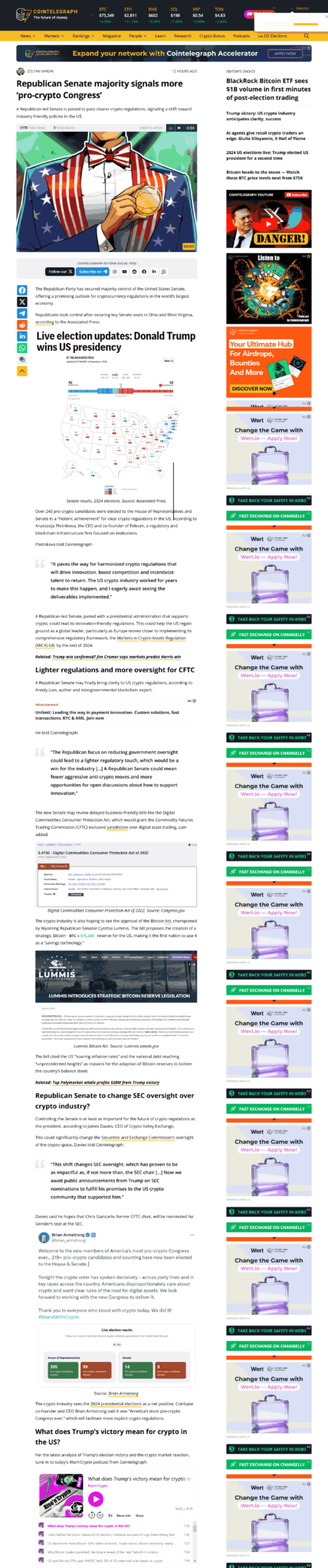
The Republican Party has secured majority control of the United States Senate, offering a promising outlook for cryptocurrency regulations in the world’s largest economy.

Republicans took control after securing key Senate seats in Ohio and West Virginia, according to the Associated Press.

Over 240 pro-crypto candidates were elected to the House of Representatives and Senate in a “historic achievement” for clear crypto regulations in the US, according to Anastasija Plotnikova, the CEO and co-founder of Fideum, a regulatory and blockchain infrastructure firm focused on institutions.

Plotnikova told Cointelegraph:

“It paves the way for harmonized crypto regulations that will drive innovation, boost competition and incentivize talent to return. The US crypto industry worked for years to make this happen, and I eagerly await seeing the deliverables implemented.”

A Republican-led Senate, paired with a presidential administration that supports crypto, could lead to innovation-friendly regulations. This could help the US regain ground as a global leader, particularly as Europe moves closer to implementing its comprehensive regulatory framework, the Markets in Crypto-Assets Regulation (MiCA) bill, by the end of 2024.

Lighter regulations and more oversight for CFTC

A Republican Senate may finally bring clarity to US crypto regulations, according to Anndy Lian, author and intergovernmental blockchain expert.

He told Cointelegraph:

“The Republican focus on reducing government oversight could lead to a lighter regulatory touch, which would be a win for the industry […] A Republican Senate could mean fewer aggressive anti-crypto moves and more opportunities for open discussions about how to support innovation.”

The new Senate may review delayed business-friendly bills like the Digital Commodities Consumer Protection Act, which would grant the Commodity Futures Trading Commission (CFTC) exclusive jurisdiction over digital asset trading, Lian added.

Digital Commodities Consumer Protection Act of 2022. Source: Congress.gov

The crypto industry is also hoping to see the approval of the Bitcoin Act, championed by Wyoming Republican Senator Cynthia Lummis. The bill proposes the creation of a strategic Bitcoin BTCtickers down$75,398 reserve for the US, making it the first nation to use it as a “savings technology.”

The bill cited the US’ “soaring inflation rates” and the national debt reaching “unprecedented heights” as reasons for the adoption of Bitcoin reserves to bolster the country’s balance sheet.

Republican Senate to change SEC oversight over crypto industry?

Controlling the Senate is at least as important for the future of crypto regulations as the president, according to James Davies, CEO of Crypto Valley Exchange.

This could significantly change the Securities and Exchange Commission’s oversight of the crypto space, Davies told Cointelegraph:

“This shift changes SEC oversight, which has proven to be as impactful as, if not more than, the SEC chair […] Now we await public announcements from Trump on SEC nominations to fulfill his promises to the US crypto community that supported him.”

Davies said he hopes that Chris Giancarlo, former CFTC chair, will be nominated for Gensler’s seat at the SEC.

The crypto industry sees the 2024 presidential elections as a net positive. Coinbase co-founder and CEO Brian Armstrong said it was “America’s most pro-crypto Congress ever,” which will facilitate more explicit crypto regulations.


Source: https://cointelegraph.com/news/republicans-majority-control-us-senate-pro-crypto-congress

Anndy Lian is an early blockchain adopter and experienced serial entrepreneur who is known for his work in the government sector. He is a best selling book author- “NFT: From Zero to Hero” and “Blockchain Revolution 2030”.

Currently, he is appointed as the Chief Digital Advisor at Mongolia Productivity Organization, championing national digitization. Prior to his current appointments, he was the Chairman of BigONE Exchange, a global top 30 ranked crypto spot exchange and was also the Advisory Board Member for Hyundai DAC, the blockchain arm of South Korea’s largest car manufacturer Hyundai Motor Group. Lian played a pivotal role as the Blockchain Advisor for Asian Productivity Organisation (APO), an intergovernmental organization committed to improving productivity in the Asia-Pacific region.

An avid supporter of incubating start-ups, Anndy has also been a private investor for the past eight years. With a growth investment mindset, Anndy strategically demonstrates this in the companies he chooses to be involved with. He believes that what he is doing through blockchain technology currently will revolutionise and redefine traditional businesses. He also believes that the blockchain industry has to be “redecentralised”.

j j j

Crypto community high on hopes after positive signals from India, Russia govts

Crypto community high on hopes after positive signals from India, Russia govts
My Additional comments:
1. After the initial green signals from India and Russia, what is next for Crypto Industry?
With the green lights from India and Russia, we are seeing an increase in Bitcoin’s spot volume in the last 24 hours on BigONE Exchange. The pricing of BTC has also increased by more than 2.5%. A huge country like Russia that embraces crypto is positive news for the whole world. We have seen more retail investors in the communities starting to feel comfortable and bullish. This is especially so in the meme coins’ communities. Still, I want to caution all that the bullish shift could be short term as it still appears negative in the charts for the longer term. With India and Russia taking their stand on crypto, I will do many other countries taking reference from them and following their footsteps. Some of the other countries that I am giving advice on are also more receptive after two big countries accepted cryptocurrencies.
2. Do you think that different regulations around the globe will help the industry or the world should come as one?
The world would not and should not come as one as it is not feasible for most nations. Cryptocurrencies are seen as bridges between worlds and the new regulations in place will serve as a financial connector between countries. This could also mean that cryptocurrencies would be further scrutinized, monitored and monitored. Those who see decentralisation as removing control and governance will not be happy with regulations. While those who really want crypto to grow will see the acceptance by the regulators as a sign of further disruptions.
3. What would be the key concerns of industry, post regulations?
There will be a lot of changes post regulations. We will see the real issues when the countries start to implement and allow crypto into their system fully. I hope the other countries can use Singapore’s sandbox model for instance to simulate the possible scenarios before going into full-scale implementation. There should be awareness programs in the country to tell new users what is crypto, the ups and downsides of investing in crypto and other taxations issues too. The education process will empower users to make better decisions, hence fewer headaches for the regulators.

Crypto community high on hopes after positive signals from India, Russia govts

Synopsis

Crypto industry at large is positive on the announcement and believes that the governments across the world are stepping ahead to take a big awaited call in the digital assets

After Russia’s intentions to regulate crypto, players in India and across the globe are high on hopes over the new-age asset class.

They are expecting that two major nations – India and Russia – have stepped ahead for the legitimisation of the crypto assets, and more major economies may join the forces soon.

However, India has made it clear that the legitimate or illegitimate are separate questions and the government is simply taxing the gains from the crypto transactions, which is its sovereign right.

On the other hand, the Putin government is eyeing crypto regulations, bucking the recommendation from its central bank to ban the mining and trading of the private digital tokens.

Crypto industry at large is positive on the announcement and believes that the governments across the world are stepping ahead to take a big awaited call in the digital assets.

Anndy Lian, Chairman, BigONE Exchange said that a country like Russia embracing crypto is positive news for the whole world. More retail investors in the communities are starting to feel comfortable and bullish, especially on memecoins.

“With India and Russia taking their stand on crypto, many other countries may take reference from them and follow in their footsteps,” he added.

Sathvik Vishwanath, Co-Founder and CEO, of Unocoin said that it will be a matter of time before more and more countries start looking at the crypto industry in a positive way.

The ones who had shied away from cryptos in the past are changing their perspectives and Russia is one of them, he added. “On the other side India has taken the wait and watch policy, but is not opening up with its views.”

Crypto fanatics, who see decentralisation as removing control and governance, will not be happy with regulations put across by the authorities across the globe.

Dileep Seinberg, Founder and CEO, Thinkchain said that every nation is likely to have its own cryptocurrency, with a potential to build a crypto-economy globally.

However, the industry players do not believe that the world should join the force and come as one to regulate the crypto assets uniformly. They do not see this as a viable option.

Cryptocurrencies are seen as bridges between worlds and the new regulations in place will serve as a financial connector between countries, said the experts.

The world would not and should not come as one as it is not feasible for most nations, said Lian of BigONE. “This could also mean that cryptocurrencies would be further scrutinized, monitored and monitored.”

It would be an unrealistic home for specific guidelines to be applicable for the entire world as one. At the tech level there definitely is uniformity irrespective of which country it is working in.

“The taxation, regulations, and enforcement differ which needs to be handled by the governments within the country,” said,” Vishwanath of Unocoin.

Once the regulations are out in different parts of the world, there will be a lot of changes through. However, experts said that governments, authorities and regulators should primarily focus on education and awareness about the asset class.

“We will see the real issues when the countries start to implement and allow crypto into their system fully,” Lian said. “I hope the other countries can use Singapore’s sandbox model for instance to simulate the possible scenarios before going into full-scale implementation.”

“Most important industry concerns would not come from technology but to see if few companies can monopolies like any other industry in the world,” said Sienberg. “This might damage the very fabric of the decentralised crypto world.”

Anndy Lian is an early blockchain adopter and experienced serial entrepreneur who is known for his work in the government sector. He is a best selling book author- “NFT: From Zero to Hero” and “Blockchain Revolution 2030”.

Currently, he is appointed as the Chief Digital Advisor at Mongolia Productivity Organization, championing national digitization. Prior to his current appointments, he was the Chairman of BigONE Exchange, a global top 30 ranked crypto spot exchange and was also the Advisory Board Member for Hyundai DAC, the blockchain arm of South Korea’s largest car manufacturer Hyundai Motor Group. Lian played a pivotal role as the Blockchain Advisor for Asian Productivity Organisation (APO), an intergovernmental organization committed to improving productivity in the Asia-Pacific region.

An avid supporter of incubating start-ups, Anndy has also been a private investor for the past eight years. With a growth investment mindset, Anndy strategically demonstrates this in the companies he chooses to be involved with. He believes that what he is doing through blockchain technology currently will revolutionise and redefine traditional businesses. He also believes that the blockchain industry has to be “redecentralised”.

j j j