Holiday liquidity warning signs emerge across stocks gold and crypto markets simultaneously

Holiday liquidity warning signs emerge across stocks gold and crypto markets simultaneously

As we approach the end of the year, US stock futures are holding steady overnight ahead of critical, delayed economic data. Investors brace for a flurry of releases, including the long-awaited third-quarter GDP figures, which promise to fill significant gaps in Wall Street’s understanding of the economy’s current health. Yet market participants largely dismiss the likelihood that these reports will dramatically alter the prevailing narrative around future interest rate cuts.

S&P 500 futures, Nasdaq 100 futures, and Dow Jones Industrial Average futures all traded near the flatline, extending a pattern of stability that has characterised the session. This cautious stance follows three consecutive days of gains for major US indices at the start of the week, a streak that has rekindled optimism about a potential year-end rally.

The S&P 500, in particular, hovers just 0.3 per cent below its all-time high reached earlier this month, a level it had retreated from after several sessions in which investors rotated away from artificial intelligence and technology stocks. The benchmark index’s recent rebound has been fuelled by unexpectedly favourable data from the prior week, including a surprising drop in inflation metrics and a labour market report that showed signs of cooling without signalling distress.

These developments have solidified expectations that the Federal Reserve will begin reducing interest rates in 2026, keeping bets on monetary easing largely intact despite the upcoming data deluge. Traders now view Tuesday’s economic releases as a final opportunity for fresh insights before the Christmas holiday pause, with the delayed Q3 GDP report standing out as a crucial indicator of underlying economic momentum following the federal government shutdown that disrupted regular reporting schedules.

Parallel to the equity market’s measured progress, precious metals continue their remarkable ascent, adding further momentum to an already stunning rally. Gold and silver futures both advanced, building on gains that position these traditional safe-haven assets for their strongest annual performance in over forty years. This sustained strength in bullion markets reflects deep-seated investor concerns about long-term economic stability and the erosive impact of persistent inflation, even as stock indices flirt with record territory.

The divergence between equities and metals underscores a nuanced market psychology where participants simultaneously chase growth-oriented assets while maintaining hedges against potential volatility. Gold’s resilience, in particular, suggests that despite optimism around eventual rate cuts, many institutional and retail investors remain wary of structural economic vulnerabilities.

This precious metals surge comes amid declining real yields and heightened geopolitical tensions, factors that historically bolster demand for non-yielding assets perceived as stores of value during periods of uncertainty. The market’s ability to sustain a prolonged rally in gold and silver, even as stocks recover, highlights a bifurcated investment landscape in which capital flows to both risk assets and traditional havens, depending on shifting risk perceptions across time horizons.

While traditional markets exhibit cautious optimism, the cryptocurrency sector experienced notable turbulence, recording a 0.56 per cent decline over the past twenty-four hours. This pullback represents a risk-off shift following recent gains, interrupting otherwise positive momentum reflected in seven-day and thirty-day trends of plus 1.51 per cent and plus 3.5 per cent, respectively. The immediate dip stems from a confluence of technical and fundamental pressures, beginning with a significant leveraged long squeeze across derivatives markets. Perpetual swap open interest surged 13.31 per cent within a single day to reach US$815.6 billion, creating a fragile foundation of overextended bullish positions.

This vulnerability materialised when Bitcoin failed to breach the psychologically important US$90,500 resistance level, triggering a cascade of forced liquidations. Bitcoin-specific liquidations alone spiked 80.45 per cent to US$83.75 million, overwhelming market liquidity and accelerating the downward momentum. Technical indicators reinforced this fragility, with Bitcoin’s fourteen-day Relative Strength Index plunging to 32.77, signalling oversold conditions yet revealing weak recovery momentum. Funding rates turned negative for many altcoins relative to Bitcoin, registering at negative 0.000948 per cent, a clear indication of overheated long positioning that required correction. Market observers now watch closely whether Bitcoin can defend the US$88,000 support level, as a decisive break below this threshold could unleash another wave of algorithmic selling.

Compounding these technical pressures, institutional activity introduced substantial bearish momentum through large-scale profit-taking. BlackRock executed a significant sell-off, offloading 2,019 Bitcoin valued at approximately US$180 million alongside 29,928 Ethereum tokens worth roughly US$91 million.

These transactions occurred near local price peaks, suggesting strategic institutional exits after recent rallies. This move by the world’s largest asset manager amplified existing selling pressure across crypto markets, particularly impacting Ethereum, which faced the added headwind of substantial exchange-traded fund outflows. Ethereum ETFs witnessed US$555 million in net outflows during the current week, marking the largest weekly withdrawal since October.

Consequently, Ethereum’s market dominance relative to other cryptocurrencies eroded, falling to 12.17 per cent, a decline of 0.4 percentage points week-over-week, as capital rotated toward Bitcoin, perceived as a comparatively safer asset within the digital ecosystem. BlackRock’s actions underscore a recurring pattern where institutional players systematically take profits after strong rallies, introducing volatility that retail investors often absorb. This dynamic highlights the growing influence of traditional finance giants on crypto price action, where large block trades can overwhelm order books optimised for smaller, retail-sized transactions.

Regulatory ambiguity further clouded the crypto market’s outlook, contributing to the recent pullback through delayed policy frameworks and persistent compliance concerns. Specific delays in advancing the US Clarity Act, legislation designed to provide regulatory certainty for digital assets, triggered US$952 million in outflows from crypto-focused investment funds. This capital flight reflects investor frustration with the prolonged uncertainty surrounding legal frameworks, particularly for alternative cryptocurrencies beyond Bitcoin.

Market sentiment metrics captured this anxiety, with the Fear and Greed Index remaining entrenched at 29, a reading categorised as Fear, for the second consecutive trading session. This sustained caution occurs despite Bitcoin’s dominance rising to 58.99 per cent, a trend suggesting that within the crypto ecosystem, Bitcoin increasingly functions as a regulatory safe haven.

Investors appear to favour Bitcoin’s first-mover status and clearer regulatory treatment relative to smaller tokens facing uncertain compliance pathways. The regulatory environment creates a two-tiered market dynamic in which policy delays disproportionately affect altcoins while reinforcing Bitcoin’s position as the primary store of value in digital asset portfolios. This divergence complicates recovery prospects for the broader crypto market, as altcoin performance often depends on regulatory catalysts that remain absent.

The interplay between these three forces, leveraged unwinding, institutional profit-taking, and regulatory stagnation, created a perfect storm for the crypto market’s short-term decline. Yet this dip occurs within a broader context of resilience, evidenced by the positive seven-day and thirty-day trends that suggest underlying demand remains intact.

The derivatives market shows early signs of capitulation, with extreme liquidation levels that could pave the way for stabilisation if Bitcoin holds critical support at US$88,000. Market structure improvements since previous downturns, including reduced exchange leverage caps and more sophisticated institutional custody solutions, may limit the depth of any correction compared to historical precedents.

The key question revolves around whether altcoins can decouple from Bitcoin’s dominance trajectory, which has climbed steadily toward 59.5 per cent. A peak in Bitcoin dominance often precedes broad-based altcoin rallies, but such a shift requires either regulatory breakthroughs or renewed risk appetite that current sentiment metrics do not yet support.

Traders monitor Ethereum ETF flow reversals as a leading indicator of changing institutional sentiment, alongside USDT dominance trends, which reflect stablecoin positioning ahead of anticipated volatility. These metrics provide key insights into whether the current pullback represents a tactical reset or the start of a deeper consolidation phase.

As traditional and digital markets approach the holiday season, their trajectories reveal both contrasts and underlying connections. The stock market’s proximity to record highs coexists with gold’s four-decade rally, reflecting investor strategies that balance growth exposure with inflation hedges.

Meanwhile, crypto markets demonstrate their evolving maturity through institutional participation patterns and sensitivity to macro factors such as regulatory shifts, even as they experience volatility distinct from that of traditional assets. The delayed Q3 GDP data will test the resilience of equity optimism, potentially reinforcing or challenging the narrative of a soft landing that underpins expectations for rate cuts. For precious metals, sustained strength depends on whether inflation proves persistently sticky despite recent encouraging prints.

In crypto, the path forward hinges on technical stabilisation above key support levels and catalysts that could reignite institutional inflows, particularly for Ethereum following its recent outflows. Market participants must navigate these crosscurrents with heightened awareness that holiday-thinned liquidity could amplify reactions to unexpected data or news.

The confluence of year-end positioning, delayed economic updates, and regulatory limbo creates a volatile environment in which risk management takes precedence over aggressive positioning. As the calendar turns, the interplay between monetary policy expectations, regulatory evolution, and technical market structures will determine whether the current cautious optimism across asset classes solidifies into a sustainable foundation for the new year or gives way to renewed uncertainty in a rapidly changing financial landscape.


 

Source: https://e27.co/holiday-liquidity-warning-signs-emerge-across-stocks-gold-and-crypto-markets-simultaneously-20251223/

Anndy Lian is an early blockchain adopter and experienced serial entrepreneur who is known for his work in the government sector. He is a best selling book author- “NFT: From Zero to Hero” and “Blockchain Revolution 2030”.

Currently, he is appointed as the Chief Digital Advisor at Mongolia Productivity Organization, championing national digitization. Prior to his current appointments, he was the Chairman of BigONE Exchange, a global top 30 ranked crypto spot exchange and was also the Advisory Board Member for Hyundai DAC, the blockchain arm of South Korea’s largest car manufacturer Hyundai Motor Group. Lian played a pivotal role as the Blockchain Advisor for Asian Productivity Organisation (APO), an intergovernmental organization committed to improving productivity in the Asia-Pacific region.

An avid supporter of incubating start-ups, Anndy has also been a private investor for the past eight years. With a growth investment mindset, Anndy strategically demonstrates this in the companies he chooses to be involved with. He believes that what he is doing through blockchain technology currently will revolutionise and redefine traditional businesses. He also believes that the blockchain industry has to be “redecentralised”.

j j j

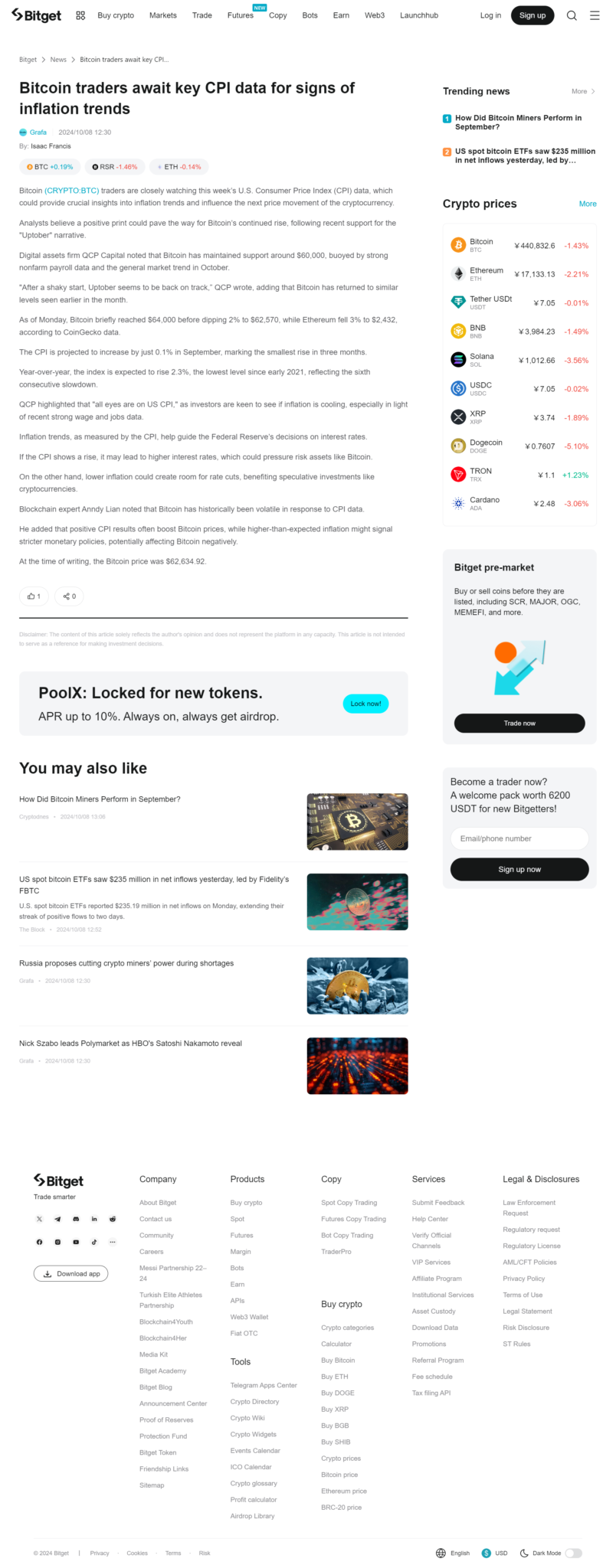
Bitcoin traders await key CPI data for signs of inflation trends

Bitcoin traders await key CPI data for signs of inflation trends

Bitcoin (CRYPTO:BTC) traders are closely watching this week’s U.S. Consumer Price Index (CPI) data, which could provide crucial insights into inflation trends and influence the next price movement of the cryptocurrency.

Analysts believe a positive print could pave the way for Bitcoin’s continued rise, following recent support for the “Uptober” narrative.

Digital assets firm QCP Capital noted that Bitcoin has maintained support around $60,000, buoyed by strong nonfarm payroll data and the general market trend in October.

“After a shaky start, Uptober seems to be back on track,” QCP wrote, adding that Bitcoin has returned to similar levels seen earlier in the month.

As of Monday, Bitcoin briefly reached $64,000 before dipping 2% to $62,570, while Ethereum fell 3% to $2,432, according to CoinGecko data.

The CPI is projected to increase by just 0.1% in September, marking the smallest rise in three months.

Year-over-year, the index is expected to rise 2.3%, the lowest level since early 2021, reflecting the sixth consecutive slowdown.

QCP highlighted that “all eyes are on US CPI,” as investors are keen to see if inflation is cooling, especially in light of recent strong wage and jobs data.

Inflation trends, as measured by the CPI, help guide the Federal Reserve’s decisions on interest rates.

If the CPI shows a rise, it may lead to higher interest rates, which could pressure risk assets like Bitcoin.

On the other hand, lower inflation could create room for rate cuts, benefiting speculative investments like cryptocurrencies.

Blockchain expert Anndy Lian noted that Bitcoin has historically been volatile in response to CPI data.

He added that positive CPI results often boost Bitcoin prices, while higher-than-expected inflation might signal stricter monetary policies, potentially affecting Bitcoin negatively.

At the time of writing, the Bitcoin price was $62,634.92.


Source: https://www.bitget.com/news/detail/12560604254521

Anndy Lian is an early blockchain adopter and experienced serial entrepreneur who is known for his work in the government sector. He is a best selling book author- “NFT: From Zero to Hero” and “Blockchain Revolution 2030”.

Currently, he is appointed as the Chief Digital Advisor at Mongolia Productivity Organization, championing national digitization. Prior to his current appointments, he was the Chairman of BigONE Exchange, a global top 30 ranked crypto spot exchange and was also the Advisory Board Member for Hyundai DAC, the blockchain arm of South Korea’s largest car manufacturer Hyundai Motor Group. Lian played a pivotal role as the Blockchain Advisor for Asian Productivity Organisation (APO), an intergovernmental organization committed to improving productivity in the Asia-Pacific region.

An avid supporter of incubating start-ups, Anndy has also been a private investor for the past eight years. With a growth investment mindset, Anndy strategically demonstrates this in the companies he chooses to be involved with. He believes that what he is doing through blockchain technology currently will revolutionise and redefine traditional businesses. He also believes that the blockchain industry has to be “redecentralised”.

j j j

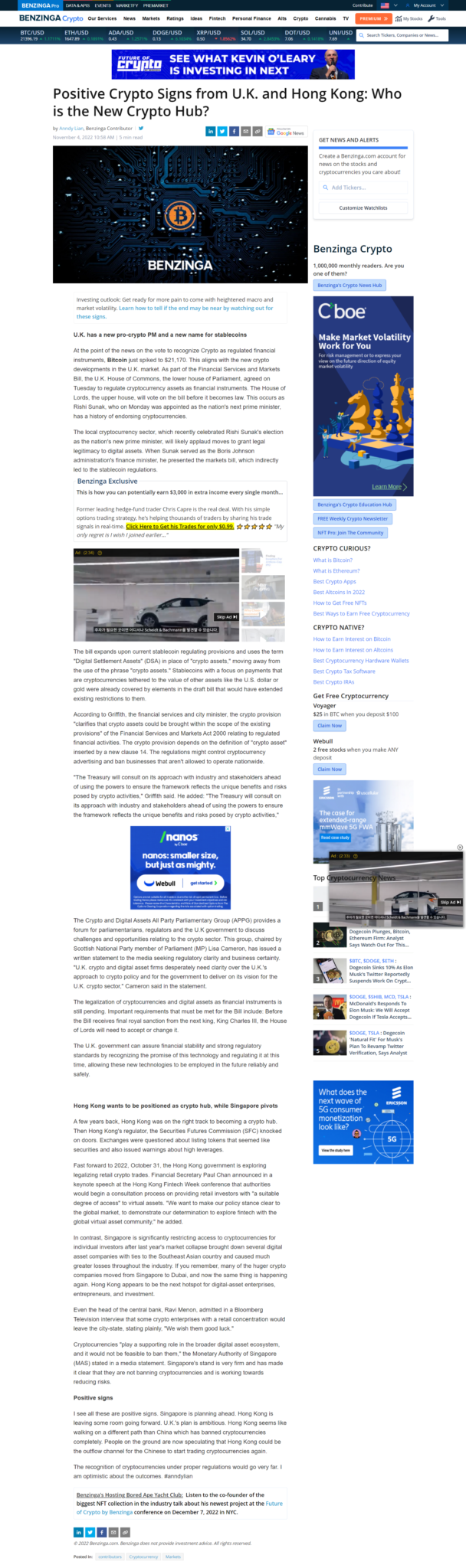
Positive Crypto Signs from U.K. and Hong Kong: Who is the New Crypto Hub?

Positive Crypto Signs from U.K. and Hong Kong: Who is the New Crypto Hub?

U.K. has a new pro-crypto PM and a new name for stablecoins

At the point of the news on the vote to recognize Crypto as regulated financial instruments, Bitcoin just spiked to $21,170. This aligns with the new crypto developments in the U.K. market. As part of the Financial Services and Markets Bill, the U.K. House of Commons, the lower house of Parliament, agreed on Tuesday to regulate cryptocurrency assets as financial instruments. The House of Lords, the upper house, will vote on the bill before it becomes law. This occurs as Rishi Sunak, who on Monday was appointed as the nation’s next prime minister, has a history of endorsing cryptocurrencies.

The local cryptocurrency sector, which recently celebrated Rishi Sunak’s election as the nation’s new prime minister, will likely applaud moves to grant legal legitimacy to digital assets. When Sunak served as the Boris Johnson administration’s finance minister, he presented the markets bill, which indirectly led to the stablecoin regulations.

The bill expands upon current stablecoin regulating provisions and uses the term “Digital Settlement Assets” (DSA) in place of “crypto assets,” moving away from the use of the phrase “crypto assets.” Stablecoins with a focus on payments that are cryptocurrencies tethered to the value of other assets like the U.S. dollar or gold were already covered by elements in the draft bill that would have extended existing restrictions to them.

According to Griffith, the financial services and city minister, the crypto provision “clarifies that crypto assets could be brought within the scope of the existing provisions” of the Financial Services and Markets Act 2000 relating to regulated financial activities. The crypto provision depends on the definition of “crypto asset” inserted by a new clause 14. The regulations might control cryptocurrency advertising and ban businesses that aren’t allowed to operate nationwide.

“The Treasury will consult on its approach with industry and stakeholders ahead of using the powers to ensure the framework reflects the unique benefits and risks posed by crypto activities,” Griffith said. He added: “The Treasury will consult on its approach with industry and stakeholders ahead of using the powers to ensure the framework reflects the unique benefits and risks posed by crypto activities,”

The Crypto and Digital Assets All Party Parliamentary Group (APPG) provides a forum for parliamentarians, regulators and the U.K government to discuss challenges and opportunities relating to the crypto sector. This group, chaired by Scottish National Party member of Parliament (MP) Lisa Cameron, has issued a written statement to the media seeking regulatory clarity and business certainty. “U.K. crypto and digital asset firms desperately need clarity over the U.K.’s approach to crypto policy and for the government to deliver on its vision for the U.K. crypto sector,” Cameron said in the statement.

The legalization of cryptocurrencies and digital assets as financial instruments is still pending. Important requirements that must be met for the Bill include: Before the Bill receives final royal sanction from the next king, King Charles III, the House of Lords will need to accept or change it.

The U.K. government can assure financial stability and strong regulatory standards by recognizing the promise of this technology and regulating it at this time, allowing these new technologies to be employed in the future reliably and safely.

Hong Kong wants to be positioned as crypto hub, while Singapore pivots

A few years back, Hong Kong was on the right track to becoming a crypto hub. Then Hong Kong’s regulator, the Securities Futures Commission (SFC) knocked on doors. Exchanges were questioned about listing tokens that seemed like securities and also issued warnings about high leverages.

Fast forward to 2022, October 31, the Hong Kong government is exploring legalizing retail crypto trades. Financial Secretary Paul Chan announced in a keynote speech at the Hong Kong Fintech Week conference that authorities would begin a consultation process on providing retail investors with “a suitable degree of access” to virtual assets. “We want to make our policy stance clear to the global market, to demonstrate our determination to explore fintech with the global virtual asset community,” he added.

In contrast, Singapore is significantly restricting access to cryptocurrencies for individual investors after last year’s market collapse brought down several digital asset companies with ties to the Southeast Asian country and caused much greater losses throughout the industry. If you remember, many of the huger crypto companies moved from Singapore to Dubai, and now the same thing is happening again. Hong Kong appears to be the next hotspot for digital-asset enterprises, entrepreneurs, and investment.

Even the head of the central bank, Ravi Menon, admitted in a Bloomberg Television interview that some crypto enterprises with a retail concentration would leave the city-state, stating plainly, “We wish them good luck.”

Cryptocurrencies “play a supporting role in the broader digital asset ecosystem, and it would not be feasible to ban them,” the Monetary Authority of Singapore (MAS) stated in a media statement. Singapore’s stand is very firm and has made it clear that they are not banning cryptocurrencies and is working towards reducing risks.

Positive signs

I see all these are positive signs. Singapore is planning ahead. Hong Kong is leaving some room going forward. U.K.’s plan is ambitious. Hong Kong seems like walking on a different path than China which has banned cryptocurrencies completely. People on the ground are now speculating that Hong Kong could be the outflow channel for the Chinese to start trading cryptocurrencies again.

The recognition of cryptocurrencies under proper regulations would go very far. I am optimistic about the outcomes. #anndylian


Source: https://www.benzinga.com/22/11/29572049/positive-crypto-signs-from-u-k-and-hong-kong-who-is-the-new-crypto-hub

Anndy Lian is an early blockchain adopter and experienced serial entrepreneur who is known for his work in the government sector. He is a best selling book author- “NFT: From Zero to Hero” and “Blockchain Revolution 2030”.

Currently, he is appointed as the Chief Digital Advisor at Mongolia Productivity Organization, championing national digitization. Prior to his current appointments, he was the Chairman of BigONE Exchange, a global top 30 ranked crypto spot exchange and was also the Advisory Board Member for Hyundai DAC, the blockchain arm of South Korea’s largest car manufacturer Hyundai Motor Group. Lian played a pivotal role as the Blockchain Advisor for Asian Productivity Organisation (APO), an intergovernmental organization committed to improving productivity in the Asia-Pacific region.

An avid supporter of incubating start-ups, Anndy has also been a private investor for the past eight years. With a growth investment mindset, Anndy strategically demonstrates this in the companies he chooses to be involved with. He believes that what he is doing through blockchain technology currently will revolutionise and redefine traditional businesses. He also believes that the blockchain industry has to be “redecentralised”.

j j j